Opens in a new tab
Join Anantam IAS Channel on Telegram

Daily Digest · Monday

13 October 2025 Current Affairs for UPSC

3 current affairs published on Monday, 13 October 2025

13 October 2025 Current Affairs for UPSC — every Why-in-News article AnantamIAS published on Monday, 13 October 2025, broken down with Why in News?, the exact GS paper it feeds, sub-topic mapping, MCQ-ready facts and a UPSC-style practice question. 3 articles in total, covering Polity, Economy, Environment, S&T, IR, Geography, History, Society and Internal Security — the same Why-in-News + GS-paper-mapping + practice-question format the Compass uses across every daily digest on the site.

Daily current affairs for UPSC is where new material enters your prep stream. Read this 13 October 2025 digest end-to-end in 25–35 minutes, attempt the practice question at the foot of each article (it's MCQ for some, 10/15-marker for others), then bookmark the entries that fall inside your active revision window. Everything stays cross-linked: tap any subject pill to jump to that subject's hub, or use the table of contents above to skip straight to a specific story.

Use this page three ways. Read sequentially for a one-sitting scan of everything that mattered on 13 October 2025. Download the 13 October 2025 PDF below for offline study or print revision. Or use the October 2025 Current Affairs compilation to see this day in the month's full context. For the previous day's reading, see 12 October 2025 Current Affairs; the next day's is 14 October 2025 Current Affairs.

Why we publish daily current affairs separately from the monthly compilation: daily is learning, monthly is revision. Use the daily page to add fresh material to your notes the day it breaks; come back to the October 2025 compilation 60 days before Prelims when the noise has settled and only the lasting takeaway is worth re-reading.

India-Afghanistan Relation

Open article →Download PDF

image 26 3

WhatsApp Image 2025 10 13 at 11.08.32 011e958e

Context:

Afghanistan’s Acting Foreign Minister Amir Khan Muttaqi has stated that the Taliban administration is ready for dialogue with Pakistan to resolve ongoing border clashes, but has also warned that “other means” remain open if diplomacy fails.

UPSC Relevance:

India and its neighborhood- relations.

UPSC PYQ:

Q. The proposed withdrawal of the International Security Assistance Force (ISAF) from Afghanistan in 2014 is fraught with major security implications for the countries of the region. Examine in light of the fact that India is faced with a plethora of challenges and needs to safeguard its own strategic interests. (2013)

India and Afghanistan:
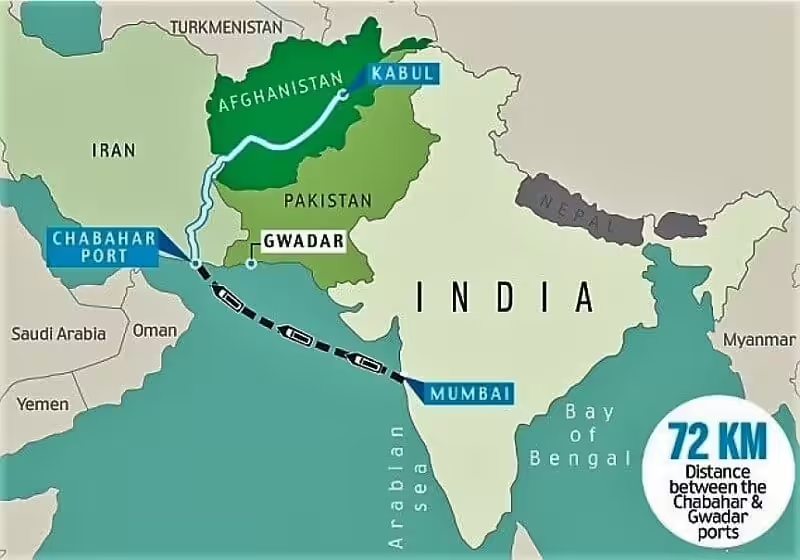
image 26 2

    The foundation of Indian interests in Afghanistan:

    • Prevent the spread of terrorist activities.
    • Using Afghanistan as a tool for access to Central Asia.
    • Limit the role of Pakistan as a rival in South Asian relations, Central Asia and Afghanistan.
    • Expand the strategic depth in the area.
    • Strengthen the south Asian security system by entering Afghanistan to this area
    • Peace in Afghanistan is crucial to prevent terrorism and instability spilling into the region.
    • Afghanistan’s rich minerals and energy reserves offer opportunities for India’s investment and cooperation.
    • Afghanistan serves as India’s gateway to Central Asia for trade and energy connectivity. 

    History:

    Afghanistan was recognized as a center of Indian civilization. Additionally, Buddha had also come to Afghanistan; this was a busy area of Hinduism and Buddhism.
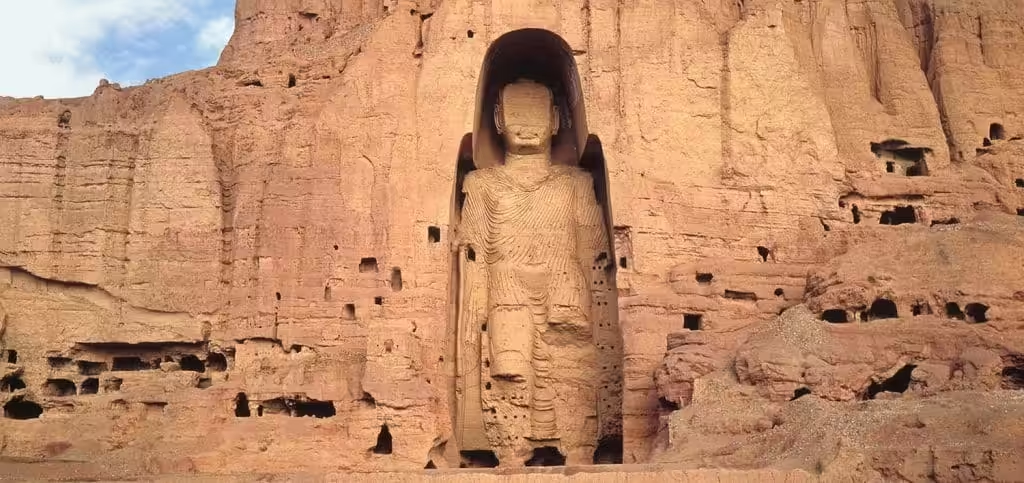
    image 26 4

    Indian Strategy of Soft Power in Afghanistan:

    India wanted to fill the power vacuum in Afghanistan after US withdraw. Therefore, India increased its relationship with Afghanistan by investing in different projects.

    • India is the largest humanitarian support provider in Afghanistan.
    • India allocated 2 billion dollars for different projects in Afghanistan.
    • India provide training to Afghan police, diplomats and civil servants of Afghanistan.

    India reconstruction efforts:

    • In the year of 2009 the Indian Army made a key road in the country side of Afghanistan in the Nimroz region. This links Delaram to Zaranj.
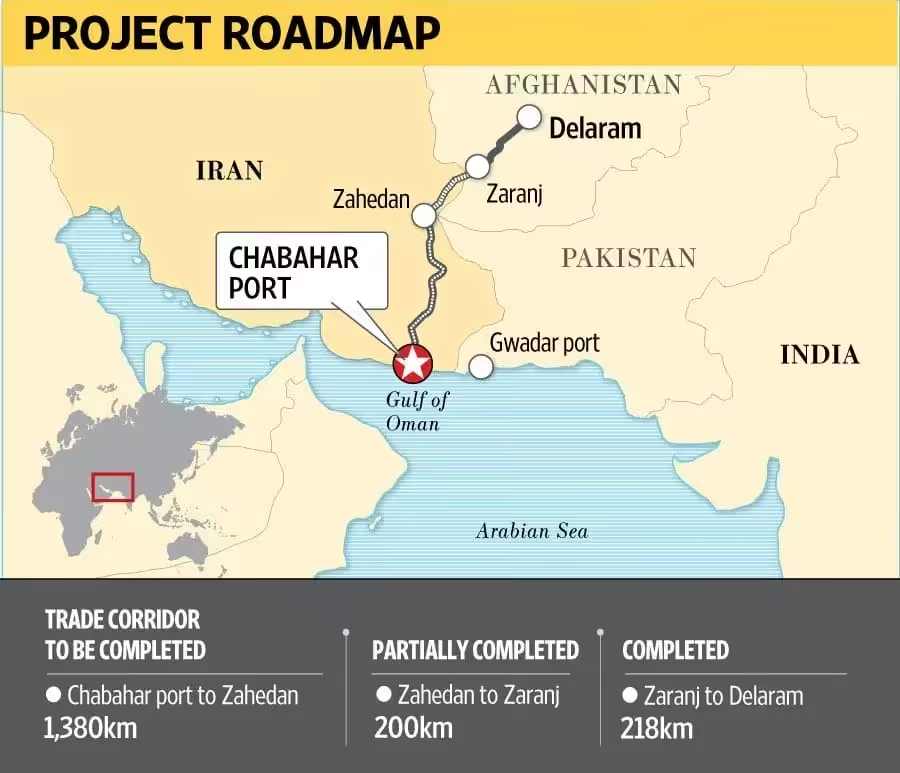
    image 26 5
    • India did make a Dam, which is called Salma power project. Moreover, India has invested over 100 million dollars to Link Afghanistan with Iran through Chabahar port for trade.
    • Parliament Building: Built by India at $90 million. It was opened in 2015; Prime Minister Narendra Modi inaugurated the building. A block in the building is named after former PM AB Vajpayee.
    • Rebuilding of power infrastructure such as the 220kV DC transmission line from Pul-e-Khumri, capital of Baghlan province to the north of Kabul, to beef up electricity supply to the capital.
    • India has reconstructed a children’s hospital it had helped build in Kabul in 1972 —named Indira Gandhi Institute for Child Health in 1985 — that was in a shambles after the war.
    • India gifted 400 buses and 200 mini-buses for urban transportation, 105 utility vehicles for municipalities, 285 military vehicles for the Afghan National Army, 10 ambulances for public hospitals in five cities. 

    Defence:

    • In 2016 India delivered three Russia-made Mi-25 attack helicopters.

    People to People ties:

    • For capacity building in Afghanistan, India has been offering 1000 scholarships to Afghan Nationals to study UG, PG level courses in Indian Universities.
    • As of 2023, there were around 14,000 Afghan students studying in India with scholarship support from different.

    Disaster assistance and emergency relief:

    In 2022, India has sent 27 tonnes of emergency relief assistance for the people of Afghanistan in the aftermath of the 5.9-magnitude earthquake that killed more than 1,000 people.

    Development aid:

    The Centre in its budget for 2023-24, has set aside Rs 200 crore as assistance.

    Line of credit: 

    • In order to expand entrepreneurship and business-to-business cooperation, especially between small and medium enterprises of India and Afghanistan, India has offered Afghanistan a 50 million US dollars line of credit facility…
    • The people of Afghanistan are also thrilled with the sporting ties and BCCI helping the Afghanistan cricket team. India is to increase the number of scholarships and visas for students, for healthcare and for business.

    Challenges:

    • Taliban being a violent and brutal actor has done little to reform itself especially in its treatment towards women and girls.
    • Groups like ISKP, Al-Qaeda, LeT, and JeM operate from Afghan soil, increasing radicalism in the region.
    • In 2021, nearly 80% of global opium came from Afghanistan — India fears this money could fund terrorism.
    • China’s increasing engagement with the Taliban regime has raised Indian concerns over Beijing’s expanding strategic and economic footprint in Afghanistan.

    Recent changes:

    • Both sides emphasized respect for each other’s sovereignty and territorial integrity. External Affairs Minister appreciated Afghan side’s understanding of India’s security concerns. The Afghan Foreign Minister reiterated the commitment that the Afghan government will not allow any group or individual to use the territory of Afghanistan against India.
    •  As a special gesture, India will gift twenty ambulances to the Afghan people. A symbolic handover of the ambulances was done by the External Affairs Minister following his meeting with the Foreign Minister.
    •  India expressed its willingness to assist the Afghan government in reconstructing residential buildings in the earthquake affected areas.
    •  The Afghan side invited Indian companies to invest in the mining sector which would help strengthen the bilateral trade and commercial relations.

    Source: India – Afghanistan Joint Statement 

    Maitri-II

    Open article →Download PDF

    image 26 6

    Context: 

    Government of India intends to operationalize a new research station in East Antarctica near the existing research base Maitri. The research station is expected to be complete by January 2029.

    UPSC Relevance:

    Science and Technology

    PYQ:

    Q. On 21st June, the Sun (2019)

    (a) does not set below the horizon at the Arctic Circle 
    (b) does not set below the horizon at Antarctic Circle 
    (c) shines vertically overhead at noon on the Equator 
    (d) shines vertically overhead at the Tropic of Capricorn

    Mains:

    Q. How do the melting of the Arctic ice and glaciers of the Antarctic differently affect the weather patterns and human activities on the Earth? Explain.(2021)

    Q. Why is India taking keen interest in resources of Arctic region?(2018)

    India’s Research Stations in Antarctica:

    • The first permanent research station was “Dakshin Gangotri” in 1983 (now abandoned).
    • Maitri: India’s second permanent research station operational since 1988. Lake Priyadarshini, a freshwater lake, was built by India around Maitri.
    • Bharati: Operational since 2012, it is India’s first committed research facility located 3000 km east of Maitri.

    India Antarctica Program:

    • It is a scientific research and exploration program under the National Centre for Polar and Ocean Research (NCPOR), Goa.
    • It started in 1981 when the 1st Indian expedition to Antarctica was made.

    India Antarctica Act 2022:

    • The Act seeks to give effect to:
      • Antarctica Treaty.
      • Protocol on Environmental Protection to the Antarctica Treaty.
      • Convention on the Conservation of Antarctica Marine Living Resources.
    • Applicability: To any person, vessel, or aircraft that is a part of an Indian expedition to Antarctica under a permit issued under the Act.
    • The Act provides for a Central Committee on Antarctica Governance and Environmental Protection.
    • The Central Government would establish it under the administrative control of the Ministry of Earth Sciences (Ministry of Earth Sciences).
    • It would ensure compliance with international laws to protect the Antarctica environment.
    • The Act provides for penalties for contravention of the Act’s provisions. E.g., 20-year imprisonment for conducting a nuclear explosion in Antarctica.
    • It provides for the Antarctica Fund for the welfare of research work and protection of Antarctica.
    • It also provides for designated courts and inspection teams to carry out inspections in Antarctica, etc.
    • Activities Prohibited:
      • Nuclear explosion/disposal of radioactive wastes.
      • Introduction of non-sterile soil/any specified substances and products.
      • Discharge of garbage, plastic, or substances into the sea, which is harmful to the marine environment.
      • Damage, destroy, or remove any historic site or monument.
    • Permit needed
      • An Indian expedition to enter/remain in Antarctica.
      • A person, vessel/aircraft registered in India to enter/remain in Antarctica.
      • A person/vessel to drill, dredge, excavate for mineral resources, or collect samples of mineral resources.
      • Activities that may harm native species.
      • Waste disposal by a person, vessel or aircraft in Antarctica.

    Antarctica Treaty:

    • It laid the foundation of a rules-based international order for a continent without a permanent population.
    • It remains the only single treaty that governs a whole continent.
    • It was signed on 1st December 1959 (entered into force in 1961) in Washington.
    • Initially, 12 member parties; currently, it has 54 members. India became a member of this treaty in 1983.
    • Headquarters: Buenos Aires, Argentina.
    • The treaty declares the continent as the world’s 1st nuclear-weapon-free zone to be preserved for scientific exploration.
    • Application of the treaty: All areas south of latitude 60°. It excludes the high seas, which come under international law.
    • The treaty provides for the use of the continent only for peaceful purposes, including promoting the freedom of scientific research.
    • It neutralises territorial sovereignty, limiting any new claim or enlarging the existing claim.
    • It forbids all contracting parties from establishing military bases, carrying on military manoeuvres, testing any weapons (including nuclear weapons), or disposing of radioactive wastes in the area.
    • Dispute settlement by the International Court of Justice if they cannot be settled by peaceful negotiation or arbitration by the involved parties.

    Protocol on Environmental Protection to the Antarctica Treaty:

    • Also known as Antarctica-Environmental Protocol or the Madrid Protocol, it was signed in 1991 (entered into force in 1998) as part of the Antarctica Treaty System.
    • It prohibits mining, requires environmental impact assessments for new activities, and designates the continent as a natural reserve.

    Convention on the Conservation of Antarctica Marine Living Resources:

    • Established in 1982 as a part of the Antarctica Treaty System.

    Antarctica Region:

    • It is the world’s southernmost and fifth-largest continent.
    • It is divided into 2 parts: East Antarctica (Largest) and West Antarctica.
    • Major geographical features: Ross Sea, Weddell Sea.
    • Climate: It is the world’s driest, windiest, coldest, and iciest continent.
    • Jurisdiction: It is considered a Global Common and does not come under the jurisdiction of any single Nation/Government.
    • It does not have any native population.
    • Its Continental ice sheet represents about 90% of the world’s ice and 80% of its fresh water.

    Natural Farming

    Open article →Download PDF

    image 26 8

    image 26 7

    Context:

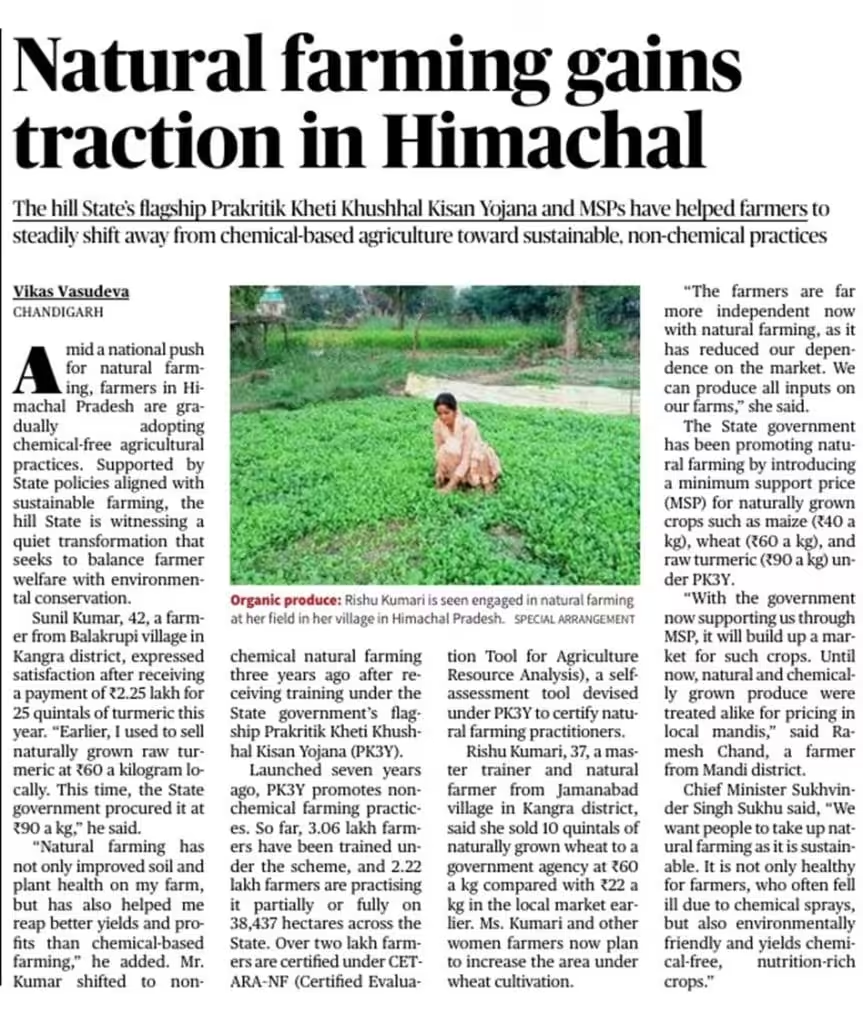
    Farmers in Himachal Pradesh are rapidly shifting away from chemical-based agriculture toward natural, sustainable, and environmentally friendly farming. This transformation has been made possible due to the State Government’s initiatives such as the “Prakritik Kheti Khushhal Kisan Yojana (PK3Y)” and the introduction of Minimum Support Price (MSP) policies for naturally grown crops.

    UPSC Relevance:

    Agriculture

    UPSC PYQ:

    Q. What are the present challenges before crop diversification? How do emerging technologies provide an opportunity for crop diversification? (2021).

    About Natural Farming:

    Natural Farming may be defined as a farming without chemicals and relies on varied farming system based on agro-ecology, that integrates crops, trees and livestock.

    Natural farming allows the optimum use of functional biodiversity, which encourages the use of on-farm inputs prepared by the farmers, and the indigenous breed of cow (Desi cow) are preferred and plays a vital role in natural farming system. Other cattles dung and urine can also be used for preparation of concoctions which builds on natural or ecological processes that exist in or around farms.

    Benefits:

    • Ensures Better Health
    • Environment Conservation
    • Increased Farmers’ Income
    • Employment Generation
    • Reduced Water Consumption
    • Minimized Cost Of Production
    • Eliminates Application Of Synthetic Chemical Inputs
    • Rejuvenates Soil Health
    • Improve Yield
    • Livestock Sustainability

    Govt Steps:

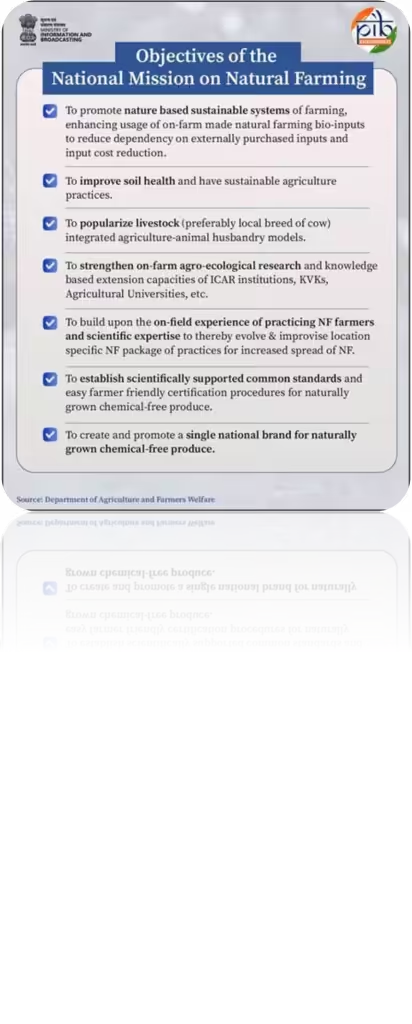
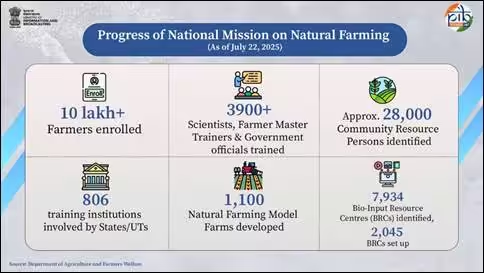
    • National Mission on Natural Farming:
      • National Mission on Natural Farming (NMNF) is a standalone Centrally Sponsored Scheme launched in November 2024 to promote chemical-free, ecosystem-based natural farming rooted in traditional knowledge.
      • The Mission targets 7.5 lakh hectares through 15,000 clusters, with ₹2,481 crore total outlay and facilitate 1 crore farmers.

    image 26

    image 27

    image 28

    • Paramparagat Krishi Vikas Yojana (PKVY):
      • The Paramparagat Krishi Vikas Yojana, launched in FY 2015-16, is the first comprehensive centrally sponsored programme by the central government for the promotion of organic farming in the country. Total funds released under this programme as of December 6, 2024 are Rs. 2,170.30 crore.
    • Krishi Vigyan Kendras
      • The concept of Krishi Vigyan Kendra (KVK) was framed by Professor M.S. Swaminathan, Father of Agriculture Research of India. KVKs have been functioning as a Knowledge and Resource Centre of agricultural technology supporting initiatives of the public, private and voluntary sectors for improving the agricultural economy of the district and linking the National Agricultural Research System (NARS) with the extension system and farmers.