Why in News?
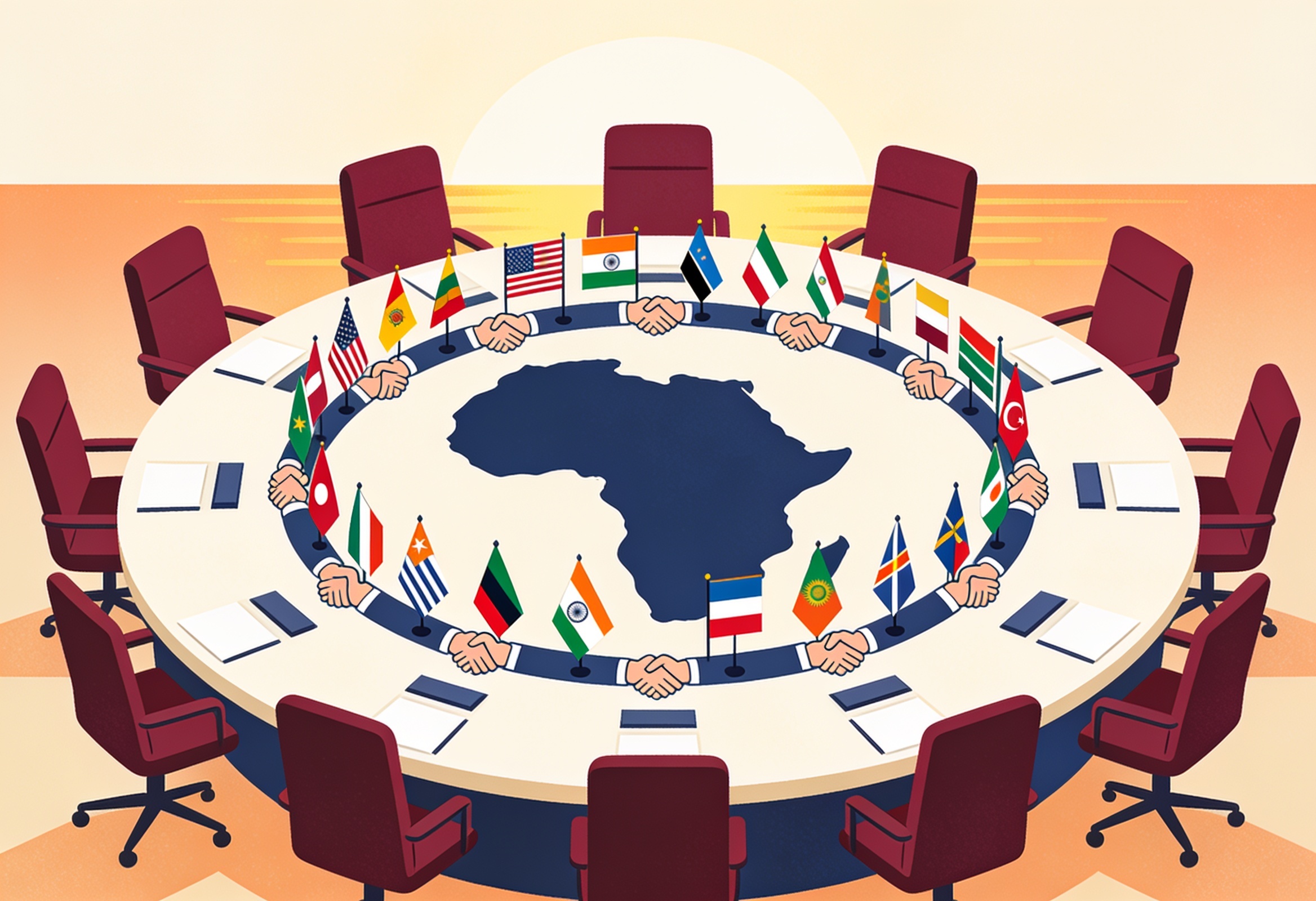
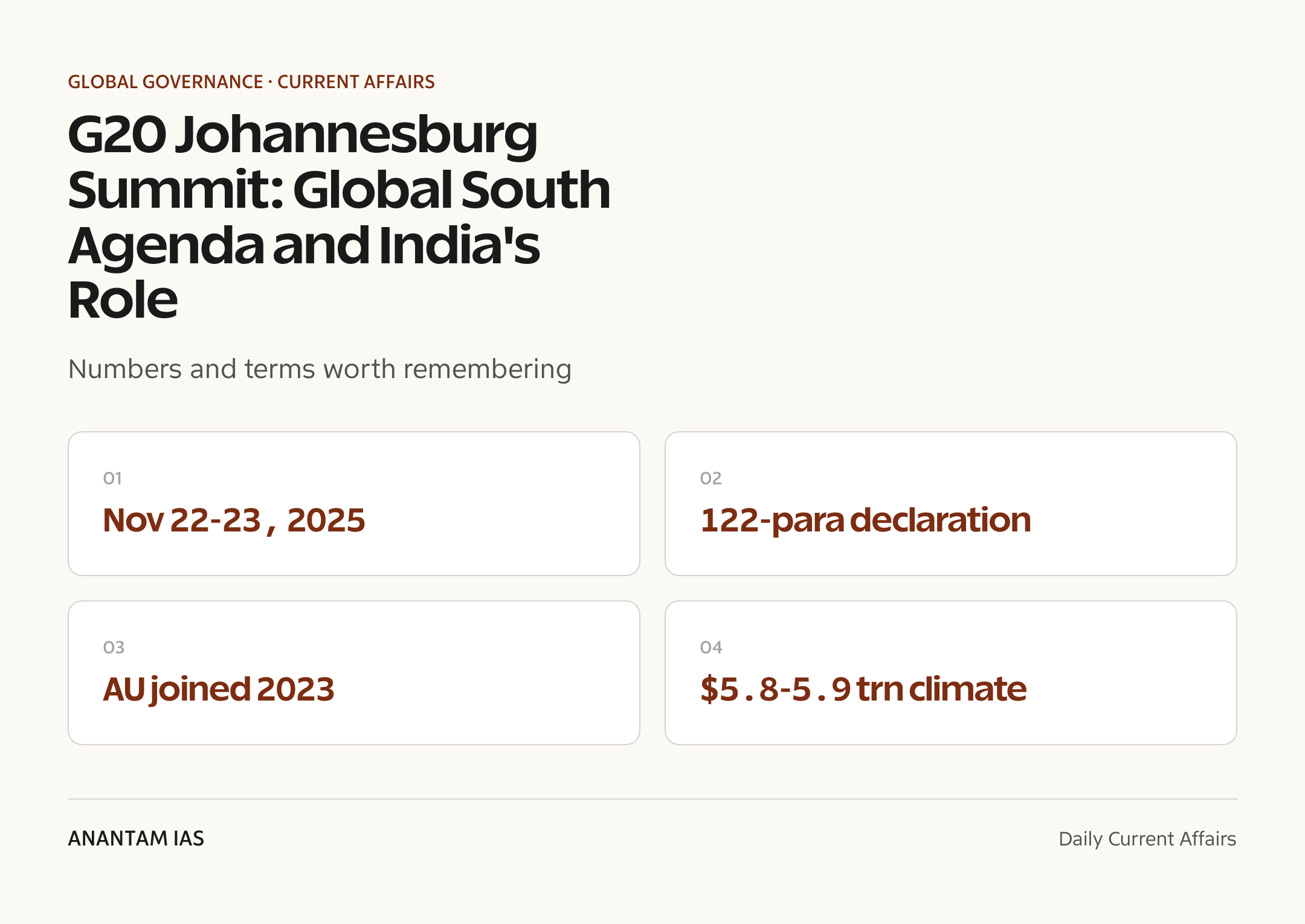
The G20 Leaders’ Summit met in Johannesburg, South Africa, on November 22-23, 2025 — the first G20 summit ever hosted on the African continent. The theme was ‘Solidarity, Equality, Sustainability’, anchored in the African philosophy of Ubuntu (‘I am because we are’), and the meeting adopted a Leaders’ Declaration despite divisions among major economies.
The Johannesburg Declaration runs to 122 paragraphs and pushes a clear Global South agenda — scaling up climate finance, easing low-income-country debt, securing critical-mineral value chains, and reforming the UN Security Council and the multilateral financial architecture.
- First-ever G20 summit on African soil; host and 2025 chair was South Africa.
- Theme: Solidarity, Equality, Sustainability, framed around the Ubuntu philosophy.
- A 122-paragraph Leaders’ Declaration was adopted, covering climate finance, debt, energy, food security and reform.
- The African Union (AU) participated as a full G20 member — a status it won under India’s 2023 presidency.
- Declaration recognised the need for USD 5.8-5.9 trillion in climate finance for developing countries before 2030.
- Summit closed the South African presidency before the troika hands the chair to the next presidency.
The development matters in the context of:
- Sits in a continuous Global South arc: Indonesia (2022) → India (2023) → Brazil (2024) → South Africa (2025), four developing-country presidencies in a row.
- Tests whether the G20 can still produce a consensus Leaders’ Declaration amid US-China friction and great-power divergence on trade and climate.
- Matters for India as a recurring agenda-setter for the Global South and the architect of the AU’s permanent G20 seat.
UPSC Relevance
Prelims Relevance
- G20 is an informal grouping of 19 countries plus the European Union and (since 2023) the African Union.
- G20 has no permanent secretariat; continuity is provided by the troika (past, present and incoming presidencies).
- The 2025 troika: Brazil, South Africa and the incoming presidency.
- AU became a permanent G20 member at the New Delhi Summit, 2023, under India’s presidency.
- Johannesburg theme: Solidarity, Equality, Sustainability; rooted in Ubuntu.
- Declaration backed the G20 Critical Minerals Framework (voluntary) and a Tropical Forest Forever Facility.
- Reaffirmed the Paris Agreement and the 1.5C temperature goal.
- Endorsed the Mission 300 platform — electricity for 300 million Africans by 2030.
- Welcomed implementation of the 16th IMF quota increase and a new IMF Executive Board chair for Sub-Saharan Africa.
- G20 grew out of the 1999 finance-ministers forum; leaders’ summits began in 2008.
Mains Relevance
GS Paper 2
- G20 as a platform for India’s Global South leadership and reform of multilateral institutions.
- Reform of the UN Security Council and the Bretton Woods architecture to reflect contemporary geopolitics.
- Continuity of the developing-country G20 presidencies (India, Brazil, South Africa) and the troika mechanism.
GS Paper 3
- Climate finance for developing countries and the ‘billions-to-trillions’ shift.
- Critical-mineral value chains, local beneficiation and energy-transition security.
Essay
- Solidarity over self-interest: can plurilateral forums still solve shared global problems?
- The Global South finding its voice in a fragmenting world order.
Background and Context
What the G20 is
A premier forum for global economic cooperation, not a treaty body.
- Members are 19 countries plus the European Union and the African Union, together representing the bulk of world GDP, trade and population.
- It has no permanent secretariat or charter; the rotating presidency sets the agenda for one year.
- Born of the 1999 Asian financial crisis as a finance-ministers’ grouping; upgraded to a leaders’ summit in 2008 after the global financial crisis.
- Outcomes are non-binding Leaders’ Declarations — political commitments, not enforceable law.
The troika and presidency continuity
With no secretariat, the G20 relies on a three-member troika to carry agendas forward.
- The troika is the past, present and incoming presidency working together for continuity.
- The 2025 troika paired Brazil (2024) and South Africa (2025) with the incoming chair.
- This let Johannesburg build on New Delhi (2023) and Rio (2024) commitments rather than restart from scratch.
- An unbroken run of developing-country hosts — Indonesia, India, Brazil, South Africa — gave the Global South sustained agenda-setting power.
India's 2023 presidency as the foundation
Johannesburg deepened the template India set in New Delhi.
- India’s New Delhi Summit (2023) made the African Union a permanent G20 member — its biggest structural change since the EU joined.
- India branded its term ‘Voice of the Global South’, convening developing countries outside the formal summit.
- New Delhi delivered a consensus declaration at a time many doubted one was possible, on language covering Ukraine and development.
- It championed Digital Public Infrastructure, MDB reform and the LiFE (sustainable lifestyles) idea — themes Johannesburg carried forward.
The Johannesburg Declaration — Global South priorities
The 122-paragraph text reads as a developing-country charter.
- Climate finance: recognised a need for USD 5.8-5.9 trillion for developing countries pre-2030 and a ‘billions-to-trillions’ scale-up.
- Debt: noted interest payments on low-income countries’ external debt have more than doubled in a decade; reaffirmed the G20 Common Framework and debt transparency.
- Critical minerals: adopted a voluntary G20 Critical Minerals Framework stressing local beneficiation and producer-country sovereignty.
- Energy and food: flagged that over 600 million Africans lack electricity and up to 720 million people faced hunger in 2024; backed Mission 300 and a Food Security Task Force.
Multilateral and UNSC reform
A recurring demand: institutions built in 1945 must reflect 2025.
- Backed reform of the UN Security Council to expand representation for Africa, Asia-Pacific and Latin America.
- Pushed the Capital Adequacy Framework reforms so Multilateral Development Banks can lend more.
- Welcomed the 16th IMF quota increase and a new IMF Executive Board chair for Sub-Saharan Africa.
- Noted Special Drawing Rights (SDR) channelling exceeding USD 100 billion to support vulnerable economies.
Significance for India
Johannesburg validated the agenda India seeded.
- The AU’s permanent seat — India’s 2023 achievement — was treated as settled and operational.
- India’s signature themes (DPI, MDB reform, climate equity) resurfaced as standing G20 business.
- It reinforced India’s claim to Global South leadership and its case for permanent UNSC membership.
- Continuity of the developing-country bloc gives India a durable coalition on debt, climate finance and reform.
Challenges and limits
Ambition outran enforceability.
- Declarations are non-binding; the climate-finance and debt commitments lack hard delivery timelines.
- Divergence among major powers on trade and tariffs strained consensus-building.
- Most new tools — the Critical Minerals Framework, debt-for-climate swaps — are voluntary.
- Gaps between rich and poor members persist on who pays for the energy transition and adaptation.
Way Forward
Turn pledges into delivery
- Convert the climate-finance recognition into measurable, time-bound flows to developing countries.
- Operationalise the Common Framework so debt restructuring for low-income countries is faster and fairer.
Institutionalise Global South gains
- Use the troika to lock the AU’s seat and developing-country priorities into every future agenda.
- Keep momentum on MDB and IMF quota reform so voice matches economic weight.
India should leverage the unbroken developing-country presidency arc to build a standing coalition on debt relief, critical minerals and climate equity, while pressing its long-standing case for UN Security Council reform.
Conclusion
The Johannesburg Summit mattered less for any single deliverable than for what it confirmed: a G20 increasingly shaped by the Global South. The first African-hosted summit took the agenda India seeded in New Delhi — the African Union’s seat, MDB reform, climate equity — and made it the forum’s everyday business.
The hard test is delivery. With non-binding declarations and voluntary frameworks, the value of Johannesburg will be judged by whether climate finance scales, debt eases and institutions actually reform. For India, the summit is both an endorsement of past leadership and an opening to anchor a durable developing-country coalition.
UPSC Practice Questions
Prelims MCQ 1
With reference to the G20, consider the following statements:
- It has a permanent secretariat headquartered in Geneva.
- The African Union became a permanent G20 member at the 2023 New Delhi Summit.
- Continuity across presidencies is maintained through a ‘troika’ of the past, present and incoming chairs.
How many of the above statements are correct?
(a) Only one (b) Only two (c) All three (d) None
Answer: (b) Only two
Explanation:
The G20 has NO permanent secretariat (statement 1 wrong). The AU joined permanently at New Delhi 2023 (2 correct) and the troika provides continuity (3 correct).
Prelims MCQ 2
The 2025 G20 Leaders’ Summit was hosted by which country, under what theme?
(a) Brazil — ‘Building a Just World and a Sustainable Planet’ (b) South Africa — ‘Solidarity, Equality, Sustainability’ (c) Indonesia — ‘Recover Together, Recover Stronger’ (d) India — ‘One Earth, One Family, One Future’
Answer: (b) South Africa — 'Solidarity, Equality, Sustainability'
Explanation:
Johannesburg, South Africa hosted the first African G20 summit on Nov 22-23, 2025, under ‘Solidarity, Equality, Sustainability’, rooted in the Ubuntu philosophy.
UPSC Mains Questions
- The G20 has increasingly become a platform for Global South aspirations. Examine how India’s 2023 presidency and the 2025 Johannesburg Summit advanced this shift, and assess the limits of a forum that produces only non-binding declarations.
- Reform of the UN Security Council and the multilateral financial architecture is a recurring G20 demand. Discuss the case for such reform and the obstacles to achieving it, with reference to recent G20 commitments.
Sources: Drishti IAS and G20 Information Centre, University of Toronto.
Frequently Asked Questions
Where and when was the 2025 G20 summit held?
The G20 Leaders’ Summit was held in Johannesburg, South Africa, on 22-23 November 2025. It was the first G20 summit ever hosted on the African continent, under the theme ‘Solidarity, Equality, Sustainability’, drawn from the African philosophy of Ubuntu.
What is the G20 troika?
Because the G20 has no permanent secretariat, the troika ensures continuity. It is a group of three members: the immediately past presidency, the current presidency, and the incoming presidency. They coordinate so each year’s agenda builds on the previous one rather than starting afresh.
When did the African Union join the G20?
The African Union became a permanent member of the G20 at the New Delhi Summit in September 2023, during India’s presidency. It was the first expansion of the grouping’s membership since the European Union, giving Africa a collective seat at the table.
What were the key outcomes of the Johannesburg Declaration?
The 122-paragraph declaration pushed scaling up climate finance, easing low-income-country debt, a voluntary Critical Minerals Framework, energy access initiatives like Mission 300, food security action, and reform of the UN Security Council and multilateral financial institutions to reflect today’s geopolitics.
How does the summit reflect India’s role?
Johannesburg built on the template India set in 2023, when it secured the AU’s permanent seat and branded itself the ‘Voice of the Global South’. India’s themes of MDB reform, climate equity and digital public infrastructure carried into 2025, reinforcing its Global South leadership and reform agenda.
Are G20 declarations legally binding?
No. The G20 is an informal forum and its Leaders’ Declarations are political commitments, not enforceable law. Many of its new tools, such as the Critical Minerals Framework and debt-for-climate swaps, are explicitly voluntary, so delivery depends on members’ political will.