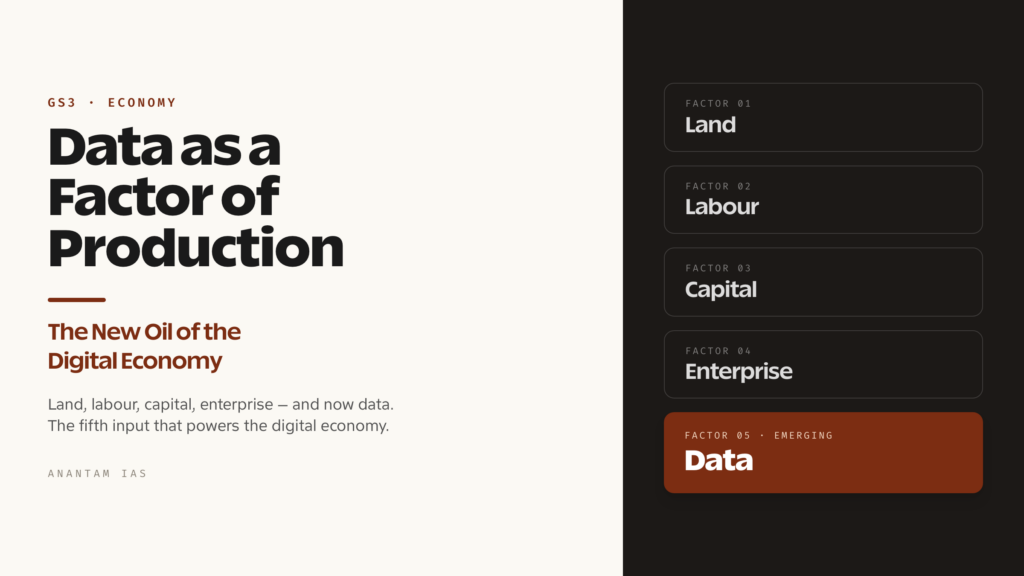
Every economics class begins the same way: there are four factors of production. Land, labour, capital and entrepreneurship — the four inputs you combine to make anything from a loaf of bread to a steel mill. That list is roughly two hundred years old, and for most of those two hundred years it held up fine. But sit in front of a screen today and you can watch a fifth factor quietly do its work. The ride you booked, the loan you were offered, the song that played next, the price you were shown — none of those came purely from land, labour or capital. They came from data: the trail of digital exhaust you leave behind, harvested, cleaned and run through an algorithm. Somewhere in the last decade, data stopped being a by-product of the economy and started becoming an input to it.
That shift is why “data is the new oil” became the slogan of the digital age, and why governments from Beijing to Brussels to New Delhi now argue over who owns data, who can use it and who profits from it. For a UPSC aspirant, this is not a soft, futuristic topic — it sits at the heart of GS Paper 3’s economy and science-and-technology sections, and it connects the data economy to privacy, competition, digital governance and India’s own data-protection law. The trick is to treat data the way an economist treats any factor of production: ask what it is, how it behaves, what it’s worth, and who should control it.
What It Means to Call Data a Factor of Production
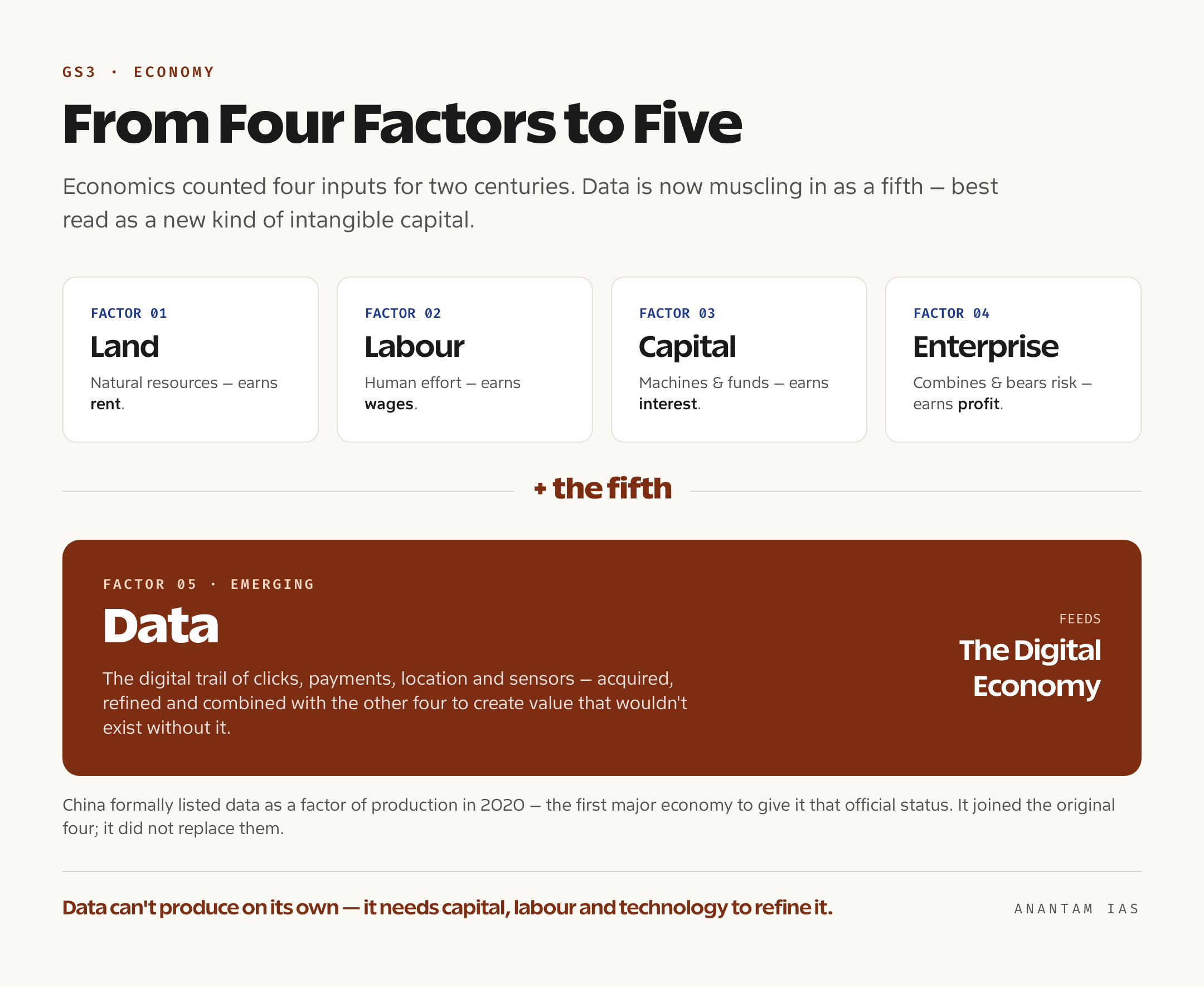
Start with the definition, because the phrase gets thrown around loosely. A factor of production is simply an input you use to produce goods and services and that earns a return — land earns rent, labour earns wages, capital earns interest, and the entrepreneur earns profit for combining them and bearing risk. To call data a fifth factor is to claim it now behaves the same way: firms acquire it, invest in it, combine it with the other inputs, and earn a return that wouldn’t exist without it. A bank that turns your transaction history into a credit score, a retailer that predicts what you’ll buy next, an insurer that prices a policy from your driving data — each is using data as a productive input, not as a happy accident.
This isn’t only a textbook claim any more; states have started writing it into policy. In 2020 China formally listed data alongside land, labour, capital and technology as a “factor of production” that markets should be allowed to price and allocate — the first time a major economy gave data that official status. The idea behind it is that you can’t build a modern economy on the old four inputs alone. Few businesses can survive in a digitised market without data to schedule, target, price and personalise, and the firms that hold the most useful data — the platform giants — have become some of the most valuable companies on earth precisely because of what they know, not what they own in land or machines. When a company’s worth is mostly the data it sits on, the economist’s instinct is to call that data capital. And that’s the fifth factor.
But a word of caution that examiners love: data didn’t replace the old four factors, it joined them, and it can’t do anything on its own. Data still needs capital (servers, cloud, chips), labour (data scientists, annotators), and the entrepreneur to combine them. It is better understood as a new kind of capital — an intangible asset — than as a free-standing fifth input divorced from the rest. And it is intertwined with technology, especially artificial intelligence, which is the machine that converts raw data into value. So the safest framing for an answer is this: data is an emerging factor of production, most naturally classified as intangible capital, that has become indispensable to value creation in the digital economy.
The Data Economy and the Data Value Chain
Now zoom out to the economy that data has built. The “data economy” is the web of activity in which collecting, storing, processing, sharing and monetising data is itself the source of value — from the platforms that gather it to the analytics firms that refine it to the businesses that act on it. Its raw material is being produced at a scale the human mind struggles to hold. The research firm IDC estimated the world’s “global datasphere” would swell to around 175 zettabytes by 2025 — a zettabyte being a trillion gigabytes — growing at well over 20 per cent a year as billions of phones, sensors and connected devices stream data every second. Most of that data is never used. The value lies not in having it but in being able to refine it.
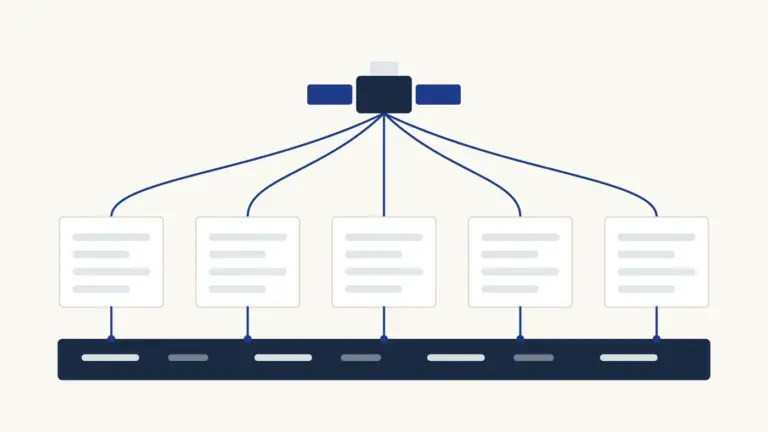
That refining happens along a data value chain, and it pays to picture it as a pipeline. First, data is generated — by your clicks, payments, location, searches and the readings of IoT (Internet of Things) devices. Then it is collected and stored, increasingly in the cloud. Then comes the crucial step where most of the value is created: data is processed — cleaned, organised, labelled and combined — because raw data, like crude oil, is almost worthless until refined. Next it is analysed, today mostly by machine-learning models that find patterns a human never could. And finally it is used to make a decision, sell a product, train an AI model or, often, sold on as a service. Each stage adds value, and the firms that control the most lucrative stages — the platforms that both generate and refine data at scale — capture the largest share of the spoils.
This is also where the metaphor earns its keep and shows its limits, which I’ll come to next. The pipeline image — generate, refine, use — is genuinely oil-like, and it explains why a handful of firms dominate: whoever owns the refinery and the wells controls the market. For India, the stakes are concrete. The country generates a staggering volume of data thanks to over 900 million internet users and the world’s busiest digital-payment system, but much of the value from that data has historically been refined and captured abroad. A central question of Indian policy has become how to keep more of that value chain — and the economic returns from it — at home.
Why Data Is Not Quite the New Oil
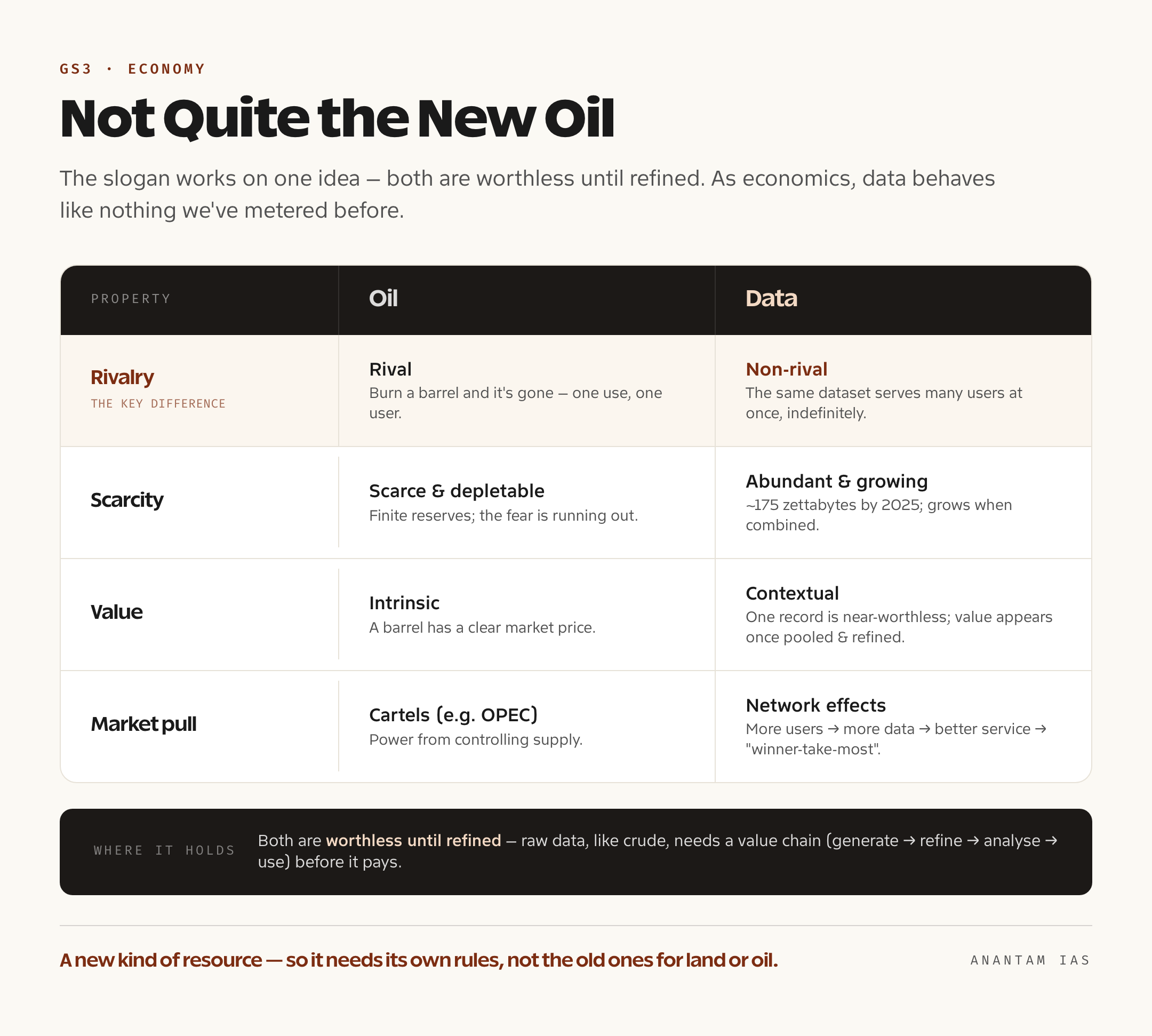
“Data is the new oil” is a brilliant slogan and a misleading one, and a strong answer can hold both ideas at once. The metaphor works on two points. Like oil, raw data is nearly useless until it’s refined into something usable — both need a value chain. And like oil in the twentieth century, data is the strategic resource that powers the leading industries of its age, concentrating wealth and power in whoever controls it. So far, so apt. But push the analogy one step further and it falls apart, and the differences are exactly where the economics gets interesting.
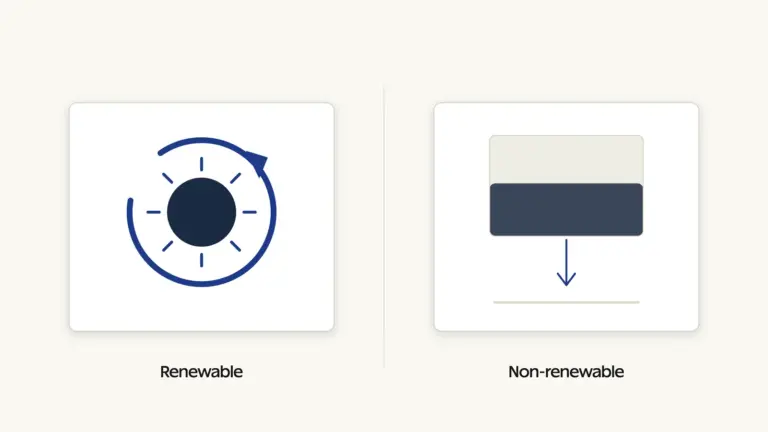
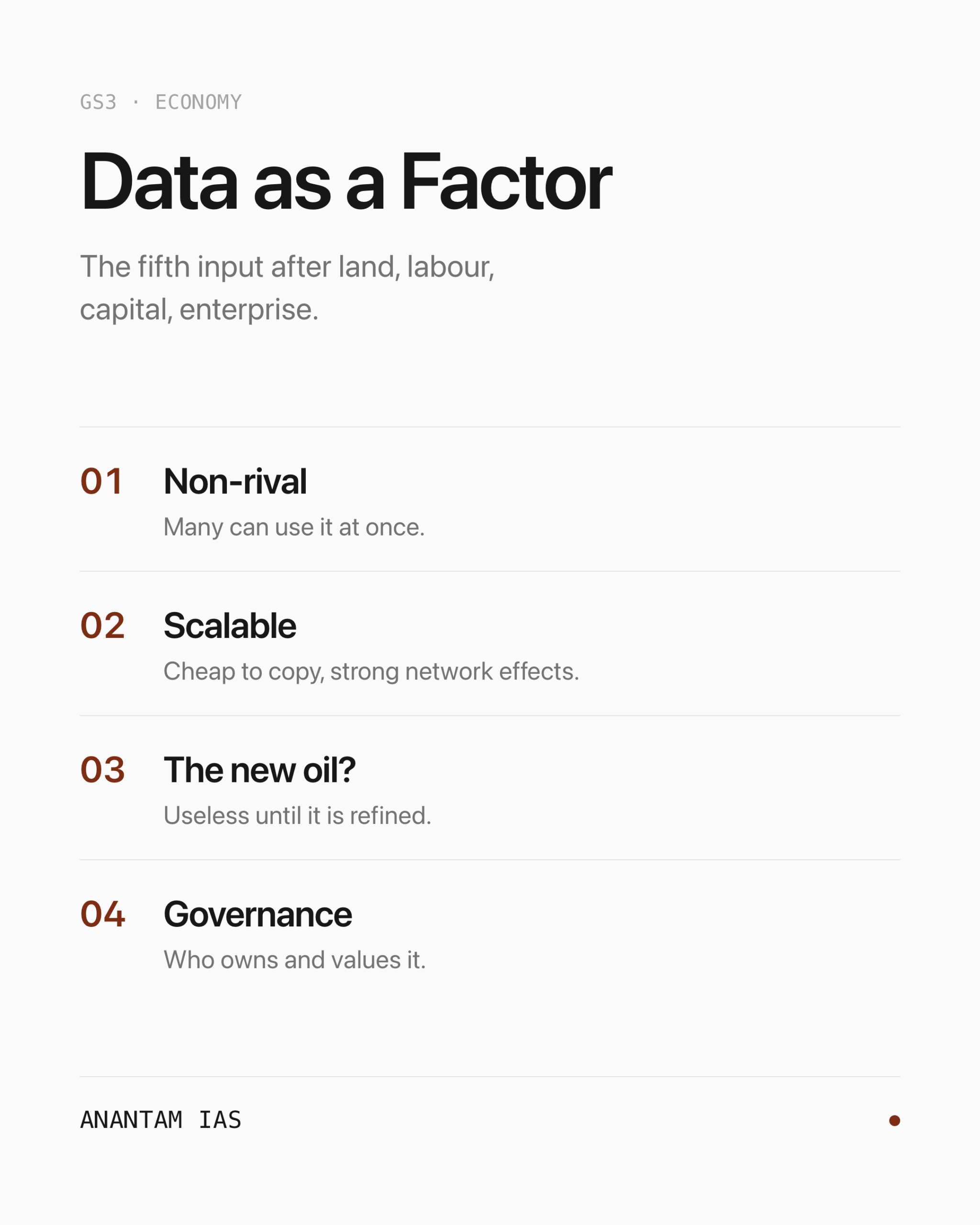
The biggest difference is that data is non-rival, while oil is rival. A barrel of oil can be burned once, by one user; once it’s gone, it’s gone. The same dataset can be used by countless people at the same time, for countless purposes, without being used up. As the economists Charles Jones and Christopher Tonetti put it, non-rivalry means the same data can be fed into many uses simultaneously — a property that creates enormous potential gains for society, because data shared widely can generate value many times over. Oil is scarce and depletable; data is abundant and, if anything, grows when combined with more data. That single distinction flips the economics: with oil, the worry is running out; with data, the worry is that it’s hoarded by those who hold it instead of shared to where it would do the most good.
A second difference is value. A barrel of crude has a clear market price. An individual’s data, on the open market, is worth almost nothing — its value appears only when millions of records are pooled, refined and matched to a use. So data’s worth is contextual and combinatorial, not intrinsic. And a third twist is that data creates powerful network effects: the more users a platform has, the more data it gathers, the better its service becomes, which attracts still more users — a feedback loop that pushes digital markets toward “winner-take-most” concentration far faster than oil ever did. The upshot for an answer: data is the new oil only as a story about strategic value and refining. As economics, data behaves like nothing we’ve metered before — non-rival, scalable and prone to monopoly — which is precisely why it needs its own rules rather than the old ones for land or oil.
The Ownership Puzzle: Personal, Non-Personal and Data as an Asset
If data is a factor of production, the obvious next question is: whose factor is it? And here the answer splits in two, a distinction worth memorising. Personal data is information that can identify an individual — your name, location, health records, spending. Non-personal data is everything else, or personal data stripped of identifiers: anonymised traffic patterns, aggregate weather and crop data, machine sensor readings, anonymised transaction trends. The two raise opposite problems. Personal data is mainly about protecting the individual from harm. Non-personal data is mainly about who gets to capture its economic value — and that is the data-as-an-asset debate.
India thought hard about this early. In 2020 a committee of experts chaired by Infosys co-founder Kris Gopalakrishnan, set up by the Ministry of Electronics and Information Technology, produced a pioneering report on a Non-Personal Data Governance Framework. Its core argument was striking: that non-personal data generated in India has economic and public value that shouldn’t be locked up inside a few private companies. It proposed treating high-value datasets almost as a community or national resource, creating a new “data business” category for firms that handle data above a threshold, and building a framework under which businesses, government and start-ups could request access to such data for sovereign, public-interest or economic purposes — overseen by a Non-Personal Data Authority. The thinking was that if data is a factor of production, a handful of incumbents shouldn’t be allowed to corner the supply, any more than they could be allowed to corner land or capital.
That framework was never enacted as a standalone law, and its more radical mandatory-sharing ideas drew pushback over property rights and feasibility. But the underlying question — can data be valued and treated as an asset on a balance sheet, and who owns the value of non-personal data — has only grown more live as artificial intelligence makes large datasets the fuel of competitive advantage. The unresolved tension runs through everything that follows: monetisation versus governance. The economic instinct is to monetise data — let it flow, let firms trade it, let markets price it. The democratic instinct is to govern it — protect privacy, prevent monopoly, keep value at home. India, like most countries, is still trying to do both at once, and the friction between those two goals is the heart of every data-policy debate today.
India’s Data Framework: Protection, Sharing and Digital Public Infrastructure
So how does India actually govern this new factor of production? Three pieces fit together. The first is protection. The Digital Personal Data Protection Act, 2023 is India’s first comprehensive privacy law, and it governs the personal-data side of the ledger. It is built on consent: a “data fiduciary” — any entity deciding why and how your data is processed — must give clear notice and obtain consent before using your data, keep it secure and accurate, delete it once its purpose is met, and honour your rights to access, correct and erase. It backs this with penalties of up to ₹250 crore per violation and a Data Protection Board to enforce it, and it gives the government discretion over cross-border data flows — the quieter cousin of data localisation, the idea that certain data should be stored or processed within India’s borders for security and sovereignty. By 2026 its rules were being finalised and phased in, turning the Act from text into practice.
The second piece is sharing and empowerment, and this is where India has been genuinely inventive. Through its Digital Public Infrastructure — the open, public “rails” of Aadhaar, UPI and data-exchange systems collectively branded India Stack — the country has tried to put data to work for ordinary people rather than just for platforms. The flagship idea is the Data Empowerment and Protection Architecture, or DEPA: instead of your data sitting locked inside whichever company collected it, DEPA lets you consent to share it, securely and for a specific purpose, with a provider of your choice. In finance this runs through RBI-regulated Account Aggregators, which since 2021 have let a person share verified bank and financial data to get a loan or a better product — turning your own data into an asset you control, not just one a company exploits. It is data-as-a-factor-of-production reimagined with the individual, not only the firm, as the owner.
The third piece is the economic ambition stitching it together. India treats data and its digital rails as engines of growth, not just objects to police. NITI Aayog’s DPI@2047 roadmap, released in April 2026, projects that digital public infrastructure could grow from contributing around 1 per cent of India’s GDP today to as much as 4 per cent by 2030, and analysts link the wider digital economy to India’s push toward an $8-trillion economy by the decade’s end. That is the prize that makes data a factor of production in the fullest sense — an input the state is deliberately cultivating for national output. The challenge ahead is the same tension as before, now at national scale: protect citizens and keep value at home without choking the openness and data flows that let the digital economy grow in the first place.
For Your Mains Answer
This is a versatile topic for GS Paper 3, which covers the Indian economy, mobilisation of resources, science and technology, and the digitisation of the economy — and it spills naturally into GS Paper 2 on governance and data privacy. Questions on the data economy, digital public infrastructure, the data-protection regime, or the economics of platforms can all draw on this material. It is also a rich, contemporary example for the Essay paper on technology, freedom and the changing nature of work and wealth. What examiners reward here is conceptual control: treat data the way you’d treat any factor of production, then show where it breaks the old rules.
How to Build the Answer
Open by placing data in the classical frame — name the four factors, then argue that data has joined them as an emerging fifth, best understood as intangible capital. Move in a chain: what makes data a factor (it’s an input that earns a return) → the data value chain (generate, refine, use) → why the new-oil metaphor is half-right (refining yes, but data is non-rival and abundant) → the ownership split (personal versus non-personal data) → India’s response (DPDP Act for protection, DEPA and DPI for empowerment, economic ambition for growth). Close by judging the central tension: monetisation versus governance. That arc — classify, characterise, contrast, contest, govern, evaluate — fits almost any data-economy question.
Common Mistakes to Avoid
Don’t claim data has simply “replaced” land, labour or capital — it joined them and depends on them. Don’t take “data is the new oil” at face value; the marks are in explaining why the analogy breaks (non-rivalry, abundance, contextual value). Don’t blur personal and non-personal data — the whole governance debate turns on that line. Don’t reduce India’s framework to the DPDP Act alone; pair it with DEPA, Account Aggregators and the Gopalakrishnan committee to show range. And don’t treat this as pure tech — the heart of it is economics: who owns the input, who captures the return.
A Compact Answer Spine
Classical factors = land + labour + capital + enterprise → data is an emerging 5th factor, best read as intangible capital, indispensable to the digital economy → value chain: generate → refine → analyse → use (raw data ≈ crude oil, worthless until refined) → “new oil” works on refining + strategic value, fails on economics (data is non-rival, abundant, network-effect-driven, monopoly-prone) → ownership split: personal data (protect the individual) vs non-personal data (capture the value) → India: Gopalakrishnan NPD committee (2020) → DPDP Act 2023 (consent, ₹250 cr penalties, localisation discretion) → DEPA + Account Aggregators + DPI (DPI@2047: ~1% to ~4% of GDP by 2030) → core tension: monetise vs govern.
Diagram or Flowchart Idea
Draw a simple horizontal pipeline — Generate → Store → Process/Refine → Analyse → Use — with a small “₹ value added” arrow rising under each stage, and a side-box splitting the output into “personal data → protect” and “non-personal data → share/monetise”. A clean process-plus-fork visual like this communicates the whole logic at a glance and is quick to sketch under time pressure.
A Balanced-Conclusion Line
A line that lands the marks: “Data has become the fifth factor of production, but unlike land or oil it is non-rival and abundant — so the policy task is not to ration a scarce resource but to share an abundant one fairly, balancing the economy’s pull to monetise data against the citizen’s right to govern it.”
How to Use Data Without Cramming
You need only a handful of anchors, not a spreadsheet: the four-plus-one framing of factors, the ~175-zettabyte global datasphere (to show scale), the non-rival nature of data (the single most examinable economic point), the ₹250-crore penalty cap and consent basis of the DPDP Act 2023, and the DPI@2047 projection of digital infrastructure rising from ~1% to ~4% of GDP by 2030. Attribute them plainly — “as the Gopalakrishnan committee argued”, “under the DPDP Act, 2023” — rather than scattering figures without a source.
Frequently Asked Questions
Is data really the fifth factor of production?
Increasingly, yes — though with a caveat. The classical four factors are land, labour, capital and entrepreneurship. Data has become an indispensable input that firms acquire, invest in and earn returns from, so many economists and even governments now treat it as a fifth factor; China formally did so in 2020. But data can’t produce anything on its own — it still needs capital, labour and an entrepreneur, and technology (especially AI) to refine it. So it is best understood as a new kind of intangible capital that has joined the original four, not replaced them.
Why is data called “the new oil,” and is the comparison accurate?
The phrase captures two real truths: like crude oil, raw data is almost worthless until refined into something usable, and like oil in its era, data is the strategic resource powering today’s leading industries. But the analogy breaks on economics. Oil is rival and scarce — burn a barrel and it’s gone. Data is non-rival and abundant — the same dataset can be used by many people at once, indefinitely, and grows in value when combined with more data. So the metaphor works as a story about strategic value, not as a description of how data actually behaves.
What is the difference between personal and non-personal data?
Personal data identifies an individual — name, location, health, spending. Non-personal data is everything else, including personal data with the identifiers stripped out, such as anonymised traffic patterns, aggregate crop data or machine-sensor readings. The distinction matters because the two raise different problems: personal data is mainly about protecting people from harm (the focus of the DPDP Act, 2023), while non-personal data is mainly about who captures its economic value — the question the Gopalakrishnan committee tried to answer in 2020.
How does India govern data as an economic resource?
Through three connected pieces. Protection comes from the Digital Personal Data Protection Act, 2023, a consent-based privacy law with penalties up to ₹250 crore and government discretion over cross-border flows. Empowerment comes from Digital Public Infrastructure and the Data Empowerment and Protection Architecture (DEPA), which — via RBI-regulated Account Aggregators — let individuals consent to share their own data securely. And economic ambition comes from initiatives like NITI Aayog’s DPI@2047 roadmap, which projects digital public infrastructure growing from around 1% to as much as 4% of GDP by 2030.
Practice Questions
Prelims MCQs
- With reference to factors of production in economics, consider the following:
(a) The four classical factors are land, labour, capital and entrepreneurship
(b) Data is increasingly described as an emerging fifth factor of production
(c) Data can produce goods and services entirely on its own, without other factors
(d) Both
(a) and
(b) are correct
Answer: (d) The four classical factors are land, labour, capital and enterprise, and data is now widely treated as an emerging fifth factor; but data cannot produce anything without capital, labour and technology, so
(c) is wrong. - The statement “data is non-rival” most accurately means which of the following?
(a) Data has no commercial value in any market
(b) The same data can be used by many users simultaneously without being used up
(c) Data is owned equally by all citizens of a country
(d) Data cannot be copied or transferred between firms
Answer: (b) Non-rivalry means one user’s use of data does not prevent others from using the same data at the same time — unlike a rival good such as oil, which is consumed once. - The Committee of Experts that produced India’s report on a Non-Personal Data Governance Framework in 2020 was chaired by whom?
(a) Nandan Nilekani
(b) Kris Gopalakrishnan
(c) Raghuram Rajan
(d) K. V. Kamath
Answer: (b) The committee set up by the Ministry of Electronics and Information Technology was chaired by Infosys co-founder Kris Gopalakrishnan. - Under the Digital Personal Data Protection Act, 2023, which of the following is correct?
(a) A “data fiduciary” determines the purpose and means of processing personal data
(b) Processing personal data generally requires the data principal’s consent
(c) The maximum penalty can extend up to ₹250 crore per violation
(d) All of the above
Answer: (d) The Act defines the data fiduciary, is built on consent with certain legitimate-use exceptions, and provides for penalties up to ₹250 crore per violation. - The Data Empowerment and Protection Architecture (DEPA) in India is implemented in the financial sector mainly through which regulated entities?
(a) Credit rating agencies
(b) Account Aggregators
(c) Non-Banking Financial Companies
(d) Asset Reconstruction Companies
Answer: (b) DEPA’s consent-based data sharing in finance runs through RBI-regulated Account Aggregators, which let individuals share their financial data securely with providers of their choice.
Mains Practice Questions
- “Data has become the fifth factor of production.” Examine this claim with reference to the classical factors of production and the characteristics that make data economically distinct. (15 marks, 250 words)
- Critically analyse the metaphor “data is the new oil.” In what ways does it illuminate the data economy, and in what ways does it mislead? (15 marks, 250 words)
- Distinguish between personal data and non-personal data. Discuss the challenges in treating non-personal data as an economic asset, drawing on India’s policy experience. (15 marks, 250 words)
- Evaluate India’s framework for governing data, from the Digital Personal Data Protection Act, 2023 to the Data Empowerment and Protection Architecture. How well does it balance data monetisation with data governance? (15 marks, 250 words)
- “The non-rivalry of data turns the usual problem of scarcity on its head.” Discuss the implications of this property for competition, market concentration and public policy in the digital economy. (10 marks, 150 words)
Tell Google you want more of this.
Add Anantam IAS as a preferred sourceOne tap, and this site shows up more often in your own Top Stories, AI Overviews and AI Mode. Remove it any time.