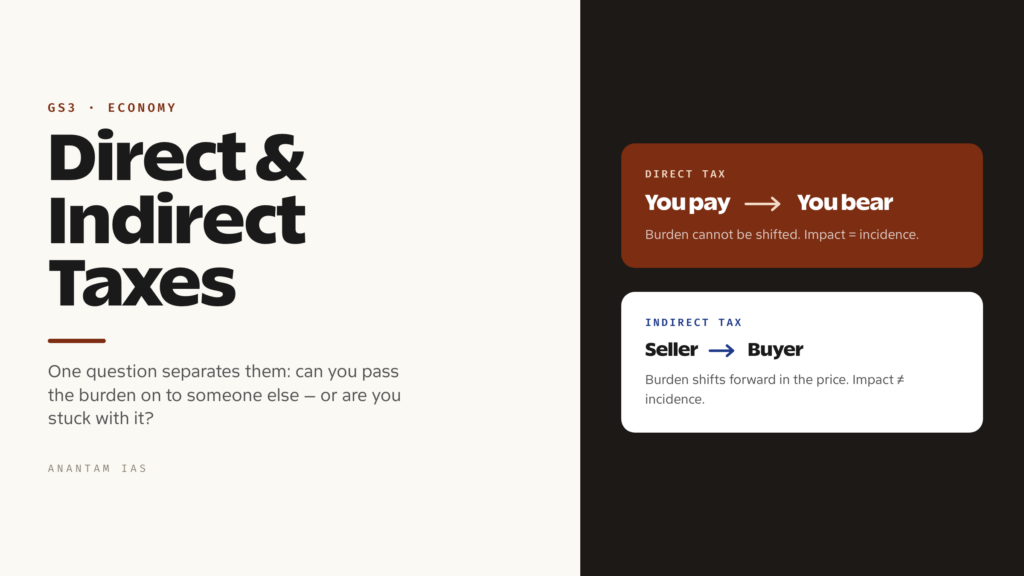
Every time you buy a packet of biscuits, you pay tax without ever filling a form, and every time you get a salary slip, tax has already been clipped off before the money reaches you. Those are two completely different kinds of tax, and the difference between them is one line: can you pass the burden on to someone else, or are you stuck with it? That single question separates a direct tax from an indirect tax, and it decides who actually pays, whether the tax hits the rich harder or the poor harder, and how the government designs the whole system.
For a UPSC aspirant this is foundational GS3 material. Fiscal policy, the Goods and Services Tax (GST), tax-to-GDP debates, equity and redistribution, the GST Council as a model of cooperative federalism all of it rests on getting this one distinction crystal clear. Get it wrong and half your economy answers wobble. Get it right and you can reason your way through any tax question in the paper.
What Makes a Tax Direct or Indirect
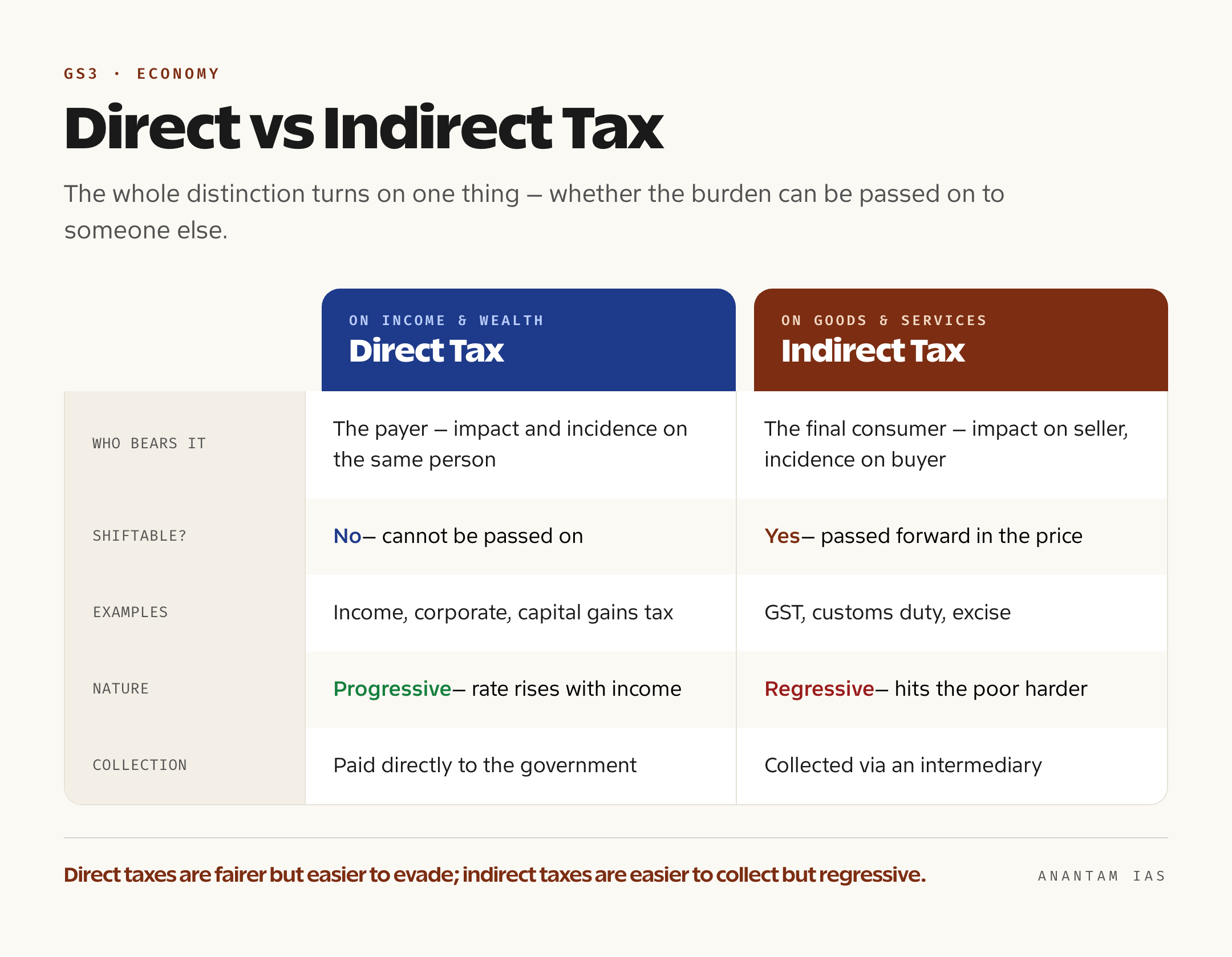
A direct tax is one where the person legally liable to pay it is also the person who actually bears the burden, and that burden cannot be shifted to anyone else. You earn income, you owe income tax, and there is no one you can hand that bill to. A indirect tax is one where the seller collects it from you but the legal liability sits on the seller, who simply passes the cost forward in the price. The shopkeeper deposits the GST on your biscuits with the government, but you, the buyer, are the one whose pocket is lighter.
The cleanest way to remember it is by who collects versus who suffers. With a direct tax, the same person does both. With an indirect tax, an intermediary (the seller, manufacturer, or importer) collects the tax and remits it, while the final consumer bears it. This is why direct taxes are paid directly to the government on your income or wealth, and indirect taxes are levied on goods and services and reach the government through a middleman.
This is also where two terms trip up almost everyone: impact and incidence. The impact of a tax falls on the person from whom the government first collects it (the legal liability). The incidence falls on the person who finally bears the money burden. In a direct tax, impact and incidence are on the same person they don’t separate. In an indirect tax, they split: the impact is on the seller, the incidence is on the consumer. That separation is the whole technical definition of shiftability, and examiners love to test it.
The Major Direct and Indirect Taxes in India
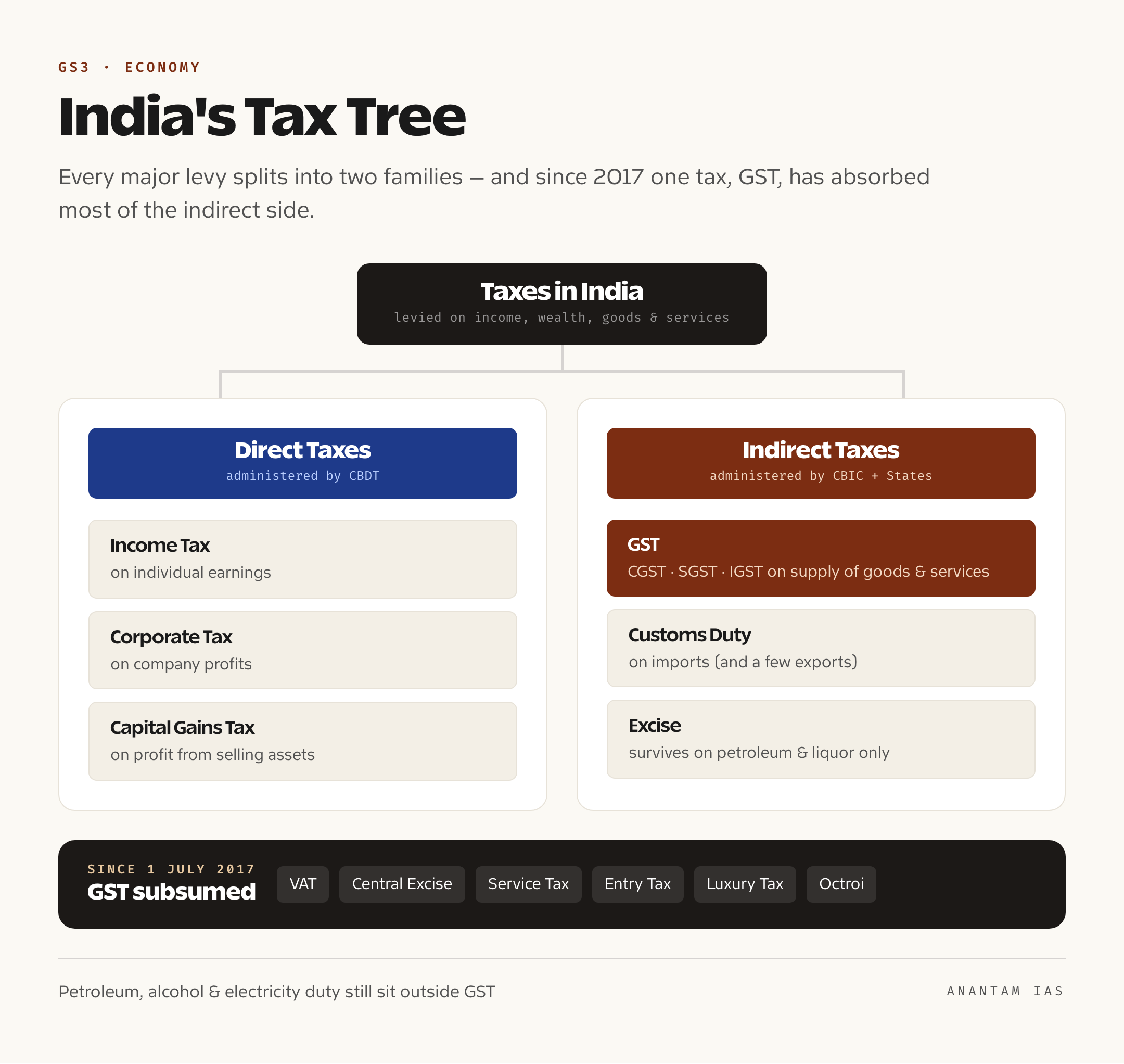
India runs a small number of direct taxes and, since 2017, a largely unified set of indirect taxes. On the direct side, the big three are income tax (on individual earnings), corporate tax (on company profits), and capital gains tax (on profit from selling assets like property, shares, or gold). These are administered by the Central Board of Direct Taxes (CBDT) under the Department of Revenue. On the indirect side, the dominant levy is now GST, with customs duty (on imports and some exports) sitting outside it, administered by the Central Board of Indirect Taxes and Customs (CBIC).
A few taxes have been quietly retired, and knowing them is useful for elimination questions. The wealth tax was abolished in the 2015 Union Budget, replaced by a surcharge on the super-rich, because it cost more to collect than it brought in. The old gift tax and estate duty are also gone. So when a question lists “wealth tax” as a current Indian tax, that’s your wrong option. For the deeper mechanics of the goods-and-services regime, our explainer on GST walks through rates, slabs, and the input-tax-credit chain.
Here is the cleanest way to hold the two families in your head:
| Type | Tax | What It’s Levied On | Who Administers It |
|---|---|---|---|
| Direct | Income Tax | Individual income and earnings | CBDT |
| Direct | Corporate Tax | Company profits | CBDT |
| Direct | Capital Gains Tax | Profit from selling assets | CBDT |
| Indirect | GST (CGST/SGST/IGST) | Supply of goods and services | CBIC + States |
| Indirect | Customs Duty | Imports (and a few exports) | CBIC |
| Indirect | Excise (on petroleum, liquor) | Manufacture of select goods | Centre/States |
Note that excise survives only on a handful of items kept outside GST, mainly petroleum products, alcohol for human consumption, and tobacco. Everything else that used to attract excise now sits inside GST.
Why One Tax Is Progressive and the Other Regressive
This is the part that actually matters for equity, and it’s where GS3 answers earn marks. A direct tax is progressive, meaning the rate rises as income rises a person earning more pays a higher percentage. India’s income tax slabs do exactly this: low incomes pay nothing or little, high incomes pay up to 30 percent plus surcharge. The logic is ability to pay, and that’s why direct taxes are the government’s main tool for reducing inequality.
A indirect tax is regressive, meaning it takes a larger share of a poor person’s income than a rich person’s. A daily-wage worker and a millionaire pay the same GST on a bar of soap, but for the worker that rupee is a bigger slice of what they earn. The tax doesn’t care about your income; it cares about your consumption, and the poor spend a far higher fraction of their income on consumption. This is the central equity criticism of indirect taxes, and it’s why governments build in relief: essentials like unbranded food grains are taxed at zero or low rates, while luxury and “sin” goods sit in the highest slabs. That tiered design is an attempt to soften the regressive edge.
So the trade-off is real. Direct taxes are fairer but harder to collect and easier to evade. Indirect taxes are easier to collect (built into every transaction) and harder to dodge, but they hit the poor disproportionately. A healthy tax system needs both, and the balance between them is a recurring policy debate that ties straight into fiscal policy and the fiscal deficit.
| Basis | Direct Tax | Indirect Tax |
|---|---|---|
| Incidence and impact | On the same person | On different persons (seller vs buyer) |
| Burden shiftable? | No | Yes, passed to the consumer |
| Levied on | Income and wealth | Goods and services |
| Nature | Progressive | Regressive |
| Examples | Income, corporate, capital gains tax | GST, customs, excise |
| Collection | Paid directly to government | Collected via an intermediary |
| Effect on inflation | Neutral | Can raise prices |
How GST Rewired India’s Indirect Taxes
Before July 1, 2017, India’s indirect taxes were a tangle. The Centre charged excise duty and service tax; the states charged VAT (Value Added Tax), plus a thicket of entry tax, octroi, luxury tax, entertainment tax, and central sales tax. Goods were taxed multiple times over (a “tax on tax” cascade), and moving them across state borders meant checkposts and paperwork. GST swept most of this away into one tax on the supply of goods and services, with seamless input-tax credit so the levy applies only to value added at each stage.
GST is collected in three streams. CGST is the Centre’s share on a sale within a state, SGST is the state’s share on that same sale, and IGST is charged by the Centre on sales between states and then apportioned. So a sale inside Gujarat splits into CGST and SGST; a sale from Gujarat to Maharashtra attracts IGST. This dual structure is what lets a “one nation, one tax” system coexist with India’s federal division of taxing powers.
The body that runs all of this is the GST Council, created by Article 279A of the Constitution (inserted by the 101st Constitutional Amendment Act, 2016). It’s chaired by the Union Finance Minister and includes the Union Minister of State for Finance and the finance minister of every state. Its decisions need a three-fourths majority of weighted votes, with the Centre holding one-third of the votes and all states together holding two-thirds. Neither side can push a decision through alone, which is exactly why the Council is cited as a working example of cooperative federalism in Indian polity and economy answers. To place all this inside the bigger picture, see our Indian economy overview.
Buoyancy, Tax-to-GDP, and the Laffer Curve
Two technical terms decide whether a tax system is actually performing. Tax buoyancy measures how much tax revenue grows relative to growth in the economy: a buoyancy above 1 means revenue is rising faster than GDP, which is what every finance minister wants. Tax elasticity is the cleaner cousin it measures revenue response to GDP holding tax rates and rules constant, isolating the effect of the base and compliance rather than rate changes. Buoyancy includes the effect of policy tweaks; elasticity strips them out.
The headline number aspirants quote is the tax-to-GDP ratio: total tax revenue as a share of GDP. India’s combined tax-to-GDP ratio sits around 11.7 percent for FY 2024-25, low compared with developed economies that cross 30 percent. The encouraging shift is that the direct tax share has been rising: direct tax collections reached roughly 6.6 to 6.7 percent of GDP, the highest in about fifteen years, while indirect taxes hover near 5 percent. A rising direct-tax share signals a more progressive, equitable system better compliance, a broader base, and less reliance on regressive consumption taxes.
The Laffer curve is the last piece worth knowing. It’s the idea, drawn as an inverted U, that tax revenue rises as rates climb but only up to a point, beyond which higher rates discourage work, encourage evasion, and actually reduce revenue. At a zero rate you collect nothing, and at a 100 percent rate you also collect nothing because no one bothers to earn. The policy lesson is that there’s an optimal rate, and pushing rates too high can be self-defeating a favourite link between tax theory and real budget decisions in Mains answers.
How to Study This for UPSC
Start with the core distinction (shiftability, impact versus incidence) and lock it down, because everything else hangs off it. Then memorise the two short lists: the direct taxes (income, corporate, capital gains) and the indirect taxes (GST, customs, the surviving excise). Learn which taxes GST subsumed and which it didn’t (petroleum, alcohol, electricity duty stay out) that’s a classic Prelims trap. Add the dates: GST from 1 July 2017, Article 279A via the 101st Amendment (2016), wealth tax abolished in 2015.
For Prelims, expect statement-matching questions on which tax is direct or indirect, which body administers it (CBDT versus CBIC), the GST Council’s composition and voting, and which levies were subsumed. For Mains GS3, this feeds fiscal-policy and equity questions: the progressive-versus-regressive debate, GST as cooperative federalism, and tax-to-GDP improvement. The smart move is to keep a one-page note linking direct/indirect taxes to the bigger fiscal-policy chapter, because UPSC almost never tests this in isolation. Skip the deep accounting detail of input-tax-credit math; you need the concept, not the chartered-accountant version.
Frequently Asked Questions
What is the main difference between direct and indirect taxes? The burden. A direct tax cannot be shifted, so the person who pays it bears it (like income tax). An indirect tax can be shifted, so the seller collects it but the consumer ultimately bears it (like GST). In direct taxes the impact and incidence fall on the same person; in indirect taxes they fall on different people.
Is GST a direct or indirect tax? GST is an indirect tax. It’s levied on the supply of goods and services, collected by the seller, and passed on to the final consumer in the price. Since 2017 it has subsumed most older indirect taxes like VAT, service tax, and central excise.
Why are indirect taxes called regressive? Because they take a larger share of a poor person’s income than a rich person’s. Everyone pays the same GST on a product regardless of income, so for low earners that tax is a bigger slice of what they make. Direct taxes are progressive because the rate rises with income.
What is tax-to-GDP ratio and why does it matter? It’s total tax revenue as a percentage of GDP, a measure of how effectively a government raises resources. India’s is around 11.7 percent for FY 2024-25, low by developed-country standards. A rising direct-tax share within it signals a fairer, more compliance-driven system.
Which taxes were abolished or subsumed in India? Wealth tax was abolished in 2015; gift tax and estate duty are long gone. On the indirect side, GST (from July 2017) subsumed VAT, service tax, central excise, entry tax, luxury tax, and several others, leaving customs duty and a narrow excise (petroleum, alcohol) outside it.
Practice Questions
Prelims MCQs
- Which of the following is a direct tax in India? (a) GST (b) Customs duty (c) Corporate tax (d) Excise duty Answer: (c) Corporate tax is levied on company profits and its burden cannot be shifted, making it a direct tax.
- With reference to direct and indirect taxes, consider the statements: In an indirect tax the impact and incidence fall on the same person. Indirect taxes are generally regressive in nature. Which is/are correct? (a) 1 only (b) 2 only (c) Both (d) Neither Answer: (b) In indirect taxes impact and incidence fall on different persons; they are regressive because they take a larger share of poor incomes.
- The GST Council in India was established under which constitutional provision? (a) Article 280 (b) Article 279A (c) Article 246A (d) Article 265 Answer: (b) Article 279A, inserted by the 101st Constitutional Amendment Act, 2016, created the GST Council.
- In the GST Council, the weightage of the Centre’s vote and the required majority are: (a) One-half and two-thirds (b) One-third and three-fourths (c) Two-thirds and three-fourths (d) One-third and two-thirds Answer: (b) The Centre holds one-third of votes, states two-thirds, and decisions need a three-fourths majority of weighted votes.
- Which tax was abolished in India in the 2015 Union Budget? (a) Capital gains tax (b) Wealth tax (c) Corporate tax (d) Customs duty Answer: (b) Wealth tax was abolished in 2015 and replaced by a surcharge on the super-rich.
Mains Practice Questions
- Distinguish between direct and indirect taxes, and examine why a rising share of direct taxes is considered desirable for equity in India. (15 marks, 250 words)
- “Indirect taxes are easier to collect but harder to justify on grounds of fairness.” Critically evaluate this statement in the Indian context. (15 marks, 250 words)
- Discuss how the introduction of GST in 2017 transformed India’s indirect tax architecture and assess the role of the GST Council as an instrument of cooperative federalism. (15 marks, 250 words)
- Explain the concepts of tax buoyancy, tax elasticity, and tax-to-GDP ratio. How do they help in evaluating the health of a country’s tax system? (10 marks, 150 words)
- What does the Laffer curve illustrate about the relationship between tax rates and revenue? Discuss its relevance for tax policy design in India. (10 marks, 150 words)
If you take away one thing, let it be the shiftability test, because it unlocks everything else: progressivity, equity, the GST design, even the policy choice between taxing income and taxing consumption. The taxes themselves will keep changing rates move, slabs get reworked, new levies appear but the logic of who actually bears the burden stays the same. Master that, and you’ll read every budget and every tax question with the same clear eye.
Tell Google you want more of this.
Add Anantam IAS as a preferred sourceOne tap, and this site shows up more often in your own Top Stories, AI Overviews and AI Mode. Remove it any time.