Public administration is the meeting place of law, politics, money and human need. At every meeting, ethical questions arise — about who gets served first, whose voice is heard, whose interest is protected, what is disclosed and what is withheld. Ethics in public administration is the discipline that supplies the principles for navigating these questions, the institutional structures that uphold the principles, and the dispositions of character that turn principles into practice.
The UPSC has placed ethics in public administration at the centre of GS IV. This article works through the meaning of administrative ethics, its dimensions across the parts of the public sphere, the importance of ethical conduct, the difficulties of practising it, and the Indian case studies and reform proposals that have shaped the field.
What ethics in public administration means
The term public service ethics (or administrative ethics) refers to the principles and standards of right conduct in the administrative sphere of government. Three things mark it off from private-sector ethics or interpersonal ethics.
- Public character. The official acts on behalf of the state; the standard of conduct is therefore what the public is entitled to expect, not merely what private morality demands.
- Discretionary power. Officials make decisions that affect citizens' lives and bind the public; misuse of discretion is the central ethical hazard.
- Institutional context. Ethics in administration operates through institutions — codes, audits, parliamentary committees — not just individual conscience.
Administrative ethics therefore combines individual virtue with institutional design.
Dimensions of administrative ethics
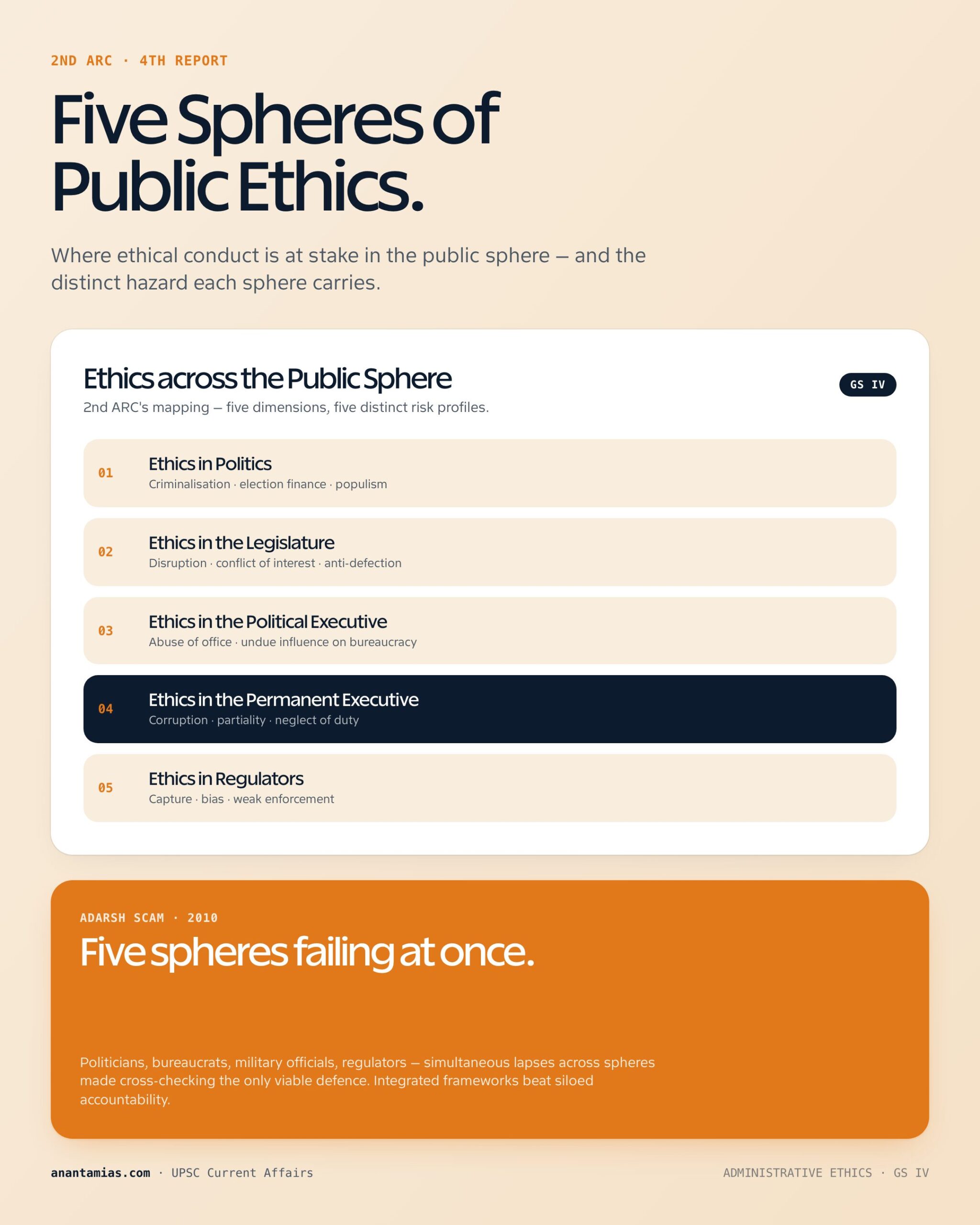
The 2nd ARC's Ethics in Governance report identifies five dimensions corresponding to the parts of the public sphere where ethical conduct is at stake.
| Dimension | What it covers | Key risks |
|---|---|---|
| Ethics in politics | Conduct of political parties and politicians | Criminalisation of politics, election finance, populism |
| Ethics in the legislature | Conduct of legislators in office | Disruption, conflict of interest, anti-defection violations |
| Ethics in the political executive | Conduct of ministers | Abuse of office, undue influence on bureaucracy |
| Ethics in the permanent executive (bureaucracy) | Conduct of civil servants | Corruption, partiality, neglect of duty |
| Ethics in regulators | Conduct of independent regulatory agencies | Regulatory capture, bias, inadequate enforcement |
Each dimension faces distinct challenges. Each requires distinct mechanisms of accountability. A complete account of public-administration ethics speaks to all five.
Importance of values in public administration
The 2nd ARC and the international literature identify several recurring rules for public-service conduct.
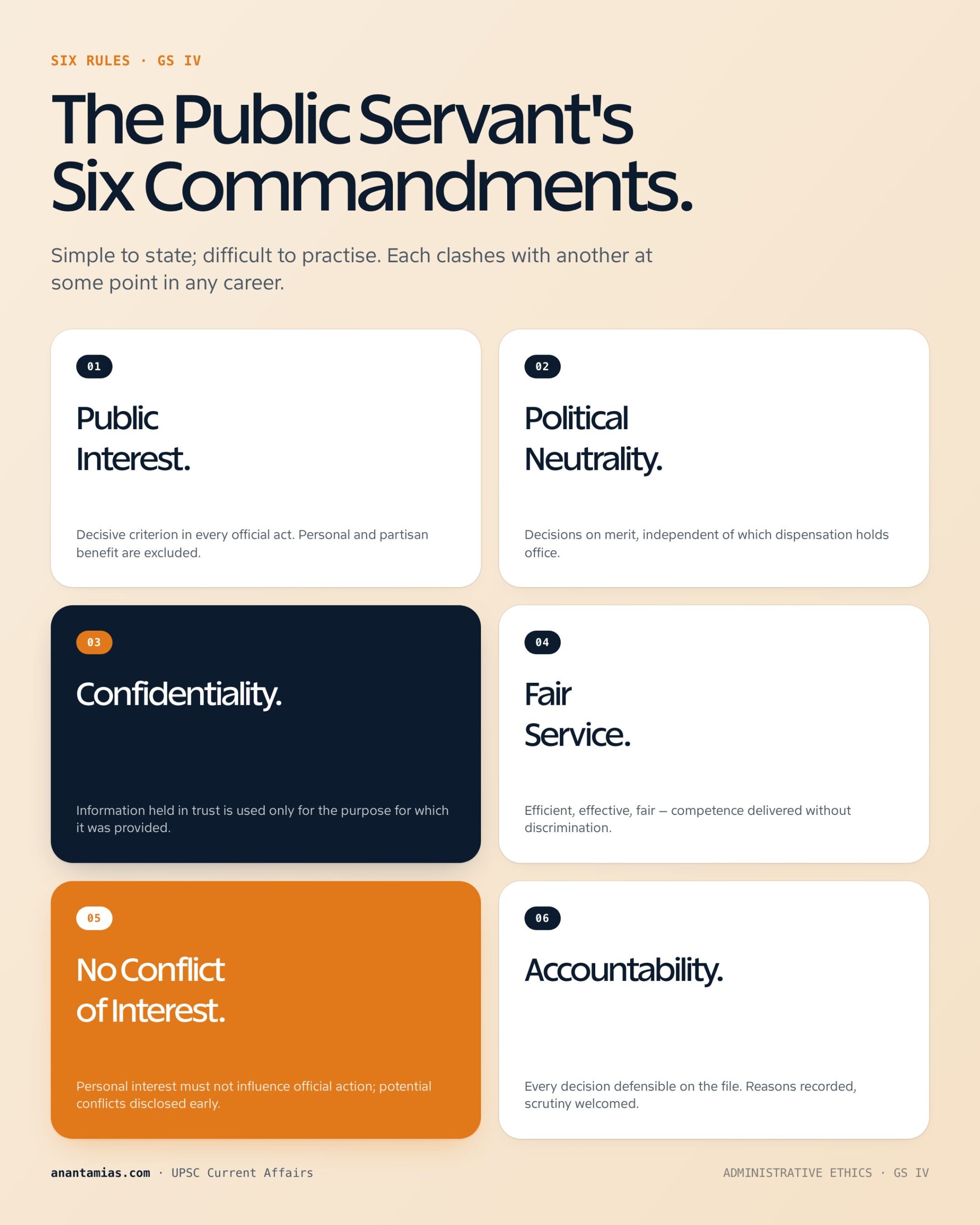
- To act in the public interest. The decisive criterion in all official action is the public benefit, not personal or partisan benefit.
- To be politically neutral. Decisions are taken on merit, independent of which party is in power.
- Not to disclose confidential information. Information held in trust is used only for purposes for which it was provided.
- To provide efficient, effective and fair service. Public services must be delivered with competence and without discrimination.
- To avoid conflicts of interest. Personal interest must not influence official action; potential conflicts must be disclosed.
- To be accountable. Decisions must be defensible, recorded with reasons, and open to appropriate scrutiny.
These commandments are simple to state. The difficulty is in their practice.
The difficulties of practising administrative ethics
The 2nd ARC and subsequent commentary identify four structural difficulties that arise when generally worded ethical principles meet specific situations.
1. Lack of clarity and certainty in meaning
What does "act in the public interest" mean when the public itself is divided? What does "be politically neutral" mean when neutrality favours a status-quo that a democratic mandate seeks to change? Generally worded rules are abstract; specific cases require interpretation, and interpretation introduces room for self-serving reasoning.
The cure is not abandoning general rules but supplementing them with case-based guidance, training in ethical reasoning, and institutional cultures that produce consistent interpretation.
2. Top-down formulation rather than bottom-up internalisation
For rules to be effective, they must be not only externally accepted but also internalised. A code of conduct handed down from above, never discussed with the officers it governs, rarely changes behaviour. Effective ethical regimes are built through participation — drafting consultation, training that engages with hard cases, peer-discussion fora.
The classic example: political neutrality. Although a core principle of civil services, it is practically unimplementable in pure form. The working relations between civil servants and politicians make strict neutrality difficult. The cure is not pretending neutrality is absolute but acknowledging its limits, training officers to manage them, and building protective institutions (fixed tenure, board-based transfers) that support practical neutrality.
3. Rules clash with one another
Often the correctness of decisions is defended by being target-oriented (results matter), whereas indecision is defended by being means-oriented (procedures matter). Efficiency, speed and effectiveness can compromise objectivity, accountability, responsibility and empathy. The officer who pushes through a decision quickly at the cost of consultation can claim outcome-orientation; the officer who delays to consult can claim process-orientation. Both are partially right; both are partially wrong.
The cure is judgement — practical wisdom calibrated to context, supported by senior advice and after-the-fact review.
4. The need for continuous evaluation
Rules of decision-making must evolve with socio-economic-political change. Rules drafted for a 1950s administrative environment may be ill-fitted to a 2020s environment of digital governance, social media accountability, and citizens with vastly higher expectations. Continuous evaluation is itself a foundational ethical commitment — the obligation to keep the system honest by keeping the system current.
Two Indian case studies
Case study 1 — Right to Information Act and the transformation of administrative ethics
The RTI Act of 2005 changed the ethical environment of Indian public administration. Decisions that had been taken in confidence now had to be defensible to citizen inquiry. File-noting practices changed; reasons started to be recorded. The Act's effect on bureaucratic conduct demonstrates the practical force of institutional design — ethics improves not only when individuals improve but when systems make ethical conduct easier to sustain and unethical conduct harder to hide.
Case study 2 — the Adarsh Society scam
The Adarsh housing scam, exposed in 2010, illustrated the multiple failures that produce ethics breakdown — politicians, bureaucrats, military officials, and regulators all facing simultaneous ethical lapses. The case showed how ethics in one sphere (the political executive) interacts with ethics in another (the bureaucracy and regulators), producing systemic failures that no single accountability mechanism alone could prevent. The reform conversation that followed reinforced the integrated framework — ethics across all five dimensions of the public sphere, with mechanisms that cross-check.
Civil services application
Practical principles for the working officer.
- Record reasons. Every decision should be defensible on the file. RTI compliance is the floor, not the ceiling.
- Disclose conflicts proactively. Before being asked, declare any potential conflict; recuse if necessary.
- Refuse the small gift. The ethical slope is steep; small favours create the path large ones travel.
- Mentor juniors actively. Most ethics violations begin in the first decade of service. Senior modelling and mentoring shape long careers.
- Use institutional channels. When witnessing misconduct, escalate through proper channels rather than colluding by silence.
Reform proposals
The Indian conversation on administrative ethics has produced several reform proposals.
- Public Service Bill / Ethics Code. Statutory backing for foundational values, drafted but not yet enacted.
- Lokpal and Lokayuktas Act, 2013. Anti-corruption ombudsman at central and state levels — implemented in part.
- Whistleblower Protection Act, 2014. Protection for those who expose misconduct — rules not fully notified.
- Civil Services Board. Mandated by Supreme Court for transparent transfers — partially implemented.
- Performance-based ACRs and 360-degree feedback. Aim to align incentives with foundational values.
UPSC past-year question references
- 2014 GS IV: "Public servants are likely to confront with the issues of 'Conflict of Interest', 'Code of Conduct vs Code of Ethics', 'Discretion vs Accountability'." Discuss.
- 2017 GS IV: "What is meant by public interest?" — direct engagement with administrative ethics.
- 2018 GS IV: "Effectiveness of public service requires foundational values." Discuss.
- 2020 GS IV: case study involving multi-dimensional ethical failure across politics and administration.
Mains answer hook
Ethics in public administration is the discipline that supplies the principles for right conduct in the public sphere, the institutional structures that uphold those principles, and the personal dispositions that turn them into practice. It operates across five dimensions — politics, legislature, political executive, bureaucracy, regulators — each with distinct risks. Generally worded commandments encounter four practical difficulties: lack of clarity, top-down imposition, conflict between rules, and the need for continuous evolution. The way forward is not abandoning principles but supplementing them with case-based judgement, participatory rule-formation, institutional design that resists capture, and training that builds the practical wisdom to apply rules well. The officer who internalises these is the officer who makes administration ethical in practice, not just in proclamation.
Prelims pointers
- 2nd Administrative Reforms Commission — Ethics in Governance (Fourth Report).
- Five dimensions — politics, legislature, political executive, permanent executive, regulators.
- Right to Information Act, 2005.
- Lokpal and Lokayuktas Act, 2013.
- Whistleblowers Protection Act, 2014.
- Public Service Bill — proposed.
FAQ
What is the difference between code of ethics and code of conduct?
A code of ethics is principles-based — broad commitments like integrity and impartiality. A code of conduct is rules-based — specific dos and don'ts. Both are needed; the ethics code provides the why, the conduct code provides the what.
Why is administrative ethics different from personal morality?
The administrator acts on behalf of the state, with discretion over public resources, in an institutional context. The standard is therefore higher and more public than personal morality.
Can ethics be enforced through laws alone?
Laws are necessary but insufficient. Without internalised values and supportive institutional cultures, even good laws are evaded.
What is the role of the 2nd ARC in Indian administrative ethics?
The 2nd ARC's Ethics in Governance report (2007) is the foundational contemporary Indian source. It mapped the dimensions, the difficulties, and the reform agenda.
How do I judge whether an action is ethically correct in administration?
Apply multiple tests — public interest, transparency (would I be comfortable if this decision were public?), reversibility (would I make the same decision if affected myself?), and procedural correctness. Where they all converge, you are likely on solid ground.
Ethics in public administration is not a separate subject from administration. It is the part of administration that survives changes in technology, organisation chart and political dispensation. Without it, administration becomes mere procedure. With it, administration is what it is meant to be — service to the public, conducted with integrity.
Tell Google you want more of this.
Add Anantam IAS as a preferred sourceOne tap, and this site shows up more often in your own Top Stories, AI Overviews and AI Mode. Remove it any time.