Fertigation is the agronomic technique of delivering water-soluble solid or liquid fertilisers through a drip or sprinkler micro-irrigation system so that nutrients reach the plant root zone in precise quantities, at the right growth stage, and uniformly across the field. By coupling water and nutrients in a single delivery channel, fertigation pushes nutrient use efficiency (NUE) from the 25-50% range of broadcast fertiliser application to 80-95% — a gain that translates directly into yield, farmer income, and groundwater protection.
For UPSC, fertigation sits at the crossroads of GS-III topics — agricultural productivity, irrigation reform, doubling farmers' income, climate-smart agriculture, and water security. Schemes like Pradhan Mantri Krishi Sinchayee Yojana (PMKSY), Per Drop More Crop (PDMC), Sub-Mission on Agricultural Mechanization (SMAM), and the Micro-Irrigation Fund (MIF) subsidise the drip and fertigation infrastructure. Prelims has tested PMKSY components, the role of NABARD-managed MIF, and water-soluble fertiliser categories.
What is Fertigation?
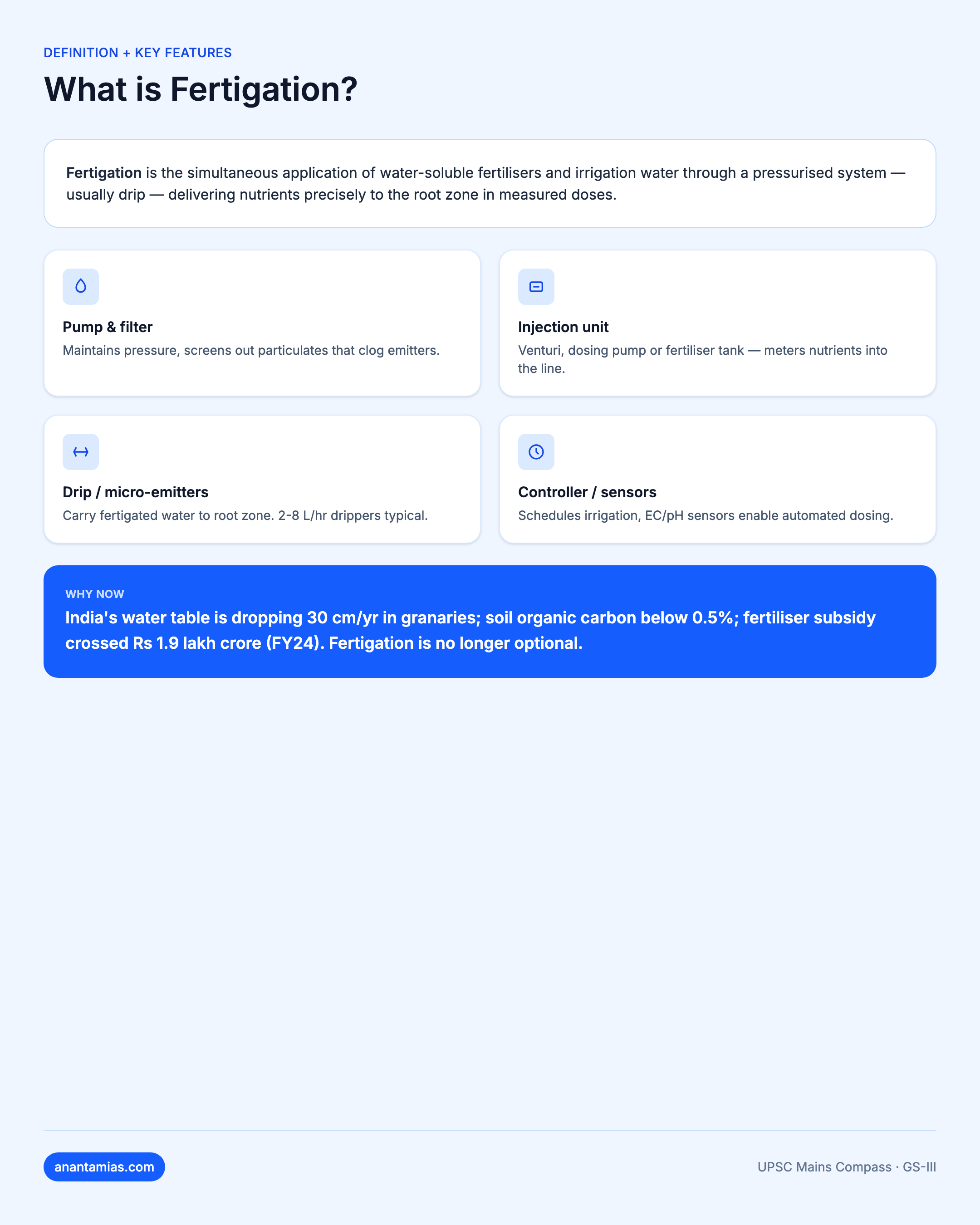
Fertigation is the simultaneous application of water and dissolved fertilisers through pressurised micro-irrigation. The system has three core elements:
- Fertiliser injection unit — a venturi, dosing pump, or fertiliser tank that meters dissolved nutrients into the irrigation line.
- Filtration unit — sand filters, screen filters, or disc filters preventing emitter clogging.
- Distribution network — mainline → submainline → laterals → emitters/drippers → plant root zone.
Inputs are water-soluble fertilisers (WSF) like urea, MOP, calcium nitrate, potassium nitrate, mono-ammonium phosphate (MAP), mono-potassium phosphate (MKP), and chelated micronutrients (Zn-EDTA, Fe-EDTA).
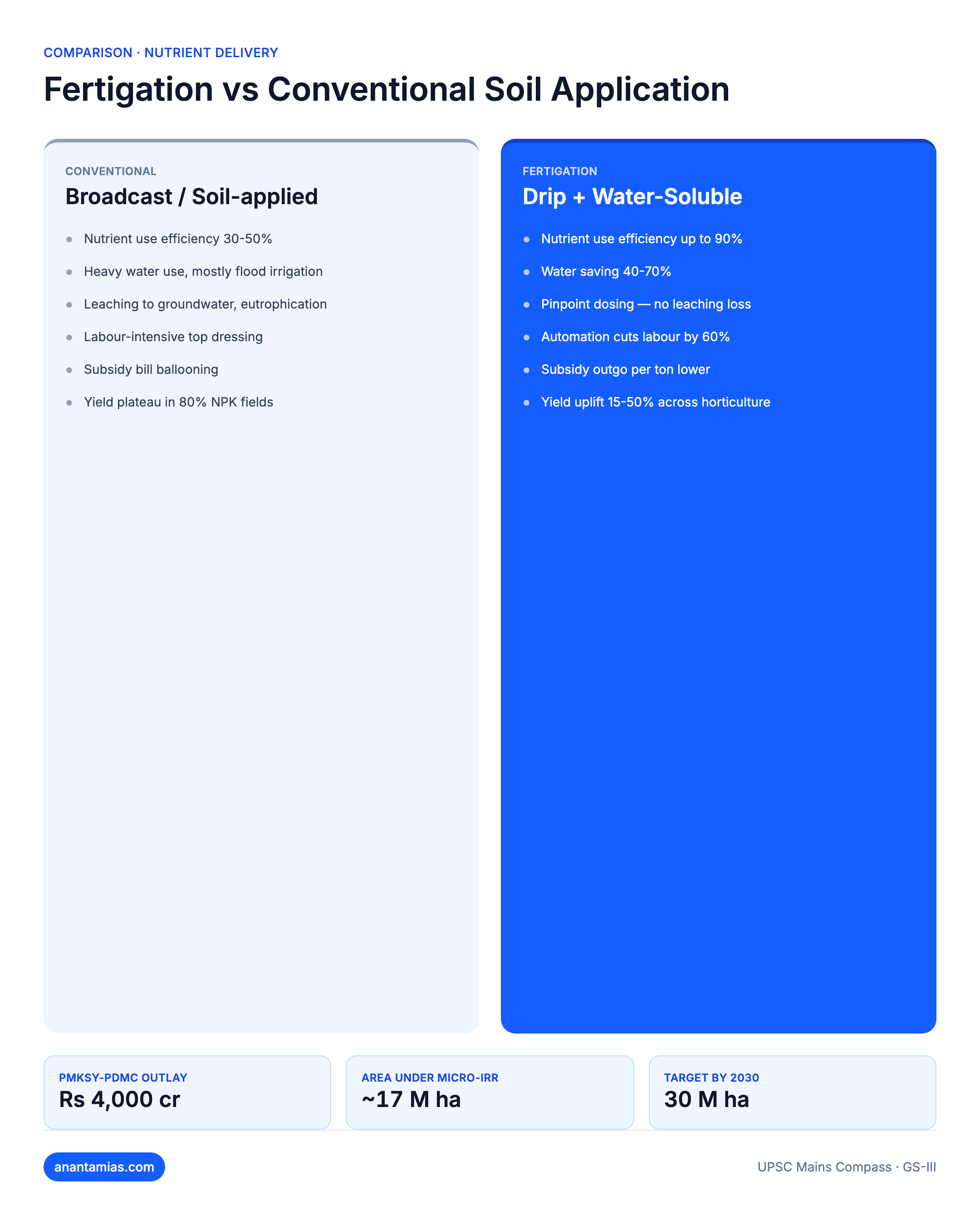
Fertigation vs Conventional Soil Application
| Parameter | Conventional broadcast | Fertigation |
|---|---|---|
| Nutrient use efficiency | 25-50% | 80-95% |
| Water consumption | High (flood/furrow) | 30-60% lower |
| Labour | High (manual broadcasting) | Minimal (automated) |
| Application precision | Uneven | Plant-specific |
| Leaching/runoff loss | High (groundwater pollution) | Negligible |
| Suitable for | Field crops on flat lands | Horticulture, high-value crops, sloped land |
| Capital cost | Low (no infrastructure) | High (drip system Rs 60,000-1,20,000/ha) |
Background: Why India Needs Fertigation
The Water Crisis
India uses 78% of its freshwater for agriculture, against a world average of 70%. Most of it is wasted in flood and furrow irrigation with field application efficiencies of 35-40%. The Composite Water Management Index (NITI Aayog) warned that 600 million Indians face high to extreme water stress and 21 cities including Delhi, Bengaluru, Chennai, Hyderabad could run out of groundwater. Drip irrigation cuts water use by 30-60%; pairing it with fertigation extracts the maximum nutrient yield from every drop.
Fertiliser Subsidy Pressure
Union Budget 2025-26 allocated Rs 1.67 lakh crore to fertiliser subsidy. Over-application of urea — common with broadcast methods — drains the exchequer. Fertigation's 80-95% NUE would let farmers achieve the same yield with half the fertiliser tonnage, slashing subsidy outgo.
Soil Degradation
Indian soils have a deteriorating soil-organic-carbon (SOC) content below the global average. Excess broadcast urea acidifies soil and disturbs microbial balance. Fertigation's targeted dosing avoids this build-up.
Doubling Farmers' Income
Fertigation has been demonstrated by ICAR-IIHR and State Agriculture Universities to increase yield by 20-50% and reduce input cost by 25-40% in vegetables, fruits, banana, sugarcane, cotton. The Dalwai Committee on Doubling Farmers' Income recommended fertigation as a backbone technology.
Components of a Fertigation System
Hardware
- Drip lines and emitters — pressure-compensating drippers ensure uniformity even on sloped fields.
- Filter unit — multi-stage filtration is essential because WSFs leave residues.
- Fertiliser injector — venturi (cheapest, suited for small farmers), dosing pump (most precise), fertiliser tank (mid-tier).
- Pressure regulator and gauges — maintain operating pressure at 0.5-2 bar.
- Backflow preventer — stops fertiliser-laden water contaminating the source.
Inputs
- Water-soluble fertilisers like 19:19:19, 13:0:45, 12:61:0, calcium nitrate, magnesium sulphate, urea phosphate.
- Liquid bio-stimulants including humic acid, fulvic acid, seaweed extracts.
- Acidulants such as urea phosphate or phosphoric acid to maintain pH 5.5-6.5.
Software/Decision Support
- Soil nutrient mapping through Soil Health Cards.
- Crop-stage nutrient schedules prepared by ICAR institutes.
- Sensor-based fertigation — soil moisture and EC sensors automating injection (advanced systems).
Benefits of Fertigation
- Higher nutrient use efficiency: 80-95% versus 25-50% for broadcast fertilisers — direct subsidy and cost saving.
- Reduced water pollution: Targeted application avoids nitrate and potassium leaching into groundwater. Fertigation is critical to address nitrate contamination in Punjab, Haryana, Rajasthan groundwater.
- Resource conservation: Saves water (30-60%), energy (20-30% pumping), labour, and time because broadcasting is replaced by automated dosing.
- Efficient micronutrient delivery: Zinc, iron, boron deficiencies — affecting 49% of Indian soils for zinc alone — can be corrected with chelated micronutrients in fertigation that are otherwise hard to broadcast.
- Effective weed management: Drip wets only the root zone; the inter-row area stays dry, depriving weeds of moisture. Combined with plastic mulch, weed pressure drops 60-80%.
- Yield gain: 20-50% in horticultural crops, 15-25% in field crops.
- Climate-smart: Lower N2O emissions due to precision dosing; supports India's Net Zero by 2070 trajectory.
- Higher farmer income: ICAR estimates Rs 25,000-Rs 75,000 additional income per hectare per season in vegetables and fruit crops.
Challenges and Criticism
- High upfront cost — drip + fertigation system costs Rs 60,000-1.2 lakh per hectare; PMKSY-PDMC subsidy of 55% (small/marginal) and 45% (others) helps but is not always timely.
- Farmer skill gap — fertigation needs knowledge of electrical conductivity (EC), pH, nutrient mixing ratios — extension services are weak.
- Clogging issues — hard water and certain WSF combinations precipitate; emitters clog without proper filtration.
- Limited WSF availability — water-soluble fertilisers are not under the Nutrient Based Subsidy (NBS), so they cost 4-5x more than conventional urea.
- Spurious products — counterfeit WSFs are a market problem; FCO testing capacity is limited.
- Land fragmentation — average Indian holding is 1.08 ha; small plots make per-hectare drip economics unfavourable without aggregation.
- Power supply — fertigation needs reliable pressurised water; erratic rural electricity and tail-end canal supply are constraints.
- Salinity concerns — long-term WSF use without organic supplementation can salt-up soil.
- Tenant farmers excluded — landlords reluctant to invest in drip on tenant-cultivated land.
Recent Developments (2024-2026)
| Year | Update |
|---|---|
| 2024 | Micro-irrigation coverage crossed 83 lakh hectares; PMKSY-PDMC outlay continued at Rs 4,000 crore/year |
| 2024 | Per Drop More Crop (PDMC) revised guidelines: 55% subsidy for SC/ST, women, NE states |
| Budget 2024-25 | Rs 5,000 crore for Micro-Irrigation Fund (MIF); raised to Rs 6,500 crore in 2025-26 |
| 2025 | WSF brought partially under DBT subsidy — pilot in Maharashtra, Karnataka |
| Budget 2025-26 | Rs 6,500 crore MIF, additional Rs 1,000 crore for fertigation training |
| 2025-26 | Drip Irrigation Mission announced for 5 crore hectares by 2030 |
| 2026 | Sensor-based smart fertigation pilot in 100 KVKs across India |
Reforms and Way Forward
- Bring water-soluble fertilisers under Nutrient Based Subsidy to make them affordable.
- Increase PMKSY-PDMC subsidy to 75% for small/marginal farmers in water-stressed districts.
- Strengthen the Micro-Irrigation Fund managed by NABARD — make it accessible at the FPO level.
- Promote Farmer Producer Organisations (FPOs) that operate community drip systems on aggregated plots.
- Integrate Soil Health Card data with fertigation schedules through AgriStack.
- Expand training through KVKs, Agricultural Universities, and private providers like Jain Irrigation, Netafim, Mahindra EPC.
- Sensor-based smart fertigation with soil moisture probes and leaf colour charts.
- Pair with mulching and protected cultivation for compounded efficiency.
- Quality assurance for WSFs under FCO with random sampling and digital traceability.
- Promote solar-powered fertigation under PM-KUSUM to cut energy cost.
Government Schemes and Budget Allocations (2025-26)
- PMKSY (Pradhan Mantri Krishi Sinchayee Yojana) — umbrella scheme for irrigation; PDMC component focuses on micro-irrigation and fertigation.
- Per Drop More Crop (PDMC): 55% subsidy for SC/ST/small/marginal/women farmers; 45% for others.
- Micro-Irrigation Fund (MIF): NABARD-managed corpus, Rs 6,500 crore in Budget 2025-26.
- PM-KUSUM: Solar pump component pairs naturally with drip and fertigation.
- Mission for Integrated Development of Horticulture (MIDH): 50% subsidy for fertigation in horticulture.
- National Mission on Sustainable Agriculture (NMSA): Soil Health Card linkage.
- AgriStack and Farmer Registry: Plot-level fertigation advisories.
Mains Answer Hook
A model GS-III answer should weave: (a) fertigation as the single highest-leverage technology for water security, fertiliser subsidy reduction, and doubling farmers' income; (b) the PMKSY-PDMC-MIF policy stack that subsidises 55-75% of capital cost; (c) structural barriers like land fragmentation, WSF affordability, skill gap; (d) the NITI Aayog warning on water stress and how fertigation directly mitigates it; (e) the climate dividend through lower N2O. Use the line: "Fertigation operationalises the Per Drop More Crop philosophy — it converts every litre of water and every kilo of fertiliser into measurable rural income."
Prelims Pointers
- Fertigation = drip irrigation + fertilisation through a single network.
- Nutrient use efficiency: 80-95% via fertigation versus 25-50% conventional.
- PMKSY-PDMC subsidy: 55% (SC/ST/small/marginal/women), 45% (others).
- Micro-Irrigation Fund (MIF): managed by NABARD; corpus Rs 6,500 crore (2025-26).
- Water-soluble fertilisers: 19:19:19, 12:61:0, 13:0:45, calcium nitrate, MAP, MKP.
- Implementing ministry: Department of Agriculture & Farmers Welfare; Ministry of Jal Shakti (PMKSY).
- Dalwai Committee recommended fertigation as a tool for doubling farmers' income.
- Ideal pH for fertigation: 5.5-6.5; salinity (EC) below 2 dS/m.
FAQ on Fertigation
What is the difference between drip irrigation and fertigation?
Drip irrigation delivers water; fertigation delivers water + dissolved fertiliser through the same drip network.
Which fertilisers can be used in fertigation?
Only water-soluble fertilisers (WSF) such as 19:19:19, 12:61:0, calcium nitrate, urea, potassium nitrate, MAP, MKP, and chelated micronutrients.
Is fertigation suitable for all crops?
Best suited for horticultural crops (vegetables, fruits, plantation), sugarcane, cotton, banana. For paddy and traditional cereals, drip-fertigation is being trialled but adoption is limited.
What is the cost of a fertigation system?
Rs 60,000-1.2 lakh per hectare; PMKSY-PDMC subsidises 45-55%.
Does fertigation reduce groundwater pollution?
Yes — by avoiding nitrate and potassium leaching, fertigation directly reduces groundwater contamination.
Which government scheme supports fertigation?
PMKSY-Per Drop More Crop, NABARD's Micro-Irrigation Fund, MIDH for horticulture, and PM-KUSUM for solar-powered fertigation.
Fertigation is one of the most evidence-backed reforms in Indian agriculture — high yield, low subsidy, low water use. For UPSC, anchor answers in the PMKSY-PDMC-MIF policy stack, the Dalwai recommendation, the NITI Aayog water stress warning, and the empirical numbers on NUE (80-95%), water savings (30-60%), and yield gains (20-50%). Pair these with structural challenges, and you have a balanced, current answer.
Tell Google you want more of this.
Add Anantam IAS as a preferred sourceOne tap, and this site shows up more often in your own Top Stories, AI Overviews and AI Mode. Remove it any time.