Why does the human mind even bother with attitudes? Holding evaluations of every person, place, idea and event we encounter is cognitively expensive. The fact that we do it persistently, across cultures and ages, suggests that attitudes serve functions — psychological work that the mind has to get done. The compass extract on Functions of Attitude lists six. Daniel Katz's classic 1960 framework names four. Together, they form a complete map of why attitudes exist and how a civil servant can use the framework to understand herself, her colleagues, and the citizens she serves.
This guide expands the compass extract into a Mains-quality reference.
The Functional Theory of Attitudes — Katz, 1960
In The Public Opinion Quarterly (1960), Daniel Katz proposed that attitudes are not random preferences but functional instruments that serve identifiable psychological needs. Identify the function, and you understand the attitude. Identify the function, and you also know how to change the attitude — by addressing the underlying need.
| Function (Katz) | What it does | Example in Civil Services |
|---|---|---|
| Utilitarian / Instrumental | Helps gain rewards and avoid punishments; maximises benefits | Officer develops positive attitude to e-governance because it reduces workload and speeds up delivery |
| Knowledge / Epistemic | Provides a simplified framework to understand the world; reduces ambiguity | 'Data-driven policymaking works', a belief that guides complex policy navigation |
| Value-Expressive / Ego-Expressive | Expresses one's core values, self-concept, and identity | IAS officer maintains anti-corruption attitude because it reflects personal integrity and identity |
| Ego-Defensive | Protects self-esteem; defence against unacceptable impulses or external threats | Officer rationalises caste prejudice as 'merit-based' to protect ego, dangerous and unethical |
Katz's four functions are:
| Function | Question It Answers | Need It Serves |
|---|---|---|
| Knowledge | What is this thing? | Cognitive economy, mental order |
| Utilitarian / Adjustment / Adaptive | How do I get rewards and avoid punishment? | Survival, gain, comfort |
| Ego-Defensive / Expression | How do I protect my self-esteem? | Psychological defence |
| Value-Expressive / Social Acceptance | How do I express who I am? | Identity, belonging |
The compass extract adds two more functions — Heuristic and Conversion of negativity to positivity — which deserve their own treatment.
Function 1 — Knowledge
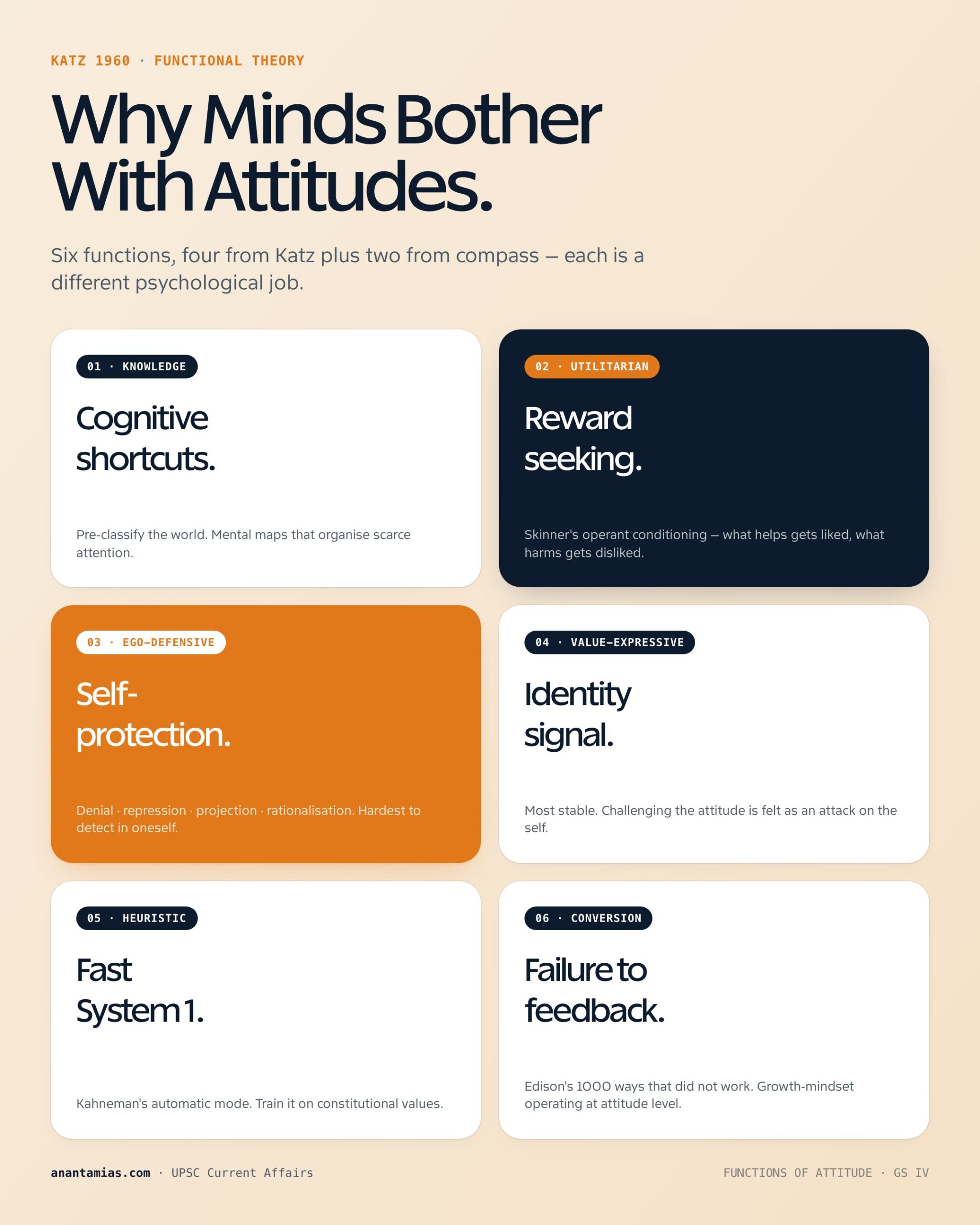
Knowing one's own or others' attitudes imparts knowledge.
The knowledge function is the cognitive simplification that attitudes provide. The world is overwhelmingly complex; attitudes give us mental shortcuts — bureaucracy is slow, traffic is bad, monsoons are unpredictable, that NGO is reliable — that organise experience into navigable patterns.
Without attitudes, every encounter would have to be evaluated from scratch. With attitudes, most encounters are pre-classified, and the mind can focus its scarce attention on novel cases.
For the civil servant, the knowledge function explains why officers cling to existing mental maps even as the world changes. New schemes, new technology, new policy frameworks all require costly re-mapping. The ethical civil servant audits her knowledge-function attitudes regularly to detect maps that have outlived their accuracy.
"It is not the things we don't know that get us into trouble. It's the things we know for sure that just ain't so." — Mark Twain (often attributed)
Function 2 — Utilitarian / Instrumental / Adjustment / Adaptive
Helps choose what is rewarding (and avoids punishment).
The utilitarian function is the most behaviourally direct. Attitudes form because a particular orientation maximises rewards or minimises punishments. We develop positive attitudes toward what helps us and negative attitudes toward what harms us.
A young officer develops a positive attitude toward seniors who mentor her and a negative attitude toward those who undermine her. A citizen develops a positive attitude toward the office that delivers her ration smoothly and a negative attitude toward the one that does not.
The utilitarian function is rooted in operant conditioning — Skinner's framework. Reward an attitude (or its associated behaviour), and the attitude strengthens. Punish it, and it weakens.
For policy design, this function is leveraged in incentive structures — performance-linked pay, rewards for whistleblowing, recognition for citizen-service excellence. Aligning incentives with desired attitudes strengthens those attitudes over time.
Function 3 — Ego-Defensive / Expression
Attitudes can help people protect their self-esteem and avoid depression. Mechanisms: Denial, Repression, Projection, Rationalization.
The ego-defensive function is the most psychologically subtle of Katz's four. Some attitudes exist not because they are useful or true, but because they shield the ego from uncomfortable truths.
The four mechanisms the compass extract names — borrowed from Freud's defence-mechanism vocabulary — are operating in everyday life.
- Denial — refusing to acknowledge an unwelcome fact. ("Corruption in this department doesn't exist.")
- Repression — pushing the unwelcome fact below conscious awareness. ("I don't really remember signing that file.")
- Projection — attributing one's own undesirable qualities to others. ("Everyone in this office is corrupt — that's why I am too.")
- Rationalisation — generating plausible reasons for ego-protective conclusions. ("I took the gift because refusing would have insulted the giver.")
The ego-defensive function explains prejudice — negative attitudes toward out-groups frequently serve to maintain the in-group member's self-esteem. It explains resistance to feedback — admitting error threatens the ego, so the officer dismisses the feedback rather than absorb it.
For the civil servant, the ego-defensive function is the most dangerous because it is hardest to detect in oneself. The reflective practice required is structured peer feedback, mentorship, and the discipline of listening to criticism without immediately responding.
"We do not see things as they are; we see them as we are." — Talmud / Anaïs Nin
Function 4 — Value-Expressive / Social Acceptance
Used to express one's core values or beliefs.
Some attitudes exist primarily to express the agent's identity. An environmentalist holds attitudes toward forests that express the value of ecological care. A constitutional democrat holds attitudes toward elections that express the value of popular sovereignty. A devout believer holds attitudes toward religious practice that express the value of faith.
Value-expressive attitudes are identity-anchored — challenging them is felt as an attack on the self. This explains why certain political, religious and cultural debates are so emotionally charged: the participants are not just defending an attitude; they are defending the identity the attitude expresses.
The social acceptance sub-function is the social variant: some attitudes exist to signal membership in a group whose acceptance the agent values. Loyalty to a party, allegiance to a regional identity, or alignment with a professional culture (cadre identity) often serves this function.
For the civil servant, value-expressive attitudes are the moral spine of her conduct. Holding the attitude citizens deserve dignified service expresses a deeper value of human equality. The expressive function is therefore not always defensive or strategic — it can be the most authentic expression of who the agent is.
Compass Additions — Two More Functions
The compass extract adds two functions that supplement Katz's framework.
Function 5 — Heuristic
Shortcut to solve a problem immediately.
Closely related to the knowledge function, the heuristic function emphasises speed. Attitudes are the fast cognitive instrument through which the agent makes decisions without deliberation. Daniel Kahneman's Thinking, Fast and Slow describes this as System 1 thinking — automatic, effortless, attitude-driven.
For a civil servant under time pressure, heuristic attitudes are unavoidable and often life-saving. But heuristics can also be biased. The reflective officer cultivates heuristics that are trained on constitutional values so that her quick decisions are still ethical decisions.
Function 6 — Conversion of Negativity to Positivity
"I have not failed 1000 times, but I have found 1000 ways that did not work." — Edison
This is a generative function. Attitudes can reframe negative experience into positive learning. Failure becomes feedback; setback becomes data; criticism becomes input.
This function is closely linked to growth mindset (Carol Dweck) and to resilience in the psychological literature. The civil servant who can convert reverses into learning sustains a long career; the one who cannot becomes brittle.
"Many of life's failures are people who did not realise how close they were to success when they gave up." — Thomas Edison
Factors Leading to Attitude Formation (Compass)
The compass extract closes with six factors that develop and form attitudes. They are the input mechanisms through which the six functions get filled with content.
- Family — primary socialisation.
- Peer — horizontal influence.
- Society — cultural norms.
- Media — modern, scaled socialisation.
- Government — laws, schemes, public campaigns.
- Organisation — workplace culture.
For a civil servant, all six continue to operate throughout life. The conscious officer audits each source periodically to check which attitudes she has inherited and which she has consciously chosen.
Two Indian Case Studies
Case 1 — Resistance to Digitisation as an Ego-Defensive Function
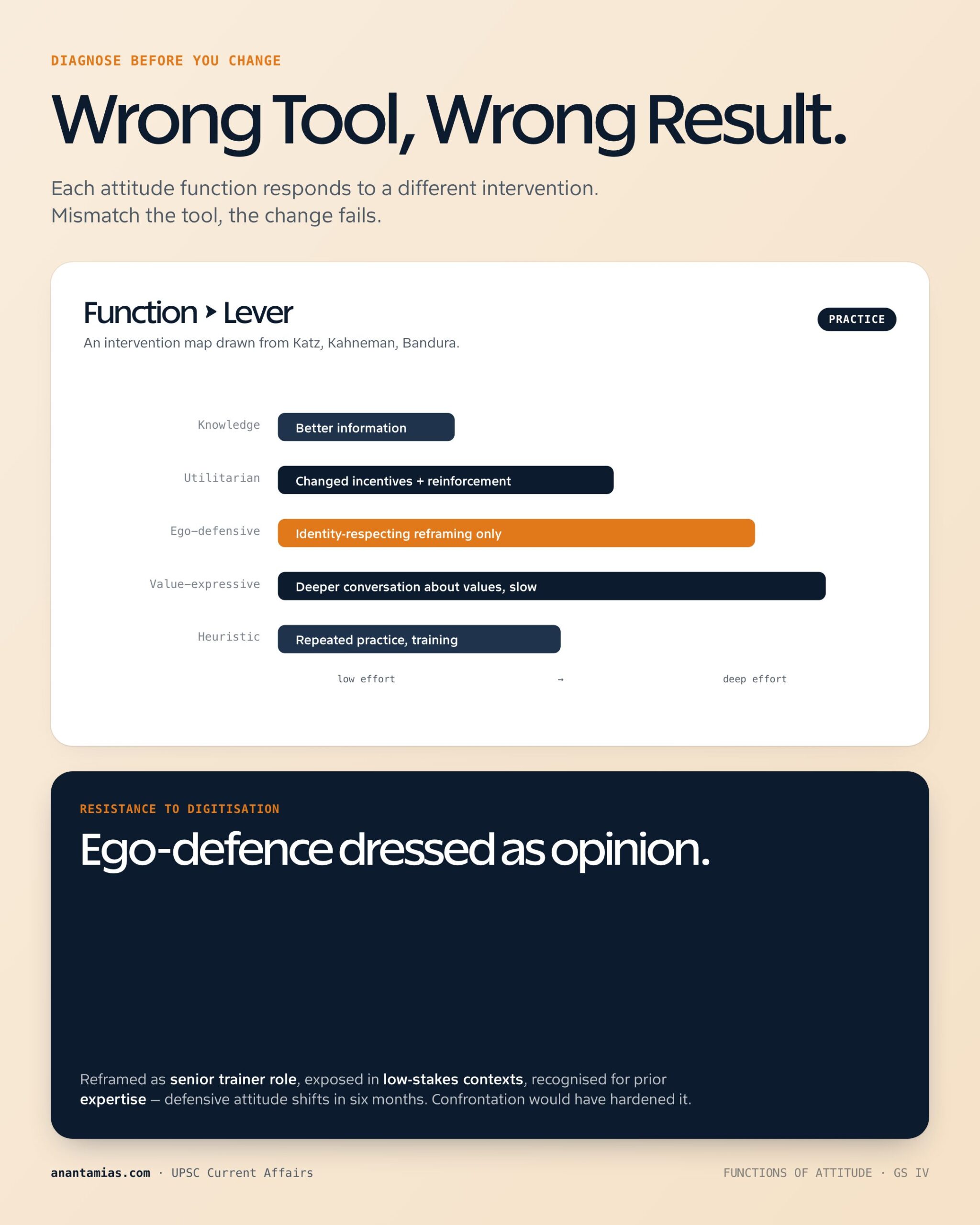
A senior officer in a district revenue department, expert in the manual record system, develops a strong negative attitude toward the new digitisation initiative. He complies publicly but undermines the project in daily interactions. Investigation reveals the ego-defensive function at work — the digital system threatens his expert identity built on procedural mastery of the manual system.
The reform combines: reframing his role as a senior trainer in the new system (preserving identity), structured exposure to the new system in low-stakes contexts (allowing competence to develop), and explicit recognition of his expertise's continued relevance (defusing the ego threat). After six months, his attitude shifts from defensive to participative. The case shows ego-defensive attitude change through identity-respecting intervention rather than confrontation.
Case 2 — Edison-Style Conversion in a Failing Pilot Project
A district pilot for a new public-health intervention fails to meet its targets in the first quarter. The default attitude of the team is despondency and blame-shifting. The District Magistrate explicitly invokes the conversion function — the failure is reframed as structured learning, with detailed root-cause analysis published transparently. The team's attitude shifts from defensive (ego-protective) to generative (learning). The next quarter shows measurable improvement. The case illustrates how the conversion function can be deliberately cultivated through leadership framing.
Practical Implications for the Civil Servant
Diagnose Before You Try to Change
When trying to change someone's attitude — your own, a subordinate's, a citizen's — first diagnose the function the attitude is serving. A knowledge-function attitude responds to better information. A utilitarian-function attitude responds to changed incentives. An ego-defensive attitude responds only to identity-respecting reframing. A value-expressive attitude responds only to deeper conversation about values. Wrong-tool intervention fails.
Audit Your Own Functions
Each of your important attitudes serves a function. Identifying which one helps you decide whether the attitude is serving you well — or just protecting you from a truth you should be hearing.
Build Heuristics That Match Constitutional Values
Heuristics are unavoidable; the question is which ones get trained. Repeated practice of constitutionally aligned action trains the heuristic so that the officer's fast decisions are also ethical decisions.
Cultivate the Conversion Function
Treat every reverse, every failure, every criticism as raw material for learning. This single disposition adds decades to a constructive career.
UPSC Syllabus Relevance
GS-IV explicitly names attitude — content, structure, function. The functions of attitude are therefore directly named in the syllabus.
Past-Year Prompts
- "What do you understand by 'attitude'? Discuss its functions and components." — 2013, 2014, 2018 (multiple variants).
- "How does cognitive dissonance occur, and how can it be reduced?" — 2017 (linked).
- "Explain the four functions of attitude with examples from public life." — 2020 paraphrased.
- "Discuss the role of ego-defensive attitudes in resisting administrative reform." — 2022 paraphrased.
Mains Answer-Writing Tips
- Open with Katz's framework explicitly cited.
- List all four functions with one-line definitions.
- Add the two compass functions as supplements.
- Cite one defence mechanism (denial, repression, projection, rationalisation) for ego-defensive depth.
- Use one Indian case (digitisation resistance, learning organisation, communication-campaign design).
Prelims Pointers
- Daniel Katz (1960) — The Functional Approach to the Study of Attitudes, Public Opinion Quarterly.
- Sigmund Freud — defence mechanisms (denial, repression, projection, rationalisation).
- Daniel Kahneman, Thinking, Fast and Slow — System 1 / System 2.
- Carol Dweck — Mindset; growth vs fixed.
- B.F. Skinner — operant conditioning underlying the utilitarian function.
FAQ
Can a single attitude serve multiple functions?
Yes — and most do. An officer's attitude toward her cadre identity may simultaneously serve value-expressive (identity), utilitarian (career advancement), and ego-defensive (self-esteem) functions. Disentangling them is part of mature self-knowledge.
Are some functions more important than others?
Value-expressive attitudes are usually most stable and most resistant to change because they are identity-anchored. Utilitarian attitudes are most responsive to incentive change. Ego-defensive attitudes are most subtle and most consequential when undetected.
Can attitudes change function over time?
Yes. An attitude that began as utilitarian (positive toward a senior because he rewarded performance) can become value-expressive (loyalty as identity). Function change is part of attitude evolution.
Is the ego-defensive function always negative?
No. Some self-protection is psychologically necessary for resilience. The pathology is when ego-defence systematically distorts perception — leading to denial of evidence, projection of one's faults, or rationalisation of unethical conduct.
How do public communication campaigns target functions?
Effective campaigns target the right function: vaccination campaigns target utilitarian (clear personal benefit) plus value-expressive (responsible citizen identity). Anti-tobacco campaigns target ego-defensive by reframing smoking from cool to vulnerable. Sanitation campaigns combine utilitarian (health), value-expressive (civic dignity), and knowledge (information).
The four (or six) functions of attitude are not academic taxonomy. They are the diagnostic toolkit through which an officer understands why she — and her colleagues, her subordinates, her citizens — believes what they believe and acts as they act. Use the toolkit as a lens, and most attitudinal puzzles become legible.
The four (or six) functions of attitude are not academic taxonomy. They are the diagnostic toolkit through which an officer understands why she — and her colleagues, her subordinates, her citizens — believes what they believe and acts as they act. Use the toolkit as a lens, and most attitudinal puzzles become legible.
Tell Google you want more of this.
Add Anantam IAS as a preferred sourceOne tap, and this site shows up more often in your own Top Stories, AI Overviews and AI Mode. Remove it any time.