When the leaders of the world’s biggest economies gathered in New Delhi for the G20 summit in September 2023, the headline most people remembered was not a communiqué or a climate pledge. It was a map. India, the United States, Saudi Arabia, the United Arab Emirates, the European Union, France, Germany and Italy signed a memorandum of understanding to build a new trade artery from the docks of western India, across the Arabian Gulf, over the deserts of the Arabian Peninsula, and on to the ports of southern Europe. They called it the India-Middle East-Europe Economic Corridor, or IMEC. It promised ships and trains and hydrogen pipelines stitched into a single ribbon of commerce, and it was unveiled with a clear, if unspoken, target in mind — China’s Belt and Road Initiative, the connectivity colossus that had spent a decade wiring the developing world to Beijing.
And that is the real reason IMEC matters far beyond logistics. We have entered an age where the map of trade routes has become a map of power. Pipelines, railways, ports and undersea cables are no longer neutral plumbing; they are instruments of statecraft, and the country that builds them sets the terms by which others trade. This is the new geoeconomics of connectivity — the deliberate use of infrastructure to win influence, lock in partners and shape the flow of goods, energy and data. IMEC is India’s most ambitious bid yet to be a builder rather than a bystander in that contest. For a UPSC aspirant, it sits squarely in GS Paper 2, at the junction of India’s foreign policy, its West Asia ties, its rivalry with China and the larger question of how a rising power secures its place in a fracturing world.
What IMEC Is and How the Two Corridors Work
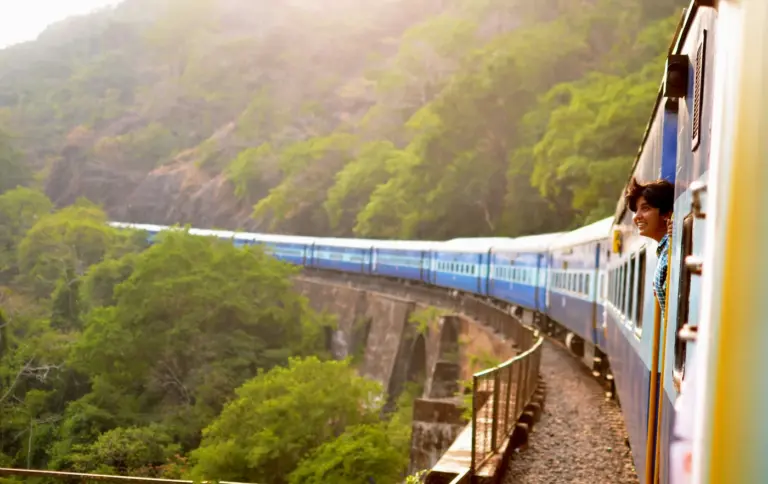
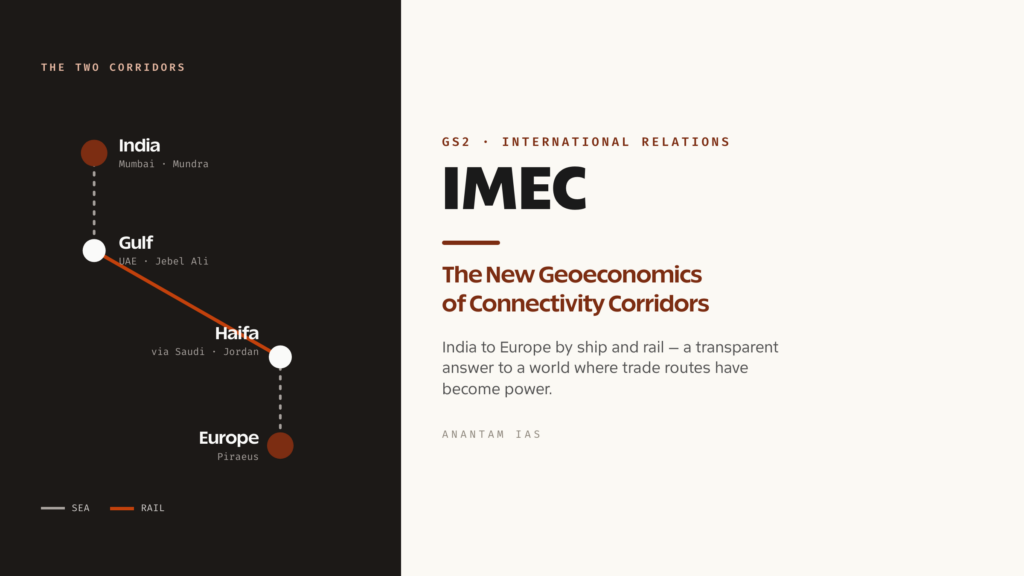
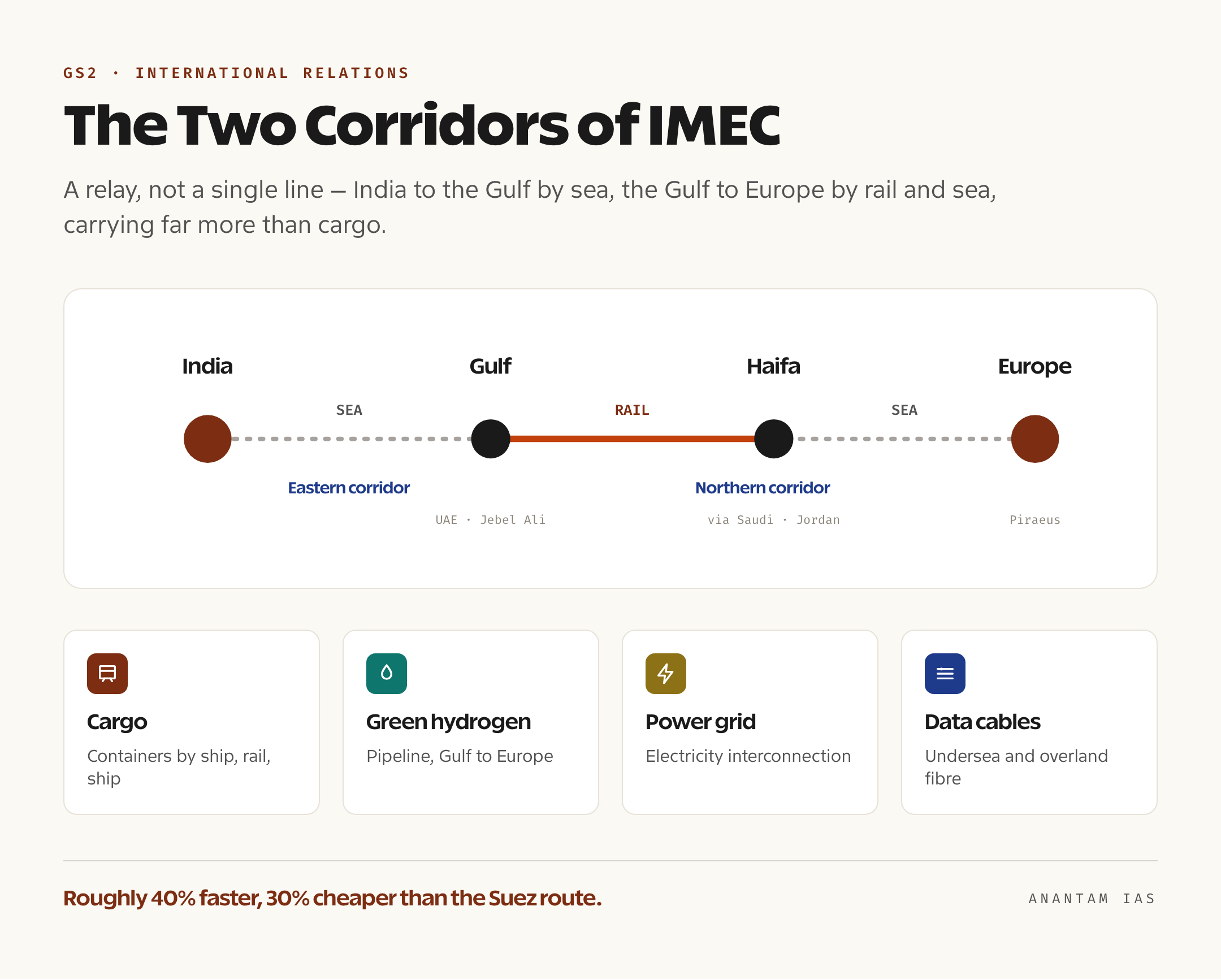
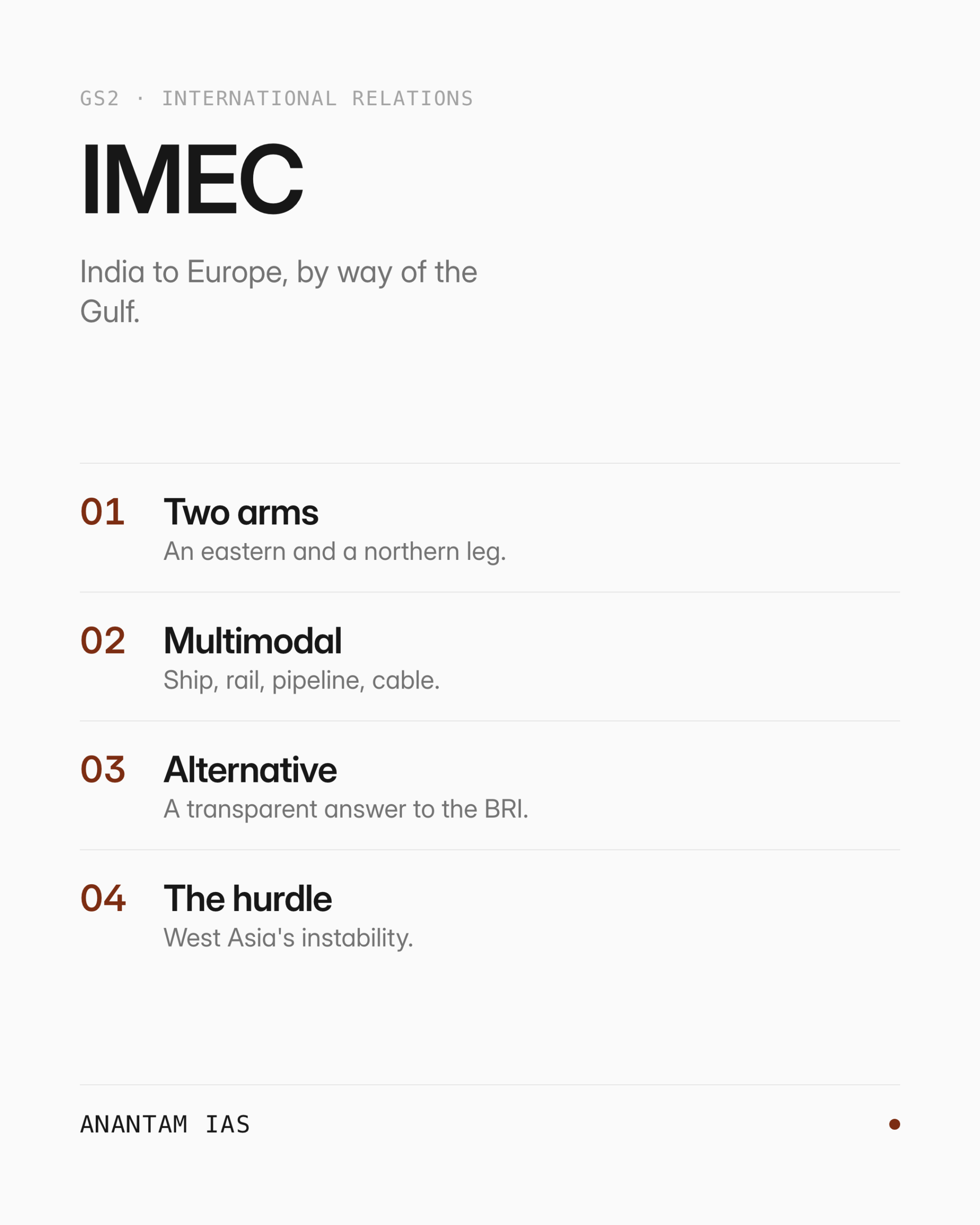
Start with the shape of the thing, because the geography is the strategy. IMEC is not one continuous line but two corridors joined at the Gulf. The first, the eastern corridor, runs by sea from India’s western ports — Mumbai’s Jawaharlal Nehru Port and Gujarat’s Mundra — across the Arabian Sea to the UAE, landing at the giant container hub of Jebel Ali near Dubai. The second, the northern corridor, is the harder and more novel leg: from the Gulf, goods would travel overland by a rail spine running up through Saudi Arabia and Jordan to the Israeli port of Haifa on the Mediterranean, then back onto ships for the final hop across to Piraeus in Greece and into the wider European market. So a container’s journey is ship, then rail, then ship again — a multimodal relay rather than a single mode. That is why IMEC is described as a ship-to-rail corridor: it swaps a long, slow sea voyage around the Arabian Peninsula for a shorter sea leg plus a fast overland dash.
The promise behind that design is speed and money. India’s Commerce Minister Piyush Goyal has said IMEC could cut transit time between India and Europe by roughly 40 per cent and logistics costs by about 30 per cent compared with the traditional route through the Suez Canal. The Mumbai-to-Piraeus journey, planners estimate, could fall to around ten or eleven days, shaving five or six days off the sea-only passage. The corridor also shortens the physical distance by more than a thousand kilometres. That said, an honest answer notes the catch: because a big stretch is rail rather than cheap ocean freight, and because cargo must be transhipped at two points, some analysts warn the per-unit cost could actually run higher unless volumes and efficiencies build up. The case for IMEC, in other words, rests as much on resilience and politics as on raw cost.
Because IMEC is meant to carry far more than boxes. Running alongside the rail line, the 2023 memorandum envisions a bundle of strategic infrastructure: an electricity grid interconnection, a pipeline to ferry clean green hydrogen — hydrogen made using renewable energy — from the sun-rich Gulf and India toward energy-hungry Europe, and undersea and overland data cables to carry digital traffic. This is what makes IMEC a corridor of the twenty-first century rather than the twentieth. It bundles trade, energy and data into one project, so a partner who joins is woven into India’s and the Gulf’s economic future across several fronts at once. The official framing is telling: the founding memorandum describes the goal as “stimulating economic development through enhanced connectivity and economic integration between Asia, the Persian Gulf and Europe” — language built to sound open, rules-based and inclusive, in pointed contrast to the way China’s projects are often described.
Connectivity as Geopolitics: BRI, Global Gateway and PGII
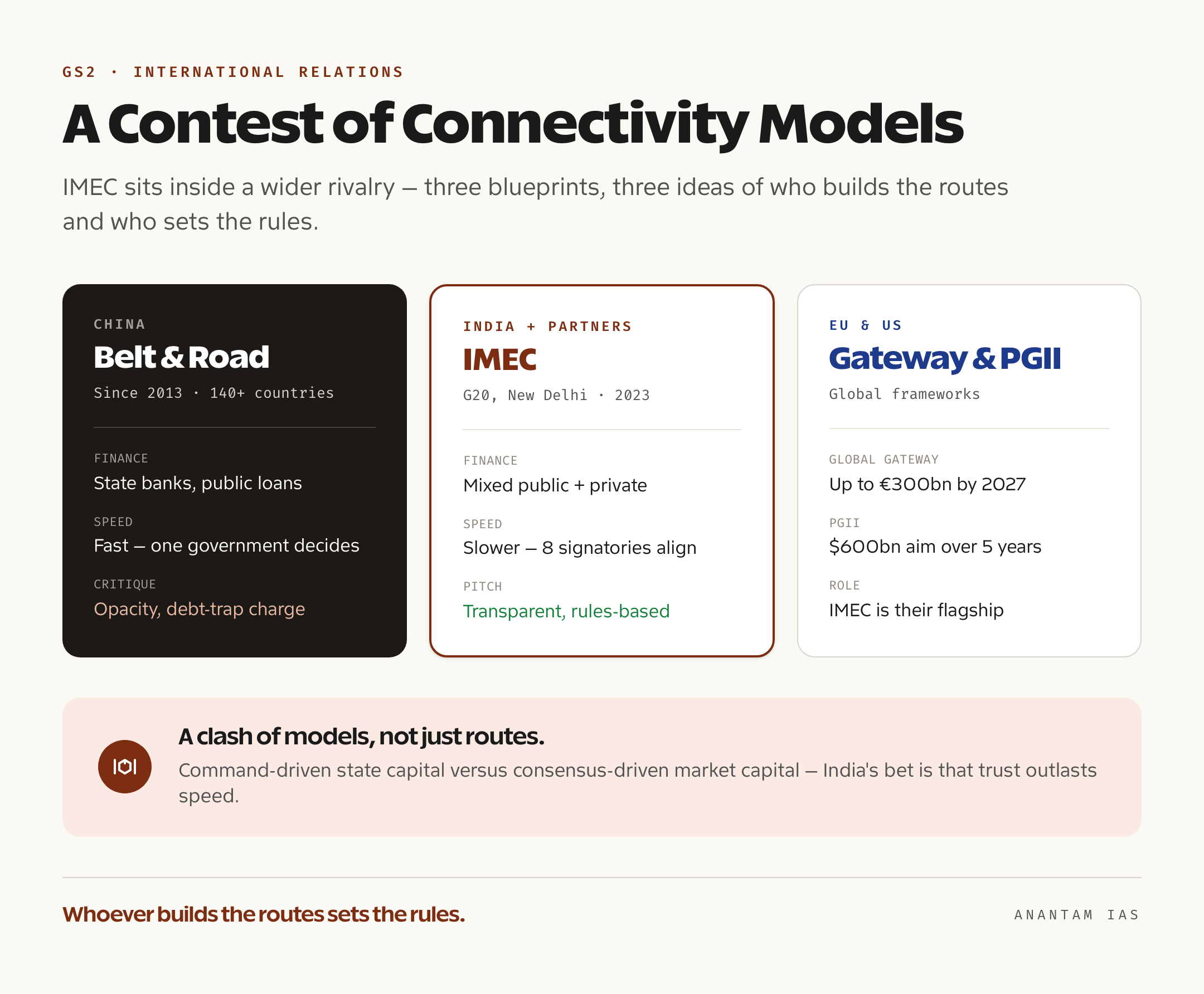
To understand why IMEC was announced with such fanfare, place it in the contest it was born to join. For a decade, the field has been dominated by China’s Belt and Road Initiative, launched in 2013 — a sprawling programme of ports, railways, highways and power plants that has reached more than 140 countries and channelled hundreds of billions of dollars, mostly as loans from Chinese state banks, built by Chinese state firms. The BRI made connectivity the central tool of Beijing’s foreign policy. It also drew sharp criticism in the West and in India: opaque contracts, environmental costs, and the charge of “debt-trap diplomacy”, where a borrowing country that cannot repay ends up surrendering control of an asset, as Sri Lanka did with the Hambantota port. Whatever the truth of each case, the perception hardened that Chinese infrastructure came with strings.
The Western response has been to build rival blueprints, and IMEC is one node in that wider answer. The European Union launched its Global Gateway in 2021, pledging to mobilise up to 300 billion euros by 2027 for connectivity, energy, digital and transport projects, with an emphasis on transparency and sustainability. At the 2022 G7 summit, the United States and its partners unveiled the Partnership for Global Infrastructure and Investment, or PGII, aiming to mobilise 600 billion dollars over five years for infrastructure in the developing world. The common pitch across all of them is the same: a “transparent”, standards-based, debt-sustainable alternative to the BRI, leaning on private capital rather than state lending. IMEC, in turn, is widely seen as the flagship project that gives PGII and Global Gateway something concrete on the map — a marquee corridor that links a democratic India and a partner-rich Gulf to Europe without passing through Chinese-controlled chokepoints.
But here is the structural weakness an examiner will reward you for naming. The Western initiatives are decentralised and depend on private investors who chase returns, while the BRI is centralised, state-financed and able to move fast because one government decides and one set of banks pays. That makes the BRI quicker off the mark and the alternatives slower, more conditional and harder to coordinate among many partners. China can simply order a port built; IMEC must align eight signatories, several private financiers and a string of host governments before a single rail bolt is tightened. So the new geoeconomics is not just a clash of routes — it is a clash of models: command-driven state capital versus consensus-driven market capital. India’s bet is that the slower, more transparent model wins trust over time, even if it loses the race for speed.
The West Asia Shadow: Why IMEC Stalled
No corridor survives contact with geopolitics unchanged, and IMEC ran into the hardest test imaginable within weeks of its launch. The whole northern corridor — the rail spine from the Gulf to Haifa — was built on a quiet assumption: that Saudi Arabia and Israel would normalise relations, letting a railway run across Arab territory to an Israeli port. That assumption rested on the Abraham Accords, the 2020 deals that opened ties between Israel and several Arab states. Then, in October 2023, barely a month after the G20 announcement, the Hamas attack on Israel and the war in Gaza that followed froze Saudi-Israeli normalisation in its tracks. The diplomatic foundation of the corridor’s central leg simply gave way, and momentum drained out of the project almost overnight.
The instability then widened. Houthi attacks on shipping in the Red Sea through 2024 and 2025 made the whole maritime neighbourhood feel dangerous and underlined why a corridor that partly bypasses those waters is attractive — yet the same regional turmoil that made IMEC look wise also made it impossible to build. Escalation between Israel and Iran, strikes and counter-strikes through 2025 and into 2026, instability in Lebanon, Syria and Yemen, all kept the Gulf on edge. A railway is a hostage to the ground it crosses; investors do not pour billions into tracks that might run through a war zone. The result is a corridor advancing at two very different speeds. The eastern leg, between India and the UAE, has moved ahead — a virtual trade corridor with digitised customs is taking shape between Mundra, Nhava Sheva and Jebel Ali, and Gulf mega-projects like Saudi Arabia’s NEOM are building out the port capacity the corridor would need. The northern leg, the diplomatically fraught rail link to Haifa, has stalled.
There are quieter obstacles too, and a balanced answer should stack them. Financing is unresolved — no one has yet put hard numbers and binding commitments behind the memorandum, and a rail line across multiple sovereign states is fearsomely expensive. Keeping eight signatories and several host governments aligned is its own diplomatic marathon. And periodic friction between partners, including strains in India-US trade ties, has at times sapped political energy from the project. None of this means IMEC is dead. Construction on parts of the corridor did begin in 2025, and most analysts expect a phased revival once West Asia steadies, with the easy eastern leg maturing first and the hard northern leg following diplomatic progress. But the lesson is clear and examinable: a corridor is only as strong as the politics of every country it crosses.
India’s Strategic Stake: Trade, Energy and Autonomy
So why does India invest so much hope in a project facing such steep odds? Because the stakes touch almost every pillar of its foreign policy at once. The first is plain economics: faster, cheaper, more reliable access to the European Union, one of India’s largest trading partners, and a logistics spine that could anchor Indian manufacturing into global supply chains as firms look to diversify away from China. The second is energy and the green transition — a hydrogen pipeline and grid links that tie India and the Gulf into Europe’s decarbonisation just as India scales up its own renewable and green-hydrogen ambitions. IMEC offers India a seat at the table where the energy map of the coming decades is being drawn.
The third stake is geographic, and it is one India feels acutely. India’s natural overland route west — through Pakistan to Iran, Afghanistan and Central Asia — has been blocked for decades by hostile relations with Islamabad, which denies India land transit. That single fact has forced India to think in terms of the sea and of corridors that go around Pakistan rather than through it. IMEC does exactly that, giving India a maritime-and-rail path to Europe that never touches Pakistani soil. It is best understood not in isolation but as one piece of a wider connectivity portfolio. India is also developing the Chabahar port in Iran and the International North-South Transport Corridor, or INSTC, which runs from India through Iran up to Russia and Europe — routes that, like IMEC, exist partly to bypass Pakistan. These are complements, not rivals, in India’s hands: IMEC reaches westward to Europe and the Gulf, while Chabahar and the INSTC reach north toward Central Asia and Russia, hedging India’s bets across an uncertain map.
The deepest stake, though, is strategic autonomy — India’s long-standing insistence on keeping its options open and refusing to be locked into any single bloc. IMEC lets India deepen ties with the United States, Europe and the Gulf monarchies, counter China’s BRI influence in its own neighbourhood, and cement its growing partnership with West Asia, all without abandoning its parallel relationships with Iran and Russia. That balancing act is the signature of Indian diplomacy, and IMEC is a textbook case of it. As an evergreen study point, the corridor is less a finished railway than a statement of intent: that India means to shape the routes of the twenty-first century rather than merely travel on them. Even if the rails to Haifa are years away, the strategic logic — diversify routes, build with trusted partners, bypass adversaries, keep every door open — is the part that endures, and the part an examiner most wants to see.
For Your Mains Answer
This is a high-value topic for GS Paper 2, which covers India’s bilateral, regional and global groupings, agreements involving India, and the effect of policies of developed and developing countries on India’s interests. Questions on India’s connectivity diplomacy, its West Asia policy, its response to China’s BRI, and the broader geoeconomics of infrastructure can all draw on this material. It also offers a rich, current example for the Essay paper on themes of globalisation, strategic autonomy and a multipolar world. The skill examiners reward is the same one this article uses: pair a few precise facts — the route, the eight signatories, the 40 per cent transit saving — with a clear argument about why connectivity has become geopolitics.
How to Build the Answer
Open with what IMEC is and when it was announced, then move in a logical chain: the two corridors and how they work, the multimodal ship-to-rail design and its savings, the strategic bundle of rail-energy-data, the wider contest with the BRI and the Western alternatives, the West Asia headwinds that stalled it, and India’s layered stake. Close by judging its prospects — a corridor of intent, advancing in phases, hostage to regional peace. That arc — define, design, contextualise, complicate, evaluate — fits almost any IMEC or connectivity question.
Common Mistakes to Avoid
Don’t describe IMEC as a single line on a map; it is two corridors — India-to-Gulf by sea, Gulf-to-Europe by rail and sea. Don’t forget it carries energy and data, not just cargo — the green-hydrogen and cable elements are what make it modern. Don’t treat IMEC and the INSTC as rivals; for India they are complementary routes, one heading west, one heading north. And don’t present it as a done deal — naming the Gaza-war freeze, the financing gap and the northern-corridor stall is what earns the higher marks.
A Compact Answer Spine
IMEC = India-Middle East-Europe Economic Corridor, signed at the 2023 G20 in New Delhi by India, US, Saudi Arabia, UAE, EU, France, Germany, Italy → two corridors: eastern (India-Gulf by sea) + northern (Gulf-Europe by rail via Saudi Arabia, Jordan, Israel’s Haifa, then sea to Piraeus) → ship-to-rail multimodal plus green-hydrogen pipeline, power grid, data cables → aim: cut India-Europe transit ~40% and cost ~30% vs Suez, a transparent alternative to China’s BRI → part of a Western answer alongside EU Global Gateway and US-led PGII → stalled by the post-2023 Gaza war freezing Saudi-Israel normalisation, Red Sea instability, financing gaps → India’s stake: trade with EU, energy, bypassing Pakistan, countering BRI, West Asia ties, strategic autonomy; complements Chabahar and the INSTC → verdict: a corridor of intent, advancing in phases, hostage to regional peace.
Diagram or Flowchart Idea
Draw a simple two-segment schematic: a node for India linked by a sea arrow to a Gulf node (eastern corridor), then a rail arrow up through Saudi Arabia and Jordan to Haifa, then a sea arrow to Europe (northern corridor). Annotate the rail leg with three small strands — hydrogen, power, data. A clean node-link sketch like this — not a literal map — communicates the whole architecture at a glance and is quick to reproduce in the exam.
A Balanced-Conclusion Line
A line that lands the marks: “IMEC is less a finished railway than a declaration that India intends to shape, not merely use, the trade routes of a multipolar century — a transparent, partner-built alternative to the Belt and Road whose promise now waits on peace in West Asia.”
How to Use Data Without Cramming
You need only a handful of anchors, not a dossier: 2023 (announced at the New Delhi G20), eight signatories, two corridors, roughly 40 per cent faster and 30 per cent cheaper than Suez, and Haifa-to-Piraeus as the European gateway. Drop those into the right sentences and the answer reads as authoritative. Attribute the savings plainly — “as India’s Commerce Ministry has estimated” — rather than scattering figures without a source.
Frequently Asked Questions
What is IMEC and who are its members?
IMEC is the India-Middle East-Europe Economic Corridor, a planned multimodal trade and infrastructure route announced through a memorandum of understanding at the G20 summit in New Delhi in September 2023. Its founding signatories are India, the United States, Saudi Arabia, the United Arab Emirates, the European Union, France, Germany and Italy. It is designed to link India to Europe through the Gulf using a combination of shipping and rail, alongside energy pipelines and data cables.
What are the two corridors that make up IMEC?
IMEC has an eastern corridor and a northern corridor. The eastern corridor runs by sea from India’s western ports to the Gulf, landing in the UAE. The northern corridor then carries goods overland by rail from the Gulf up through Saudi Arabia and Jordan to the Israeli port of Haifa, from where they travel by sea across the Mediterranean to Piraeus in Greece and into Europe. So the journey is ship, then rail, then ship — a multimodal relay rather than a single mode.
How is IMEC different from China’s Belt and Road Initiative?
IMEC is pitched as a transparent, rules-based and debt-sustainable alternative to the BRI. The BRI is centralised and state-financed, mostly through Chinese government loans and state firms, which makes it fast but has drawn charges of opacity and debt traps. IMEC, like the EU’s Global Gateway and the US-led PGII, leans on multiple partners and private capital and emphasises transparency — which makes it slower and harder to coordinate but, its backers argue, more trustworthy over time.
Why has IMEC stalled, and is it dead?
Its central rail leg to Israel’s Haifa port depended on Saudi-Israeli normalisation, which the Gaza war that began in October 2023 froze. Red Sea instability, the Israel-Iran escalation, unresolved financing and the challenge of keeping eight signatories aligned have all slowed it further. But it is not dead — the eastern India-to-Gulf leg has advanced, some construction began in 2025, and most analysts expect a phased revival once West Asia steadies.
Practice Questions
Prelims MCQs
- The India-Middle East-Europe Economic Corridor (IMEC) was announced through a memorandum of understanding at which event?
(a) The 2022 G7 summit
(b) The 2023 G20 summit in New Delhi
(c) The 2023 BRICS summit
(d) The 2024 Quad summit
Answer: (b) IMEC was unveiled at the G20 summit hosted by India in New Delhi in September 2023. - Which of the following was NOT a founding signatory of the IMEC memorandum of understanding?
(a) Saudi Arabia
(b) the European Union
(c) China
(d) the United Arab Emirates
Answer: (c) The signatories were India, the US, Saudi Arabia, the UAE, the EU, France, Germany and Italy; China was not a party. - With reference to IMEC’s structure, consider the following:
1. It comprises an eastern corridor linking India to the Gulf and a northern corridor linking the Gulf to Europe.
2. It is designed to carry, besides cargo, green hydrogen and digital data.
3. It relies entirely on rail with no maritime leg. Which statements are correct?
(a) 1 and 2 only
(b) 2 and 3 only
(c) 1 and 3 only
(d) 1, 2 and 3
Answer: (a) IMEC has two corridors and bundles hydrogen and data with cargo, but it is multimodal — ship, then rail, then ship — not rail-only. - The Israeli port that serves as the Mediterranean gateway in IMEC’s northern corridor, before goods move by sea to Europe, is:
(a) Eilat
(b) Ashdod
(c) Haifa
(d) Tel Aviv
Answer: (c) The planned rail line runs from the Gulf through Saudi Arabia and Jordan to Haifa, from where cargo travels by sea to Piraeus in Greece. - The Partnership for Global Infrastructure and Investment (PGII) and the EU’s Global Gateway are best described as:
(a) components of China’s Belt and Road Initiative
(b) Western-led connectivity initiatives positioned as transparent alternatives to the BRI
(c) United Nations infrastructure funds
(d) regional trade blocs in West Asia
Answer: (b) Both are Western-led programmes mobilising public and private capital as standards-based alternatives to the BRI, with IMEC seen as a flagship project linked to them.
Mains Practice Questions
- “Connectivity has become the new currency of geopolitics.” In light of the India-Middle East-Europe Economic Corridor, examine how infrastructure is being used as an instrument of statecraft. (15 marks, 250 words)
- Critically analyse the strategic significance of IMEC for India, with reference to trade, energy security and its policy of strategic autonomy. (15 marks, 250 words)
- Compare IMEC and the wider Western connectivity initiatives with China’s Belt and Road Initiative. Why do the alternatives find it harder to match the BRI’s pace? (15 marks, 250 words)
- Discuss how instability in West Asia has affected the progress of IMEC. What does this reveal about the vulnerabilities of cross-border connectivity corridors? (10 marks, 150 words)
- “For India, IMEC, the INSTC and Chabahar are complements, not competitors.” Evaluate India’s connectivity strategy in the context of its blocked overland routes and its relations with neighbouring states. (15 marks, 250 words)
Tell Google you want more of this.
Add Anantam IAS as a preferred sourceOne tap, and this site shows up more often in your own Top Stories, AI Overviews and AI Mode. Remove it any time.