Shale gas is natural gas trapped inside shale, a fine-grained rock so tight that the gas can’t flow out on its own, and it’s produced by drilling sideways through the rock and cracking it open with high-pressure fluid. It turned the United States into the world’s largest gas producer. India has studied it since ONGC’s first shale well near Durgapur in 2011 and has opened its law and licences to it three times since 2013.
The confusion most readers carry is that India is sitting on a proven shale bonanza and only policy is holding it back. The numbers say something else: official estimates of India’s shale gas run from 6.1 to 584 trillion cubic feet depending on who counted and what they counted, and the last official tally on record still showed no commercial production. This note settles what shale gas is, how fracking works, what India actually found and why the gas hasn’t arrived.
Shale Gas at a Glance
Shale gas is the same methane-rich gas that comes out of a conventional well. What differs is the rock that holds it and the method needed to get it out.
| Fact | Detail |
|---|---|
| What it is | Natural gas held in low-permeability, organic-rich shale that is both source rock and reservoir |
| How it is produced | Horizontal drilling plus hydraulic fracturing (“fracking”) |
| US share | About 78% of US dry gas production in 2023, per the EIA |
| India’s first shale gas | ONGC well RNSG-1, Icchapur near Durgapur, West Bengal, gas on 25 January 2011 |
| First Indian policy | Shale guidelines for ONGC and OIL in nomination blocks, 14 October 2013 |
| Current licensing | HELP (2016) uniform licence; 2018 framework for existing contracts |
| Estimates | 6.1 tcf recoverable (USGS) to 584 tcf in-place (EIA, 2013) |
| Key basins | Cambay, Krishna-Godavari, Cauvery, Damodar |
| Output so far | No commercial production, per the Lok Sabha reply of 17 December 2018 |
What Shale Gas Is
Shale gas is natural gas that never left the rock it formed in. That one idea explains nearly everything else about it.
Most gas forms when organic matter buried in mud gets cooked by heat and pressure over millions of years. That mud hardens into shale. In a conventional field, the gas slowly migrates upward out of the shale into a porous rock such as sandstone, where it collects under a cap of impervious rock. Drill into that trap and the gas flows to the well by itself.
Shale gas is the gas that stayed behind. Shale has pores, but they’re tiny and poorly connected, so the rock has very low permeability, which means fluids can barely move through it. Think of a sponge versus a brick. Both hold water, but only one lets it out when you squeeze. Shale is the brick. The analogy breaks at one point: a brick has no hidden cracks to open, while shale can be cracked artificially, and that’s the whole trick of production.
How It Differs From Its Neighbors
Shale gas is one of several unconventional hydrocarbons, a term for oil and gas that won’t flow from the rock by ordinary drilling. The siblings get mixed up often:
- Conventional gas has migrated into porous, permeable reservoir rock and flows naturally to a vertical well.
- Coal-bed methane (CBM) is gas held on the internal surfaces of coal seams, usually released by pumping out water to cut the pressure. The site’s note on coal-bed methane covers India’s CBM blocks.
- Tight gas sits in sandstone or limestone with very low permeability, not in shale.
- Shale oil is liquid oil held in shale the same way, and it’s produced with the same methods.
The US Geological Survey’s 2011 assessment of India shows why the source rock matters. It screened Indian shales on organic carbon content, thermal maturity and thickness, and found the Cambay Shale of Gujarat richest in organic carbon at more than 4 percent by weight in the deepest parts of the basin.
How Shale Gas Is Produced
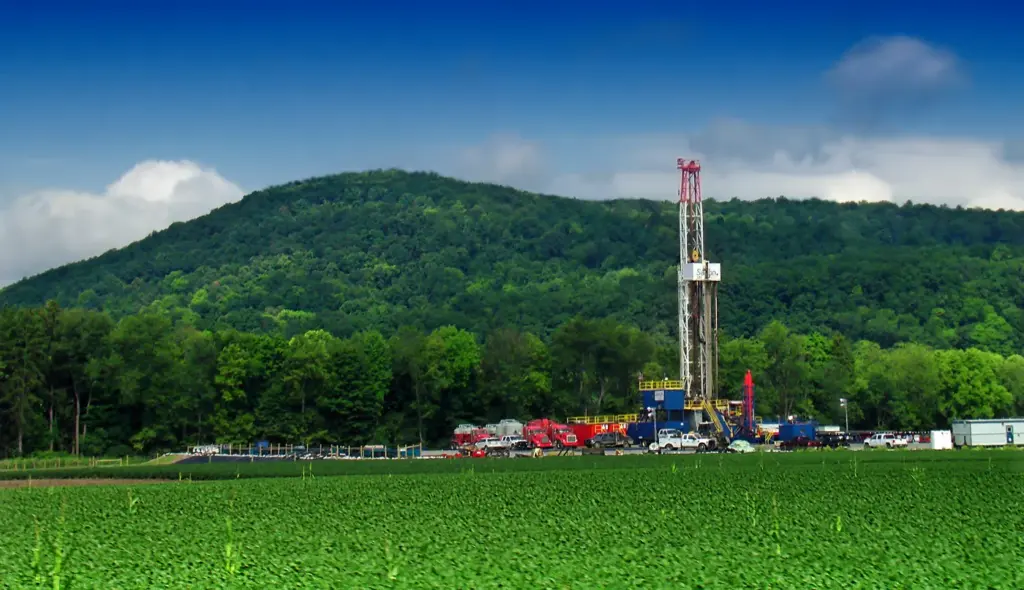
Shale gas is produced by combining two technologies: horizontal drilling and hydraulic fracturing. Together they made shale pay.
Here’s what happens, step by step:
- A well is drilled vertically down to the shale layer, which in India’s first shale well lay between 985 and 1,843 m.
- The drill bit turns and runs horizontally inside the shale for a long distance, so the well touches far more gas-bearing rock than a vertical hole could.
- The horizontal section is fractured in stages. Water mixed with sand and chemicals is pumped in at very high pressure, which cracks the rock.
- The sand, called a proppant, lodges in the cracks and props them open when the pressure is released.
- Gas flows through the new cracks into the well, along with “flowback” water that has to be treated or disposed of.
The water bill is large. The USGS says there’s no typical fractured well, because water use depends on the rock, the operator and the number of stages, but it puts the range at about 1.5 million to 16 million gallons per well. In litres, that’s roughly 5.7 million to 60 million per well. That figure is the bridge to India’s problem, which comes later.
The US Shale Revolution
The US shale revolution is the reason the rest of the world, India included, took shale seriously. The dates from the US Energy Information Administration (EIA) tell the story compactly:
- The US passed Russia in 2009 as the world’s largest natural gas producer, with shale gas driving the growth.
- In 2017 the US exported more gas than it imported, its first year as a net gas exporter since 1957.
- In 2023 about 78 percent of US dry gas production, 37.87 trillion cubic feet, came from shale formations.
When ONGC announced its Durgapur find in 2011, its own note put shale at nearly 17 percent of US gas output. Twelve years later it was 78 percent. That shift is what made shale look like a template other countries could copy.
The same EIA report on India warns why copying is hard. It lists “above-the-ground” advantages the US and Canada enjoy that may not apply elsewhere:
- private ownership of the rights to what lies under the land, which gives landowners a reason to welcome drilling;
- many independent operators and contractors with rigs and skills;
- gathering lines and pipelines already in place;
- enough water for fracturing.
Shale Gas in India: Policy Timeline
India’s approach moved from a single pilot well to a licence that covers all hydrocarbons. The timeline below is drawn from PIB releases of Parliament replies and Cabinet decisions.
| Date | Step |
|---|---|
| 26 September 2010 | ONGC spuds RNSG-1 near Durgapur, West Bengal |
| 6 November 2010 | India-US MoU on shale gas resource assessment |
| 25 January 2011 | Gas flows from Barren Measure shale at about 1,700 m in RNSG-1 |
| 14 October 2013 | Policy guidelines let ONGC and OIL explore shale in nomination blocks |
| 10 March 2016 | Cabinet approves HELP with a uniform licence for all hydrocarbons |
| 20 August 2018 | Framework notified for unconventional hydrocarbons in existing contracts |
| 12 March 2025 | Lok Sabha passes the Oilfields (Regulation and Development) Amendment Bill, 2024 |
The 2013 guidelines were narrow by design. They applied only to the national oil companies, ONGC and Oil India Limited (OIL), and only in onland blocks they already held under the nomination regime, the older system in which the government handed blocks directly to state companies without bidding. In the first phase ONGC identified 50 blocks and OIL 6, according to the Lok Sabha reply of November 2016. A July 2015 reply gave OIL’s figure as 5, so the official count varies by one.
The Hydrocarbon Exploration and Licensing Policy (HELP) of 2016 changed the unit of licensing. Before it, a contractor licensed for oil and gas couldn’t touch CBM in the same block, and a CBM contractor couldn’t touch anything else. HELP gave one licence for conventional and unconventional resources alike, including shale gas, shale oil, CBM, tight gas and gas hydrates. It also brought open acreage, meaning companies pick the blocks they want. Revenue sharing replaced cost recovery.
The 2018 framework closed the remaining gap. Blocks awarded before HELP were still locked into one resource type, so the Cabinet opened 72,027 sq km under older production-sharing contracts and 5,269 sq km under CBM contracts for unconventional work. New finds there pay the government an extra 10 percent share of profit.
Shale Gas Reserves in India
India’s shale gas reserves are not a single number, and the gap between the estimates is the lesson. A Rajya Sabha reply of 31 July 2015 listed five of them side by side.
| Agency | Estimate | Coverage |
|---|---|---|
| Schlumberger | 300 to 2,100 tcf | Whole country, “as available in public domain” |
| EIA, USA (2013) | 584 tcf gas, 87 billion barrels shale oil | Cambay, Damodar, Krishna-Godavari and Cauvery onland |
| ONGC | 187.5 tcf | Cambay, Ganga Valley, Assam and Assam-Arakan, Krishna-Godavari and Cauvery onland |
| CMPDI | 45 tcf | Jharia, Bokaro, North and South Karanpura, Raniganj and Sohagpur sub-basins |
| USGS | 6.1 tcf technically recoverable | Cambay, Krishna-Godavari and Cauvery onland |
These numbers measure different things, which is why they differ so widely. The EIA separates three layers:
- Gas in-place is all the gas physically present in the rock.
- Technically recoverable gas is the part current technology could extract, whatever the price.
- Economically recoverable gas is the part worth extracting at today’s costs and prices.
Put that to work on the EIA’s own India figures. Its 584 tcf is risked gas in-place. The same report puts technically recoverable gas at 96 tcf, about a sixth of that. The USGS figure of 6.1 tcf is already a recoverable estimate, and it is about one-sixteenth of the EIA’s 96. So the most-quoted number, 584, and the most cautious one, 6.1, aren’t really in conflict. They answer different questions. None of them is an economically recoverable figure, and that’s the one that decides whether anyone drills.
The Damodar valley, which carries the Raniganj coalfield along the Damodar river, matters because RNSG-1 was drilled there, into the Permian-age Barren Measure shale that lies between coal-bearing layers. The 56 first-phase blocks were spread over six states: Gujarat 28, Andhra Pradesh 10, Tamil Nadu 9, Assam 6, Arunachal Pradesh 2 and Rajasthan 1.
What India’s Exploration Found
India’s exploration found gas in shale but no commercial production, going by the official record. The trail runs through three statements.
- By November 2016, ONGC had drilled 20 assessment wells for shale gas and oil, and OIL had completed geological and geochemical studies and cut a conventional core in one Rajasthan well.
- By December 2018, ONGC had drilled 23 wells and OIL 4. The minister told the Lok Sabha that exploration was “at initial stage” and no commercial production had been made.
- The EIA’s India chapter notes that two vertical wells in the Cambay basin had “modest” shale gas and oil production from the Cambay Black Shale.
That’s a thin record for 15 years. The 2018 reply is the latest official well count on record here; any later figure should come with its source.
Why Shale Gas Has Not Taken Off in India
Shale gas hasn’t taken off in India because the rock is harder and the surface conditions weaker than in the US, not because policy has stood still. The policy door was opened in 2013, 2016 and 2018 and widened by law in 2025. Output didn’t follow. The reasons line up with the EIA’s own list.
Geology comes first. The EIA calls Indian shale basins “geologically highly complex.” Cambay and Cauvery are broken into horst and graben blocks, which are raised and sunken slabs of crust between faults, so the promising shale sits in isolated pockets rather than one continuous sheet. The EIA also rates some Indian shales as moderate to high in clay, and clay-rich rock tends to deform rather than crack cleanly. The USGS figure of 6.1 tcf recoverable reflects the same caution.
Water is the second constraint. At 1.5 million to 16 million gallons per well, a drilling program of hundreds of wells would compete with farms and towns for water in basins such as Cambay in Gujarat, which already sits in a water-stressed region. The site’s note on water stress in India shows how little slack there is.
Land and subsurface rights are the third. The EIA names private ownership of subsurface rights as a US advantage. In India, oil and gas leases are granted under the Oilfields (Regulation and Development) Act, 1948, while the surface land must still be acquired or leased from its owners, who lack the incentive a US rights-holder has. Shale needs many well pads, so that friction multiplies.
Infrastructure and industry depth come fourth. The US had thousands of rigs, independent operators and gathering pipelines ready when shale took off. India’s onland shale basins would need that service industry built largely for shale.
Pricing and fiscal terms are the fifth. Until HELP in 2016, gas from Indian blocks didn’t carry the marketing and pricing freedom that HELP introduced, and nomination blocks still run on their existing terms under the 2018 framework. Shale’s high drilling cost needs a price that covers it. The major constraints in the energy sector note places this within India’s wider gas economics.
The fair judgment is a middle one. Writing shale off is premature, because the data from 23-odd wells is too thin to rule out a sweet spot. Treating it as a near-term answer to import dependence isn’t wise either, because every official number points to slow, costly and uncertain gas.
Environmental Concerns of Fracking
The environmental case against fracking rests on four risks, and the evidence behind each differs in strength.
- Water use. The USGS range of 1.5 million to 16 million gallons per well is the documented figure. In water-stressed basins this is the most direct conflict.
- Water contamination. The US Environmental Protection Agency’s 2016 final assessment found that fracturing activities can affect drinking water resources “under some circumstances”, such as spills or poorly built wells, while data gaps stopped it from estimating how often. The risk to aquifers links to the site’s note on groundwater contamination.
- Induced seismicity. This means earthquakes caused by human activity. The USGS says reports of fracturing itself causing felt earthquakes are “extremely rare”; the larger risk comes from injecting wastewater into deep disposal wells, which raises pressure over wider areas for longer. The mechanics of faults and stress are covered in earthquake causes and types.
- Methane leakage. Gas that escapes from wells and pipelines is mostly methane, which the EPA calls more than 28 times as potent as carbon dioxide at trapping heat. Oil and gas systems are among the largest human sources in the US. The Global Methane Pledge note explains why cutting these leaks is a climate priority.
India’s rules put these risks through the standard clearance route. The 2018 Lok Sabha reply says an Environmental Impact Assessment and environmental clearance under the Environment (Protection) Act, 1986 are required before production begins. Watch the acronym: in Indian documents “EIA” usually means this assessment, while in energy data it means the US Energy Information Administration.
Shale Gas Today
Shale gas today is fully legal to explore in India, but it’s still a prospect, not a source of supply. Three recent developments define its position.
- The Oilfields (Regulation and Development) Amendment Bill, 2024 was passed by the Rajya Sabha on 3 December 2024 and the Lok Sabha on 12 March 2025. It widens “mineral oils” to include any naturally occurring hydrocarbon, CBM and shale gas and oil, excludes coal, lignite and helium, and replaces the mining lease with a petroleum lease.
- Under HELP’s Open Acreage Licensing Policy, 172 exploration blocks covering 3,78,652 sq km had been awarded in Rounds I to IX, and Round X with 25 blocks was launched on 15 April 2025, per a PIB release of 11 August 2025. Every one of those blocks carries the uniform licence, so shale is open to any winner.
- Exploration is permitted in all allocated blocks, a point the ministry made in its December 2018 Lok Sabha reply, which is also where the “no commercial production” statement sits.
Meanwhile India’s gas security still leans on imported LNG, a weakness laid bare during recent West Asian disruptions, as the current-affairs note on LNG supply disruption and storage explains. That’s why shale keeps returning to policy discussion even without output.
How to Study Shale Gas for Exams
Shale gas sits in three places in the syllabus: resource distribution in GS Paper I geography, energy and infrastructure in GS Paper III, and environmental impact across both. It’s tested as an “availability and issues” question rather than a pure definition. Mains 2013 GS Paper I asked: “It is said that India has substantial reserves of shale oil and gas, which can feed the needs of the country for quarter century. However, tapping of the resource does not appear to be high on the agenda. Discuss critically the availability and issues involved.” For Prelims, the site’s bank of Prelims questions from 2013 to 2026 has 249 of the 1,403 questions in Environment and 82 in Geography, the two areas shale draws from.
The facts worth revising until they’re automatic:
- Two technologies: horizontal drilling and hydraulic fracturing, used together.
- RNSG-1: ONGC, Icchapur near Durgapur, Damodar basin, gas on 25 January 2011, Barren Measure shale.
- 14 October 2013: shale guidelines for ONGC and OIL in nomination blocks; 50 and 6 blocks in phase one.
- HELP, 10 March 2016: uniform licence for all hydrocarbons, open acreage, revenue sharing.
- Estimates: EIA 2013 584 tcf in-place and 96 tcf recoverable; USGS 6.1 tcf recoverable in Cambay, Krishna-Godavari and Cauvery.
- Status: 23 ONGC and 4 OIL wells by December 2018; no commercial production.
- 2025 amendment: shale gas and oil now inside the definition of mineral oils.
The confusions to keep apart:
- In-place versus recoverable. Quote 584 tcf only with the word “in-place”. The recoverable figures are 96 tcf (EIA) and 6.1 tcf (USGS).
- Fracking versus wastewater quakes. The USGS ties most induced quakes to wastewater disposal, not the fracturing step itself.
- Shale oil versus oil shale. Shale oil is liquid oil in shale. Oil shale holds kerogen, a solid organic material that must be heated to yield oil. The 2025 amendment names both separately.
- The 2013 policy versus HELP. The 2013 guidelines covered only state companies in nomination blocks; HELP opened shale to every bidder.
| Resource | Where the gas sits | How it is produced | India status |
|---|---|---|---|
| Conventional gas | Porous reservoir rock under a trap | Vertical wells, natural flow | Main domestic source |
| Shale gas | Inside the shale source rock | Horizontal drilling and fracking | Explored, no commercial output on record |
| Coal-bed methane | On coal surfaces in seams | Dewatering the coal seam | Produced from CBM blocks |
| Tight gas | Low-permeability sandstone or limestone | Fracturing, often horizontal wells | Covered by the HELP licence |
| Gas hydrates | Ice-like solid under seabed or permafrost | Still experimental worldwide | Covered by the HELP licence |
For your preparation, shale gas is a topic where precision earns marks. An answer that separates in-place from recoverable, names the basins and dates the policies will stand out from one that repeats a single reserve figure. And the real analytical point, that geology and surface conditions rather than policy explain the missing output, is the kind of judgment examiners reward in a “discuss critically” question.
Frequently Asked Questions
What is shale gas in simple words?
Shale gas is natural gas trapped inside shale, a fine-grained rock with pores so poorly connected that the gas can’t flow out on its own. It is produced by drilling horizontally through the shale and cracking it with high-pressure water, sand and chemicals. Chemically it’s the same methane-rich gas that comes from a conventional well.
How is shale gas different from natural gas?
Shale gas is a type of natural gas, so the difference lies in the rock and the method, not the gas. Conventional gas has migrated into porous reservoir rock and flows naturally to a well. Shale gas never left its source rock and needs horizontal drilling and fracking to be released.
Does India have shale gas reserves?
India has shale gas resources, but the estimates vary widely. The US EIA put risked gas in-place at 584 trillion cubic feet in 2013, with 96 tcf technically recoverable, while the USGS estimated only 6.1 tcf recoverable in the Cambay, Krishna-Godavari and Cauvery basins. None of these is a proven commercial reserve.
Where was India’s first shale gas found?
India’s first shale gas flowed from ONGC’s well RNSG-1 at Icchapur near Durgapur in West Bengal on 25 January 2011. The gas came from the Barren Measure shale in the Damodar basin at a depth of about 1,700 metres. ONGC said it made India the first Asian country to find gas in shale outside the US and Canada.
What is hydraulic fracturing or fracking?
Hydraulic fracturing, or fracking, is the method of pumping water mixed with sand and chemicals into rock at very high pressure to crack it. The sand props the cracks open so trapped gas or oil can flow to the well. Combined with horizontal drilling, it made shale production commercial in the United States.
Why is shale gas production not happening in India?
Shale gas production hasn’t taken off in India mainly because of complex, faulted geology, heavy water needs, difficult land acquisition, a thin service industry and costly drilling. The government opened shale to exploration in 2013, 2016 and 2018, but a December 2018 reply to Parliament said no commercial production had been made.
Is fracking harmful to the environment?
Fracking carries four main environmental risks: heavy water use, possible contamination of drinking water, earthquakes linked to wastewater disposal and leaks of methane, a potent greenhouse gas. The US EPA found that fracking can affect drinking water under some circumstances. The USGS says the fracturing step itself rarely causes felt earthquakes.
Which policy allows shale gas exploration in India?
Shale gas exploration in India is allowed under the Hydrocarbon Exploration and Licensing Policy of 2016, which gives one licence for all hydrocarbons. The 2013 guidelines had first allowed ONGC and OIL to explore shale in their nomination blocks, and a 2018 framework extended it to older contracts.
Practice Questions
Prelims
1. Consider the following statements about shale gas: 1. Shale gas is held in rock of very low permeability, so it does not flow to an ordinary vertical well. 2. Shale gas is chemically different from the natural gas produced from conventional reservoirs. Which of the statements given above is/are correct?
- (a) 1 only
- (b) 2 only
- (c) Both 1 and 2
- (d) Neither 1 nor 2
Answer: (a) Shale gas is the same methane-rich gas; only the rock and the extraction method differ.
2. Consider the following statements: 1. The policy guidelines of October 2013 allowed all private contractors to explore shale gas in their production-sharing blocks. 2. The Hydrocarbon Exploration and Licensing Policy provides a uniform licence for conventional and unconventional hydrocarbons. Which of the statements given above is/are correct?
- (a) 1 only
- (b) 2 only
- (c) Both 1 and 2
- (d) Neither 1 nor 2
Answer: (b) The 2013 guidelines covered only ONGC and OIL in nomination blocks; HELP brought the uniform licence.
3. India’s first shale gas flowed from an ONGC well in which basin?
- (a) Cambay basin
- (b) Krishna-Godavari basin
- (c) Damodar basin
- (d) Cauvery basin
Answer: (c) RNSG-1 near Durgapur tapped the Barren Measure shale of the Damodar basin in January 2011.
4. Consider the following statements about induced seismicity: 1. According to the USGS, the fracturing step itself rarely causes felt earthquakes. 2. Injecting wastewater into deep disposal wells is more likely to induce earthquakes than hydraulic fracturing. Which of the statements given above is/are correct?
- (a) 1 only
- (b) 2 only
- (c) Both 1 and 2
- (d) Neither 1 nor 2
Answer: (c) The USGS calls fracturing-caused felt quakes extremely rare and ties most induced quakes to wastewater disposal.
5. The USGS estimate of 6.1 trillion cubic feet of technically recoverable shale gas in India covers which basins?
- (a) Cambay, Krishna-Godavari and Cauvery
- (b) Damodar, Assam-Arakan and Cambay
- (c) Cauvery, Vindhyan and Rajasthan
- (d) Krishna-Godavari, Damodar and Ganga Valley
Answer: (a) The USGS 2011 assessment covered the Cambay (Bombay), Cauvery and Krishna-Godavari provinces.
Mains
- Explain how horizontal drilling and hydraulic fracturing together make shale gas production possible, and why a shale industry needs continuous drilling. (10 marks, 150 words)
- Estimates of India’s shale gas resources range from 6.1 to 584 trillion cubic feet. Explain the reasons for this range and its implications for energy planning. (10 marks, 150 words)
- India has liberalised its shale gas policy several times since 2013, yet commercial production has not followed. Critically examine the geological, economic and social reasons. (15 marks, 250 words)
- Examine the environmental risks of fracking and suggest a regulatory framework suited to India’s water-stressed basins. (15 marks, 250 words)
- “The US shale revolution cannot simply be copied in India.” Evaluate this statement with reference to subsurface rights, water availability and industry structure. (15 marks, 250 words)
Tell Google you want more of this.
Add Anantam IAS as a preferred sourceOne tap, and this site shows up more often in your own Top Stories, AI Overviews and AI Mode. Remove it any time.