Look at the most valuable companies on Earth and try to find their wealth. You can’t touch most of it. Apple’s worth is not in its assembly lines; it is in the design, the software, the brand and the patents. A pharmaceutical giant’s value sits in molecules it has the right to make, not in the steel vats that brew them. Hindustan Unilever, one of India’s most valuable consumer firms, holds an estimated 97.5 per cent of its enterprise value in things you cannot weigh — recipes, brands, distribution know-how and data. The modern economy has quietly inverted an old assumption. For most of history, capital meant machines, buildings and land — things you could kick. Today, the most important capital is made of ideas, and the World Intellectual Property Organization reckons the corporate intangibles of the world are now worth close to $100 trillion. The factory has not disappeared. It has simply stopped being where the money is.
Economists call this the intangible economy, and the phrase has moved from academic seminars into the everyday vocabulary of investors and policymakers. It is the subject of a hugely influential 2017 book, Jonathan Haskel and Stian Westlake’s Capitalism Without Capital: The Rise of the Intangible Economy, which gave the shift both a name and a grammar. For a UPSC aspirant, this is one of those concept articles that unlocks a dozen others — it explains the productivity puzzle, rising inequality, the power of Big Tech, the financing troubles of startups and the reason India’s IT and pharma strength matters more than its share of GDP suggests. Master the idea once, and it pays off across the whole economy section of GS Paper 3.
What the Intangible Economy Actually Is
Start with the plain distinction. A tangible asset is physical — a machine, a truck, a warehouse, an office tower. An intangible asset has no physical form but still produces value over time. Haskel and Westlake group the important intangibles into a handful of buckets that are worth memorising, because examiners and editorials both use them. There is research and development — the new drug formula, the better battery chemistry. There is software and databases — the code that runs a bank and the data it sits on. There is design — the look, feel and ergonomics that make one phone sell and another flop. There is branding and marketing — the trust and recognition packed into a name. There is intellectual property — patents, copyrights and trademarks, the legal walls that fence off ideas. And there is organisational capital and training — the firm-specific know-how, processes and skilled teams that make a company run, none of which appear on a shipping manifest but all of which took real money to build.
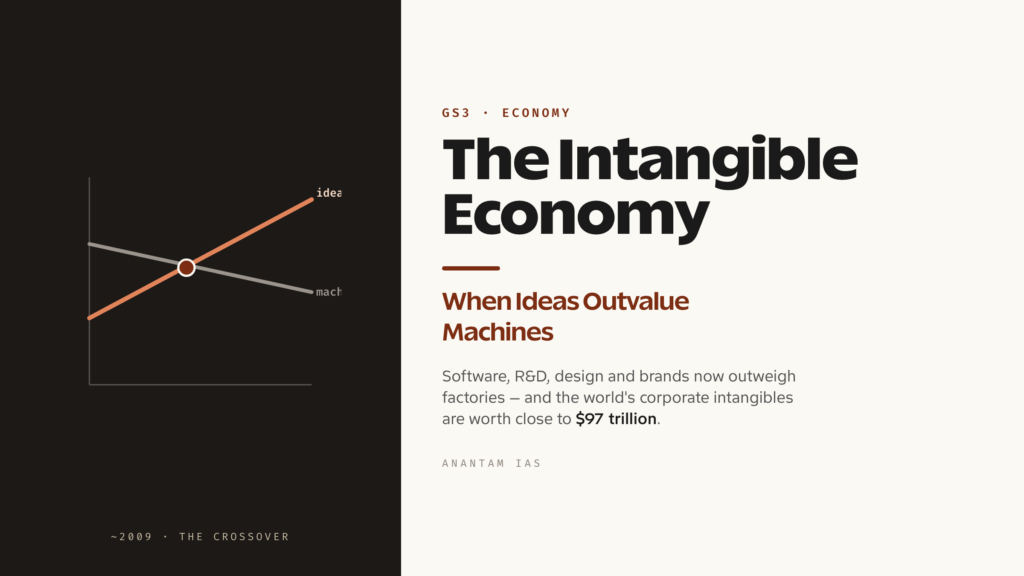
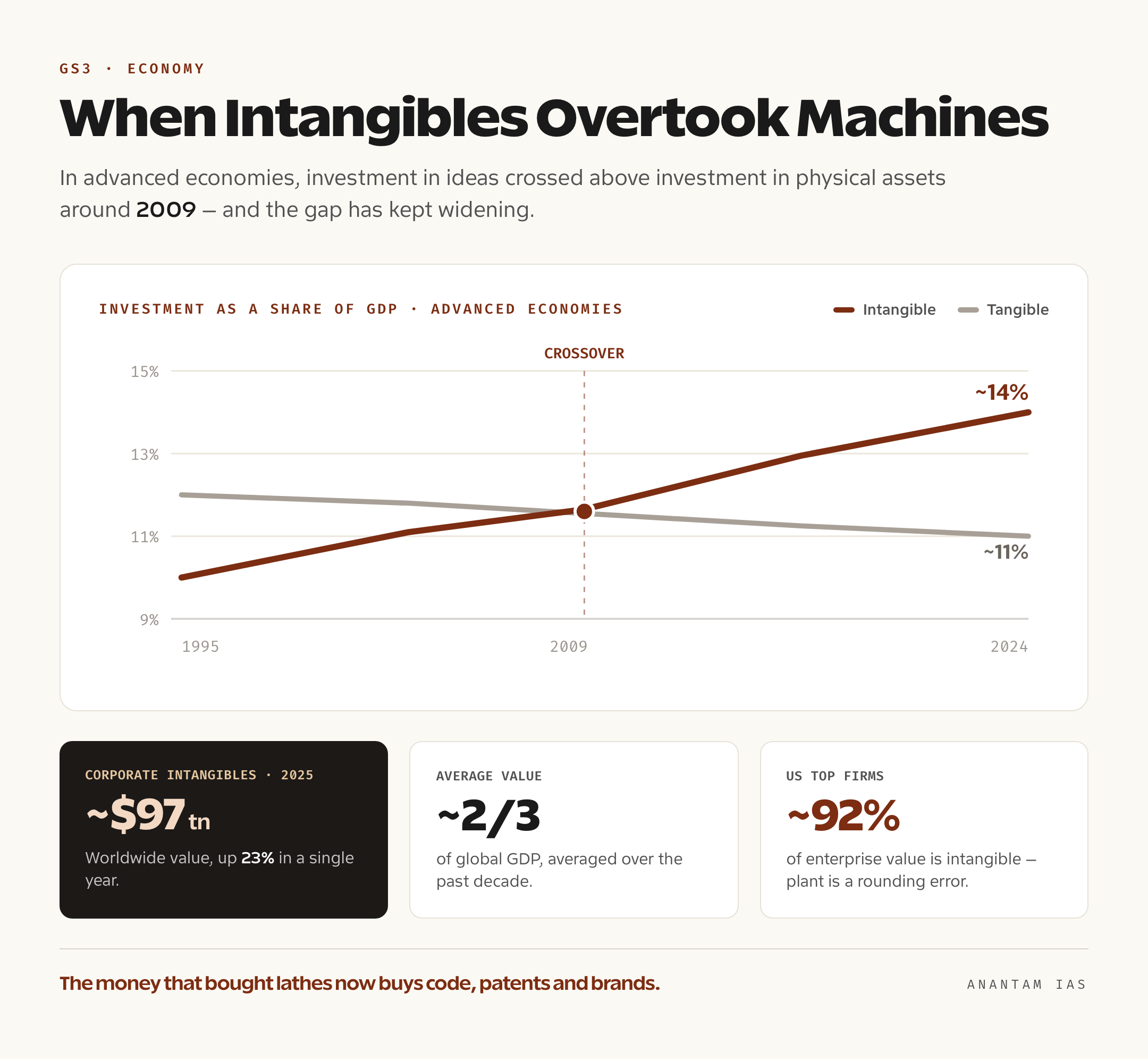
The headline fact is a crossover. For most of the twentieth century, businesses in advanced economies invested more in tangible things than intangible ones. Then, around 2009, the lines crossed. Intangible investment as a share of GDP overtook tangible investment for the first time, and the gap has widened since. By the WIPO’s 2025 estimates, across the major economies it tracks, intangible investment had climbed toward 14 per cent of GDP while tangible investment slipped to around 11 per cent. In the United States, firms now invest nearly twice as much in intangibles as in physical assets. The money that once bought lathes and conveyor belts now buys code, patents and brand campaigns. That is not a marginal trend; it is the defining structural change in how rich economies create wealth.
And the value has compounded into something staggering. The WIPO’s analysis of listed companies found that corporate intangible assets worldwide reached roughly $97 trillion in 2025, growing 23 per cent in a single year and now averaging about two-thirds of global GDP. For the top US firms, intangibles make up close to 92 per cent of total enterprise value — the physical plant is almost a rounding error. This is what Haskel and Westlake mean by “capitalism without capital”: a system whose most valuable capital is precisely the kind the old textbooks could barely see.
The Four S’s: Why Intangibles Behave Differently
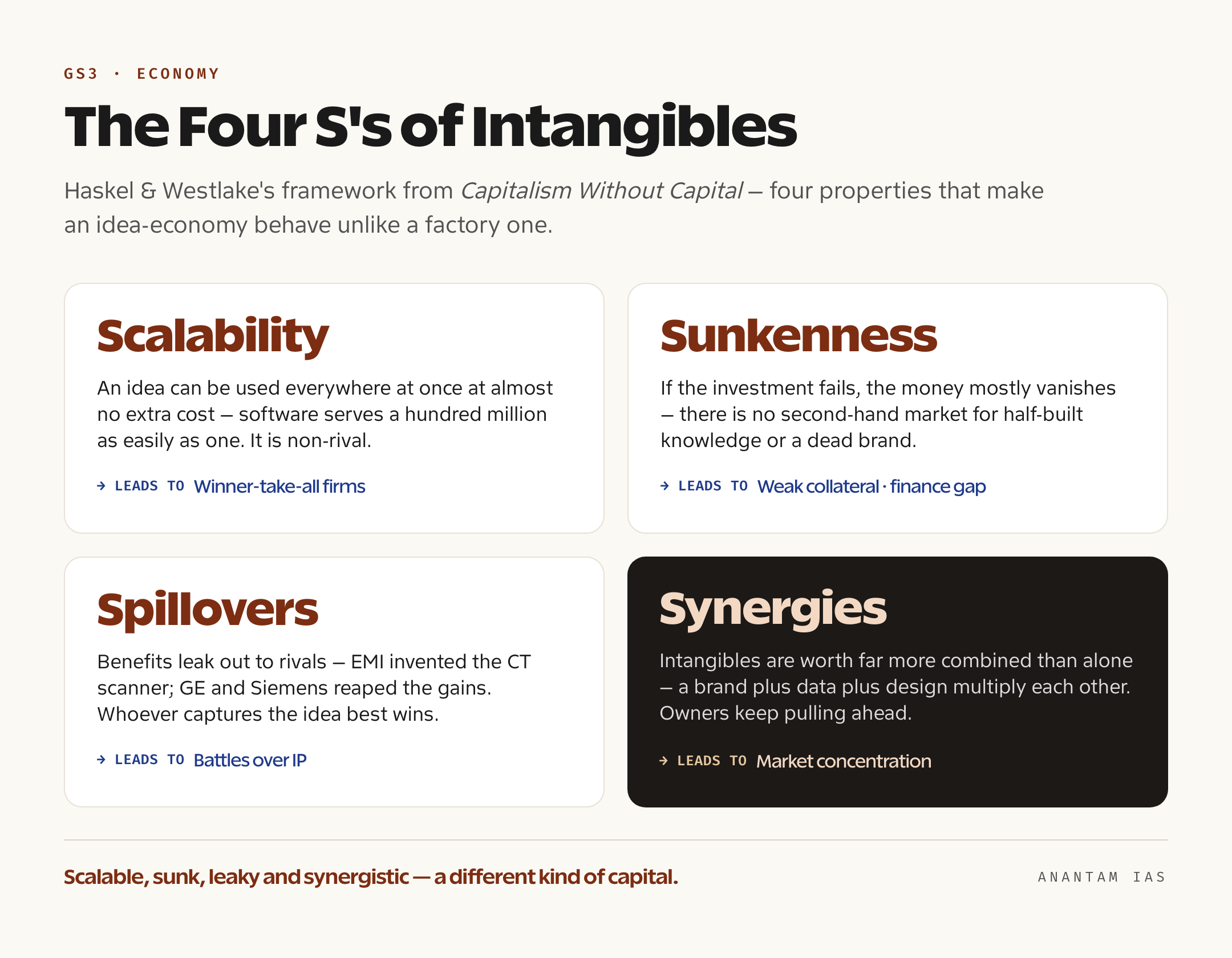
Here is the part that earns marks, because it explains why an economy built on ideas behaves so strangely. Haskel and Westlake argue that intangible assets share four economic properties that tangible assets mostly don’t, and they neatly label them the four S’s: scalability, sunkenness, spillovers and synergies. Get these four and you can predict almost every downstream consequence of the intangible economy.
Scalability comes first. A factory has a fixed capacity — to serve twice as many customers you must build a second factory. An intangible scales almost for free. The software that serves one user can serve a hundred million at trivial extra cost, because an idea, once created, can be used in many places at once without being used up. Economists call this non-rivalry. Scalability is why a single firm can come to dominate a global market — a winning piece of code or a beloved brand can be everywhere at once, with no physical limit to hold it back.
Sunkenness is the flip side. When a tangible investment goes wrong, you can usually sell the asset and recover some money — a closed factory still has machines and a building someone will buy. When an intangible investment fails, the money mostly vanishes. The classic example Haskel and Westlake cite is EMI, the British firm that invented the CT scanner: when it left the business, it could recover almost nothing of the R&D, expertise and brand it had poured in, because there was no second-hand market for half-finished knowledge. Intangible spending is hard to reverse, which makes it risky — and, as we will see, hard to borrow against.
Spillovers are the third S. The benefits of an intangible investment leak out to others. Your R&D often helps your rivals as much as you, because once an idea exists it is hard to fence in completely. Where EMI failed with the CT scanner, General Electric and Siemens picked up the underlying ideas and built thriving businesses. Spillovers mean that whoever is best at capturing the value of ideas — through patents, secrecy, speed or sheer scale — wins big, while the original inventor may not. This is why firms fight so hard over intellectual property, and why a strong patent system matters.
Synergies complete the set. Intangibles are worth far more in combination than alone. A brand is more valuable if you also own proprietary data and great design; an algorithm is more valuable paired with a vast user base. Ideas multiply each other. This is why the firms that already own a stack of intangibles can keep pulling ahead — each new idea is worth more to them than to a newcomer who owns nothing to combine it with. Synergies and scalability together are the engine of the winner-take-all economy.
The Measurement Gap and the Productivity Puzzle
Now a problem that sounds technical but reaches deep into policy. Our official statistics were designed for a tangible world, and they badly undercount intangibles. National accounts — the system that produces GDP — have slowly started to capitalise some intangibles, such as R&D and software, treating the money spent on them as investment rather than as a passing cost. But a great deal still slips through. The WIPO estimates that more than 60 per cent of intangible investment goes unrecorded as investment, because categories like branding, market research, design and organisational capital are not yet recognised under the accounting frameworks most countries use. When a firm spends a crore on a new machine, the statisticians call it investment that builds the nation’s capital stock. When it spends the same crore building a brand or training a team, much of it is written off as an expense that vanishes the moment it is spent. The economy is building enormous stocks of value that the official ruler cannot see.
This measurement gap helps untangle one of the great economic mysteries of the past two decades — the productivity puzzle. Across rich economies, measured productivity growth slowed sharply after the 2008 crisis, even as smartphones, cloud computing and artificial intelligence transformed daily life. How could the economy feel so innovative while the statistics said growth had stalled? Part of the answer is that intangible investment — the very thing driving the innovation — is partly invisible to the measurements. If you don’t count the inputs properly, the output looks like it appeared from nowhere or didn’t appear at all. The mismeasurement of intangibles doesn’t explain the whole puzzle, but most economists now agree it is a real piece of it, and a candidate who can say so precisely stands out.
There is a second, more uncomfortable strand. Even setting measurement aside, the intangible economy may genuinely widen the gap between a few superstar firms and everyone else. Because intangibles are scalable and synergistic, the leaders — the “frontier” firms — race ahead while the “laggards” fall further behind, and the productivity gap between them has widened just as intangibles have risen. The aggregate slowdown may partly reflect a small number of firms hoarding the gains of the idea economy while the rest stagnate. That is a productivity story and an inequality story at the same time.
Inequality, Finance and Winner-Take-All Markets
Follow the four S’s to their social conclusions and you arrive at the political economy of our age. Scalability plus synergies produce winner-take-all markets, where one or two firms capture an entire global category — search, social media, smartphone operating systems, e-commerce. Spillovers reward the firms best placed to capture ideas, which tend to be the giants who can patent aggressively, move fast and buy up promising rivals. The result is rising market concentration: in sector after sector, a shrinking number of firms take a growing share of profits. The intangible economy doesn’t just tolerate monopoly-like power; in some ways it manufactures it.
This reshapes inequality in ways that go beyond the firms themselves. The synergies of the idea economy reward people who can combine skills, networks and information — and those people cluster in a handful of expensive, dynamic cities. So the intangible economy tends to concentrate good jobs and high pay in superstar cities while leaving older industrial towns behind, deepening the geographic divides that now drive so much of the world’s politics. The wealth of an intangible firm flows to its founders, its star employees and its shareholders far more than to a broad workforce, because it takes fewer hands to run a software business than a steel mill.
Finance is the last piece, and it is where intangibles bite hardest for new firms. Banks like to lend against collateral — something they can seize and sell if the loan goes bad. A factory or a fleet of trucks makes good collateral. An intangible makes terrible collateral, because of sunkenness: if the firm fails, its half-built software, its brand and its research are worth almost nothing to a lender. So intangible-heavy firms — exactly the innovative startups a modern economy most wants to grow — struggle to raise bank debt and must rely on equity, venture capital and their own cash. As the OECD has documented in its work on the financing gap, this leaves promising but asset-light firms starved of capital, unable to scale, and easy for incumbents to outspend or acquire. An economy that runs on intangibles needs a financial system built for ideas, not just for bricks — and most countries are still adapting.
For India, all of this lands close to home. India is one of the most intangible-intensive of the major emerging economies — the WIPO ranks it among the top middle-income economies for the intangible intensity of its leading firms, with India’s biggest companies holding roughly three-quarters of their value in intangibles, and names like Hindustan Unilever, Titan and Bharti Airtel near the very top. Indian intangible investment has grown fast — at close to 7 per cent a year in the decade to 2022, among the quickest of any large economy. The country’s comparative advantage in IT services, software, pharmaceuticals and increasingly in design and brands is, at its core, a strength in intangibles. But India also faces the intangible economy’s hardest challenges in sharp form: a financial system still built around tangible collateral, a startup ecosystem hungry for patient equity, intellectual-property institutions that are still maturing, and the risk that a few clustered, high-skill hubs pull away from the rest of the country. Understanding intangibles is, for India, less an academic exercise than a map of where its growth and its inequalities will both come from.
For Your Mains Answer
This is a high-value concept for GS Paper 3, which covers the Indian economy, growth and development, the effects of liberalisation, science and technology, and intellectual property rights. It is a versatile tool: questions on the knowledge economy, the services-led growth model, the startup ecosystem, IP regimes, or rising inequality can all be sharpened by the intangibles lens. It also serves the Essay paper beautifully on themes of technology, change and the future of work. The skill examiners reward is the one this article models: name the framework (the four S’s), attach a couple of hard figures, and then trace the chain from a property of intangibles to a real-world consequence.
How to Build the Answer
Open by defining the shift, not by listing facts — say what intangible capital is and note the crossover around 2009 when ideas overtook machines as the main object of investment. Then deploy the four S’s as your analytical spine: scalability and synergies explain winner-take-all firms; sunkenness explains the financing gap; spillovers explain the fight over IP and the productivity-leader gap. Layer in the measurement problem to explain the productivity puzzle. Close on India — its intangible strengths in IT, pharma and brands, and the institutional reforms (IP, startup finance, skilling) it needs. That arc — define, mechanism, consequence, India — fits almost any question in this space.
Common Mistakes to Avoid
Don’t treat “intangible economy” as a vague synonym for “the internet” — it is a precise idea about a type of capital. Don’t claim GDP is simply wrong; say more carefully that national accounts undercount intangibles, capturing R&D and software but missing much of branding, design and organisational capital. Don’t present winner-take-all concentration as purely sinister — note the genuine efficiency of scalable ideas alongside the competition concerns. And don’t forget the financing angle, which is where the concept connects most directly to Indian policy and the startup debate.
A Compact Answer Spine
Intangible capital = R&D + software & data + design + brands + IP + organisational capital → in advanced economies intangible investment overtook tangible around 2009, now ~14% vs ~11% of GDP, with corporate intangibles worth ~$97 trillion globally → four S’s: Scalable (non-rival → winner-take-all), Sunk (hard to reverse → weak collateral), Spillovers (leak to rivals → IP battles), Synergies (worth more combined → concentration) → consequences: rising market concentration, superstar firms and cities, widening inequality, a financing gap for asset-light startups, and a measurement gap that helps explain the productivity puzzle → India: top-ranked among middle-income economies for intangible intensity (IT, pharma, brands), but needs IP, startup-finance and skilling reforms.
Diagram or Flowchart Idea
Draw two crossing lines on a time axis — tangible investment falling, intangible investment rising, meeting around 2009 — to capture the structural shift at a glance. Beside it, sketch a 2×2 box labelled with the four S’s, with a one-word consequence under each (Scalability → monopoly; Sunkenness → finance gap; Spillovers → IP fights; Synergies → concentration). The pair tells the whole story visually and is quick to reproduce in the answer booklet.
A Balanced-Conclusion Line
A line that lands the marks: “The intangible economy is neither a curse nor a miracle — it is a new kind of capitalism whose scalable, spillover-rich ideas can lift productivity and inequality together, and the countries that thrive will be those, like India aspires to be, that build the intellectual-property, finance and skilling institutions an idea-driven economy demands.”
How to Use Data Without Cramming
You need only four anchors, not a dataset: the 2009 crossover (ideas overtake machines), ~$97 trillion (the value of corporate intangibles worldwide in 2025), about two-thirds of global GDP (their average value), and India’s top rank among middle-income economies for intangible intensity. Attribute them plainly — “as the WIPO’s 2025 estimates show” — and let the four S’s carry the analysis.
Frequently Asked Questions
What is the intangible economy in simple terms?
It is an economy in which the most valuable kind of capital is not physical — not factories or machines — but ideas: research and development, software and data, design, brands, intellectual property and organisational know-how. In advanced economies, businesses now invest more in these intangible assets than in tangible ones, a crossover that happened around 2009. Jonathan Haskel and Stian Westlake popularised the term in their 2017 book Capitalism Without Capital.
What are the four S’s of intangible assets?
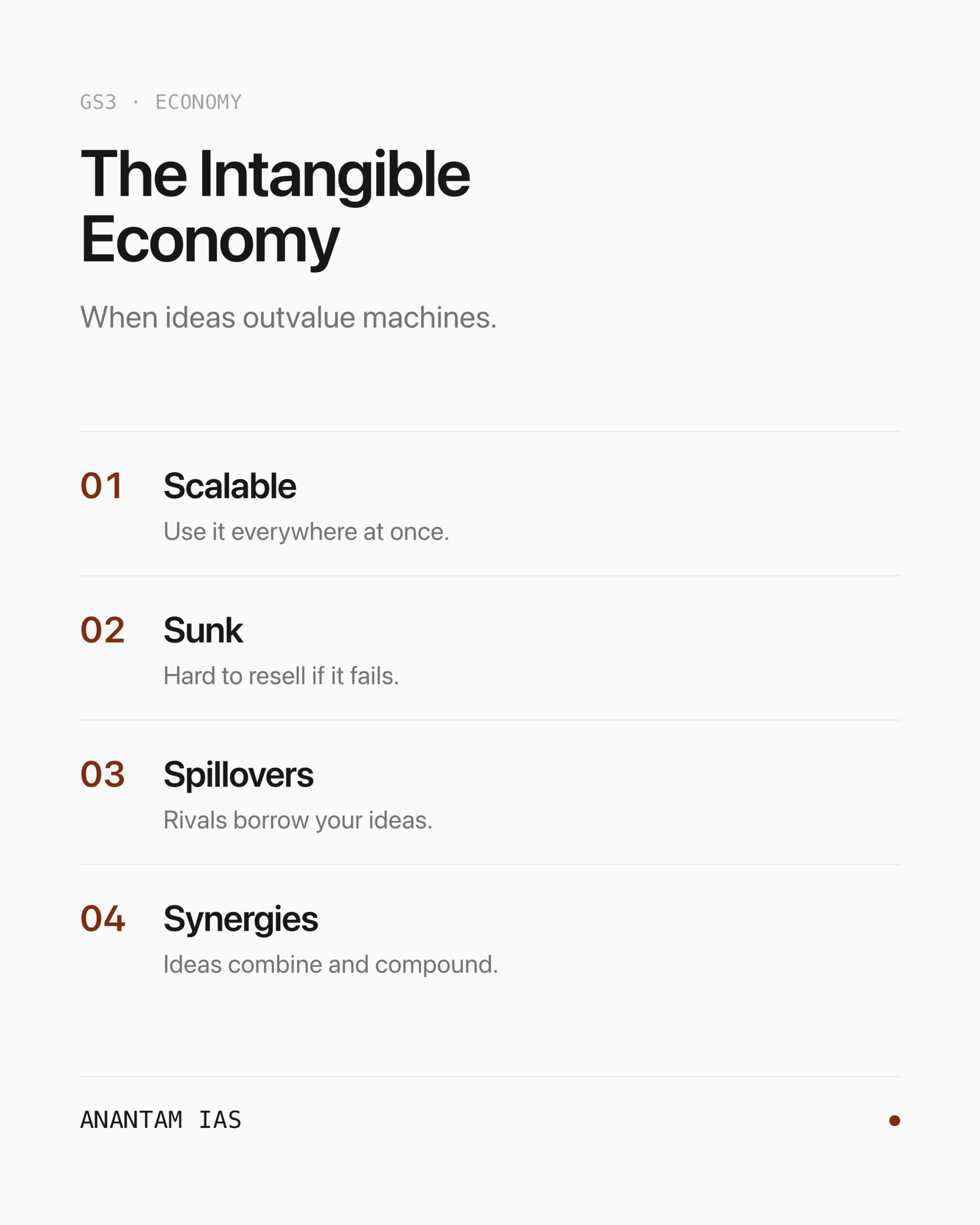
They are the four economic properties that make intangibles behave unlike physical assets. Scalability: an idea can be used everywhere at once at almost no extra cost. Sunkenness: if the investment fails, the money is hard to recover. Spillovers: the benefits leak out to rivals. Synergies: intangibles are worth far more in combination than alone. Together they explain winner-take-all firms, the startup financing gap, fights over intellectual property and rising market concentration.
Why does the intangible economy worsen inequality?
Because scalable, synergistic ideas let a few “superstar” firms and individuals capture a huge share of the gains, while the people best placed to combine skills and networks cluster in a handful of expensive cities. The wealth of an idea-driven firm flows to founders, star employees and shareholders more than to a broad workforce, and good jobs concentrate geographically — widening both the gap between firms and the gap between regions.
How does the intangible economy matter for India?
India is among the most intangible-intensive emerging economies: its leading firms hold roughly three-quarters of their value in intangibles, and its strengths in IT services, software, pharmaceuticals and brands are intangible strengths. Indian intangible investment has grown among the fastest of any large economy. But India must also fix the intangible economy’s hard problems — a financial system built around physical collateral, a need for patient startup equity, maturing IP institutions and the risk of a few hubs pulling away from the rest.
Practice Questions
Prelims MCQs
- The term “intangible economy”, popularised by the book Capitalism Without Capital, refers primarily to which of the following?
(a) An economy based mainly on subsistence agriculture
(b) An economy in which investment in non-physical assets such as R&D, software, design and brands dominates
(c) An economy that has abolished private property
(d) An economy with no foreign trade
Answer: (b) The intangible economy is one where intangible assets — ideas, software, design, brands, IP and organisational capital — are the main object of investment and source of value. - With reference to the “four S’s” of intangible assets, which set correctly lists them?
(a) Scale, Stability, Security, Surplus
(b) Scalability, Sunkenness, Spillovers, Synergies
(c) Savings, Subsidy, Supply, Surplus
(d) Scarcity, Sunkenness, Speculation, Synergy
Answer: (b) Jonathan Haskel and Stian Westlake identify scalability, sunkenness, spillovers and synergies as the defining properties of intangible assets. - Which property of intangible assets is the main reason intangible-heavy firms find it hard to raise bank loans?
(a) Scalability
(b) Synergies
(c) Sunkenness
(d) Spillovers
Answer: (c) Sunkenness means a failed intangible investment recovers little value, making it poor collateral, so banks are reluctant to lend against it. - The “measurement gap” associated with the intangible economy refers to which problem?
(a) National accounts undercount intangible investment because categories like branding and design are often not treated as investment
(b) Firms deliberately hide their profits abroad
(c) Census data on population is outdated
(d) Banks cannot measure interest rates accurately
Answer: (a) A large share of intangible investment is not recorded as investment in national accounts, which helps explain part of the productivity puzzle. - According to recent WIPO assessments of intangible intensity, India ranks among the top economies in which category?
(a) Low-income economies
(b) High-income economies, ahead of the United States
(c) Middle-income economies, with leading firms holding most of their value in intangibles
(d) Economies with the lowest share of intangibles
Answer: (c) India ranks near the top of middle-income economies for the intangible intensity of its leading firms, which hold roughly three-quarters of their value in intangibles.
Mains Practice Questions
- “The most valuable capital in a modern economy is the kind you cannot touch.” Explain the concept of the intangible economy and discuss why intangible investment has overtaken tangible investment in advanced economies. (15 marks, 250 words)
- Discuss the “four S’s” of intangible assets and analyse how each shapes competition, inequality and the financing of firms. (15 marks, 250 words)
- The rise of intangibles is often linked to both the productivity puzzle and rising market concentration. Critically examine this relationship. (15 marks, 250 words)
- “Intangible-intensive startups are exactly the firms a modern economy most wants to grow, yet they are the hardest to finance.” Examine the financing challenges of the intangible economy and suggest policy responses for India. (10 marks, 150 words)
- Assess India’s position in the global intangible economy. What institutional reforms would help India convert its strengths in IT, pharmaceuticals and brands into durable, broad-based growth? (15 marks, 250 words)
Tell Google you want more of this.
Add Anantam IAS as a preferred sourceOne tap, and this site shows up more often in your own Top Stories, AI Overviews and AI Mode. Remove it any time.