For most of the history of war, the decision to take a human life has rested with a human being. A soldier aims, judges, and chooses to fire — or not to. A weapon that breaks that link, that can search for a target, decide it is an enemy, and kill it with no person in the loop, is no longer just a tool. It is something closer to a decision-maker. That is the unsettling idea at the centre of the global argument over lethal autonomous weapons systems, the machines that campaigners have nicknamed “killer robots.” The technology to build them is no longer science fiction; cheap drones, fast image-recognition and machine learning have brought the prospect within reach, and the world’s diplomats have spent more than a decade trying, and largely failing, to agree on what to do about it.
The stakes are not narrowly military. They reach into ethics, into the laws of war, into questions about human dignity and accountability that predate any computer. And the clock is loud: the UN Secretary-General and the International Committee of the Red Cross have jointly called on states to conclude a legally binding instrument by 2026, the year the issue comes to a head at a major review conference in Geneva. For a UPSC aspirant, this is one of the richest crossover topics on the syllabus — it sits where science and technology meet international relations, ethics and disarmament, and it rewards anyone who can hold the moral, legal and strategic threads together at once.
What Counts as a “Lethal Autonomous Weapon”
Start with a careful definition, because the whole debate turns on it. A lethal autonomous weapon system, or LAWS, is broadly understood as a weapon that, once activated, can select and engage targets — that is, identify, track and attack them — without further intervention by a human operator. The key phrase is “without meaningful human control.” A landmine is automated but dumb; it goes off when stepped on. A guided missile follows a human’s chosen target. An autonomous weapon is different in kind: it uses sensors and software, increasingly artificial intelligence, to make the find-fix-finish decision itself. That is the line the international community has struggled to draw, and the lack of an agreed definition is itself one of the great obstacles to regulation, because states cannot easily ban or limit a thing they have not jointly defined.
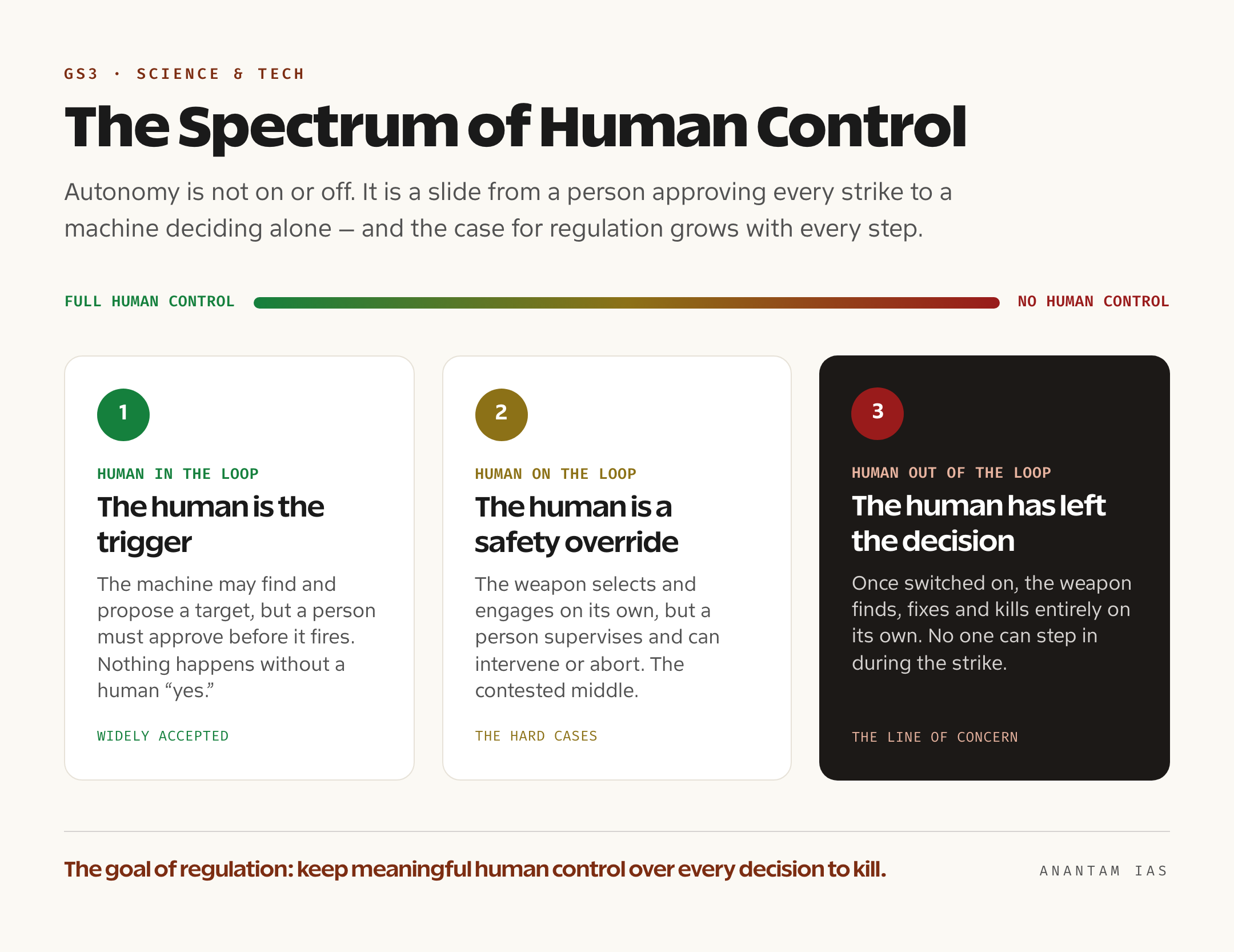
It helps to think of autonomy as a spectrum of human control rather than an on-off switch, usually described in three settings. In a human-in-the-loop system, the machine may find and propose a target, but a person must approve before it fires — the human is the trigger. In a human-on-the-loop system, the weapon can select and engage on its own, but a human supervises and can intervene or abort — the human is a safety override. In a human-out-of-the-loop system, the weapon operates entirely on its own once switched on, with no person able to step in during the engagement — the human has left the decision behind. Almost everyone is comfortable with the first setting and deeply worried about the third. The hard cases, and the diplomacy, live in the contested middle, where “supervision” can be so fast or so distant that it becomes a fiction.
The point campaigners and the ICRC press is that the danger is not robots becoming conscious or going rogue, the Hollywood image. It is far more mundane and more real: ordinary software, working exactly as designed, applying lethal force based on a sensor profile, in conditions its designers could not fully anticipate, with no human making the final moral judgment. That is why the debate is framed not around banning artificial intelligence but around preserving meaningful human control over the use of force — keeping a person genuinely responsible for each decision to kill.
The Ethical and Legal Case Against Killer Robots
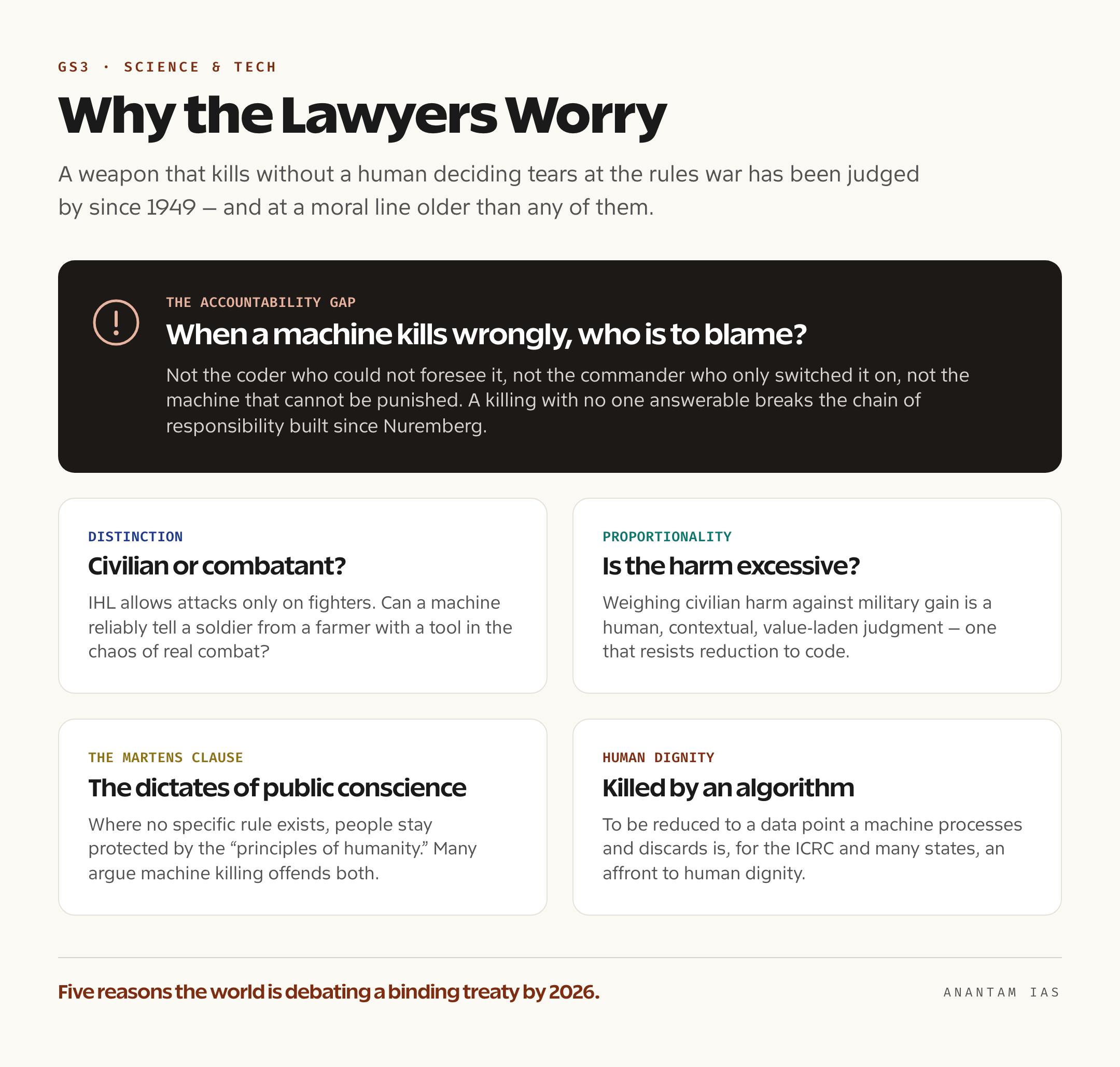
Now the heart of the argument, which is more legal and moral than technical. The first and most discussed problem is the accountability gap. International law assumes that when something goes wrong in war — a massacre, an unlawful strike — a human can be held responsible. But who is to blame when an autonomous weapon kills the wrong people? The programmer who wrote code months earlier and could not foresee the situation? The commander who switched it on but did not choose the victims? The manufacturer? The machine itself, which cannot be punished? Because many AI systems make decisions through opaque, “black box” processes that even their designers cannot fully explain, holding any individual criminally liable becomes very hard. A weapon that can kill but leaves no one answerable for the killing tears a hole in the entire system of legal responsibility built up since Nuremberg.
The second problem is compliance with international humanitarian law, the body of rules — rooted in the 1949 Geneva Conventions and their 1977 Additional Protocol I — that governs how wars may be fought. Two rules matter most. Distinction requires combatants to tell fighters apart from civilians and to attack only the former; critics doubt that a machine can reliably make that judgment in the chaos of real combat, where a farmer with a tool can look like a soldier with a weapon. Proportionality requires that the expected civilian harm of an attack not be excessive against the military advantage gained — an inherently human, contextual, value-laden weighing that resists reduction to code. If a weapon cannot apply these rules, deploying it may itself be unlawful. To this lawyers add the Martens Clause, a venerable provision appearing in the Geneva Conventions and the preamble of the very treaty now used to discuss these weapons, which says that where no specific rule exists, civilians and combatants remain protected by the “principles of humanity” and the “dictates of public conscience.” Many argue that handing life-and-death decisions to a machine offends both.
Beneath the law sits a plainer moral objection: human dignity. The ICRC and many states contend that being killed by an algorithm — reduced to a data point a machine processes and discards — is an affront to human dignity in a way that being killed by a human, terrible as that is, is not. The Secretary-General has called such weapons “politically unacceptable and morally repugnant,” and the campaign’s rallying idea is simple: machines making life-and-death decisions over people crosses a moral line humanity should not cross. This is exactly the kind of ethical reasoning UPSC’s GS Paper 4 rewards, and it connects directly to debates over AI governance in India and the limits we set on automated decision-making.
The Strategic Worry: An Arms Race and a Lower Threshold for War
Even a reader unmoved by the ethics should worry about the strategy, because autonomous weapons threaten to make war more likely and harder to control. The first fear is an arms race. Autonomous weapons promise speed, reach and a way to project force without risking your own soldiers’ lives — advantages no major military wants to concede to a rival. So the very prospect that an adversary might build them becomes a reason to build them first, a classic security dilemma that pulls states into competition no one quite chose. Analysts increasingly speak of an AI arms race, in which the pressure to deploy fast outruns the caution that careful testing and human oversight would demand.
The second fear is a lower threshold for war. If a state can strike without putting its own people in harm’s way, the political cost of using force falls, and leaders may reach for it more readily — the restraint that flag-draped coffins once imposed weakens. The third, and most futuristic, is the risk to strategic stability from machine speed. Weapons that act faster than human cognition remove the human as a fail-safe against escalation; two opposing autonomous systems, each reacting to the other in milliseconds, could spiral into a “flash war” before any general could pick up a phone, much as algorithmic trading once triggered stock-market flash crashes. And because the underlying software and drones are comparatively cheap, there is a real proliferation worry: these capabilities could spread not just to many states but to non-state actors and terrorists, for whom an attack that needs no suicide volunteer is grimly attractive. The ICRC’s warning is that autonomy in weapons adds up to an accumulation of risk that the world has every reason to step back from. The drone dimension of this is explored further in our guide to drone technology and its military uses.
It is worth being fair to the other side, because examiners reward balance. Proponents argue that autonomy, used well, could make war more humane, not less — a machine does not panic, seek revenge, rape, or commit atrocities out of fear or hatred; it could in principle apply the rules of war more consistently than a frightened, exhausted soldier. Greater precision, some say, might mean fewer civilian casualties, not more. These claims are contested and unproven, but a strong answer acknowledges them before explaining why the risks have, so far, dominated the international conversation.
The Governance Effort: A Decade of Talks and a 2026 Deadline
So what is the world actually doing? The main forum has been the Convention on Certain Conventional Weapons (CCW), a 1980 UN treaty in Geneva that already restricts weapons judged excessively injurious or indiscriminate, such as blinding lasers and certain landmines. Since 2014, states party to the CCW have discussed LAWS, and from 2016 a Group of Governmental Experts (GGE) has met to study them. Its one concrete achievement came in 2019, when states agreed on eleven guiding principles — among them that international humanitarian law applies fully to such weapons, and that human responsibility and accountability must be retained across a weapon’s entire life cycle. India, which chaired the group in 2017, helped shepherd those principles through.
But the GGE works by consensus, meaning any single state can block progress, and that is exactly what has happened. The group has been gridlocked for years over the two hardest questions — how to define LAWS, and how to guarantee human control — with a handful of major military powers reluctant to accept binding limits on a technology they are investing in. Frustrated by the deadlock, supporters of regulation moved the argument to a forum where no one holds a veto: the UN General Assembly. A first resolution in 2023 drew overwhelming support and asked the Secretary-General to gather views; follow-up resolutions in 2024 and a further one in late 2025 — the latter backed by around 156 to 164 states — have built a clear majority calling to start negotiating an actual treaty. In parallel, the Secretary-General and the ICRC issued their joint 2023 appeal urging states to conclude a legally binding instrument by 2026, a deadline now tied to the CCW’s Seventh Review Conference that year.
Pushing all of this from outside government is the “Stop Killer Robots” campaign, a coalition of more than a hundred and fifty non-governmental organisations launched in 2013 and coordinated by groups including Human Rights Watch. It has done for autonomous weapons roughly what earlier coalitions did for landmines and cluster munitions — kept the moral case in the headlines, briefed diplomats, and pressed for a treaty with two tiers: an outright prohibition on weapons that operate without meaningful human control or that target people, and regulation ensuring meaningful human control over all the rest. Whether 2026 actually produces a binding instrument is genuinely uncertain — the consensus rule and great-power resistance make a near-term treaty an uphill climb — but the direction of travel, toward some form of international rule, is now unmistakable.
Where India Stands
India is not a bystander here; it is a heavyweight in these talks, and its position is more subtle than a simple yes or no. As one of the world’s larger militaries and a rising technology power, India approaches LAWS with a careful balance between humanitarian concern and what it calls its legitimate defence and security interests. Its central procedural conviction is that the CCW and its consensus-based GGE are the right venue — a forum, in India’s view, that strikes the proper balance between military necessity and humanitarian imperatives, and one where decisions are not imposed by a voting majority. And so India has been cautious about the rush toward a binding treaty negotiated outside that framework, arguing such moves can be premature when the world has not yet jointly defined or fully understood the technology.
On substance, India’s stated line is firm on the law and open on the technology. It insists that any military use of these systems must comply fully with international humanitarian law, and it has supported the principle of retaining human responsibility. At the same time, India argues that the existing rules of armed conflict are largely technology-neutral and already provide a framework, and it cautions against “stigmatising” the underlying technology, noting that autonomy in some functions can improve precision and reduce human error. A recurring and distinctively Indian emphasis is that any new rules must not widen the technology gap between developed and developing countries — that regulation should not become a way for those already ahead to freeze others out of beneficial civilian and defence applications of AI and robotics. India also wants reassurance that any instrument would not curb peaceful uses or its own security preparedness. Reflecting this nuance, India voted in favour of the recent UN General Assembly resolutions keeping the issue alive while still championing the Geneva process — a posture that mirrors its broader approach to emerging military technology, examined in our explainer on AI in defence.
For Your Mains Answer
This topic is a natural fit for GS Paper 3 (science and technology developments, and internal/external security), and it overlaps powerfully with GS Paper 2 (international institutions, treaties and India’s foreign policy) and GS Paper 4 (ethics — applied to technology, human dignity and accountability). A question on emerging military technologies, on the governance of AI, on disarmament, or on the ethical limits of automation can all draw on this material. It is also strong Essay fodder on themes like “technology outpacing morality” or “should machines decide who lives and dies.” The skill examiners reward is integration: weaving the ethical, legal and strategic strands into one coherent argument rather than listing them separately.
How to Build the Answer
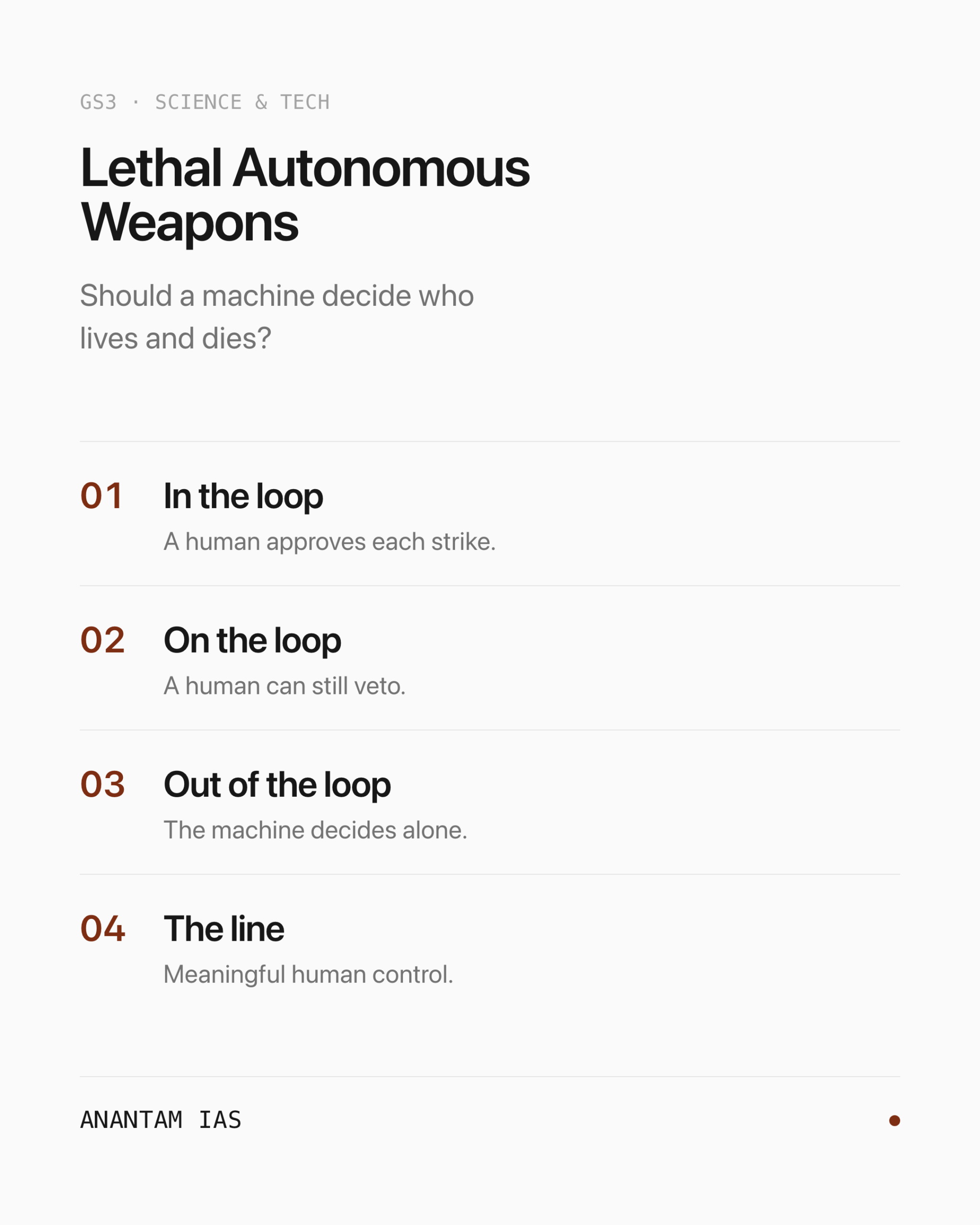
Move in a clear chain. Define LAWS and the idea of meaningful human control; lay out the spectrum (in-the-loop, on-the-loop, out-of-the-loop). Then give the three-part case against — accountability gap, clash with IHL (distinction, proportionality, the Martens Clause), and human dignity. Add the strategic worries — arms race, lower threshold for war, flash-war instability, proliferation — and, for balance, the proponents’ precision argument. Map the governance landscape — CCW and GGE gridlock, the UNGA resolutions, the Secretary-General-ICRC 2026 call, the Stop Killer Robots campaign. Close with India’s nuanced stance and a forward-looking line. That arc — define, object, contextualise, govern, locate India, evaluate — fits almost any framing of the question.
Common Mistakes to Avoid
Don’t describe killer robots as conscious or rogue machines — the real concern is ordinary software applying lethal force without human judgment. Don’t claim there is already a treaty; there isn’t, only guiding principles and a contested push for one. Don’t paint India as simply pro- or anti-ban — capture its “right venue, technology-neutral rules, don’t widen the tech gap” position. And don’t forget the proponents’ counter-argument; a one-sided answer reads weaker than a balanced one.
A Compact Answer Spine
LAWS = weapons that select and engage targets without meaningful human control → spectrum: in-the-loop / on-the-loop / out-of-the-loop → case against: accountability gap + IHL strain (distinction, proportionality, Martens Clause) + human dignity → strategic risks: arms race, lower war threshold, flash-war instability, cheap proliferation → balance: proponents’ precision/consistency claim → governance: CCW GGE (11 principles, 2019) stuck on consensus → UNGA resolutions (2023 onward, 150+ states) + SG-ICRC call for a binding instrument by 2026 + Stop Killer Robots campaign → India: backs CCW/GGE, insists on IHL compliance and human responsibility, technology-neutral rules, no widening of the tech gap → verdict: meaningful human control as the non-negotiable principle.
Diagram or Flowchart Idea
Sketch the spectrum of control as a simple left-to-right bar — in-the-loop, on-the-loop, out-of-the-loop — with an arrow showing “meaningful human control decreasing, concern increasing.” Beside it, a small cluster of four labelled boxes for the core objections (accountability, distinction, proportionality, dignity). This pairing — how much human control, and why losing it matters — captures the whole debate at a glance.
A Balanced-Conclusion Line
A line that lands the marks: “The question is not whether machines can fight, but whether they should decide who dies — and the emerging global consensus, which India shares in principle, is that a meaningful human hand must remain on every decision to take a life, even as states still argue over how to write that conviction into binding law.”
How to Use Data Without Cramming
You need only a few anchors: the three control settings; the 2019 eleven guiding principles; the roughly 150-plus states backing UNGA resolutions; and the Secretary-General-ICRC call for a binding instrument by 2026. Attribute them plainly — “as the ICRC and UN Secretary-General have jointly urged” — rather than scattering figures loose.
Frequently Asked Questions
What exactly are lethal autonomous weapons, or “killer robots”?
They are weapons systems that, once switched on, can select and attack targets on their own — finding, tracking and killing — without a human making the final decision to fire. The defining feature is the absence of “meaningful human control” over the use of force. They are not conscious or rogue machines; the worry is ordinary software, often AI-driven, applying lethal force based on a sensor profile in situations its designers could not fully foresee.
Why do critics say these weapons are illegal or unethical?
For three linked reasons. They create an accountability gap — if a machine kills wrongly, it is unclear who can be held responsible. They strain international humanitarian law, because a machine may not reliably apply the rules of distinction (telling civilians from combatants) and proportionality (weighing civilian harm against military gain), and may offend the Martens Clause’s “dictates of public conscience.” And they affront human dignity by reducing the decision to kill a person to an algorithm’s calculation.
Is there a treaty banning autonomous weapons?
Not yet. States have discussed them since 2014 under the Convention on Certain Conventional Weapons and agreed eleven non-binding guiding principles in 2019, but the expert group works by consensus and has been gridlocked. The UN Secretary-General and the ICRC have called for a legally binding instrument by 2026, and successive UN General Assembly resolutions backed by 150-plus states support negotiating one — but a binding treaty does not yet exist.
What is India’s position on killer robots?
India favours handling the issue through the CCW’s consensus-based expert group, which it sees as the right venue for balancing humanitarian concerns with legitimate security interests. It insists any use must comply with international humanitarian law and that human responsibility be retained, but argues existing rules are largely technology-neutral, cautions against stigmatising the technology, and stresses that new rules must not widen the technology gap between developed and developing nations.
Practice Questions
Prelims MCQs
- Lethal autonomous weapons systems (LAWS) are best defined as weapons that:
(a) are remotely piloted by human operators at all times
(b) can select and engage targets without meaningful human control
(c) use only non-lethal force to incapacitate targets
(d) are powered exclusively by nuclear energy
Answer: (b) The defining feature of LAWS is the ability to find, track and attack targets without a human making the final decision to use force. - In the spectrum of human control over weapons, a “human-on-the-loop” system is one where:
(a) a human must approve each target before the weapon fires
(b) the weapon selects and engages on its own while a human supervises and can override
(c) no human can intervene once the weapon is activated
(d) the weapon cannot operate without continuous manual piloting
Answer: (b) On-the-loop means the machine acts autonomously but a human supervises and retains the ability to intervene or abort. - The “Martens Clause,” relevant to the debate on autonomous weapons, is associated with which body of law?
(a) International trade law
(b) International humanitarian law
(c) International space law
(d) International maritime law
Answer: (b) The Martens Clause appears in the Geneva Conventions and the CCW preamble, holding that the principles of humanity and the dictates of public conscience continue to protect people where no specific rule exists. - Discussions on regulating lethal autonomous weapons have primarily taken place under which framework?
(a) The Nuclear Non-Proliferation Treaty
(b) The Convention on Certain Conventional Weapons (CCW)
(c) The Chemical Weapons Convention
(d) The Outer Space Treaty
Answer: (b) Since 2014, states have discussed LAWS under the 1980 CCW in Geneva, through a Group of Governmental Experts that agreed eleven guiding principles in 2019. - Which of the following best describes India’s stated position on LAWS?
(a) India demands an immediate, unconditional ban negotiated outside the UN
(b) India opposes any application of international humanitarian law to such weapons
(c) India favours the CCW consensus process, insists on IHL compliance and human responsibility, and warns against widening the technology gap
(d) India has refused to participate in any international discussions on the issue
Answer: (c) India backs the CCW/GGE route, insists on IHL compliance and retained human responsibility, and stresses that new rules must not widen the technology gap between developed and developing countries.
Mains Practice Questions
- “Machines making life-and-death decisions over human beings crosses a moral line.” Critically examine the ethical and legal objections to lethal autonomous weapons systems. (15 marks, 250 words)
- Discuss how lethal autonomous weapons challenge the core principles of international humanitarian law, particularly distinction, proportionality and the Martens Clause. (15 marks, 250 words)
- Examine the strategic risks — an arms race, a lowered threshold for the use of force, and threats to strategic stability — posed by the development of autonomous weapons. (15 marks, 250 words)
- The global effort to regulate killer robots has progressed from the CCW’s expert group to the UN General Assembly. Analyse why consensus-based disarmament forums struggle to govern emerging technologies. (10 marks, 150 words)
- Critically evaluate India’s position on lethal autonomous weapons systems, balancing its humanitarian commitments against its defence, security and technology interests. (15 marks, 250 words)
Tell Google you want more of this.
Add Anantam IAS as a preferred sourceOne tap, and this site shows up more often in your own Top Stories, AI Overviews and AI Mode. Remove it any time.