


The Negotiable Instruments Act, 1881 (NI Act) is a colonial-era statute that remains the foundational legal framework governing promissory notes, bills of exchange, and cheques in India. It defines what constitutes a negotiable instrument, establishes rules for their transfer, and prescribes both civil and criminal liability for dishonour — most famously under Section 138. Though enacted over 140 years ago, the Act continues to evolve through amendments to keep pace with digital payments, electronic cheques, and the fight against wilful defaulters. The NI Act is relevant for UPSC Prelims, GS Paper II (Polity/Governance), and GS Paper III (Indian Economy — Banking).
What is a Negotiable Instrument?
A negotiable instrument is a written document that promises or orders the payment of a specific sum of money, and whose ownership can be transferred from one person to another by delivery or endorsement. The defining feature is negotiability — the transferee acquires better title than the transferor in some circumstances.
Key features:
- In writing and signed by the maker/drawer.
- Contains an unconditional promise or order to pay.
- Pays a certain sum of money.
- Payable on demand or at a fixed/determinable future time.
- Payable to a specified person or bearer.
- Freely transferable by endorsement or delivery.
Types of Negotiable Instruments Under the NI Act
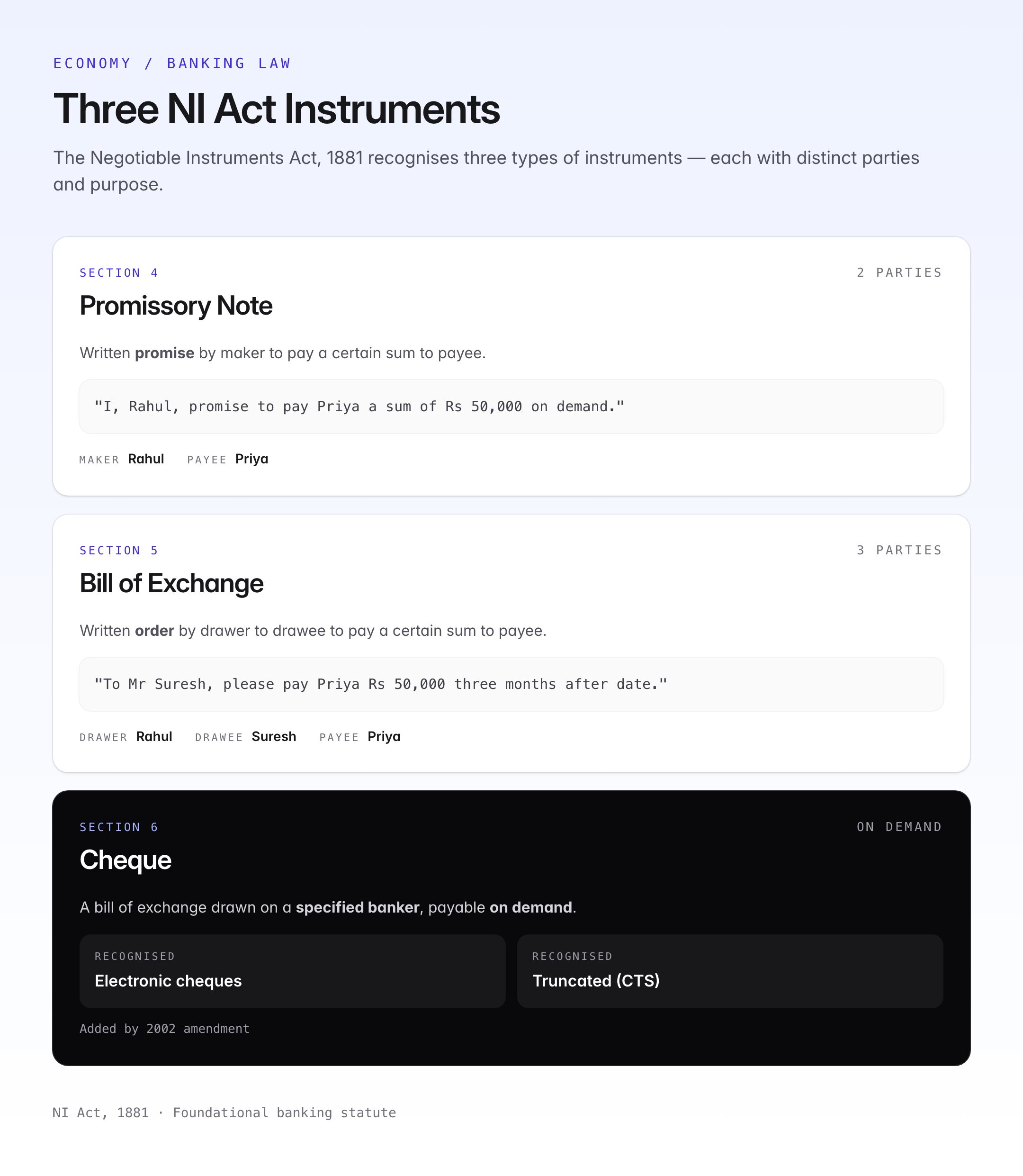
The Act recognises three types of negotiable instruments:
| Instrument | Defined in | Key Features |
|---|---|---|
| Promissory Note | Section 4 | Written promise by maker to pay a certain sum to payee; two parties |
| Bill of Exchange | Section 5 | Written order by drawer to drawee to pay a certain sum to payee; three parties |
| Cheque | Section 6 | Bill of exchange drawn on a specified banker, payable on demand; includes electronic cheques and truncated cheques (added by 2002 amendment) |
Promissory Note — Example
"I, Rahul, promise to pay Priya a sum of Rs 50,000 on demand. [Signed, Rahul]"
- Maker: Rahul
- Payee: Priya
Bill of Exchange — Example
"To Mr Suresh, please pay Priya Rs 50,000 three months after date. [Signed, Rahul]"
- Drawer: Rahul
- Drawee: Suresh
- Payee: Priya
Cheque
- A cheque is essentially a bill of exchange with the bank as drawee.
- Must be payable on demand (unlike other bills that may be time-bound).
Parties to a Negotiable Instrument
| Party | Role |
|---|---|
| Drawer / Maker | Person who creates the instrument |
| Drawee | Person on whom the instrument is drawn (banker in case of cheque) |
| Payee | Person to whom payment is to be made |
| Endorser | Transfers the instrument by signing on the back |
| Endorsee | Person to whom instrument is transferred |
| Holder | Person entitled in own name to possession and payment |
| Holder in Due Course | Holder who acquired the instrument for consideration, before maturity, and in good faith |
The Holder in Due Course (HDC) is a crucial concept — the HDC acquires the instrument free from any defects of title of previous holders.
Section 138 — Dishonour of Cheque
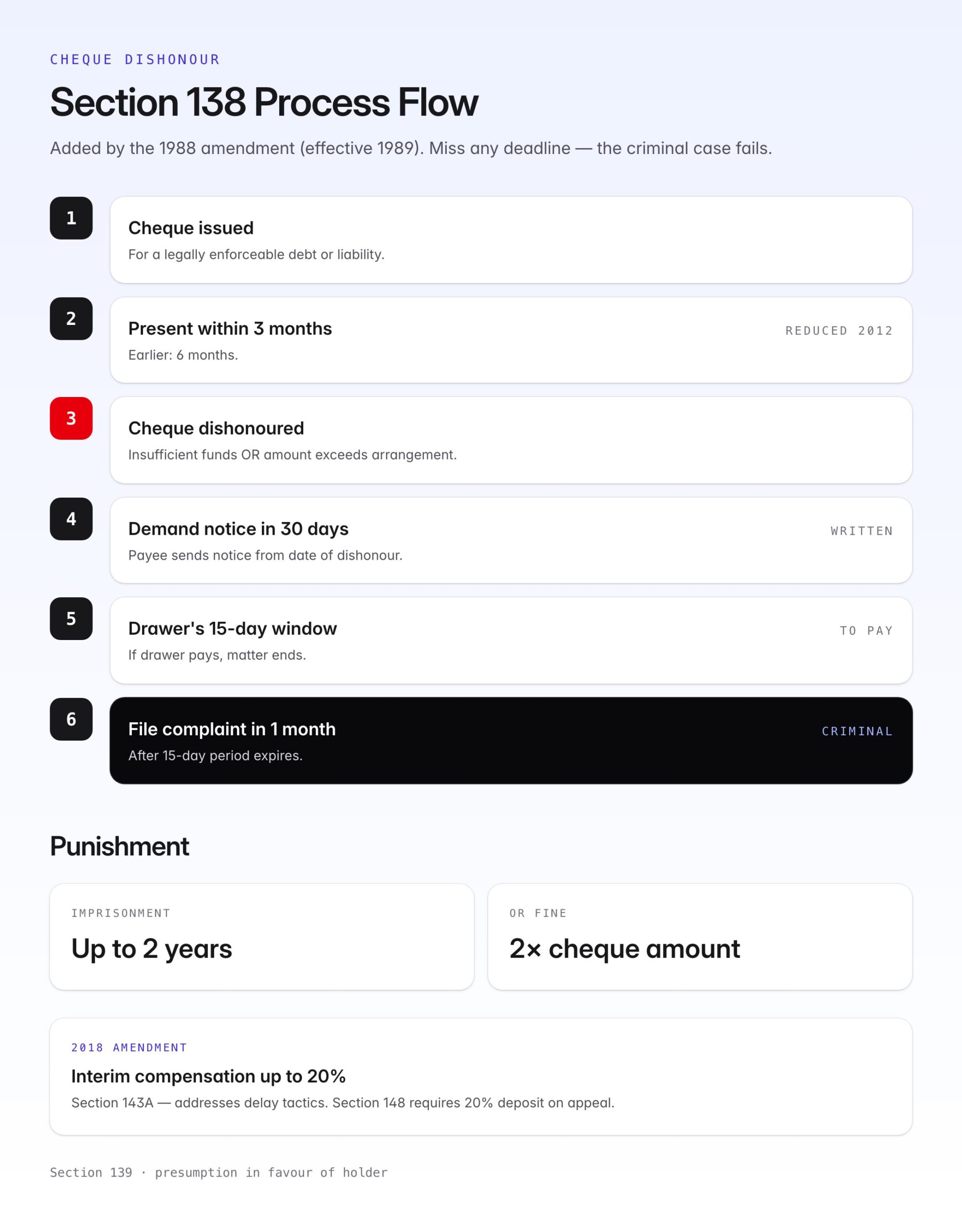
Section 138 was inserted by the Banking, Public Financial Institutions and Negotiable Instruments Laws (Amendment) Act, 1988, effective from 1 April 1989, to criminalise cheque dishonour.
Essential Ingredients of Section 138
For a cheque bounce case to succeed, all the following must be satisfied:
- A cheque must be drawn on an account maintained by the drawer.
- The cheque must be issued for the discharge of a legally enforceable debt or liability.
- The cheque must be dishonoured by the bank due to:
- Insufficient funds, OR
- The amount exceeds the arrangement with the bank.
- The payee must present the cheque within 3 months (reduced from 6 months effective 1 April 2012).
- The payee must send a demand notice in writing within 30 days of dishonour.
- The drawer must fail to pay within 15 days of receiving the demand notice.
- Complaint must be filed within 1 month of the expiry of the 15-day period.
Punishment under Section 138
- Imprisonment up to 2 years, OR
- Fine up to twice the cheque amount, OR
- Both.
Key Related Sections
| Section | Provision |
|---|---|
| Section 139 | Presumption in favour of the holder — the cheque is presumed to have been issued for discharge of debt unless the contrary is proved |
| Section 141 | Offences by companies — every person in charge of the company's business is deemed guilty |
| Section 142 | Cognizance of offences — complaint must be in writing |
| Section 143 | Summary trial procedure — to expedite disposal |
| Section 143A | Interim compensation up to 20% of cheque amount (added in 2018) |
| Section 148 | Appellate court may require deposit of at least 20% of award (added in 2018) |
Recent Amendments
| Year | Amendment | Change |
|---|---|---|
| 2002 | Recognised electronic cheques and truncated cheques; expedited trial provisions | |
| 2012 | Reduced presentation period for cheques from 6 months to 3 months | |
| 2015 | Territorial jurisdiction clarified — case filed where payee's bank is located | |
| 2018 | Added Section 143A (interim compensation) and Section 148 (deposit on appeal); strengthened enforcement |
The 2018 amendment was particularly significant — it addressed the issue of drawers delaying cases to avoid payment by requiring interim compensation.
Landmark Supreme Court Judgments
| Case | Ruling |
|---|---|
| Dalmia Cement v. Galaxy Traders (2001) | Section 138 has both civil and criminal nature |
| Meters and Instruments v. Kanchan Mehta (2017) | Encouraged compounding of offences at any stage |
| Makwana Mangaldas Tulsidas v. State of Gujarat (2020) | Directed courts to dispose of cheque bounce cases within 6 months |
| P. Mohanraj v. Shah Brothers Ispat (2021) | Clarified that moratorium under IBC does not bar Section 138 proceedings against the individual signatory (though it protects the company) |
Cheque Bounce Cases — Scale of the Problem
As per data cited by the Supreme Court and the Ministry of Law & Justice:
- Over 35 lakh cheque bounce cases are pending in Indian courts.
- They form ~10% of all criminal cases in the country.
- This backlog led to the 2018 amendments and suggestions for special courts.
The NI Act in the Digital Payments Era
With the rise of UPI, NEFT, RTGS, IMPS, and Aadhaar-enabled payments, the volume of cheques has declined sharply. However, cheques remain important in:
- High-value business transactions.
- Rent and security deposits (post-dated cheques).
- Legal compliance — cheques are admissible evidence under Section 138.
- Secured lending — as fallback security instruments.
Digital Parallels
- e-Cheques — electronic versions, legally recognised since the 2002 amendment.
- Cheque Truncation System (CTS) — images of cheques cleared instead of physical movement.
- Electronic Bills / BHIM-UPI mandates — parallel to bills of exchange in concept.
Digital payments are governed primarily by the Payment and Settlement Systems Act, 2007, and RBI guidelines, rather than the NI Act.
Civil vs Criminal Remedy
A dishonoured cheque gives the payee two simultaneous options:
| Option | Forum | Relief |
|---|---|---|
| Civil suit | Under the Code of Civil Procedure | Recovery of cheque amount + interest + costs |
| Criminal complaint | Under Section 138 of NI Act | Imprisonment and/or fine (twice the cheque amount) |
Both can be pursued in parallel.
UPSC Relevance
GS Paper II: Indian Constitution and Polity; Government Policies; Statutory Bodies.
GS Paper III: Indian Economy — Banking, Financial Sector Reform.
Prelims key points:
- Negotiable Instruments Act, 1881 governs promissory notes (Sec 4), bills of exchange (Sec 5), and cheques (Sec 6).
- Section 138 (inserted by 1988 amendment, effective 1989) criminalises cheque dishonour — punishment up to 2 years imprisonment or fine up to twice the cheque amount.
- Section 139 creates a presumption in favour of the holder that the cheque was issued for a legally enforceable debt.
- A cheque must be presented within 3 months (reduced from 6 months by 2012 amendment).
- The 2018 amendment added Sections 143A (interim compensation) and 148 (appeal deposit).
- Holder in Due Course acquires the instrument free from defects of title.
- The Payment and Settlement Systems Act, 2007 governs digital payments and works alongside the NI Act.
- Cheque Truncation System (CTS) and e-cheques were recognised by the 2002 amendment.
Tell Google you want more of this.
Add Anantam IAS as a preferred sourceOne tap, and this site shows up more often in your own Top Stories, AI Overviews and AI Mode. Remove it any time.






