Disclosure: this guide contains Amazon affiliate links. As an Amazon Associate, Anantam IAS earns from qualifying purchases — at no extra cost to you.
The DD Basu Introduction to the Constitution of India book is worth adding when you can remember a constitutional provision but can’t explain how it connects to another. Reading it from the first page as your only polity source can make preparation heavier before that need becomes clear.
I recommend selective reading after you’ve built a basic polity outline. Keep your exam manual for recall and use Basu for questions about constitutional reasoning, institutions and relationships between provisions. If you’re still learning what Parliament and the executive do, start with that foundation before buying another reference.
Identify Your Edition
The English book is Introduction to the Constitution of India, credited to Durga Das Basu and published by LexisNexis. The verified 28th-edition listing is dated 2026 and corresponds to ISBN 9788119403790.
- The LexisNexis edition listing identifies the English 28th edition.
- Check the title page and copyright page on your copy. A seller’s “original” or “hologram” wording isn’t enough to establish an edition.
- Distinguish this title from Basu’s Commentary on the Constitution of India and Workbook on Constitution of India. They serve different reading needs.
- Later editions appear under Basu’s name. Read the copy’s revision credits before attributing a new discussion to the original author.
The Hindi book has its own title and edition sequence. LexisNexis lists D D Basu Bharat ka Samvidhan- Ek Parichaya, 16th edition, copyright year 2026, ISBN 9788119403196. Don’t assume “28th edition” describes the Hindi version, or that both editions have identical pagination.
Use our Indian polity booklist for the main-book decision. This reading guide helps you use Basu as a reference without creating a second full syllabus to finish.
Read With The Constitutional Text
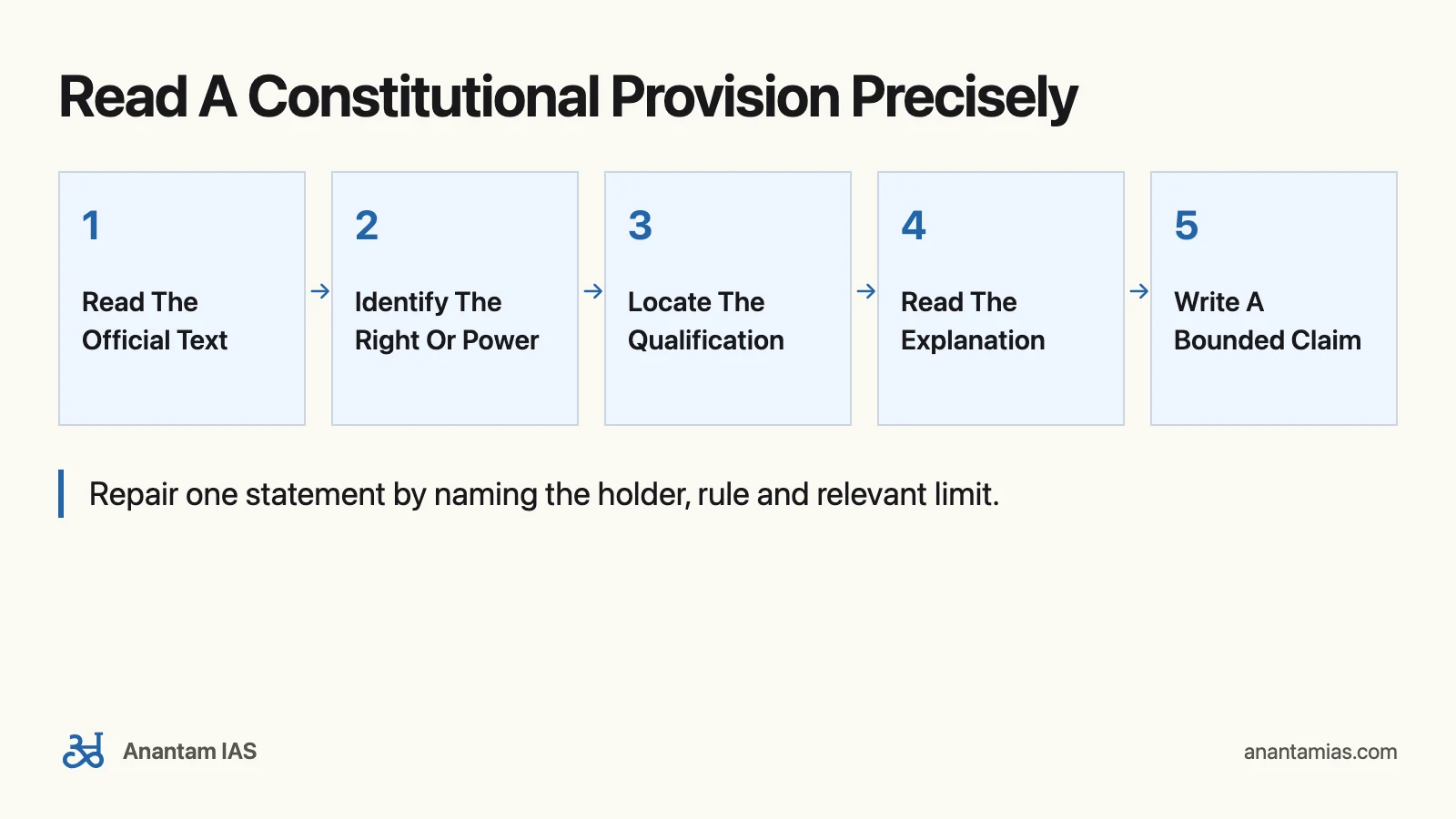
Read a provision in the official constitutional text, then use Basu to understand its setting and relationship with other provisions. A textbook’s explanation and the constitutional wording have different jobs.
The Legislative Department’s Constitution page is the starting point for official copies. Check a document’s date when you consult it; an older PDF may omit later amendments.
Think of the constitutional text as the rule and a commentary as an explanation of how that rule works. The explanation can help you interpret a difficult clause, but a paraphrase mustn’t silently replace the clause. Judicial interpretation also matters when a topic requires it; an Article number alone won’t establish the present legal position.
Use a small reading card with provision, plain meaning, institution, limitation and question. For example, “Article 19” is too broad for a useful card. “Article 19(1)(a), who holds the right, and Article 19(2), permitted restriction grounds” gives you a defined task.
Map Topics To Reading Tasks
Choose topics from a question you need to answer. Locate them in your own edition’s contents and index rather than following chapter numbers from another printing.
| Topic | Reading Task | Revision Output |
|---|---|---|
| Preamble and constitutional design | Explain one principle and how an institution gives it practical effect | Principle, institution and boundary |
| Fundamental Rights | Identify the holder, protected interest and relevant qualification | Right-and-restriction card |
| Directive Principles | Explain their role in governance and the limit on direct court enforcement | A comparison with rights |
| Parliamentary government | Trace who exercises a power and who answers for its use | Institution-and-accountability map |
| Federal relations | Separate legislative, executive and financial relationships | A comparison with one tension per relationship |
| Constitutional amendment | Identify the procedure before discussing limits and judicial interpretation | Procedure-and-limit note |
For PSIR, connect constitutional institutions to the analytical demands in your PSIR booklist. Basu can deepen the constitutional part; it won’t provide the whole political theory, thinkers and international-relations syllabus.
Work Through A Speech Question
This is an original study exercise, not a UPSC question or an assessment of a real dispute. A student writes: “Article 19 gives everyone an unrestricted right to criticize the government.” Find and repair the overstatements.
Start with the constitutional wording and split the sentence into claims.
- Holder: Article 19(1) speaks of citizens. Replace “everyone” with “citizens” when describing this Article. This doesn’t settle whether another constitutional protection applies to a non-citizen.
- Protected interest: Article 19(1)(a) protects freedom of speech and expression. Criticism can fall within that freedom, but the exercise doesn’t resolve every real speech dispute.
- Qualification: Article 19(2) permits laws imposing reasonable restrictions on specified grounds. “Unrestricted” is therefore inaccurate.
- Grounds: public order is a listed ground; mere displeasure at criticism isn’t itself one of the listed grounds. The actual legal assessment also needs the applicable law, facts and judicial interpretation.
A repaired statement is: “Article 19(1)(a) protects citizens’ freedom of speech and expression, subject to reasonable restrictions imposed by law on the grounds specified in Article 19(2).”
Now use Basu’s index to locate its discussion of speech and restrictions. Write what the explanation adds, then close the book and reproduce the distinction. You have one useful revision card instead of an underlined paragraph.
The important habit is testing the words everyone, unrestricted and always against the relevant provision. Don’t apply that habit as a shortcut that makes every absolute statement false. The text may justify one.
Compare Rights And Policy Duties
Use a comparison to prevent another common reading error: treating a limitation on enforcement as a declaration that a constitutional provision doesn’t matter.
- Article 37: Directive Principles aren’t enforceable by a court, but the Article also describes them as fundamental in governance and places a duty on the State to apply them in making laws.
- Reading task: separate those two statements. A limit on direct enforcement and a role in governance can coexist.
- Application: when discussing a welfare policy, explain the policy objective and the relevant rights questions separately. A desirable objective doesn’t remove the need to examine a law’s constitutional limits.
Check this in the official text and your edition’s discussion. Avoid flattening the relationship into “rights are important, Directive Principles aren’t.” Your note should preserve both the role and the boundary.
Keep The Reading Selective
Use a four-week reference cycle if you have an established foundation. It is a way to organize chosen topics, not a promise to finish the whole book.
- Week 1: Preamble, constitutional design and rights; make provision-and-limit cards.
- Week 2: Union and State institutions; draw responsibility maps from memory.
- Week 3: federal relations and local government; write comparisons around concrete questions.
- Week 4: amendment, selected constitutional disputes and consolidation; check current materials where needed.
A 40-minute session can use 10 minutes for constitutional wording, 20 for Basu’s explanation and 10 for a closed-book response. If a section contains many case references, begin with the main issue and reasoning. Expand the legal detail only when your study question requires it.
Keep an older copy if you need it for foundational explanation, but maintain a separate update list for amendments and judgments. Buy a newer edition when the differences matter to your chosen topics. A new cover alone doesn’t establish that.
Before adding another book, repair three weak statements from your existing polity notes using the provision-and-limit method. If you can explain the corrections clearly without the book open, the reference is doing useful work.
Frequently Asked Questions
Is D.D. Basu necessary for every UPSC beginner?
No. Build a basic polity outline first. Add Basu selectively when you need a deeper explanation of constitutional institutions and relationships between provisions.
Which English edition is identified here?
The verified listing is Introduction to the Constitution of India, LexisNexis, 28th edition, 2026, ISBN 9788119403790.
Does the Hindi version also use the 28th-edition number?
No. LexisNexis lists D D Basu Bharat ka Samvidhan- Ek Parichaya, 16th edition, copyright year 2026, ISBN 9788119403196. Check each language separately.
Can Basu replace the full PSIR booklist?
No. It can support constitutional understanding, but the PSIR syllabus also requires political theory, thinkers and international relations.
How should I use an older edition?
Use it for foundational explanation where appropriate, but check amendments and judicial developments separately. Replace it when differences matter to your selected topics.
Tell Google you want more of this.
Add Anantam IAS as a preferred sourceOne tap, and this site shows up more often in your own Top Stories, AI Overviews and AI Mode. Remove it any time.