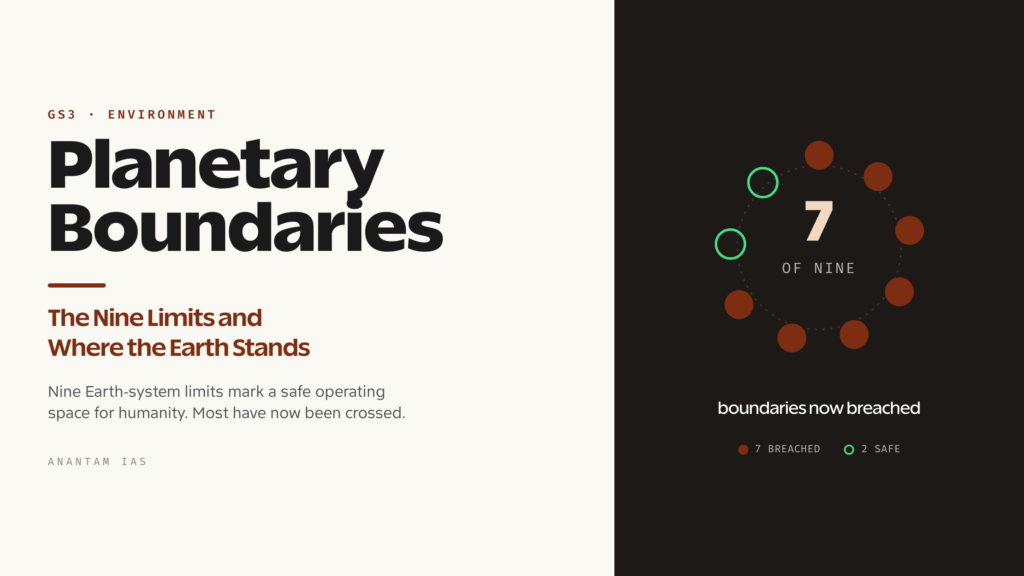
In September 2025, a group of Earth-system scientists quietly moved a line that had held for sixteen years. For the first time since the Planetary Boundaries framework was published in 2009, the ocean was added to the list of limits humanity has broken. Ocean acidification became the seventh of nine boundaries to be transgressed — and with it, the planet crossed a threshold that touches every coral reef, every fishery and every coastline, India’s included.
That number — seven of nine — is the single fact worth carrying out of this article. It tells you that the systems keeping Earth livable are not abstractions for a distant future; most of them are already past the point scientists consider safe. The Centre for Science and Environment and Down To Earth put exactly this finding on the cover of their State of India’s Environment 2026 report, alongside a domestic figure just as stark: India saw extreme weather on 331 of 334 days in the first eleven months of 2025. For UPSC, the framework is the cleanest way to hold the entire environment syllabus — climate, biodiversity, water, pollution, sustainability — inside one diagram. So it’s worth getting exactly right.
What the Planetary Boundaries Framework Actually Is
The idea is simpler than the jargon suggests. In 2009, the Swedish scientist Johan Rockström, then director of the Stockholm Resilience Centre, led a team of 28 researchers who asked a blunt question: which Earth-system processes, if pushed too far, could tip the whole planet out of the stable state that made human civilisation possible? Their answer, published in the journal Nature under the title “A safe operating space for humanity,” was a set of nine such processes — and for each, a boundary line that humanity should not cross.
The reference point matters. For roughly the last 11,700 years — a geological epoch called the Holocene — Earth’s climate and biosphere stayed remarkably steady. Farming, cities and every empire in history all grew up inside that calm window. The framework’s claim is that we have now pushed the planet into a new, human-driven epoch many scientists call the Anthropocene, and that the nine boundaries mark the edges of the Holocene-like conditions we evolved to depend on. Stay inside them, and the planet keeps its self-correcting stability. Cross them, and you raise the odds of abrupt, large-scale, sometimes irreversible change.
The framework’s lead authors are careful to say a boundary is not a cliff. Katherine Richardson, who led the 2023 assessment, compares it to blood pressure: a reading above the safe range doesn’t mean a heart attack today, but it sharply raises the risk, and the longer you ignore it the worse the odds get. So “crossing a boundary” means entering a danger zone of rising risk, not triggering instant catastrophe. That distinction is exactly the kind of nuance an examiner rewards — and exactly the kind candidates flatten into alarmism.
The Nine Boundaries and Where Earth Stands
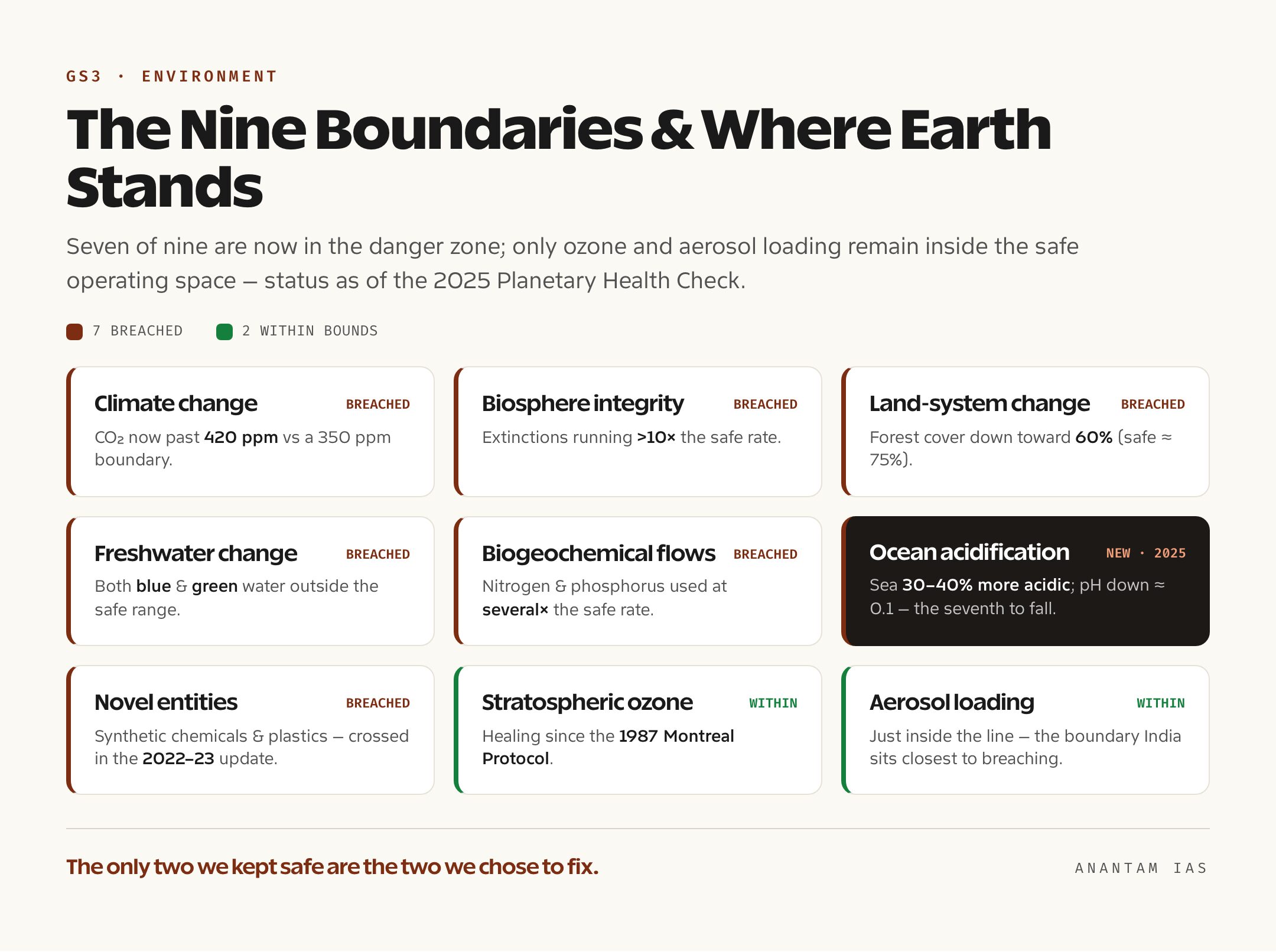
Here are the nine, in plain language, with their status as of the 2025 Planetary Health Check.
Climate change. Measured chiefly by atmospheric carbon dioxide; the original 2009 boundary was set at 350 parts per million, and we are now well past 420 ppm. Breached.
Biosphere integrity — the health of life itself. It has two parts: genetic diversity, tracked by the rate of species extinction, and functional diversity, the work ecosystems do. Extinctions are running at more than ten times the safe rate. Breached.
Land-system change — chiefly the conversion of forests to farmland and concrete. The safe line is keeping about three-quarters of the original forest cover; the world is down toward 60 per cent. Breached.
Freshwater change, recently split into “blue water” (rivers, lakes, aquifers) and “green water” (the moisture held in soil and plants). Both are now outside the safe range. Breached.
Biogeochemical flows — how much nitrogen and phosphorus we push through the environment, mostly as fertiliser. We are using these elements at several times the safe rate, choking rivers and creating dead zones. Breached.
Ocean acidification — as the sea absorbs our carbon dioxide, it turns more acidic, dissolving the shells of corals and plankton. Surface-ocean pH has fallen by about 0.1 units since industrialisation, a 30-to-40 per cent rise in acidity. This is the newest casualty, declared transgressed in 2025. Breached.
Novel entities — substances that did not exist in nature: synthetic chemicals, plastics, pesticides, even nuclear waste. We make them faster than we can test or contain them. This was declared breached in the 2022-23 update. Breached.
Stratospheric ozone depletion — the shield against ultraviolet radiation. After the 1987 Montreal Protocol banned ozone-eating chemicals, this layer is healing, and it sits comfortably inside the safe zone. Within bounds.
Atmospheric aerosol loading — the burden of fine particles and pollution haze in the air. Globally it remains, just, inside the boundary, helped by falling pollution in parts of the world. Within bounds.
So the scorecard reads seven breached, two safe — and the only two we’ve kept are the two we actively fixed or are fixing. That is the framework’s real lesson, and its only hopeful one: ozone proves a boundary can be pulled back across the line when governments cooperate.
Why 2025-26 Was the Year the Picture Got Worse
The framework is updated every few years, and the trend line has gone one way. The first 2009 paper flagged three boundaries as already crossed. The 2015 update raised it. The September 2023 assessment, published in Science Advances, was the first to quantify all nine at once — and found six transgressed, with every breached boundary except ozone still getting worse. Then the September 2025 Planetary Health Check, produced by the Potsdam Institute for Climate Impact Research with international partners, added ocean acidification as the seventh.
Rockström’s framing of that update is worth quoting for an answer: “We are witnessing widespread decline in the health of our planet,” he said, but “the window of cure is still open.” The science is not a death sentence; it’s a diagnosis with a prognosis that still depends on what we do.
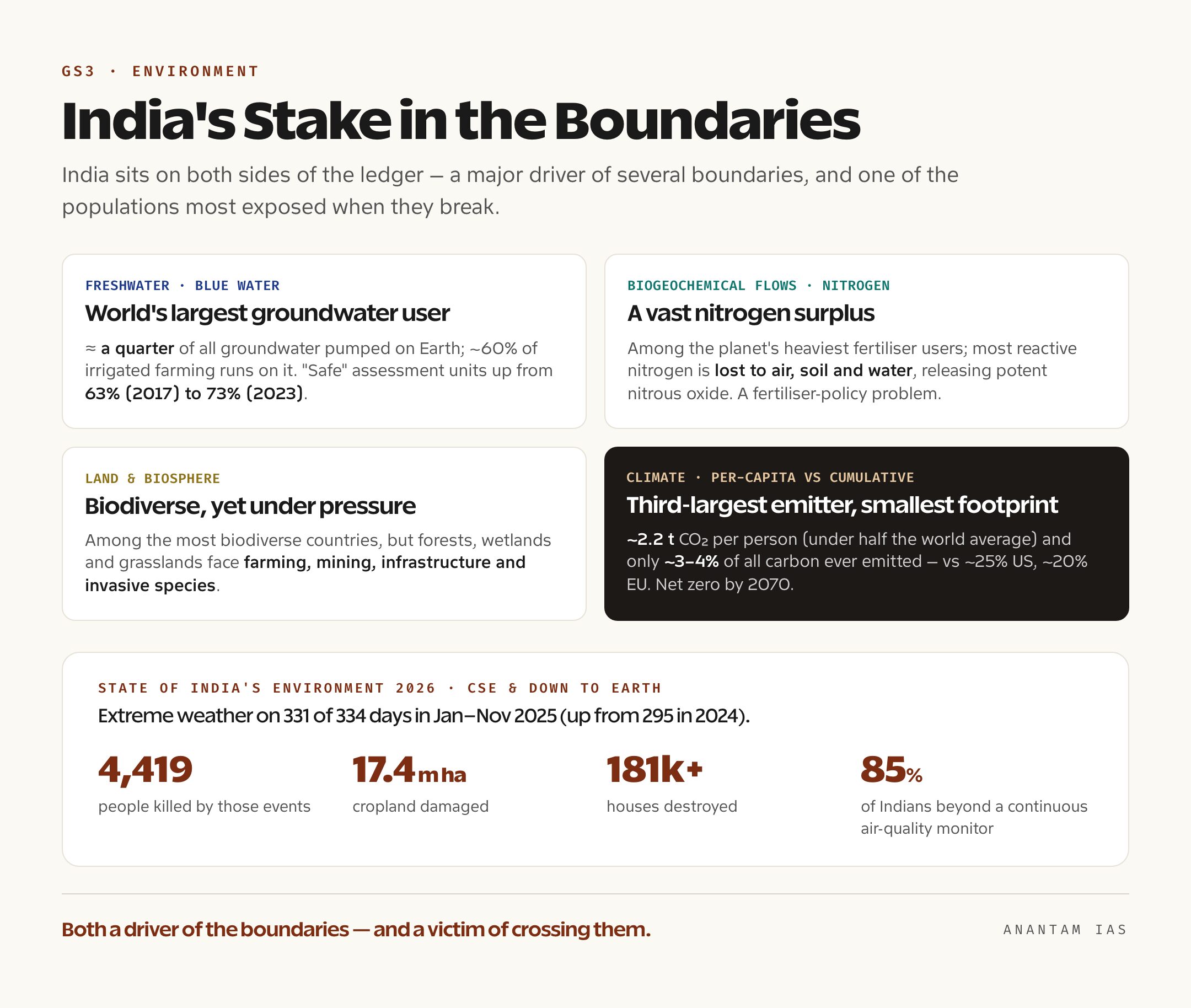
For India, the 2026 reckoning came through the State of India’s Environment 2026 report, released by CSE and Down To Earth at the Anil Agarwal Dialogue and carrying the seven-of-nine finding to a domestic audience. Its India numbers are the ones to memorise. Extreme weather struck on 331 of 334 days in January-November 2025, up from 295 such days in 2024. Those events killed at least 4,419 people, damaged 17.4 million hectares of cropland, destroyed more than 181,000 houses and killed some 77,000 animals. The report also flags that India’s forest cover and biodiversity are under strain — the invasive weed Lantana camara now smothers nearly half of some forest and scrubland — and that 85 per cent of Indians live beyond the reach of any continuous air-quality monitor. The planetary boundaries are not happening to India from outside. They are arriving as floods in Himachal, heat in Rajasthan and dying reefs off the Andamans.
How India Sits Inside Each Boundary
This is where the framework earns its place in an Indian answer, because India is unusual: it is a major driver of several boundaries and, at the same time, one of the populations most exposed when they break.
On freshwater, India is the world’s single largest user of groundwater, accounting for roughly a quarter of all the groundwater pumped on Earth. About 60 per cent of irrigated farming runs on it, and the Central Ground Water Board still classes a large share of assessment units as over-exploited or critical — though, encouragingly, the “safe” share has climbed from around 63 per cent in 2017 to 73 per cent in 2023 as recharge schemes spread. India is, in miniature, the global blue-and-green water story.
On biogeochemical flows, India is one of the planet’s heaviest fertiliser users, and decades of subsidised, skewed urea use have left a vast nitrogen surplus. Studies estimate that a large majority of the reactive nitrogen India applies is lost to air, soil and water rather than taken up by crops — fouling groundwater, blooming algae in lakes, and releasing nitrous oxide, a greenhouse gas far more potent than carbon dioxide. The nutrient boundary is, for India, a fertiliser-policy problem.
On land-system change and biosphere integrity, India holds a striking paradox: it is among the most biodiverse countries on Earth, yet its forests, wetlands and grasslands face relentless pressure from farming, mining, infrastructure and invasive species. The country’s record on extinction risk and habitat fragmentation feeds directly into the two boundaries the world has pushed furthest.
On climate change and ocean acidification, India’s position is the one that anchors its diplomacy. India is the world’s third-largest emitter in absolute terms, yet its per-capita emissions — around 2.2 tonnes of carbon dioxide a year — are well under half the world average and a fraction of the rich world’s. And on the measure India insists matters most, cumulative historical emissions, the country has contributed roughly 3 to 4 per cent of all the carbon ever put into the atmosphere, against about a quarter from the United States and around a fifth from the European Union. So when India argues at climate talks, it argues from the principle of Common But Differentiated Responsibilities — that those who filled the atmospheric space must lead in vacating it — while still pledging net zero by 2070 and pushing one of the world’s largest renewable build-outs. The boundary framework, by counting impact rather than fault, quietly strengthens that climate-justice case: the populations least responsible for crossing the lines are often the most exposed to the consequences.
What the Framework Demands, and What to Watch
The honest takeaway is double-edged. The bad news is in the scoreboard: seven of nine, and almost all still worsening. The good news is that the framework was never meant only to frighten. It was designed to define a safe operating space we can choose to return to — and ozone is living proof that return is possible when policy, science and cooperation line up.
What does staying inside the lines actually demand? It demands treating the boundaries as connected, not separate. Cutting fossil fuels eases climate, ocean acidification and aerosols at once; restoring forests helps land-use change, biodiversity and the carbon and water cycles together. It demands moving, as the SOE 2026 report puts it, from “reactive compensation” — paying out after each flood — to “proactive restoration.” And, increasingly, it demands building the boundaries into how nations measure success, so that a “developed India @ 2047” is counted in clean air, living rivers and intact forests, not GDP alone.
For UPSC, three things are worth watching over the next few years. First, whether aerosol loading — the boundary India sits closest to breaching, given its pollution — gets formally quantified and crossed. Second, how the framework feeds into global negotiations, from climate COPs to the plastics treaty that targets the novel-entities boundary. And third, whether India’s own environmental accounting starts naming these limits explicitly. The planet has drawn its lines. The exam, and the century, will turn on whether we learn to live inside them.
For Your Mains Answer
This topic is a direct fit for GS Paper 3 — “conservation, environmental pollution and degradation” and sustainable development — and it doubles as ready-made material for the Essay paper on environment, sustainability and the human-nature relationship. Its real value is as an organising frame: planetary boundaries let you connect climate, biodiversity, water and pollution in a single structure instead of four disconnected notes. Link it to the Sustainable Development Goals and the concept of the Anthropocene to show range.
How to Build the Answer
Open with the headline fact and a source: as of the 2025 Planetary Health Check, seven of nine planetary boundaries are breached, ocean acidification the latest. Then define the framework in one clean line — nine Earth-system limits marking a “safe operating space for humanity,” set against Holocene stability. Move to the scorecard (what’s breached, what’s safe, and why ozone is the exception). Then pivot hard to India: place the country inside the water, nitrogen, land, biodiversity and emissions boundaries. Close on the framework’s purpose — a space we can choose to re-enter — and a way-forward line. That arc, definition → status → India → way forward, fits almost any phrasing of the question.
Common Mistakes to Avoid
Don’t treat a boundary as a doomsday switch; it’s a zone of rising risk, and saying so signals you’ve read the science. Don’t say “six are crossed” — that was 2023; the current figure is seven. Don’t forget the two that are safe, and don’t forget why they’re safe (active policy, especially the Montreal Protocol for ozone). And don’t make it a Western story — the India linkage is what lifts an average answer into a strong one.
A Compact Answer Spine
Nine boundaries define a safe operating space (Rockström, 2009, vs Holocene stability) → seven now breached as of 2025, ocean acidification newest, only ozone and aerosols safe → India both driver and victim: largest groundwater user, huge nitrogen surplus, biodiversity under pressure, low per-capita but third-largest emitter → boundaries strengthen the CBDR/climate-justice case → way forward: integrated action, “proactive restoration,” and the ozone precedent that boundaries can be re-crossed.
Diagram or Flowchart Idea
Draw the signature wheel: a central circle (the safe operating space) with nine wedges radiating out, each labelled with one boundary. Shade seven wedges to show they’ve burst past the ring and leave two (ozone, aerosols) inside it. A single, fast, instantly legible visual that earns marks and frames the whole answer.
A Balanced-Conclusion Line
Something like: “The planetary boundaries are less a verdict than a map — they show how far we have strayed from the safe space, but also, in the recovery of the ozone layer, that the road back is still open if cooperation meets ambition.” It states the crisis and the agency in one breath.
How to Use Data Without Cramming
Pick three or four anchors and use them well: seven of nine boundaries breached (2025); India as the world’s largest groundwater user at about a quarter of global extraction; per-capita emissions near 2.2 tonnes against a cumulative share of only 3-4 per cent; and the SOE 2026 figure of extreme weather on 331 of 334 days in 2025. Four numbers, each doing real argumentative work, beat a paragraph of statistics no examiner will remember.
FAQ
What are the nine planetary boundaries? They are nine Earth-system processes that, together, define a “safe operating space for humanity”: climate change, biosphere integrity (genetic and functional diversity), land-system change, freshwater change (blue and green water), biogeochemical flows (nitrogen and phosphorus), ocean acidification, atmospheric aerosol loading, stratospheric ozone depletion, and novel entities such as synthetic chemicals and plastics. The framework was proposed in 2009 by Johan Rockström and colleagues at the Stockholm Resilience Centre.
How many planetary boundaries have been breached? As of the September 2025 Planetary Health Check, seven of the nine have been transgressed — climate change, biosphere integrity, land-system change, freshwater change, biogeochemical flows, novel entities, and now ocean acidification, which was newly added in 2025. Only two remain within the safe zone: stratospheric ozone, which is recovering thanks to the Montreal Protocol, and atmospheric aerosol loading.
Why is ocean acidification the seventh boundary, and why does it matter for India? As the ocean absorbs human carbon dioxide, its surface water has become 30 to 40 per cent more acidic since industrialisation, dissolving the shells of corals, plankton and shellfish. In 2025 this crossed the safe threshold. For India, with a long coastline, coral systems in the Andamans and Lakshadweep, and millions dependent on fisheries, acidification is a direct threat to coastal livelihoods and food security.
How does the planetary boundaries framework connect to India’s climate justice argument? The framework measures impact on Earth systems regardless of who caused it. India contributes only about 3 to 4 per cent of all carbon emitted historically and has per-capita emissions under half the world average, yet it is among the most exposed to climate extremes. That gap underpins India’s stand on Common But Differentiated Responsibilities — that developed nations, having used most of the safe space, must lead in cutting back, while developing countries keep room to grow.
Practice Questions
Prelims MCQs
- With reference to the Planetary Boundaries framework, consider the following: which of the following pairs of boundaries are currently considered to be within the safe operating space?
(a) Climate change and ocean acidification
(b) Stratospheric ozone depletion and atmospheric aerosol loading
(c) Freshwater change and land-system change
(d) Biosphere integrity and novel entities.
Answer: (b) Only ozone (recovering after the Montreal Protocol) and aerosol loading remain inside the boundary; the other seven are breached. - The Planetary Boundaries framework was first proposed in 2009 by a team led by which scientist, associated with the Stockholm Resilience Centre?
(a) Katherine Richardson
(b) Paul Crutzen
(c) Johan Rockström
(d) James Hansen.
Answer: (c) Johan Rockström led the original 2009 group of 28 scientists; Richardson led the later 2023 assessment. - Which of the following was the most recent planetary boundary to be declared transgressed, as reported in the 2025 Planetary Health Check?
(a) Novel entities
(b) Ocean acidification
(c) Freshwater change
(d) Biogeochemical flows.
Answer: (b) Ocean acidification became the seventh breached boundary in the September 2025 update; novel entities had been crossed earlier. - The “biogeochemical flows” planetary boundary is primarily concerned with the human-driven cycles of which two elements?
(a) Carbon and sulphur
(b) Nitrogen and phosphorus
(c) Oxygen and hydrogen
(d) Potassium and calcium.
Answer: (b) It tracks nitrogen and phosphorus, pushed largely through fertiliser use; India’s large nitrogen surplus is a notable contributor. - The planetary boundaries are defined against the relatively stable conditions of which geological epoch, which the framework treats as the safe baseline for human civilisation?
(a) Pleistocene
(b) Anthropocene
(c) Holocene
(d) Pliocene.
Answer: (c) The roughly 11,700-year Holocene provided the stable climate in which agriculture and civilisation developed; the framework warns we are now entering the Anthropocene.
Mains Practice Questions
- “The planetary boundaries framework offers a single map for the entire environmental crisis.” Explain the framework, identify which boundaries have been transgressed, and discuss why two have so far been kept within safe limits. (15 marks, 250 words)
- Examine India’s position within the planetary boundaries, distinguishing between the boundaries India helps drive and those to which it is most exposed. (15 marks, 250 words)
- The planetary boundaries framework measures environmental impact rather than historical responsibility. Discuss how this strengthens — and complicates — India’s climate-justice argument based on Common But Differentiated Responsibilities. (15 marks, 250 words)
- “Crossing a planetary boundary is a zone of rising risk, not an instant catastrophe.” Analyse this distinction and its implications for environmental policymaking, with examples from India’s water and nitrogen challenges. (10 marks, 150 words)
- The recovery of the stratospheric ozone layer is the framework’s only success story. What lessons does the Montreal Protocol offer for governing the other, still-worsening planetary boundaries? (10 marks, 150 words)
Tell Google you want more of this.
Add Anantam IAS as a preferred sourceOne tap, and this site shows up more often in your own Top Stories, AI Overviews and AI Mode. Remove it any time.