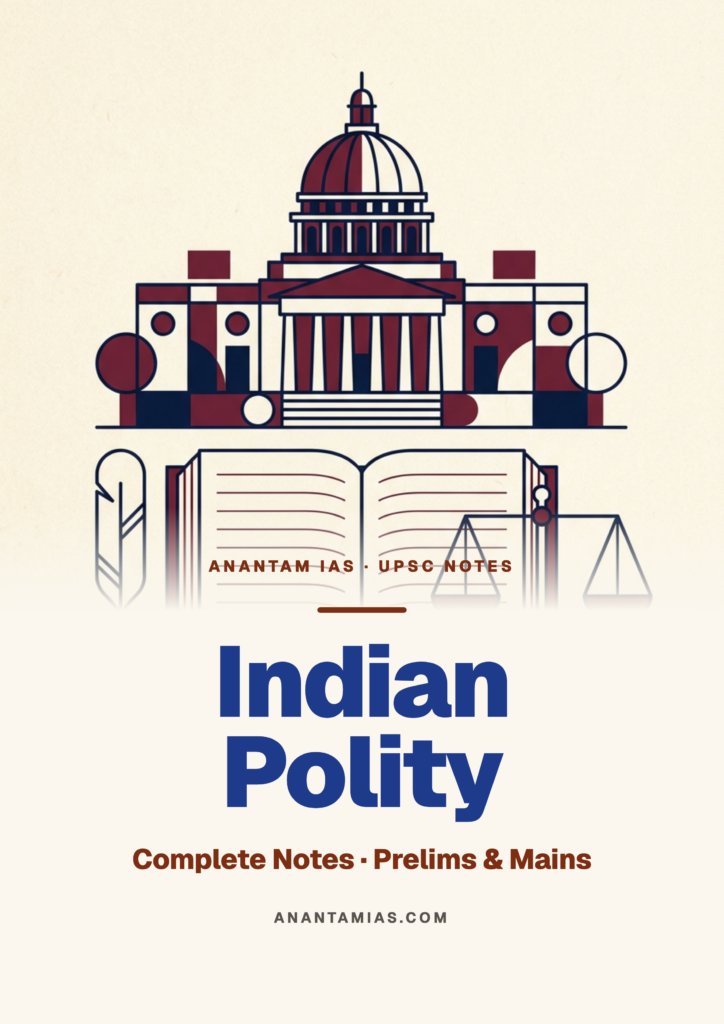
The complete Indian Polity notes for the UPSC Civil Services Examination, as one downloadable book of 463 pages (A4 PDF, mobile PDF and ePub), written by Gaurav Tiwari. Written topic by topic and mapped to the Constitution, for both Prelims and Mains.
What you get
- All 24 units across 4 parts, in syllabus order: Constitutional Foundations; Rights, Duties and Policy; Government and Institutions; Federalism, Local Government and Bodies.
- Exact Article references, landmark judgments with their holdings, and every major constitutional amendment.
- Comparison tables, key-term glossaries and previous-year questions mapped to each theme.
- A last-mile revision box and a common-errors box in every unit.
Completely free — no sign-up, no watermark. Instant download after checkout.
Complete Table of Contents
Everything inside the 463-page book, unit by unit and section by section.
Part 1: Constitutional Foundations
- Historical Background of the Constitution
Why This Unit Matters: The Constitution Did Not Begin in 1950 · The Regulating Act 1773: Parliament Enters the Company · Amending Act 1781 and Pitt's India Act 1784: The Board of Control · The Charter Acts 1793 to 1853: From Trader to Administrator · The Government of India Act 1858: The Crown Takes Over · Indian Councils Acts 1861, 1892 and 1909: Representation Begins · The Government of India Act 1919: Dyarchy and Responsible Government · The Government of India Act 1935: The Immediate Blueprint · The Indian Independence Act 1947: The Transfer of Power · Evolution of the Four Pillars: Legislature, Executive, Judiciary, Services · Which 1935-Act Features Carried into the Constitution - Making of the Constitution and the Constituent Assembly
The Demand for a Constituent Assembly and the Cabinet Mission Plan · Composition and Election of the Assembly · First Sessions, the Objectives Resolution, and the Impact of Partition · The Committees of the Assembly · The Drafting Committee and B.N. Rau · Working, Timeline and the Three Readings · Enactment, Adoption and Commencement · Sources and Borrowed Features of the Constitution · Criticisms of the Constituent Assembly - Salient Features and the Preamble
The Lengthiest Written Constitution: Scale and Sources · A Blend of Rigidity and Flexibility · Federal System with a Unitary Bias · Parliamentary Government and the Synthesis of Sovereignty and Judicial Review · The Remaining Salient Features: Judiciary, Citizenship, Franchise, Secularism and the Rest · The Preamble: Text, the Objectives Resolution, and the Four Ingredients · The Keywords and the 42nd Amendment · Is the Preamble Part of the Constitution? Berubari, Kesavananda, LIC, and Amendability - Union and Its Territory
Article 1 — Union of States, and the 'federation' debate · Territory of India versus Union of India · Article 2 — Admission and establishment of new States · Article 3 — Formation of new States and alteration of areas, boundaries and names · Article 4 — Consequential provisions and why they need only a simple majority · Cession of Indian territory to a foreign State — the Berubari question · Reorganisation of States — the road to 1956 · New States after 1956, up to Telangana (2014) - Citizenship
Why the Constitution Says So Little: Articles 5 to 11 · Single Citizenship · The Citizenship Act, 1955: Acquisition by Birth and Descent · Acquisition by Registration, Naturalisation and Incorporation of Territory · Loss of Citizenship · Overseas Citizenship of India and the Erstwhile PIO Scheme · The Citizenship (Amendment) Act, 2019 · The National Register of Citizens (NRC): Context · Rights of Citizens versus Aliens - Amendment of the Constitution and the Basic Structure Doctrine
Article 368: The Amending Power, Its Location and Its Scope · The Three Majorities and the Federal Provisions Needing State Ratification · The Categories of Amendable Provisions and the Round One Disputes · Golaknath (1967) and Parliament's Counter: the 24th and 25th Amendments · Kesavananda Bharati (1973): the Basic Structure Doctrine · Testing the Doctrine: Raj Narain (1975), the 42nd Amendment, Minerva Mills (1980) and Waman Rao (1981) · What Counts as Basic Structure: the Evolving List and the Doctrine's Limits · The Ninth Schedule After Coelho and the Present Position
Part 2: Rights, Duties and Policy
- Fundamental Rights: Overview and the Right to Equality
Fundamental Rights: Nature, Classification and Enforceability · Article 12: The Meaning of 'State' · Article 13: Judicial Review and the Fate of Inconsistent Laws · Article 14: Equality Before the Law and Equal Protection of the Laws · Reasonable Classification and the Doctrine of Arbitrariness · Article 15: Prohibition of Discrimination · Article 16: Equality of Opportunity in Public Employment and the Reservation Jurisprudence · The EWS Quota: The 103rd Amendment and Janhit Abhiyan (2022) · Article 17: Abolition of Untouchability and Article 18: Abolition of Titles - Right to Freedom (Articles 19-22)
Article 19: The Six Freedoms and Who May Claim Them · Article 19 in Detail: Each Freedom, Its Grounds of Restriction and the Case Law · Article 20: Protection in Respect of Conviction for Offences · Article 21: From A.K. Gopalan to Maneka Gandhi · Article 21: The Derived Rights Read into Life and Personal Liberty · The Right to Privacy: Puttaswamy (2017) · Article 21A: The Right to Education · Article 22: Protection Against Arrest and Detention - Rights against Exploitation, Freedom of Religion, Cultural and Educational Rights
Article 23: Prohibition of Traffic in Human Beings and Forced Labour · Article 24: Prohibition of Employment of Children in Hazardous Work · Article 25: Freedom of Conscience and the Right to Profess, Practise and Propagate Religion · Article 26: Freedom to Manage Religious Affairs and the Religious Denomination · The Essential Religious Practices Doctrine · Articles 27 and 28: Freedom from Religious Taxation and from Religious Instruction · Article 29: Protection of the Interests of Sections of Citizens · Article 30: Minority Educational Institutions and the T.M.A. Pai Framework · Minority Institutions and Recent Law: RTE, NEET and the NCMEI - Right to Constitutional Remedies and the Writs
Article 32: The Right to Constitutional Remedies and Why It Is Itself a Fundamental Right · The Writ Jurisdiction: Nature, Origin and the Anatomy of the Five Writs · Habeas Corpus and Mandamus · Certiorari, Prohibition and Quo Warranto · Article 32 versus Article 226: The Supreme Court and the High Courts Compared · Public Interest Litigation and the Relaxation of Locus Standi · Suspension of the Writs, the Emergency and Martial Law · The Abolition of the Fundamental Right to Property and Article 300A - Directive Principles of State Policy
Nature, Source and Philosophy of the Directive Principles · The Threefold Classification: Socialist, Gandhian and Liberal-Intellectual · The Directives Article by Article, and the Amendments that Enlarged Them · Justiciability, Sanctions and the Judicial Use of the Directives · Directive Principles Outside Part IV · Fundamental Rights versus Directive Principles: Champakam to Article 31C · The Record of Implementation · Criticism, Utility and the Balanced Assessment - Fundamental Duties and the Philosophy of the Constitution
Origins: The Swaran Singh Committee and the 42nd Amendment · The Text of Article 51A: The Eleven Duties and the 86th Amendment · Legal Character and Enforcement: Non-Justiciable, But Not Without Force · Significance, Criticism and the Judiciary's Use of the Duties · The Threefold Scheme: Fundamental Rights, Directive Principles and Fundamental Duties · The Nature of the Polity: Is the Indian Constitution Federal or Unitary? · Sovereignty and Constitutionalism · Parliamentary Sovereignty versus Judicial Supremacy: The Indian Synthesis
Part 3: Government and Institutions
- The President and the Vice-President
The Office of the President: Position, Qualifications and Conditions · Election of the President: The Electoral College and the Value of Votes · Oath, Term, Vacancy and Impeachment under Article 61 · Powers of the President: Executive, Diplomatic, Military, Judicial and Financial · Legislative Powers and the Veto: Absolute, Suspensive and Pocket · The Ordinance-Making Power under Article 123 · The Pardoning Power under Article 72 and Its Contrast with the Governor · The Real Position of the President: Article 74 and Situations of Discretion · The Vice-President: Election, Removal, Rajya Sabha Chairman and the US Comparison - Prime Minister and the Council of Ministers
The Office of Prime Minister: Appointment and the Constitutional Silence · Powers and Functions of the Prime Minister · The Prime Minister, the President and the Council of Ministers: Articles 74 and 78 · The Council of Ministers: Article 75 in Full · Collective and Individual Responsibility · Categories of Ministers, and the Cabinet versus the Council of Ministers · The 91st Amendment Act 2003: Capping the Size of the Ministry · Cabinet Committees and the Kitchen Cabinet · The Attorney General of India: Article 76 - Parliament: Structure and Working
Composition of Parliament and the President's Place in It · Rajya Sabha: Composition, Representation and Election · Lok Sabha: Composition, Election and Delimitation · Rajya Sabha versus Lok Sabha: Equal, Unequal and Exclusive Powers · Sessions: Summoning, Prorogation, Dissolution and Adjournment · Quorum, Voting and the Ordering of Business · Presiding Officers: Speaker, Deputy Speaker and the Rajya Sabha Chairman · Parliamentary Devices: Question Hour, Zero Hour, Motions and Resolutions - Parliament: Legislative Procedure, Budget and Committees
The Legislative Process: Ordinary Bills and the Three Readings · Money Bills: The Article 110 Definition and the Speaker's Certificate · Financial Bills and the Money Bill versus Financial Bill Distinction · Joint Sitting (Article 108) and the Resolution of Deadlock · The Budget: the Annual Financial Statement, Charged versus Voted Expenditure · The Three Government Funds: Consolidated Fund, Contingency Fund and Public Account · Enacting the Budget: Demands for Grants, Cut Motions, Appropriation and Finance Bills · Parliamentary Committees: the Financial Trio and the Standing Committees · Parliamentary Privileges (Article 105) - The Supreme Court and the Judiciary
The Supreme Court: Composition, Qualifications and the Guarantees of Independence · Appointment and Removal of Judges: from Consultation to the Collegium · Jurisdiction of the Supreme Court: the Six Heads · Judicial Review: the Power to Test the Validity of Laws · Public Interest Litigation: the Loosening of Locus Standi · Judicial Activism and Judicial Restraint · Contempt of Court · Separation of Powers - State Executive, State Legislature and High Courts
The Governor: Office, Appointment, Tenure (Articles 153 to 159) · The Governor's Powers: Executive, Legislative, Financial and Judicial (Articles 154, 161, 174, 200, 213) · The Governor's Discretionary Powers and the Controversies (Articles 163, 200, 356) · The Chief Minister, the State Council of Ministers and the Advocate General (Articles 163 to 167) · The State Legislature: Composition of Assembly and Council (Articles 168 to 173) · Creating and Abolishing a Legislative Council (Article 169) and the Unequal Powers of the Two Houses · The High Courts: Constitution, Appointment, Independence (Articles 214 to 224) · High Court Jurisdiction, Article 226 versus Article 32, and the Subordinate Judiciary (Articles 225 to 237)
Part 4: Federalism, Local Government and Bodies
- Federalism and Centre-State Relations
Federal and Unitary Features: Why India Is Called Quasi-Federal · Legislative Relations I: The Seventh Schedule, the Three Lists and Residuary Powers · Legislative Relations II: Repugnancy, the Interpretive Doctrines and Parliament in the State Field · Administrative Relations: Directions, Cooperation and All-India Services · Financial Relations I: The Distribution of Taxes · Financial Relations II: Grants-in-Aid, the Finance Commission and Borrowing · Goods and Services Tax and the GST Council (101st Amendment, Article 279A) · Trends: Centralisation, Cooperative and Competitive Federalism - Inter-State Relations and Emergency Provisions
The Architecture of Inter-State Relations · Inter-State Water Disputes: Article 262 and the 1956 Act · Coordination: The Inter-State Council (Article 263) and the Zonal Councils · Full Faith and Credit and the Free Internal Market · The Emergency Provisions: Overview and Rationale · National Emergency (Article 352): Grounds, Procedure and the 44th Amendment · President's Rule (Articles 355 and 356): Grounds, Effects and Duration · S.R. Bommai v. Union of India (1994): Article 356 Made Justiciable · Financial Emergency (Article 360) and the 38th versus 44th Amendment Story - Local Government, Scheduled Areas and Union Territories
From Directive Principle to Constitutional Status: the Road to the 73rd and 74th Amendments · The 73rd Amendment: Part IX, the Gram Sabha and the Three-Tier Panchayat · Reservation, the State Election Commission and the State Finance Commission · PESA 1996: Extending Panchayats to the Scheduled Areas · The 74th Amendment: Part IXA, the Municipalities and Urban Planning Bodies · The Fifth Schedule: Administration of Scheduled Areas and Scheduled Tribes · The Sixth Schedule: Autonomous District Councils in the North-East · Union Territories and the Special Status of Delhi and Puducherry - Constitutional Bodies I: Election Commission, UPSC and Finance Commission
The Election Commission of India: Article 324 and the Sweep of Its Mandate · Composition: From a Single-Member to a Three-Member Commission · Appointment, Tenure and Removal: Anoop Baranwal and the 2023 Act · Powers and Functions of the Election Commission · The Model Code of Conduct · Independence, Limitations and the Reform Debate · The Public Service Commissions: Articles 315 to 323 · The Finance Commission: Article 280, Composition and Terms of Reference · Finance Commission versus the Planning Commission and NITI Aayog - Constitutional Bodies II and Non-Constitutional Bodies
The Comptroller and Auditor-General — Article 148 and the guarantee of independence · CAG duties and the audit process — Articles 149 to 151, and why the title misleads · The CAG and the Public Accounts Committee — closing the accountability loop · The Advocate General of the State — Article 165 (with the Attorney General compared) · Special constitutional commissions I — Scheduled Castes (Art 338) and Scheduled Tribes (Art 338A) · Special constitutional commissions II — Backward Classes (Art 338B) and Linguistic Minorities (Art 350B) · Statutory watchdogs I — NHRC, Central Information Commission and Central Vigilance Commission · Statutory watchdogs II — Lokpal and Lokayuktas · Executive bodies and the constitutional-statutory-executive map — NITI Aayog and the CBI - Elections, the Representation of People Acts and Anti-Defection
The Two Representation of the People Acts: What 1950 Does and What 1951 Does · Electoral Rolls, Voter Qualifications and the Nature of the Right to Vote · Candidate Qualifications, Disqualifications and Corrupt Practices under the 1951 Act · The Electoral Process, Election Disputes and the EVM-VVPAT Question · Electoral Reforms and Political Funding: From the Reform Committees to the 2024 Electoral Bonds Verdict · The Anti-Defection Law: 52nd Amendment, the Tenth Schedule, Grounds and Exceptions · Kihoto Hollohan, the Speaker as Adjudicator and the Working of Anti-Defection · Political Parties, Recognition and Symbols; and Pressure Groups