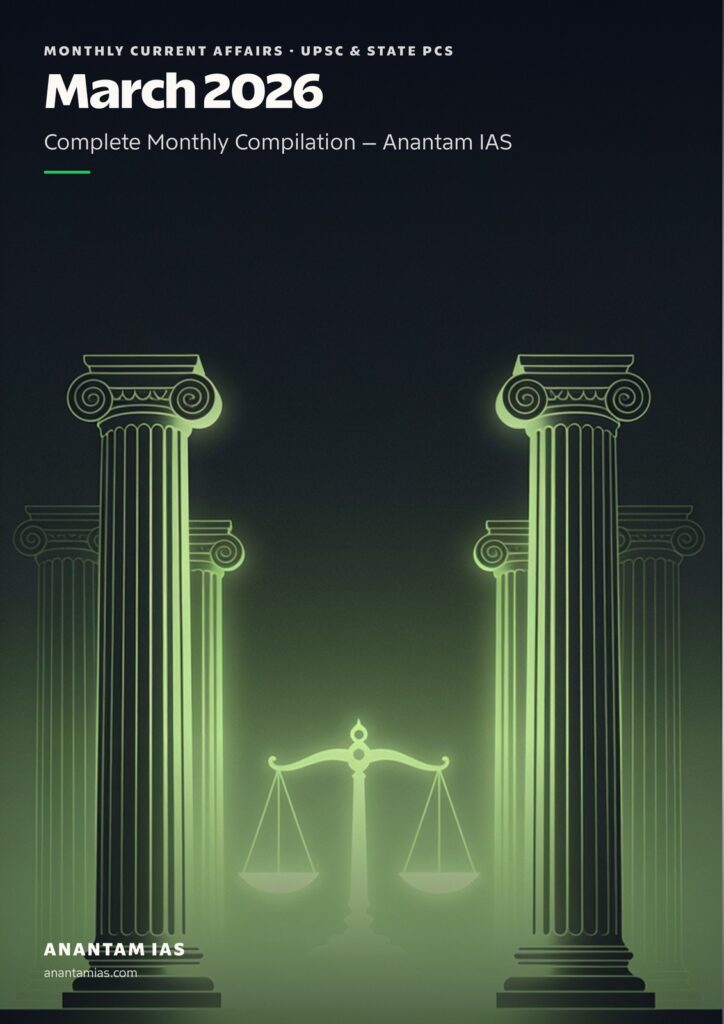
The March 2026 Monthly Current Affairs PDF compiles the full month of news into a single, structured document organised by UPSC syllabus topic. Built for UPSC 2026 candidates who want one consolidated read for March 2026 instead of going back through separate daily PDFs.
Why a monthly compilation is the right unit of revision
Daily current affairs is good for staying current. Monthly compilations are where retention happens. Reading a month of news in one structured pass forces you to see the threads — how a court hearing in week one connected to a parliamentary debate later in the month, how an economic indicator shifted the policy conversation by month-end. UPSC questions are designed around these threads, not around isolated facts.
What's inside this PDF
- Every major Polity & Governance development of March 2026 — court rulings, parliamentary actions, constitutional matters.
- Economy — RBI moves, fiscal data, government policies, indices and rankings.
- Environment & Geography — climate decisions, biodiversity events, project approvals, disaster events.
- International Relations — bilateral and multilateral developments, India's foreign policy positions.
- Science & Technology — ISRO, defence, biotech, and digital infrastructure.
- Schemes & Reports — newly launched programmes, key reports, committee findings.
- Important Days, Persons in News, and Awards.
How to use the monthly PDF
- Use this as your primary monthly revision document — set aside three hours in the first week of the next month.
- Underline 8–10 facts per topic you'd want as Prelims-level recall.
- Extract one or two argumentative threads per topic for Mains use.
- Cross-link to your daily PDFs only when you need the original context.
- Add this to your monthly revision archive — at exam time, you'll revise the monthlies, not the dailies.
- Test recall by writing the headline facts of March 2026 from memory before your second read.
Common mistakes with monthly compilations
The first is treating the monthly as a substitute for daily reading — it isn't. Daily reading builds context; the monthly compresses and confirms that context. Read the dailies through March 2026 first, then the monthly afterwards. The second mistake is reading the monthly only once. Two reads, three weeks apart, produces dramatically more recall than one careful read. The third is highlighting too liberally. Force yourself to two highlights per page — the constraint is what makes revision possible. The fourth is failing to add monthly highlights to a final-month revision sheet.
How March 2026 fits in your overall preparation
The monthly compilation occupies the middle layer of a three-tier current affairs system: dailies for awareness, monthlies for retention, the year-end Compass for exam-time revision. The March 2026 PDF is the retention layer — read it, distil it, retain it. Strong candidates keep a clear written habit by mid-year: by the time UPSC 2026 Prelims approaches, they've revised each monthly compilation at least three times. The structure of this PDF is designed to make those repeat revisions fast.
Who should download this
UPSC 2026 aspirants who want one structured monthly read for March 2026, repeat candidates building a second-pass revision archive, and candidates using current affairs as a Mains essay material bank. State PSC aspirants will find the full month equally usable. Working professionals preparing UPSC will find this the most efficient single-document option for March 2026.
What you get
- Free PDF — no payment, no signup.
- Topic-organised structure covering 31 days of news.
- Mobile-readable and printable.
- Companion to our Daily Current Affairs PDFs and Year-End Compass volumes.
Quick reference
Sources behind the March 2026 compilation include The Hindu, Indian Express, Press Information Bureau, Ministry-level press releases, and Supreme Court orders. Significant data points are cross-checked against original government publications. The PDF is best printed in A4, two-sided, for revision over coffee — it reads in roughly two hours end-to-end and revises cleanly on the second and third pass.
Use this in conjunction with a daily answer-writing practice for the strongest retention.