A child does not arrive into the world with values. Society pours them in — through religion, traditions, politics, economy, media, civil society, local community, and leadership. By the time the child becomes a UPSC aspirant, an officer-trainee, and finally a serving administrator, the layers of social value formation have already shaped most of what she takes for granted. The GS-IV syllabus explicitly names role of family, society and educational institutions in inculcating values. This guide expands the compass extract on the Role of Society into a Mains-quality reference.
Why Society's Role Is Central
A person learns values from many sources, but society is the medium through which most other sources operate. The family that teaches honesty does so in a language society shaped. The school that teaches civics uses a curriculum society approved. The religion that teaches compassion is a social institution. Society is therefore both the content and the container of value education.
"Society exists for the benefit of its members; not the members for the benefit of society." — Herbert Spencer
The flip side: when society's values misalign with constitutional ethics — caste hierarchy, gender bias, communal antagonism — the corrective is not less society but a better-designed society, supported by law, education, civil society, and the conscientious public servant.
Eight Channels Through Which Society Shapes Values
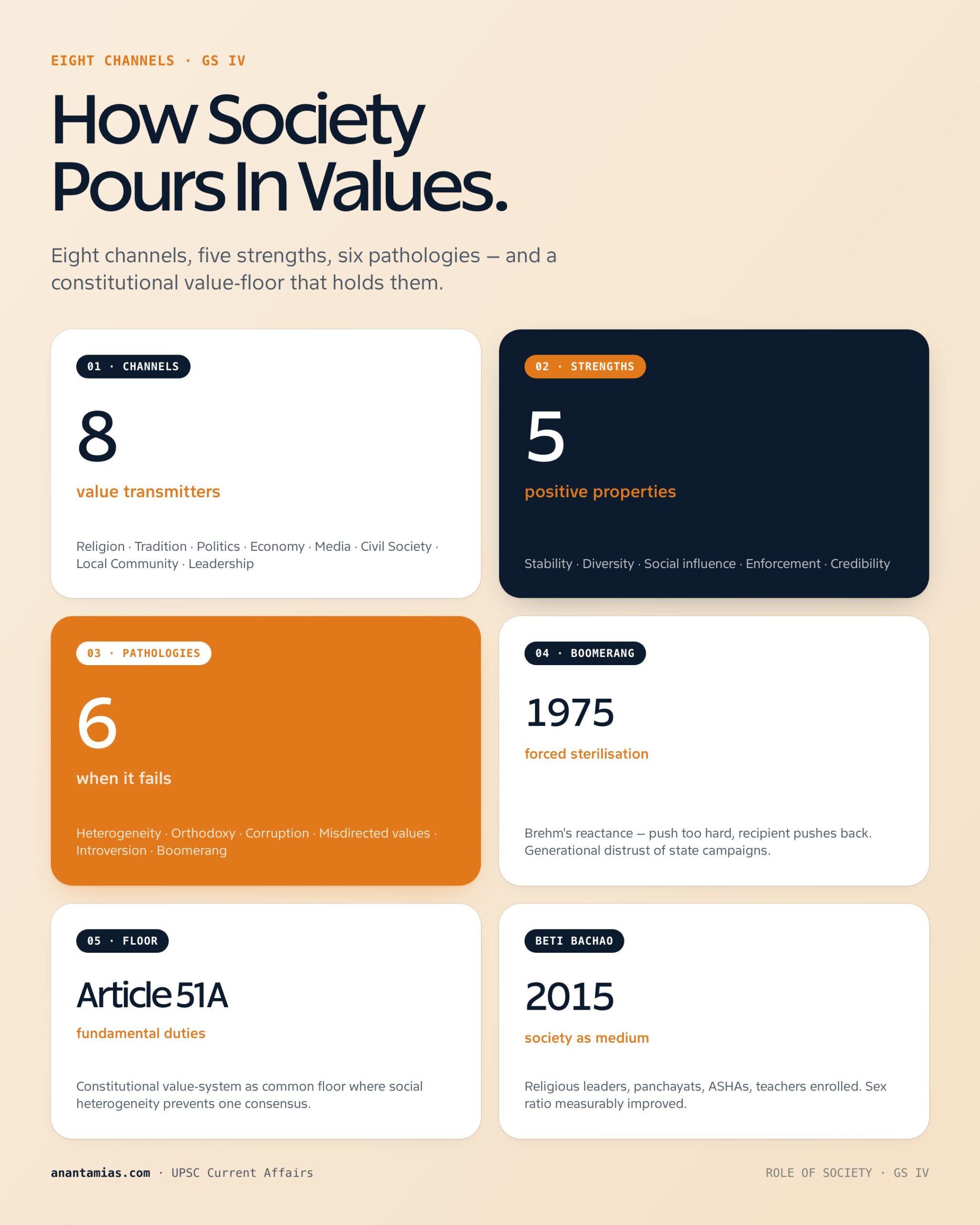
The compass extract lists eight channels.
1. Religion
The earliest and deepest social transmitter of values. Indian religions provide rich value inheritances: dharma (Hinduism), ahimsa and anekantavada (Jainism), karuna and seeing oneself in all beings (Buddhism), kirat-naam-vand chhakna (Sikhism), tawhid, ihsan, sadaqah (Islam), agape and forgiveness (Christianity), honesty and humility in Sanatana traditions and tribal animism alike.
Religion's role in modern India is constitutionally bounded — Article 25 protects free profession; Article 28 prohibits state sponsorship of religious instruction in state-funded institutions. Society retains religion as a value source; the state does not.
2. Traditions and Customs
Traditions transmit accumulated wisdom about how to live. Atithi devo bhava (the guest is divine), vasudhaiva kutumbakam, shraddha (faith and reverence), sahbhojan (eating together), dana (gift-giving) — all are traditional value-instruments.
Some traditions, however, encode injustice — untouchability, child marriage, dowry, sati. The role of society in inculcating values is not unambiguously positive; the constitutional civil servant has to reform from within while respecting what is worth keeping.
3. Politics
Political life shapes the value-vocabulary of a society. Universal adult suffrage (Article 326) inculcated the value of political equality. The Right to Information Act, 2005 inculcated transparency. Reservation policy inculcated affirmative justice. Political parties, social movements, agitations, and electoral campaigns are sites of value inculcation at scale.
"The most violent element in society is ignorance." — Emma Goldman
4. Economy
The dominant economic system of a society shapes its values. A subsistence agrarian society values land, family labour, weather-knowledge. An industrial society values punctuality, specialisation, efficiency. A service / digital economy values communication, learning agility, customer-centrism.
India's mixed economy combines agrarian, industrial, and service value-clusters — which is one source of the cultural complexity Indian civil servants have to navigate.
5. Media
In the twenty-first century, media is the scaled instrument of value inculcation — for better and worse.
- Public-service broadcasting (DD, AIR) inculcated national integration values for decades.
- Private television inculcated consumerist and aspirational values from the 1990s.
- Social media in 2020s simultaneously democratises voice and amplifies division.
Media literacy is now a civic value in itself — a society that cannot read its own media slips into manipulation.
6. Civil Society
Civil society — voluntary associations, NGOs, religious-charitable bodies, professional associations, RWAs, SHGs, trade unions — inculcates values through participation. A member of a self-help group learns cooperation, collective bargaining, financial discipline. A member of a bhajan mandali learns shared cultural inheritance.
The Indian Constitution explicitly trusts civil society — Article 19(1)(c) protects the right to form associations, and Article 51A(e) asks citizens to promote harmony.
7. Local Community
The mohalla, the village, the gali, the housing colony is where values get tested daily. Local community is where children learn that the postman, the autorickshaw driver, the maid, the policeman, the school teacher are all members of one shared moral universe — or, alternatively, where children learn the opposite. Panchayati Raj institutions (73rd and 74th Amendments) institutionalise local community as a site of public-value formation.
8. Leadership
Society's leaders — political, spiritual, intellectual, sporting — are intense value-transmitters. The leader who behaves with integrity in public life inculcates integrity in millions of admirers; the corrupt leader inculcates the opposite.
"The supreme quality of leadership is integrity." — Dwight D. Eisenhower
For Indian society in 2026, the value-effect of past leaders — Gandhi, Patel, Nehru, Ambedkar, Bose, Rajaji, Jayaprakash Narayan — continues to operate alongside the value-signals of contemporary leadership.
Strengths of Society in Value Inculcation
The compass extract lists five strengths.
Stability and Harmony
A shared value-system gives society stability. Without overlapping values, every interaction would have to be negotiated from scratch. Markets, courts, marriages, schools all rely on a baseline of shared values.
Diversity
Indian society is a layered repository of values — pluralism is a value in itself. Unity in diversity is not just a slogan; it is an operating principle of inter-community ethical exchange.
Social Influence
Society provides the sanction that gives values force. Praise, blame, exclusion, honour — these are the mechanisms by which a community sustains its values. Robert Cialdini's social-influence research and Indian log kya kahenge (what will people say) describe the same phenomenon.
Enforcement
Where private conscience fails, social enforcement steps in — gossip, ostracism, withdrawal of trust, public disapproval. The Hawthorne effect (people behave better when observed) is the workplace cousin of social enforcement.
Credibility
Values transmitted by trusted social actors — elders, religious figures, respected teachers — have higher psychological purchase than values transmitted by impersonal sources. This is why public-information campaigns now routinely partner with respected community figures.
Issues in the Role of Society — When the Mechanism Fails
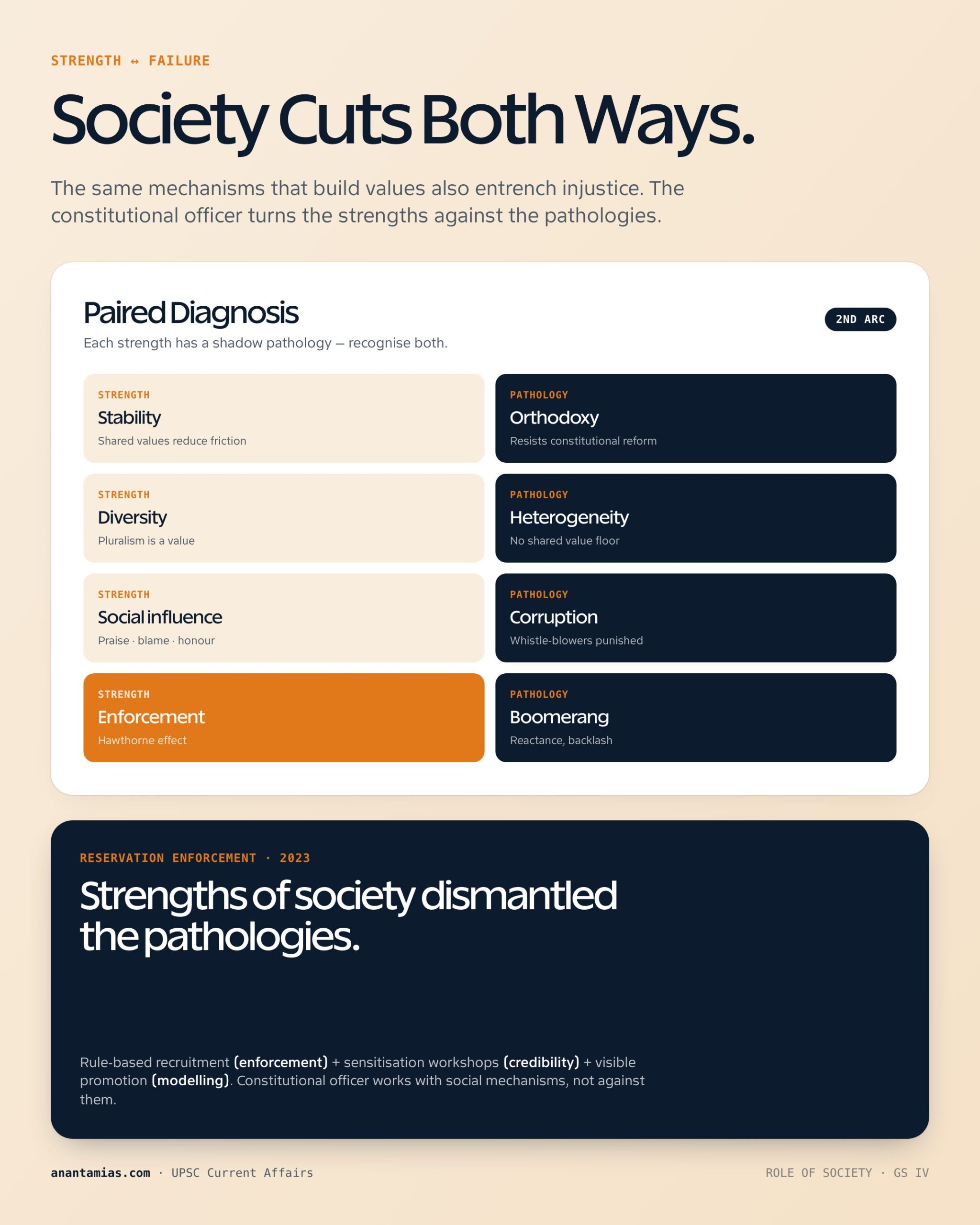
The compass extract lists six pathologies.
1. Heterogeneity
A heterogeneous society can struggle to produce a shared value-floor. Different communities transmit different values; the public servant has to navigate without imposing one community's values on another. The constitutional answer is the constitutional value-system as the common floor.
2. Orthodoxy
When tradition becomes rigid, the society resists reform even where reform is constitutionally required. Caste-based exclusion, dowry, female foeticide — orthodoxy preserves these against legal abolition.
3. Corruption
If the dominant social ethos is corrupt — speed money, jugaad, favour-trading — the conscientious individual is socialised against her own values. Whistle-blowers in such environments face social punishment even when they are constitutionally right.
4. Misdirected Values
Society sometimes inculcates values that are toxic — communal hatred, exclusion of minorities, militarism, hyper-consumerism. The role of education, law, and conscience is corrective.
5. Introversion
Some individuals are temperamentally introverted and do not absorb values transmitted communally. The compass note is empirical: not everyone receives equally what society broadcasts. Public-information design needs both broad and targeted channels.
6. Boomerang Effect
The compass identifies a subtle pathology: sometimes society uses harsh and unreasonable methods to inculcate values that are not understood by individuals which compels people to rebel. Forced value induction often produces the opposite of the intended value. This is psychological reactance (Brehm, 1966) — the more you push, the harder the recipient pushes back.
The Emergency (1975-77) is the standard Indian example — forced sterilisation under coercive sloganeering produced massive backlash and a generational distrust of state-led value campaigns.
Two Indian Case Studies
Case 1 — Beti Bachao Beti Padhao and the Slow Work of Society
The Beti Bachao Beti Padhao scheme launched in 2015 explicitly used society as the medium of value change. Religious leaders, panchayats, school teachers, MGNREGA self-help groups, ASHA workers, and local-level officers were enrolled as value-transmitters. Sex ratios at birth in target districts improved measurably between 2015 and 2024. The case shows the strengths (social influence, credibility, enforcement, stability) of society as a value-instrument when state intervention works through, not against, social channels.
Case 2 — Reservation Resistance in Recruitment
A district administration in 2023 noticed social resistance to recruiting Dalit candidates into a particular department, despite legally mandated reservation. The dominant local society's orthodoxy and embedded value of caste-superiority worked against the constitutional value of equality. The administration's response combined enforcement (rule-based recruitment), education (sensitisation workshops), and modelling (visible promotion of one Dalit officer to a respected role). The case shows how the constitutional civil servant works with society's strengths to dismantle society's pathologies.
UPSC Syllabus Relevance
GS-IV explicitly names role of family, society and educational institutions in inculcating values. This is a high-frequency Mains topic.
Past-Year Prompts
- "How could you as a civil servant come up against the menace of corruption? Discuss in the context of the foundational values of civil services." — 2014 (society's role implicit).
- "Today we find that in spite of various measures of prescribing codes of conduct, setting up vigilance cells/commissions, RTI, and so on… corruption still remains a serious problem. Discuss the role of society in inculcating values that prevent such behaviour." — 2015 paraphrased.
- "Why should impartiality and non-partisanship be considered as foundational values in public services, especially in the present-day socio-political context?" — 2016.
- "What do you understand by 'probity' in public life? What are the difficulties in practising it in the present times? How can these difficulties be overcome?" — 2014.
- "Discuss the role of family, society and educational institutions in inculcating values among children." — 2018.
Mains Answer-Writing Tips
- Use the eight channels as the structuring frame; pick four to elaborate.
- Pair each strength with one pathology to show analytical balance.
- Quote Article 51A for the constitutional anchor.
- Use Beti Bachao and reservation enforcement as the standard Indian case studies.
- Close with the constitutional value-floor as the resolution to social heterogeneity.
Prelims Pointers
- Article 51A — Fundamental Duties — citizens' role in inculcating values.
- Article 19(1)(c) — right to form associations — civil society as value-channel.
- National Education Policy, 2020 — value education explicitly mandated.
- Emile Durkheim, The Elementary Forms of the Religious Life (1912) — society as the source of moral order.
- Talcott Parsons — socialisation as the central mechanism of value transmission.
FAQ
Is the family or the wider society more important in value inculcation?
The family is primary in early years; society dominates from school age onward. Both matter, but the family lays the affective foundation on which society later builds.
Can the state directly inculcate values?
Within constitutional limits — yes. NEP 2020, school curricula, public-information campaigns, civil-service training are state instruments of value education. The state cannot, however, coerce conscience.
What is the role of the educational institution?
The school is the planned, structured, scalable value-transmitter. It can correct family-level deficits and prepare citizens for constitutional life. India's challenge has been the quality and reach of this institution.
How does globalisation affect society’s role in inculcating values?
Globalisation introduces competing value sets through media, migration, and economic exchange. The compass note on heterogeneity becomes more pressing. The Indian response has been to anchor in constitutional values while remaining open to global learning — unity in diversity, but on a constitutional floor.
Can a civil servant do anything against negative social values?
Yes. The officer has the law, the budget, the convening authority, the visible role. Used patiently — through enforcement, persuasion, modelling, partnership with civil society — the conscientious officer is one of society's most effective reformers.
Society is both the soil from which the civil servant's own values grew and the soil she now tends as a public servant. Knowing how that soil works — its strengths, its pathologies, its eight channels — is the foundation of every value-inculcation question in GS-IV.
Society is both the soil from which the civil servant's own values grew and the soil she now tends as a public servant. Knowing how that soil works — its strengths, its pathologies, its eight channels — is the foundation of every value-inculcation question in GS-IV.
Tell Google you want more of this.
Add Anantam IAS as a preferred sourceOne tap, and this site shows up more often in your own Top Stories, AI Overviews and AI Mode. Remove it any time.