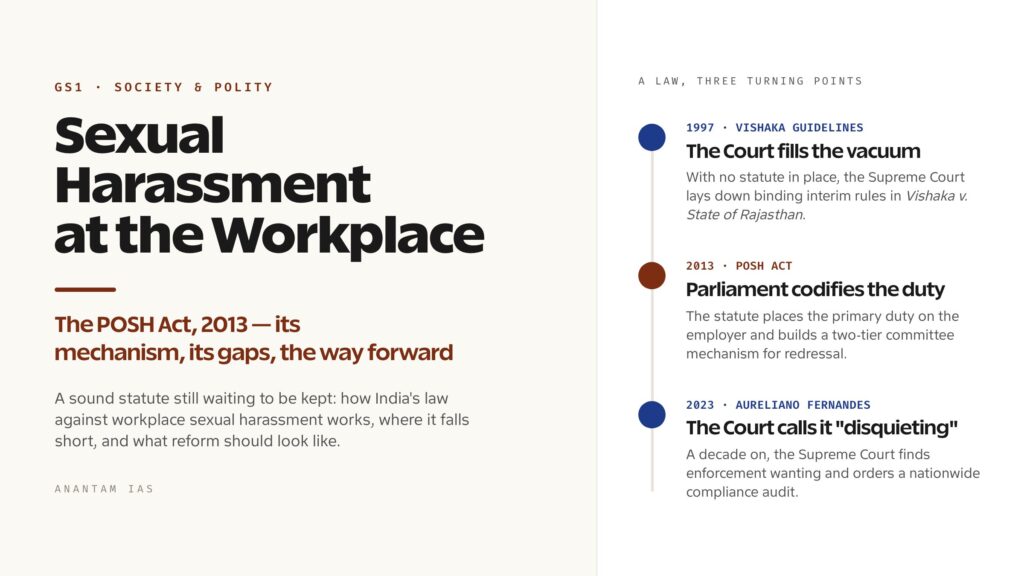
Pick up the text of a single law and you can read a country’s intentions. India’s principal statute against workplace sexual harassment is the Sexual Harassment of Women at Workplace (Prevention, Prohibition and Redressal) Act, 2013, known everywhere as the POSH Act. It promises something plain and important: that a woman should be able to earn a living without being made to trade her dignity for it. More than a decade on, the promise on paper and the protection in practice have not quite met.
The reason this matters goes beyond any single workplace. When women leave jobs after harassment, or never take certain jobs because they fear it, the loss is counted in careers cut short and in a labour market that runs at half power. India’s female labour force participation rate has climbed to 41.7% in 2023-24, according to the Periodic Labour Force Survey, up sharply from 23.3% in 2017-18. Keeping that rise going depends partly on whether the workplace feels safe to walk into. So the POSH Act is not only a women’s-rights law. It is also, quietly, an economic one.
What the Law Actually Says
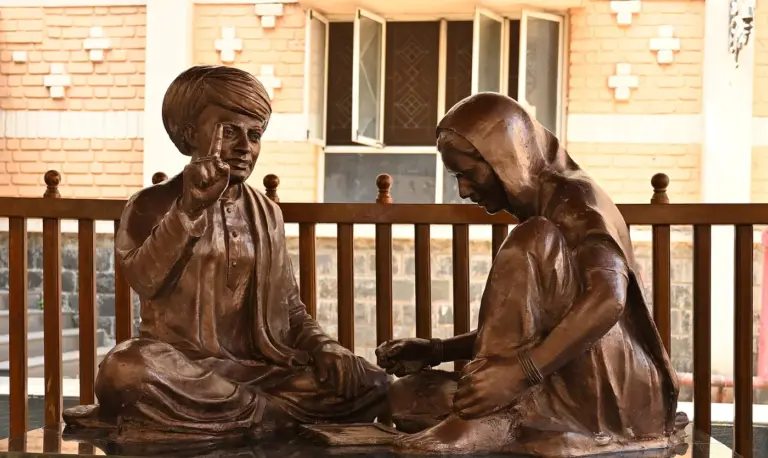
The POSH Act did not appear from nowhere. It grew out of the Supreme Court’s Vishaka Guidelines of 1997, handed down in Vishaka v. State of Rajasthan after the gang-rape of Bhanwari Devi, a social worker attacked for trying to stop a child marriage. Because there was no statute then, the Court read the Constitution’s guarantees of equality, life and the right to practise any profession together with India’s obligations under the international women’s-rights convention, CEDAW, and laid down binding interim rules. Those rules governed Indian workplaces for sixteen years until Parliament finally passed the POSH Act in 2013.
The Act’s definition is broad on purpose. Sexual harassment covers unwelcome physical contact and advances, a demand or request for sexual favours, sexually coloured remarks, showing pornography, and any other unwelcome verbal, non-verbal or physical conduct of a sexual nature. It also names the situations that turn such conduct into harassment under the law: an implied or explicit promise of favourable treatment, a threat of detrimental treatment, a threat about present or future employment, interference that creates a hostile or intimidating work environment, or humiliating treatment likely to affect a woman’s health or safety. The word doing the heavy lifting throughout is “unwelcome.” The test is the woman’s experience, not the harasser’s intent.
Two ideas in that definition are worth pausing on, because they decide how far the law reaches. The first is the “hostile work environment” limb, which moves the law beyond the crude quid-pro-quo of “sleep with me or lose your job” to the steady, low-grade conduct that wears a woman down without any single dramatic incident. The second is the deliberately wide notion of “workplace” itself: the Act extends to any place a woman visits arising out of her employment, including transport provided by the employer, so harassment on a work trip or in an office cab is not outside the law simply because it happened past the office gate.
Two features anchor the rest. First, the law places the primary duty on the employer, not the victim, to provide a safe workplace and a working complaints mechanism. Second, it builds a two-tier redressal structure so that, in theory, no working woman is left without a door to knock on.
How the Mechanism Is Meant to Work
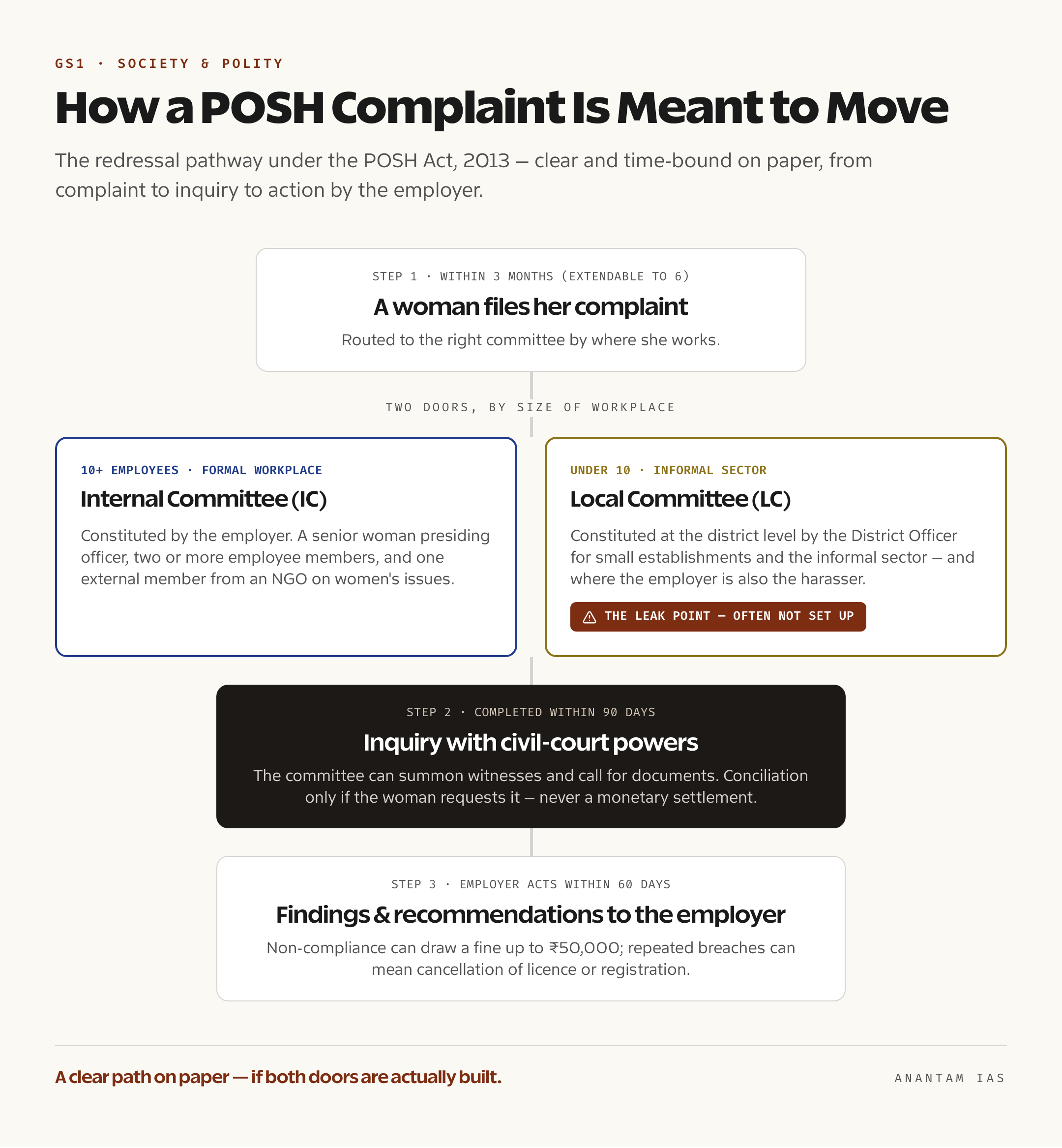
Every workplace with ten or more employees must set up an Internal Committee, usually still called the ICC. The law is specific about who sits on it, because composition is what keeps it honest. The presiding officer must be a senior woman employee. There must be at least two more employee members, ideally with some commitment to the cause of women or legal knowledge, and one external member from an NGO or association working on women’s issues. That outsider matters: it is the one seat the employer does not fill from within, and it exists to dilute the home-team bias of a committee judging its own organisation.
For the vast world of work that the ICC cannot reach, the Act creates a Local Committee at the district level, constituted by the District Officer. The Local Committee is meant to receive complaints from establishments with fewer than ten employees and from the informal sector, including the woman who is harassed by an employer who is also the person she would otherwise complain to. On paper, then, the domestic worker, the construction labourer and the small-shop assistant all have somewhere to go.
The process is built to be quicker and gentler than a criminal trial without being toothless. A complaint must usually be filed within three months of the incident, extendable to six. The committee conducts an inquiry with civil-court powers to summon witnesses and call for documents, and must complete it within 90 days. It then sends its findings and recommendations to the employer, who is to act within 60 days. The Act also allows conciliation if the woman requests it, though no monetary settlement is permitted. Non-compliance by an employer can draw a fine of up to fifty thousand rupees, and repeated breaches can mean cancellation of the business licence or registration.
Where the Law Falls Short
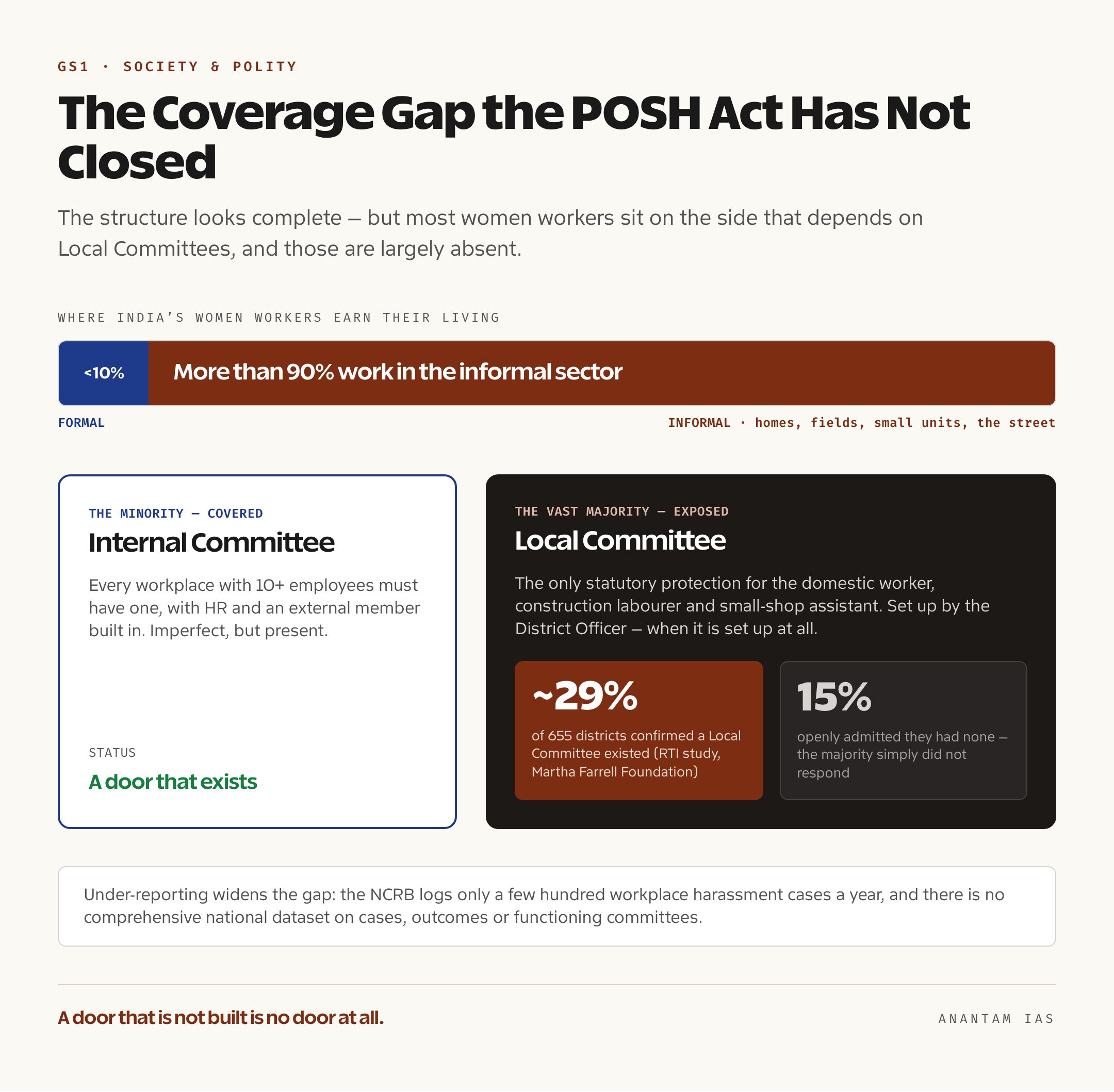
The clearest failure is geographic and structural at once: the informal sector. More than 90% of India’s women workers earn their living outside the organised economy, in homes, fields, small units and on the street, where there is no Internal Committee and no HR department. Their only statutory protection is the Local Committee. And the Local Committee is, across much of the country, missing. An early Right to Information study by the Martha Farrell Foundation, covering 655 districts, found that only about 29% confirmed they had set one up, while 15% admitted they had not and the majority simply did not respond. Of the committees that did exist, very few met the law’s requirements on composition. A door that is not built is no door at all.
Under-reporting compounds the gap. The National Crime Records Bureau logs only a few hundred workplace harassment cases a year, a figure everyone who works on the issue treats as a fraction of the reality rather than a measure of it. The reasons are familiar and heavy: fear of retaliation, the stigma that often attaches to the woman rather than the man, family pressure to stay silent, slow internal processes, and the simple economic truth that a poor woman who reports may lose the job she cannot afford to lose. There is also no comprehensive national dataset on cases filed, outcomes reached or committees functioning, which makes the scale of the problem easy to lose sight of.
Critics point to design flaws too. Internal Committee members exercise civil-court powers without any legal training requirement, which means the body weighing a serious allegation may have no grounding in evidence or natural justice, the very failing the Supreme Court later seized on. The employer nominates the very committee meant to scrutinise the employer, a built-in conflict of interest that is sharpest exactly where it matters most, when the person complained against is senior or powerful. A provision penalising “false or malicious” complaints, however well-intended, can chill genuine reporting, because a frightened woman weighs the risk of being disbelieved and then punished. And the conciliation route sits awkwardly with the seriousness of the conduct, treating something close to an offence as a dispute to be settled.
There is, finally, an unresolved debate about scope. The POSH Act protects only women. It does not cover men, transgender persons or the harassment of one woman by another, and India has not ratified the International Labour Organization’s Convention 190 of 2019, the first global treaty on violence and harassment in the world of work, which takes a far broader, gender-inclusive view of who can be harmed and where. Some argue the law should stay focused on the structural disadvantage women face at work; others say dignity at the workplace cannot logically be rationed by gender. Whether and how to widen the law is now a live policy question rather than a settled one.
Recent Developments
The Supreme Court reopened the implementation question forcefully in May 2023 in Aureliano Fernandes v. State of Goa. The case itself turned on an inquiry conducted in undue haste against a university teacher, and the Court set that finding aside for breaching natural justice. But the judges went much further, calling the state of POSH enforcement, a decade after the law, “disquieting.” They issued a long set of directions: governments and Union Territories were to audit whether ministries, public bodies, universities and institutions had actually constituted their committees, and to make compliance and committee details public. The Court asked for a nationwide survey and ordered chief secretaries to report.
When that data did not arrive cleanly, the Court kept the matter alive. In August 2025 it directed every state and Union Territory to run a fresh district-wise survey, this time through the labour machinery, with district labour officers checking under Section 4 whether workplaces have set up their committees, all within six weeks, and to upload the results to the central portal. The Court also flagged that licences can be withheld from non-compliant employers. The signal is unambiguous: the bench is treating non-constitution of committees not as a paperwork lapse but as a denial of a statutory right.
The other notable move is administrative. The Ministry of Women and Child Development relaunched the She-Box portal, the Sexual Harassment electronic Box, in August 2024 as a single online window for filing complaints across the public and private sectors, with better tracking and the ability to route a complaint to the correct committee. Early usage is modest, with a few hundred complaints filed since relaunch, which tells its own story about awareness and trust rather than about the absence of harassment.
The Way Forward
The honest diagnosis is that India does not mainly need a new law; it needs the law it already has to actually exist on the ground. So the first priority is implementation: a real, audited, published count of which workplaces and which districts have functioning committees, exactly the exercise the Supreme Court has now ordered, sustained beyond a single round of affidavits.
The second priority is reaching the women the Act has so far missed. That means making Local Committees genuinely available, arguably by moving them closer to people at the block or tehsil level, giving them a budget line and full-time support, and writing sector-specific protocols for domestic, garment, gig and construction work where vulnerability is highest. Awareness has to travel the same last mile, through panchayat training, MSME clusters and school and college curricula, so that a woman knows the door exists before she needs it.
Reform of design should follow the evidence. Several committees and commentators have urged independent or external adjudication to cure the conflict-of-interest problem, mandatory orientation and basic legal training for committee members, a rethink of the chilling false-complaint clause, and a serious public debate on broadening the law toward the gender-inclusive standard of ILO Convention 190. The penalty structure deserves a look as well, since a fifty-thousand-rupee ceiling is a rounding error for a large company and unlikely to change behaviour. And prevention belongs beside redressal: a committee that only acts after harm has occurred is doing half the job the Act actually assigns the employer.
Better data is the thread running through all of it: you cannot manage what you refuse to measure, and the absence of a credible national picture has let poor compliance hide in plain sight for a decade. None of this is exotic. It is the unglamorous work of making a sound statute do what it already promises, so that the right to work and the right to dignity stop being read as separate clauses.
For Your Mains Answer
This topic is core to GS Paper 1 (the status of women, women’s empowerment and social issues), sits squarely in GS Paper 2 (welfare legislation, the mechanisms and institutions that implement it, and the role of the judiciary), connects to GS Paper 3 (labour, the informal economy and female labour force participation) and offers a clean GS Paper 4 angle on dignity, gender justice and institutional integrity. It is also strong material for the Essay paper on women and work.
How to Build the Answer
Move from origin to outcome. Open with Vishaka and why a court had to write the rules first, pivot to what the POSH Act codified, explain the two-tier committee mechanism, then turn to the gaps with the informal sector front and centre, use Aureliano Fernandes as the proof that even the courts are dissatisfied, and close with a layered reform package. The arc law to mechanism to gap to judicial push to reform reads as analysis rather than recall.
Common Mistakes to Avoid
Don’t describe the POSH Act as if it covers everyone; its limitation to women and to the formal sector’s committees is the heart of the critique. Don’t confuse the Internal Committee with the Local Committee. Don’t treat the Vishaka Guidelines and the Act as the same thing; the point is that the Act replaced the interim judicial code. And keep the tone sober, this is a dignity question, not a place for rhetoric.
A Compact Answer Spine
Vishaka 1997 fills a legislative vacuum → POSH Act 2013 codifies it, employer’s duty, broad definition → Internal Committee for 10-plus employees, Local Committee for the rest, 90-day inquiry → gaps: informal-sector exclusion, absent Local Committees, under-reporting, conflict of interest, scope debate → Aureliano Fernandes and the 2025 compliance survey → way forward: implement, reach the informal worker, fix the design, measure.
Diagram or Flowchart Idea
Draw the redressal pathway as a single flow: complaint → Internal Committee (10+ employees) or Local Committee (informal sector, fewer than 10) → 90-day inquiry with civil-court powers → findings to employer → action within 60 days. A parallel side-bar can mark the leak point, where the Local Committee branch is often missing.
A Balanced-Conclusion Line
“The POSH Act is a well-drafted promise still waiting to be kept; the task before India is less to rewrite the law than to make it reach the woman it was written for.”
How to Use Data Without Cramming
Two or three anchors carry an answer: female labour force participation at 41.7% in 2023-24 (PLFS) to frame the stakes, the fact that over 90% of women workers are in the informal sector to size the gap, and the May 2023 Aureliano Fernandes directions plus the August 2025 district survey to show the judiciary’s active push. Name the source in the sentence and stop there.
FAQ
What is the difference between the Vishaka Guidelines and the POSH Act? The Vishaka Guidelines were binding rules laid down by the Supreme Court in 1997 in Vishaka v. State of Rajasthan because no law existed. They were a stopgap. The POSH Act, 2013 is the statute Parliament finally passed to codify and replace those guidelines with enforceable law.
Which workplaces must set up an Internal Committee? Every workplace with ten or more employees must constitute an Internal Committee, headed by a senior woman, with at least two more employee members and one external member from an NGO working on women’s issues. Establishments with fewer than ten employees, and the informal sector, are covered by a district-level Local Committee instead.
Does the POSH Act cover the informal sector and domestic workers? On paper, yes, through the Local Committee at the district level. In practice this is the Act’s weakest link, because Local Committees are often not constituted or are dormant, leaving the more than 90% of women workers in the informal economy with little real recourse.
What did the Supreme Court say in the Aureliano Fernandes case? In May 2023 the Court called the implementation of the POSH Act, a decade on, “disquieting” and issued directions for governments, public bodies and universities to audit and publicise whether committees had actually been constituted. It later ordered, in 2025, a district-wise compliance survey through the labour departments.
Practice Questions
Prelims MCQs
- With reference to the Sexual Harassment of Women at Workplace (Prevention, Prohibition and Redressal) Act, 2013, consider the requirement for an Internal Committee. An Internal Committee must be constituted at a workplace having how many employees?
(a) 5 or more
(b) 10 or more
(c) 20 or more
(d) 50 or more
Answer: (b) The Act mandates an Internal Committee in every workplace with ten or more employees. - Which of the following is correctly matched regarding the POSH Act, 2013?
(a) Local Committee — constituted by the employer
(b) Internal Committee — constituted by the District Officer
(c) Local Committee — constituted at the district level by the District Officer
(d) Internal Committee — constituted by the State Government
Answer: (c) The Local Committee is constituted at the district level by the District Officer to cover small establishments and the informal sector. - The POSH Act, 2013 traces its direct origin to which of the following?
(a) The Bhanwari Devi case and the Vishaka v. State of Rajasthan judgment
(b) The Mathura custodial case
(c) The Visakha district administration order
(d) The 73rd Constitutional Amendment
Answer: (a) The Act codified the Vishaka Guidelines (1997), laid down by the Supreme Court after the gang-rape of social worker Bhanwari Devi. - Consider the following about the inquiry process under the POSH Act, 2013:
1. The Internal Committee has the powers of a civil court for gathering evidence.
2. The inquiry is to be completed within 90 days.
3. Monetary settlement is the preferred mode of conciliation.
Which of the statements are correct?
(a) 1 and 2 only
(b) 2 and 3 only
(c) 1 and 3 only
(d) 1, 2 and 3
Answer: (a) The committee has civil-court powers and must finish the inquiry in 90 days; conciliation is allowed only on the woman’s request and cannot be a monetary settlement. - The “She-Box” associated with workplace safety refers to:
(a) A women’s savings scheme of the Finance Ministry
(b) An online portal to file sexual harassment complaints, maintained by the Ministry of Women and Child Development
(c) A self-help-group credit window under NRLM
(d) A grievance cell of the National Commission for Women
Answer: (b) The She-Box (Sexual Harassment electronic Box) is the central online complaint portal under the Ministry of Women and Child Development, relaunched in 2024.
Mains Practice Questions
- Trace the evolution of India’s law against workplace sexual harassment from the Vishaka Guidelines to the POSH Act, 2013, and explain why the shift from judicial guidelines to statute mattered. (10 marks, 150 words)
- “The POSH Act, 2013 is sound in design but hollow in implementation.” Critically examine, with reference to the informal sector and the functioning of Local Committees. (15 marks, 250 words)
- Examine the role of the Supreme Court in enforcing the POSH Act, with specific reference to the directions issued in Aureliano Fernandes v. State of Goa (2023) and subsequent compliance measures. (15 marks, 250 words)
- Discuss how gaps in protection against workplace sexual harassment affect female labour force participation in India, and suggest measures to close them. (15 marks, 250 words)
- Should India’s law against workplace sexual harassment be made gender-neutral and aligned with ILO Convention 190? Present a balanced view. (10 marks, 150 words)
Tell Google you want more of this.
Add Anantam IAS as a preferred sourceOne tap, and this site shows up more often in your own Top Stories, AI Overviews and AI Mode. Remove it any time.