Auroville is an international township near Puducherry, founded on 28 February 1968 by Mirra Alfassa, known as the Mother, of the Sri Aurobindo Ashram. It is planned for 50,000 people, has about 3,300 residents from some 60 countries and, since 1988, has been run under a law Parliament wrote for this one township: the Auroville Foundation Act.
Many aspirants file Auroville under spiritual tourism and move on. That is where the marks leak. Questions on Auroville rarely test the golden dome at its center; they test the UNESCO resolutions, the 1988 Act, a 1982 Supreme Court ruling on what counts as a religious denomination and the 2025 judgments on who actually governs the township.
Read it as a governance case with a spiritual origin, and the facts fall into place.
Where Auroville Is and How Big It Is Meant to Be
Auroville sits mostly in Tamil Nadu, with some parts in the Union Territory of Puducherry, a few kilometers inland from the Coromandel Coast. That split location is itself a common Prelims trap, because the township is usually described as being in Puducherry.
- About 150 km south of Chennai and 10 km north of Puducherry town.
- City area: 2.5 km in diameter, or 5 km including the green belt.
- Planned population: 50,000.
- Current population: about 3,300, drawn from around 60 nationalities.
The gap between 3,300 and 50,000 is worth holding on to. Almost six decades after its founding, Auroville has reached well under a tenth of its planned size, and much of the later conflict is really an argument about how fast it should grow. The Union Territory itself is covered in the note on Union Territories of India.
Origin: The Mother’s Idea and the 1968 Inauguration
The idea of an ideal township devoted to human unity came to the Mother as early as the 1930s, by Auroville’s own account. In the mid-1960s she put the concept before the Government of India, which backed it and took it to UNESCO. The philosophical roots lie in Sri Aurobindo’s thought, covered in the notes on Sri Aurobindo Ghosh and on his nineteenth-century response to the West.
The inauguration of 28 February 1968
The founding ceremony was designed as a symbol, and each element carries a fact that turns up in questions.
- About 5,000 people gathered near a lone banyan tree on a barren plateau at the center of the future township.
- The Mother read the Charter in French from her room in Pondicherry, and All India Radio broadcast it live.
- The Charter was then read in 16 languages, starting with Tamil and Sanskrit.
- Young people from 124 nations and from Indian states placed a handful of soil from their homelands in a marble-clad urn shaped like a lotus bud.
The urn still stands in the Amphitheatre, with the handwritten Charter sealed inside it along with the soil.
The Charter in four lines
The Auroville Charter is short, and its first line is the one that matters most for everything that follows.
- Auroville belongs to nobody in particular; it belongs to humanity as a whole. To live there, one must be a willing servitor of the Divine Consciousness.
- It will be a place of unending education, of constant progress and “a youth that never ages”.
- It wants to be the bridge between the past and the future.
- It will be a site of material and spiritual research for “a living embodiment of an actual human unity”.
If a township belongs to nobody in particular, who decides what gets built, who may live there and who manages the money? Every later dispute, from the 1970s to the Supreme Court in 2025, is an attempt to answer that question.
UNESCO’s Support, and What It Is Not
UNESCO has passed five resolutions supporting Auroville: in 1966, 1968, 1970 and 1983, and a fifth on 13 November 2017 at its 39th General Conference, ahead of the township’s 50th anniversary.
- The 1966 resolution commended Auroville as a project of international importance for the future of humanity.
- The resolutions invited member states and international non-governmental organizations to take part in its development as an international cultural township.
- The 2017 resolution asked the Director-General to reinforce UNESCO’s association with Auroville and to mark its 50th anniversary.
- The Auroville Earth Institute holds the UNESCO Chair of Earth Architecture.
Here is the trap. These are General Conference resolutions of support. They are a different thing from inscription on the World Heritage List, which is a separate process altogether, and Auroville does not appear on India’s World Heritage roster in the note on UNESCO World Heritage Sites in India. The organization’s structure is summarized in the note on UNESCO.
From Crisis to Statute: 1980, 1982 and 1988
Auroville’s legal story begins with a quarrel over control. The Sri Aurobindo Society managed the project in its early years. By the late 1970s, as the 1988 Act’s own preamble puts it, “serious difficulties” had arisen over its management, and an audit and a committee chaired by the Lieutenant Governor of Pondicherry reported serious irregularities.
Step 1: the Auroville (Emergency Provisions) Act, 1980
An Ordinance came first, followed by the Auroville (Emergency Provisions) Act, 1980. The Act vested the management of Auroville in the Central Government for a limited period, run by an Administrator with guidance from an International Advisory Council. That was meant as a pause, not a permanent arrangement.
Step 2: S. P. Mittal v Union of India, 1982
The 1980 takeover was challenged in the Supreme Court, and the answer shaped Auroville’s legal identity.
- A five-judge bench decided the case on 8 November 1982.
- It upheld the validity of the Auroville (Emergency Provisions) Act, 1980.
- It held that the Sri Aurobindo Society and Auroville did not constitute a religious denomination, so the Act did not violate Articles 25 and 26.
Why does that matter? Under Article 26, a religious denomination has the right to manage its own affairs in matters of religion. If Auroville had been treated as one, a government takeover of its management would have faced a much harder constitutional test. The case is a standard reference for the religious-denomination test, and it links this note to fundamental rights questions.
Step 3: the Auroville Foundation Act, 1988
The permanent answer came in 1988, and it is the fact most often tested.
- The Auroville Foundation Act is Act No. 54 of 1988. It received the President’s assent on 29 September 1988.
- It acquired all undertakings relatable to Auroville without payment of compensation, vested them first in the Central Government and then in a new body corporate, the Auroville Foundation.
- Its stated aim is the better management and further development of Auroville “in accordance with its original charter”.
- The Auroville Foundation came into existence in January 1991, and the assets were vested in it on 1 April 1992.
- The Foundation is an autonomous body under India’s Ministry of Education.
- Section 22 allows the Central Government to dissolve the Foundation for a specified period by notification, with reasons.
How the Auroville Foundation Act 1988 Organizes Power
The Act creates three authorities and a working arm under one of them. The list is easy to memorize. The balance between them is what the answer needs.
| Body | Composition under the Act | Main role |
|---|---|---|
| Governing Board (Section 11, 17) | Up to seven members nominated by the Centre, plus two Central Government representatives; Chairman nominated by the Centre | General superintendence, direction and management of the Foundation; approves programs; prepares the master plan in consultation with the Residents’ Assembly |
| Residents’ Assembly (Section 18, 19) | All residents aged 18 and above entered in the register of residents | Advises the Governing Board on all activities relating to residents; admits and removes residents under regulations; formulates the master plan for the Board’s approval |
| Working Committee (Section 20) | Up to seven members chosen by the Residents’ Assembly from among themselves | Assists the Residents’ Assembly and the Governing Board |
| International Advisory Council (Section 21) | Up to five members nominated by the Centre; elects its own Chairman | Advises the Governing Board, aiming to encourage Auroville’s ideals and the residents’ freedom to grow |
Read Sections 17 and 19 together, because that is where the trouble lives. Section 17(e) asks the Governing Board to prepare a master plan “in consultation with the Residents’ Assembly”. Section 19(2)(c) says the Residents’ Assembly may “formulate the master plan” for the Board’s approval. Both bodies have a hand on the same document. For years that worked because people broadly agreed. When they disagreed about the pace of building the city, the overlap turned into a legal fight.
Governance Debates and the 2025 Supreme Court Judgments
On 17 March 2025 the Supreme Court decided two appeals filed by the Auroville Foundation, and both went the Foundation’s way. Together they settle, for now, how power is shared inside the township.
The township and environment case
The first case began with a road and some trees.
- A petition before the Tribunal challenged tree-felling for the Crown Road, one of the roads in the master plan, in the Darkali area.
- On 28 April 2022 the National Green Tribunal directed the Foundation to prepare a comprehensive township plan, obtain environmental clearance under item 8(b) of the EIA Notification, 2006, and halt construction until then.
- A bench of Justices Bela M. Trivedi and Prasanna B. Varale set that order aside in The Auroville Foundation v Navroz Kersasp Mody. It held that no substantial question relating to the environment had arisen and that the Tribunal had committed “gross error in assuming the jurisdiction”.
- On principle, the Court said the right to development “equally claims priority under the fundamental rights, particularly under Articles 14, 19 and 21”, and called for sustainable development striking a “golden balance” with the right to a clean environment.
- The Court held that the Auroville Master Plan, approved by the Town and Country Planning Organisation on 15 February 2001 and published in the Official Gazette on 28 August 2010, had “attained a statutory force and a finality”.
- It also faulted the Tribunal for brushing aside the Environment Ministry’s affidavit that the township, under construction long before environmental clearance became mandatory for such projects in 2004, was not a new project needing fresh clearance.
The case sits naturally beside the notes on environmental impact assessment and Article 21, because it is a clean example of development and environment being weighed against each other.
The Residents’ Assembly case
The second case was about who runs the committees.
- In The Auroville Foundation v Natasha Storey, the Madras High Court had in March 2024 struck down the Foundation’s Standing Order No. 01/2022.
- The Supreme Court reversed it and upheld the Governing Board’s power to constitute and reconstitute committees, including the town development council.
- It held that the Residents’ Assembly’s functions are “confined only to advise the Governing Board”.
- It imposed costs of Rs 50,000 on the petitioner.
What the debate is really about
The Charter imagines a township that belongs to nobody in particular. The 1988 Act vests its property in a statutory foundation run by a Board the Centre nominates. For two decades those two ideas lived together because most people agreed on the plan. When they stopped agreeing over how fast to build, the statute won, and the 2025 judgments confirmed that it wins.
Two positions are both defensible. One says a clear chain of authority is what finally lets the Mother’s city get built after decades of drift. The other says a community experiment that answers to a government-nominated Board has stopped being a community experiment. It is wise to present both in an answer and then take a side on the evidence, rather than treat either as obvious.
Matrimandir and the Galaxy Plan
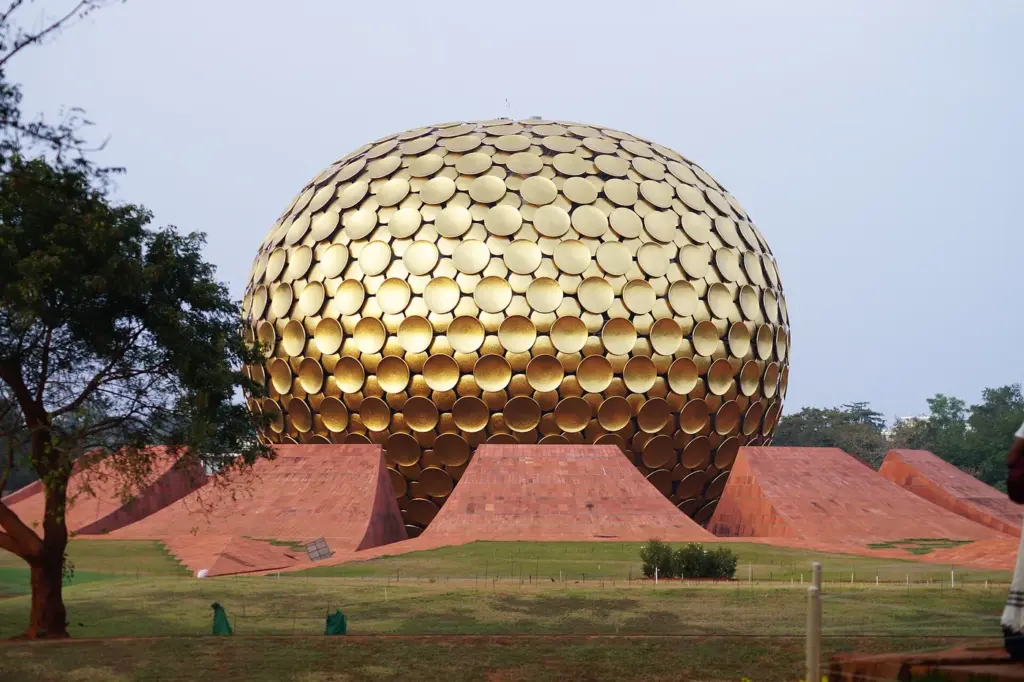
The Matrimandir, meaning Temple of the Mother, is the golden sphere at the center of Auroville, set in an open area called Peace. The Mother described it as the soul of the city.
- The foundation stone was laid on 21 February 1971.
- It was completed as a building in 2008, after 37 years of work.
- It was designed by the French architect Roger Anger.
- It is surrounded by twelve gardens, each named for a quality such as Harmony, Bliss or Progress.
- The Mother insisted it should not become a religion: “I don’t want it to be made into a religion; with all my force I refuse.”
That last line connects straight back to the 1982 judgment. The founder herself rejected the religious frame, and the Court agreed that Auroville was not a religious denomination.
The Galaxy plan is the city’s intended shape: a circular township radiating out from the Matrimandir into Residential, Cultural, Industrial and International zones, held inside a green belt. It is also the plan behind the Crown Road dispute, which is why a design drawn in the 1960s still ends up in court. For the wider planning context, see the note on urbanisation in India.
Auroville at a Glance
| Item | Detail |
|---|---|
| Founded | 28 February 1968 |
| Founder | Mirra Alfassa, the Mother |
| Location | Mostly Tamil Nadu, partly Puducherry; about 10 km north of Puducherry town |
| Planned population | 50,000 |
| Current population | About 3,300 from around 60 nationalities |
| Inauguration | About 5,000 people; soil from 124 nations placed in an urn |
| UNESCO support | Resolutions of 1966, 1968, 1970, 1983 and 2017 |
| Interim law | Auroville (Emergency Provisions) Act, 1980 |
| Key case | S. P. Mittal v Union of India, 8 November 1982 |
| Governing law | Auroville Foundation Act, 1988 (Act No. 54), assent 29 September 1988 |
| Foundation set up | January 1991; assets vested 1 April 1992 |
| Administrative ministry | Ministry of Education |
| Authorities | Governing Board, Residents’ Assembly, International Advisory Council |
| Matrimandir | Foundation stone 21 February 1971; completed 2008 |
| Recent judgments | Two Supreme Court rulings, 17 March 2025 |
How Auroville Is Tested and How to Revise It
Auroville questions come from three directions: culture, polity and environment. Prelims tests the facts in the table. Mains tests the tensions.
- Prelims traps to watch: Auroville as a World Heritage Site (it has UNESCO resolutions, not inscription), Auroville as wholly in Puducherry (it is mostly in Tamil Nadu) and Sri Aurobindo as founder (the Mother founded it).
- Know the three authorities under the Auroville Foundation Act 1988 and which of them is merely advisory.
- For polity answers, use S. P. Mittal to show how the religious-denomination test works under Article 26.
- For environment answers, use the 2025 Crown Road judgment as a case study in balancing development and conservation, and link it to sustainable development.
- For culture and international relations, treat Auroville as an example of India’s cultural diplomacy through UNESCO.
- For revision, compress it to four dates (1968, 1980, 1988, 2025), three bodies and one case.
Final Remarks
Auroville is best studied as a question about governance, not as a spiritual curiosity. It began as a promise that the township would belong to nobody in particular, and it now runs under a statute that gives a centrally nominated Board the final word.
That tension is not a flaw in the notes. It is the topic. An answer that explains how the 1980 takeover, the 1982 judgment, the 1988 Act and the 2025 rulings each moved the balance, and then says clearly where it should rest, will stand out from one that only describes the golden dome.
Frequently Asked Questions
What is Auroville?
Auroville is an international township near Puducherry, founded on 28 February 1968 by Mirra Alfassa, known as the Mother. It is planned for 50,000 people and currently has about 3,300 residents from around 60 nationalities. Since 1988 it has been governed by the Auroville Foundation Act.
Is Auroville in Tamil Nadu or Puducherry?
Mostly in Tamil Nadu. Some parts lie in the Union Territory of Puducherry. The township is a few kilometers inland from the Coromandel Coast, about 10 km north of Puducherry town and about 150 km south of Chennai.
Who founded Auroville?
Auroville was founded by Mirra Alfassa, the Mother, of the Sri Aurobindo Ashram. She read the Auroville Charter in French at its inauguration on 28 February 1968, and the reading was broadcast live by All India Radio. Sri Aurobindo’s thought shaped its ideals, but he was not its founder.
What is the Auroville Foundation Act 1988?
It is Act No. 54 of 1988, which received the President’s assent on 29 September 1988. It acquired the undertakings of Auroville without compensation and vested them in the Auroville Foundation, a statutory body governed by a Governing Board, a Residents’ Assembly and an International Advisory Council. The Foundation is an autonomous body under the Ministry of Education.
Is Auroville a UNESCO World Heritage Site?
No. UNESCO’s General Conference passed resolutions supporting Auroville in 1966, 1968, 1970, 1983 and 2017. Those are resolutions of support, which are a separate thing from inscription on the World Heritage List.
What did the Supreme Court decide in S. P. Mittal v Union of India?
In its judgment of 8 November 1982, a five-judge bench upheld the Auroville (Emergency Provisions) Act, 1980. It held that the Sri Aurobindo Society and Auroville were not a religious denomination, so the Act did not violate Articles 25 and 26.
What did the Supreme Court decide about Auroville in 2025?
On 17 March 2025 the Court set aside a National Green Tribunal order that had halted construction pending environmental clearance, held that the Master Plan approved in 2001 had attained statutory force, and stressed a balance between development and a clean environment. In a second case the same day, it upheld the Governing Board’s power over committees and held that the Residents’ Assembly’s role is advisory.
What is the Matrimandir?
The Matrimandir, meaning Temple of the Mother, is the golden sphere at the center of Auroville. Its foundation stone was laid on 21 February 1971 and it was completed as a building in 2008. It was designed by the French architect Roger Anger, and the Mother insisted it should not be made into a religion.
Practice Questions
Prelims MCQs
Q1. Auroville, the international township near Puducherry, was founded in 1968 by:
(a) Sri Aurobindo
(b) Mirra Alfassa, the Mother
(c) Roger Anger
(d) Indira Gandhi
Answer: (b) The Mother founded Auroville on 28 February 1968; Roger Anger was the architect of the Matrimandir.
Q2. Consider the following statements: 1. Auroville is located entirely within the Union Territory of Puducherry. 2. The Auroville Foundation is an autonomous body under the Ministry of Education. 3. The Auroville Foundation Act was enacted in 1988. Which of the statements given above are correct?
(a) 1 and 2 only
(b) 2 and 3 only
(c) 1 and 3 only
(d) 1, 2 and 3
Answer: (b) Auroville lies mostly in Tamil Nadu, with only some parts in Puducherry.
Q3. Under the Auroville Foundation Act, 1988, which body consists of all registered residents of Auroville aged 18 and above?
(a) Governing Board
(b) Working Committee
(c) Residents’ Assembly
(d) International Advisory Council
Answer: (c) Section 18 constitutes the Residents’ Assembly from all residents entered in the register of residents.
Q4. In S. P. Mittal v Union of India (1982), the Supreme Court held that:
(a) Auroville is a religious denomination protected by Article 26
(b) The Auroville (Emergency Provisions) Act, 1980 was valid and Auroville was not a religious denomination
(c) Parliament lacked legislative competence to take over Auroville
(d) The management of Auroville must be returned to the Sri Aurobindo Society
Answer: (b) The five-judge bench upheld the 1980 Act and found no violation of Articles 25 and 26.
Q5. UNESCO’s General Conference has passed resolutions supporting Auroville in which of the following years? 1. 1966 2. 1983 3. 2017. Select the correct answer using the code given below.
(a) 1 only
(b) 1 and 2 only
(c) 2 and 3 only
(d) 1, 2 and 3
Answer: (d) UNESCO passed resolutions in 1966, 1968, 1970 and 1983, and a fifth in November 2017.
Mains Questions
- Auroville’s Charter says the township belongs to nobody in particular, yet it is governed by a statutory foundation. Examine this tension with reference to the Auroville Foundation Act, 1988. (15 marks, 250 words)
- Discuss the significance of S. P. Mittal v Union of India (1982) for the meaning of religious denomination under Article 26 of the Constitution. (10 marks, 150 words)
- With reference to the Supreme Court’s 2025 Auroville judgment, discuss how courts balance the right to development with environmental protection. (15 marks, 250 words)
- Evaluate Auroville as an instrument of India’s cultural diplomacy and soft power. (10 marks, 150 words)
- What lessons can Indian urban planning draw from Auroville’s Galaxy plan and the difficulties in implementing it? (10 marks, 150 words)
Tell Google you want more of this.
Add Anantam IAS as a preferred sourceOne tap, and this site shows up more often in your own Top Stories, AI Overviews and AI Mode. Remove it any time.