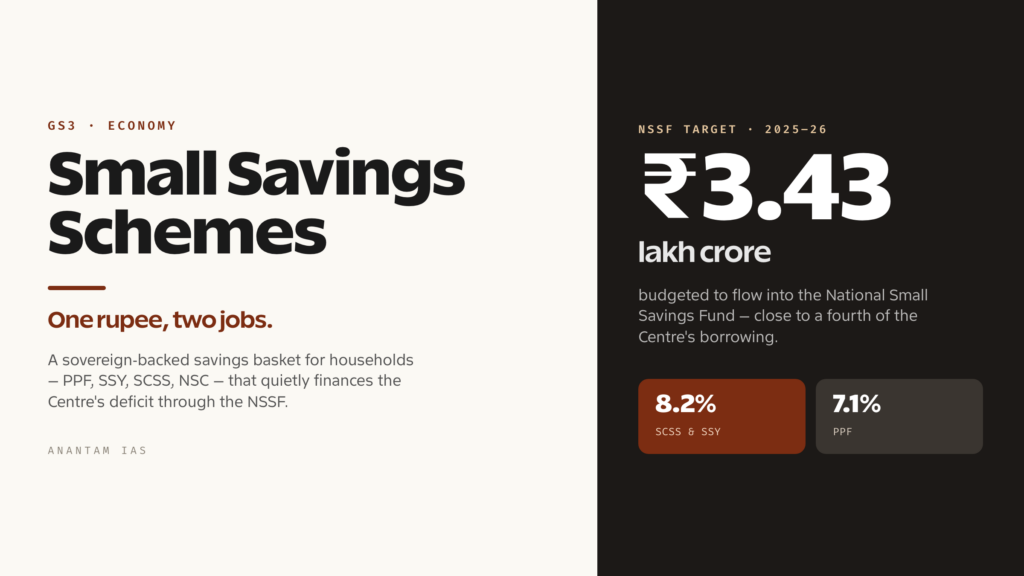
Walk into any post office in a small town and you’ll see the queue that explains India’s savings habits better than any survey. A retired schoolteacher renewing a Senior Citizens’ deposit. A young father opening a Sukanya Samriddhi account in his daughter’s name. A daily-wage worker buying a Kisan Vikas Patra because it’s the one place his money can’t disappear overnight. None of them is talking about mutual funds or index returns. They want a government stamp on their savings and a rate they can count on. That’s what small savings schemes have offered for decades, and it’s why roughly ₹3.43 lakh crore is expected to flow into them in a single year.
These schemes are the closest thing India has to a universal savings system for a workforce that is overwhelmingly informal. More than 90 per cent of Indian workers have no employer pension, no provident fund deducted from a salary slip, no formal retirement plan. For them, the Public Provident Fund, the Sukanya Samriddhi Yojana and the Senior Citizens’ Savings Scheme are the retirement and life-stage products that the formal sector takes for granted. But these schemes are not only a social cushion. Every rupee deposited also quietly finances the government’s deficit, which is why the politics of their interest rates is far more loaded than a savings rate has any right to be.
What Small Savings Schemes Actually Are
So let’s be precise about what we’re describing. Small savings schemes are a basket of government-backed deposit, certificate and savings instruments, sold mainly through India Post’s network of around 1.55 lakh post offices and, for several products, through authorised public-sector and private banks. The word “small” is the point — these are designed for the small saver, often with minimum deposits of a few hundred rupees, and they carry a sovereign guarantee that no bank fixed deposit can match. If a bank fails, deposit insurance covers up to ₹5 lakh; with a small savings scheme, the Government of India itself stands behind every paisa.
Two features make the basket distinctive. The first is the sovereign backing, which is why these instruments are the default home for risk-averse households, retirees and anyone who treats capital protection as non-negotiable. The second is the tax treatment. The PPF and the Sukanya Samriddhi Yojana enjoy what tax law calls EEE status — exempt at investment, exempt on interest, and exempt on maturity — so the money goes in tax-free, grows tax-free and comes out tax-free. Contributions to several schemes also qualify for the Section 80C deduction of up to ₹1.5 lakh, though that deduction only survives under the old income-tax regime. Under the new default regime, the 80C carrot is gone, yet PPF and SSY interest and maturity stay tax-free, which is a large part of why the schemes remain popular even with the deduction stripped away.
The Main Instruments in the Basket
The basket runs to roughly a dozen instruments, and it helps to group them under three heads rather than memorise a flat list.
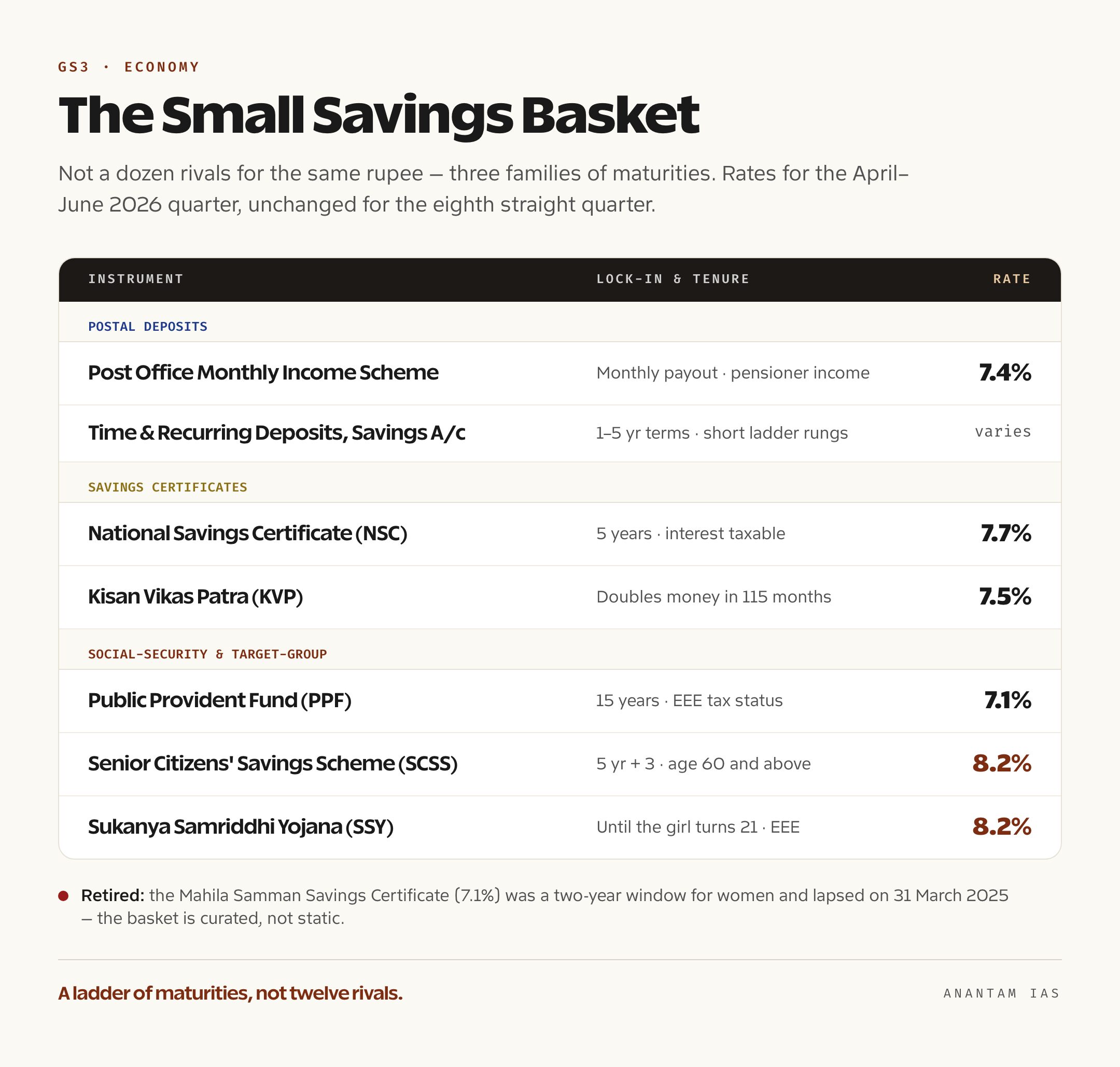
The first group is postal deposits: the Post Office Savings Account, the Recurring Deposit, Time Deposits of one, two, three and five years, and the Post Office Monthly Income Scheme, which pays out interest every month and is a favourite of pensioners who want a regular income stream. The second group is savings certificates: the National Savings Certificate (NSC), a five-year instrument, and the Kisan Vikas Patra (KVP), which currently doubles your money in 115 months. The third group is the social-security and target-group schemes: the Public Provident Fund, the 15-year workhorse of Indian household saving; the Senior Citizens’ Savings Scheme (SCSS) for those above 60; and the Sukanya Samriddhi Yojana (SSY), opened for a girl child below ten and designed to fund her education and marriage.
A fourth strand is worth flagging because it shows how the basket changes over time. The Mahila Samman Savings Certificate, launched in the 2023 Budget as a two-year window for women, was a genuine hit — but it was always a fixed-term offer, and the government let it lapse on 31 March 2025. No new accounts have been opened since; existing holders simply ride out their 7.1 per cent return to maturity. It’s a clean reminder that this basket is curated, not static: schemes are added, merged and retired as fiscal and political priorities shift, the way the old Indira Vikas Patra was wound down once it had served its purpose.
The schemes also differ in the one dimension small savers care about most — how long their money is locked away. The PPF runs for 15 years with limited partial withdrawals, the SSY until the daughter turns 21, and the SCSS for five years extendable by three. The certificates are shorter and the post office time deposits shorter still. So the basket isn’t really a dozen rivals competing for the same rupee; it’s a ladder of maturities, letting a household park money for a month, a child’s college fund, or a retirement that’s two decades away — each rung carrying its own rate, lock-in and tax flavour.
How the Rates Are Set, and the NSSF
Here’s where small savings stop being a personal-finance topic and become an economics one. The interest rate on every scheme is not a market price — it’s a quarterly administrative decision. The Department of Economic Affairs in the Finance Ministry notifies fresh rates for each scheme before every quarter begins.
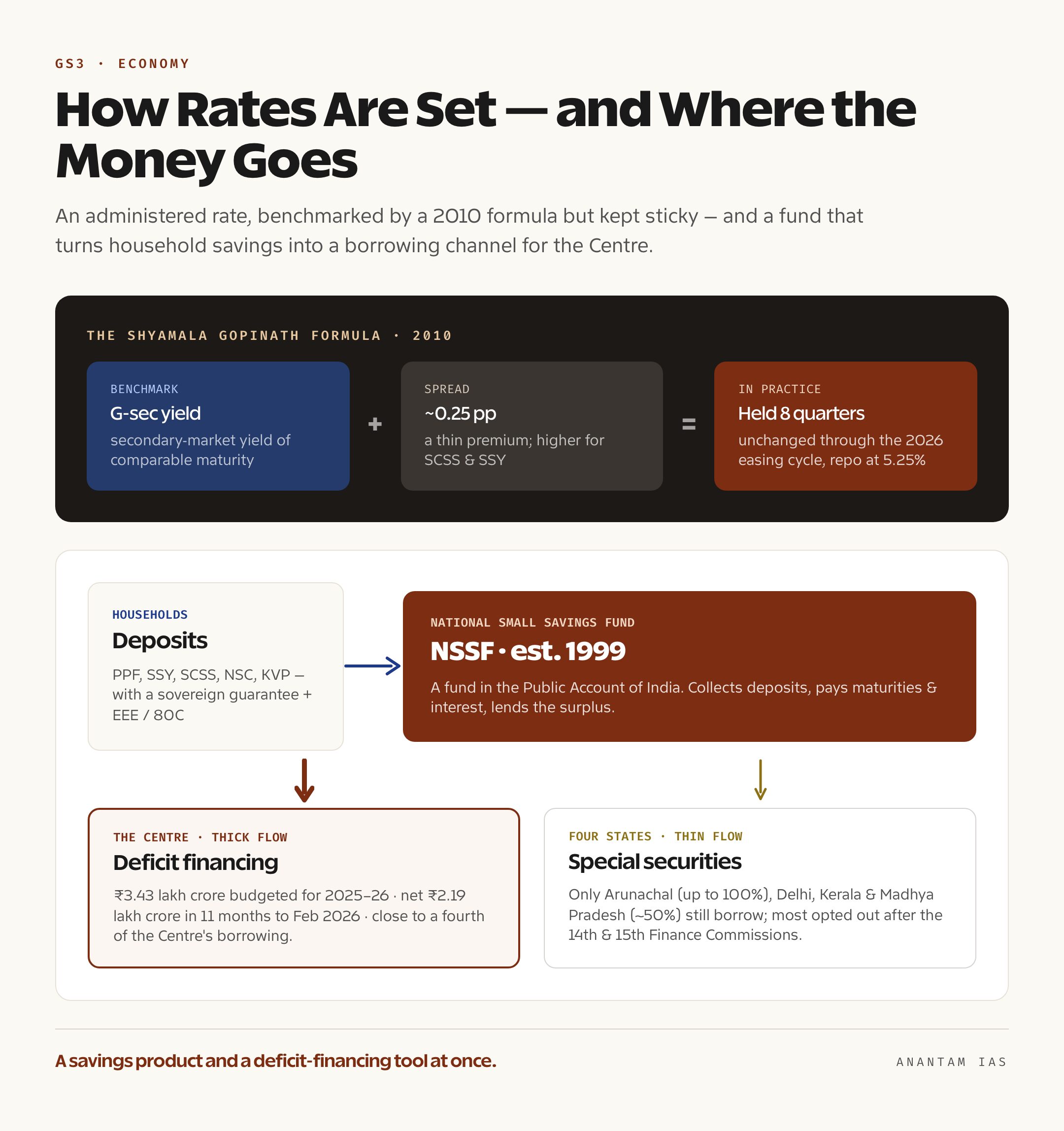
In theory, those rates follow a formula. The Shyamala Gopinath Committee, set up in 2010, recommended that small savings rates be benchmarked to the secondary-market yields on government securities (G-secs) of comparable maturity, reset every quarter, with a small positive spread on top — typically around 0.25 percentage points, and a little higher for the SCSS and SSY because those carry a social objective. The logic is clean: if the government can borrow from the bond market at a given yield, it should pay savers roughly that yield plus a thin premium, so the schemes neither overpay nor undercut the market.
In practice, the formula is honoured as much in the breach. For the April-June 2026 quarter, the government kept rates unchanged for the eighth consecutive quarter even though the RBI had been easing and the repo rate sat at 5.25 per cent. PPF stayed at 7.1 per cent, NSC at 7.7 per cent, the SCSS and SSY at 8.2 per cent, KVP at 7.5 per cent and the Monthly Income Scheme at 7.4 per cent. With G-sec yields softening through the easing cycle, a strict reading of the formula would have pulled several of these rates down — but the government chose to hold, paying savers above what the formula would justify.
Now follow the money, because this is the part candidates most often miss. Every rupee deposited in a small savings instrument doesn’t sit in a post office vault. It flows into the National Small Savings Fund (NSSF), a fund inside the Public Account of India, created in 1999. The NSSF collects the deposits, pays out maturities and interest, and lends what’s left to the Centre and, in a few cases, to states by buying their special securities. So the NSSF is simultaneously two things: a savings vehicle for households and a borrowing source for governments, running parallel to the Centre’s market borrowing through dated G-secs.
The state side of this used to be larger. Following the 14th and 15th Finance Commissions, most states chose to stop borrowing from the NSSF because market loans were cheaper, and the rules were redrawn to let them opt out. Today only a handful — Arunachal Pradesh, Delhi, Kerala and Madhya Pradesh — still draw NSSF loans, with Arunachal getting up to 100 per cent of the collections raised within its territory and the others around 50 per cent. The Centre absorbs the rest, which is why the NSSF has become, in effect, a financing channel for the Union government.
Why Small Savings Matter to the Economy
The first reason is fiscal. Small savings are a large and relatively cheap source of deficit financing. The government budgeted to raise about ₹3.43 lakh crore from the NSSF in 2025-26, and net collections had already crossed ₹2.19 lakh crore in the eleven months to February 2026. To put that in scale, small savings now finance close to a fourth of the Centre’s borrowing programme. Every rupee mobilised this way is a rupee the Centre doesn’t have to raise by auctioning bonds, which softens the upward pressure on G-sec yields and, by extension, on borrowing costs across the economy. With the fiscal deficit targeted at 4.4 per cent of GDP in the 2025-26 revised estimate and 4.3 per cent for 2026-27, this captive pool of household savings is doing quiet, heavy lifting on the financing side.
The second reason is social. For the vast informal workforce outside the EPFO and the National Pension System, the PPF, SCSS and SSY are the retirement and precautionary-savings system. They turn scattered, small, irregular household savings into long-term financial assets — and they do it with a sovereign guarantee that builds trust where banking penetration is thin. The Post Office network reaches deeper into rural and remote India than commercial banks do, so the schemes are also a financial-inclusion tool, pulling first-time savers into the formal financial system.
The third reason is targeted empowerment. Sukanya Samriddhi exists specifically to make families save for daughters, and its above-market 8.2 per cent rate is a deliberate nudge — a way of putting a financial reason behind the social message of the Beti Bachao, Beti Padhao campaign. The Mahila Samman certificate did the same for women savers during its short life, and the SCSS gives the elderly a safe, regular-income product at a time when annuities are thin and EPS pensions modest. These are instruments that carry a policy intent beyond mere savings mobilisation — they’re trying to change behaviour, not just store money, which is why they survive even when a strict rate formula would argue for cutting them.
Issues and the Way Forward
But a system this large carries real strains, and a UPSC answer has to name them honestly. The most discussed is rate stickiness and its drag on monetary transmission. When the RBI cuts the repo rate to make credit cheaper, banks are supposed to follow by lowering deposit and lending rates. They hesitate, because if small savings keep paying 7-8 per cent, a bank that cuts its fixed-deposit rate too far simply watches its depositors walk to the post office. So administratively high small savings rates put a floor under bank deposit rates and blunt the very transmission the RBI is trying to achieve — which is exactly the criticism levelled when rates were frozen for an eighth straight quarter through the 2026 easing cycle.
The second strain is fiscal cost. By paying savers above the Shyamala Gopinath formula, the government borrows from households at a rate higher than it would pay the bond market — a hidden cost that the CAG and successive Finance Commissions have flagged, alongside the accumulated income deficit and the asset-liability mismatch inside the NSSF, where long-tenure liabilities like PPF and SSY are funded against shorter-duration on-lending. The third is equity: the deepest tax benefits flow to those who can park ₹1.5 lakh a year and have the income to use an 80C deduction, so the subsidy tilts towards the middle and upper-middle class rather than the genuinely poor saver the schemes invoke. The fourth is the basket’s clutter — a dozen overlapping instruments confuse small investors and raise administrative cost — and the lag in digitisation, where post-office channels still trail the seamless mobile banking that commercial banks offer.
So the way forward writes itself. Move closer to the formula and let rates track yields more honestly, while protecting the genuinely social schemes — SCSS for the elderly, SSY for the girl child — from the sharpest cuts, so that easing doesn’t punish savers who have no other safe option. Rationalise the basket by merging redundant certificates. Push the India Post Payments Bank to make every scheme fully digital, as PPF and SSY subscriptions through mobile banking already are. Strengthen NSSF accounting and tighten the disclosure of its liabilities, as the 16th Finance Commission, chaired by Arvind Panagariya, is now examining. The balance to strike is the one running through this whole topic: protect the small saver and the social goal, without letting an administered rate quietly distort the credit market and the Centre’s books.
For Your Mains Answer
Small savings schemes sit squarely in GS Paper 3, under government budgeting, mobilisation of resources, and the financial sector. The richest framing treats them as a single instrument doing two jobs at once — a household savings-and-security product and a deficit-financing tool — because the tension between those two jobs is where every good answer lives. There’s a clean GS Paper 1 / society overlap too, through Sukanya Samriddhi and women-focused saving, and the topic feeds essays on welfare, fiscal prudence and financial inclusion.
How to Build the Answer
Open with the dual identity: a savings vehicle for households and a borrowing source for the government, linked by the NSSF. Then lay out the architecture briefly — the three families of instruments — before moving to the analytical core: how rates are set (the Shyamala Gopinath formula), why they stay sticky, and what that does to monetary transmission and the fisc. Close on the way forward. The arc — what they are → how the money flows → why the rates are political → what to fix — works for almost any small-savings question.
Common Mistakes to Avoid
Don’t list all twelve schemes with their rates; the examiner wants the logic, not a brochure. Don’t forget the NSSF — an answer that discusses rates without explaining where the money goes has missed the economics entirely. Don’t treat the rates as market-determined; their administered nature is the whole story. And don’t ignore the transmission angle, which is what separates a personal-finance answer from an economics one.
A Compact Answer Spine
Sovereign-backed basket for the small saver → three families (postal deposits, certificates, social-security schemes) → rates set quarterly, benchmarked to G-sec yields plus a spread (Shyamala Gopinath, 2010) → but kept sticky for political reasons (eight quarters unchanged through 2026) → deposits pool into the NSSF, which funds the Centre’s deficit (≈ ₹3.43 lakh crore, near a fourth of borrowing) → strains: weak transmission, fiscal cost, regressive subsidy, clutter → fix: formula discipline with social protection, basket rationalisation, digitisation, tighter NSSF accounting.
Diagram or Flowchart Idea
Draw a simple two-stage flow: a row of household icons feeding arrows into a central box labelled NSSF (Public Account of India), and two arrows out of that box — a thick one to the Centre and a thin one to four states. Annotate the inflow with “sovereign guarantee + EEE/80C” and the outflow with “deficit financing.” It captures the dual identity in one glance and is quick to reproduce under time pressure.
A Balanced-Conclusion Line
“Small savings schemes are a genuinely progressive idea executed through a regressive instrument — the challenge is to keep the security they offer the small saver while removing the distortions they impose on the credit market and the Centre’s books.”
How to Use Data Without Cramming
Carry three numbers, no more: the ≈ ₹3.43 lakh crore NSSF target for 2025-26, the fact that small savings finance close to a fourth of the Centre’s borrowing, and the eight-quarter rate freeze through the 2026 easing cycle with the repo at 5.25 per cent. One date — the Shyamala Gopinath Committee, 2010 — anchors the rate framework. Those four facts, used in the right sentences, signal currency without turning the answer into a data dump.
FAQ
What are small savings schemes in simple terms? They’re a basket of around a dozen government-backed savings products — PPF, NSC, Sukanya Samriddhi, the Senior Citizens’ Savings Scheme, Kisan Vikas Patra, the Monthly Income Scheme and post office deposits — sold mainly through post offices and some banks. They carry a sovereign guarantee, often pay more than bank fixed deposits, and several offer tax benefits, which makes them the default safe-savings choice for risk-averse households.
How are the interest rates decided? The Finance Ministry notifies rates every quarter. The Shyamala Gopinath Committee of 2010 recommended benchmarking them to secondary-market G-sec yields of comparable maturity plus a small spread. In practice the government often pays more than the formula suggests — for the April-June 2026 quarter it left rates unchanged for the eighth straight quarter even as the RBI eased and the repo rate sat at 5.25 per cent.
What is the National Small Savings Fund? The NSSF is a fund in the Public Account of India, created in 1999, into which all small savings deposits flow. It pays maturities and interest and lends the surplus to the Centre and a few states by buying their special securities. So it acts as both a savings vehicle for households and a parallel borrowing channel for governments, currently financing close to a fourth of the Centre’s borrowing.
Are PPF and Sukanya Samriddhi still tax-free under the new tax regime? The interest earned and the maturity amount stay tax-free under both regimes — they keep their EEE status. What you lose under the new default regime is the Section 80C deduction on contributions, which survives only in the old regime. That’s why both schemes remain popular even after the 80C benefit narrowed.
Practice Questions
Prelims MCQs
- With reference to the National Small Savings Fund (NSSF), consider the following statements: it is maintained in the Consolidated Fund of India; collections in it are used to finance the fiscal deficit of the Centre and some states; and most states have stopped borrowing from it. Which is correct?
(a) Statements 2 and 3 only
(b) Statements 1 and 2 only
(c) All three statements
(d) Statement 2 only
Answer: (a) The NSSF is in the Public Account, not the Consolidated Fund; the other two statements are correct, as most states opted out and only a few still borrow from it. - The Shyamala Gopinath Committee (2010) is associated with which of the following?
(a) Restructuring of public-sector banks
(b) Comprehensive review of the National Small Savings Fund and small savings interest rates
(c) Goods and Services Tax design
(d) Fiscal responsibility legislation
Answer: (b) The committee recommended benchmarking small savings rates to G-sec yields plus a spread and reviewing the NSSF. - Which of the following small savings instruments enjoys Exempt-Exempt-Exempt (EEE) tax status?
(a) Kisan Vikas Patra
(b) Post Office Monthly Income Scheme
(c) Public Provident Fund
(d) National Savings Certificate
Answer: (c) PPF is fully EEE — contributions, interest and maturity are all tax-exempt; NSC interest is taxable, and KVP and MIS do not have EEE status. - Consider the Sukanya Samriddhi Yojana: it can be opened for a girl child; it currently pays a higher rate than the PPF; and the interest and maturity are tax-free. Which are correct?
(a) 1 and 3 only
(b) 2 and 3 only
(c) 1 and 2 only
(d) 1, 2 and 3
Answer: (d) All three are correct — SSY is for a girl child below ten, pays 8.2 per cent against PPF’s 7.1 per cent, and enjoys EEE treatment. - “Sticky small savings rates can weaken the transmission of the RBI’s monetary policy.” This is because:
(a) higher administered rates put a floor under bank deposit rates
(b) they increase the fiscal deficit directly
(c) they raise the cash reserve ratio
(d) they reduce the government’s market borrowing
Answer: (a) When small savings keep paying high rates, banks hesitate to cut deposit rates after a repo cut, which blunts transmission.
Mains Practice Questions
- “Small savings schemes are a household savings instrument and a deficit-financing tool at the same time.” Examine this dual character and the tensions it creates. (15 marks, 250 words)
- Discuss how the interest rates on small savings schemes are determined and explain why their stickiness weakens the transmission of monetary policy. (15 marks, 250 words)
- Evaluate the role of the National Small Savings Fund in financing the fiscal deficits of the Centre and the states, and the issues raised by the CAG and Finance Commissions in this regard. (15 marks, 250 words)
- To what extent do small savings schemes promote financial inclusion and social security for India’s informal workforce? Suggest reforms to make them more equitable. (10 marks, 150 words)
- “The case for small savings is social; the cost is fiscal and monetary.” Critically analyse this statement in the context of recent interest-rate decisions. (15 marks, 250 words)
Tell Google you want more of this.
Add Anantam IAS as a preferred sourceOne tap, and this site shows up more often in your own Top Stories, AI Overviews and AI Mode. Remove it any time.