
Disclosure: this guide contains Amazon affiliate links. As an Amazon Associate, Anantam IAS earns from qualifying purchases — at no extra cost to you.
Every week, someone sends me a “perfect UPSC study plan” screenshot from YouTube or Telegram asking if they should follow it. My answer is always the same: a study plan built for nobody in particular works for nobody in particular.
I have built personalized plans for 200+ aspirants. An engineer working at TCS with 4 hours a day needs a completely different plan than a history graduate preparing full-time. A first-timer needs different sequencing than a second-attempt candidate who cleared Prelims but failed Mains. A student targeting 2027 has a different urgency than someone targeting 2026.
Generic plans fail because they ignore the four variables that actually determine your preparation trajectory. Here is the framework I use.
Don’t just read the framework — download it and use it
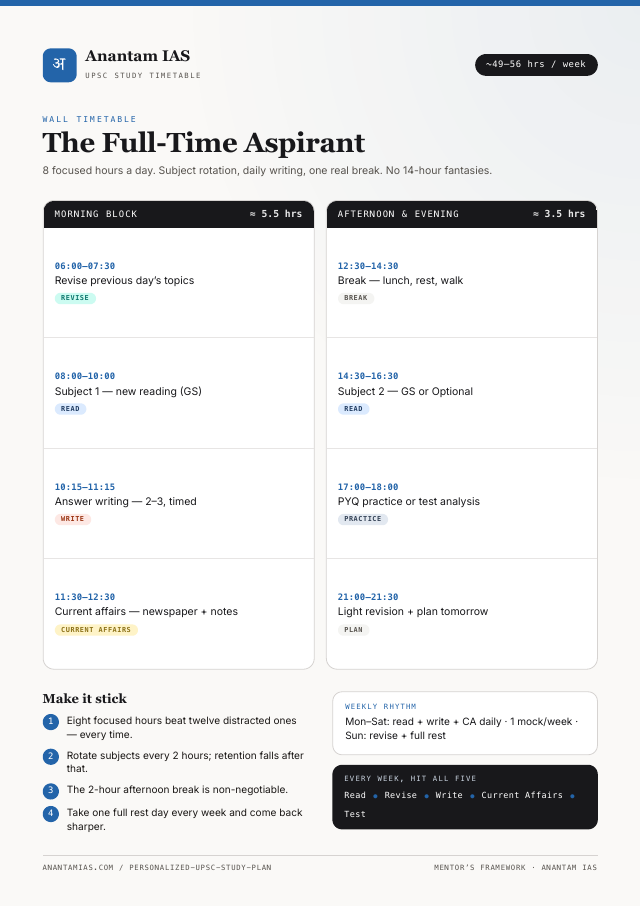
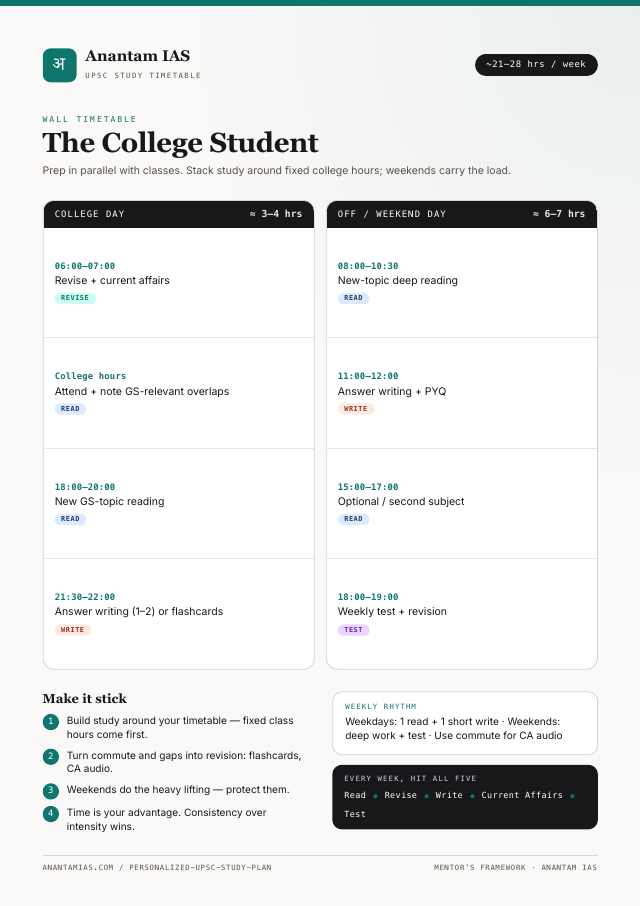
This guide ships with a complete, free toolkit: a fill-in Study Plan Workbook, four wall timetables you can print or set as a phone/desktop wallpaper, and worksheets for every step — subject audit, booklist, tracker, revision planner and a crisis-recovery plan. Start by finding the timetable that fits your real life.
↓ Download the whole kit · ZIP01Which describes you right now?
02Hours you can really study on a normal day?
03Months until your target exam?
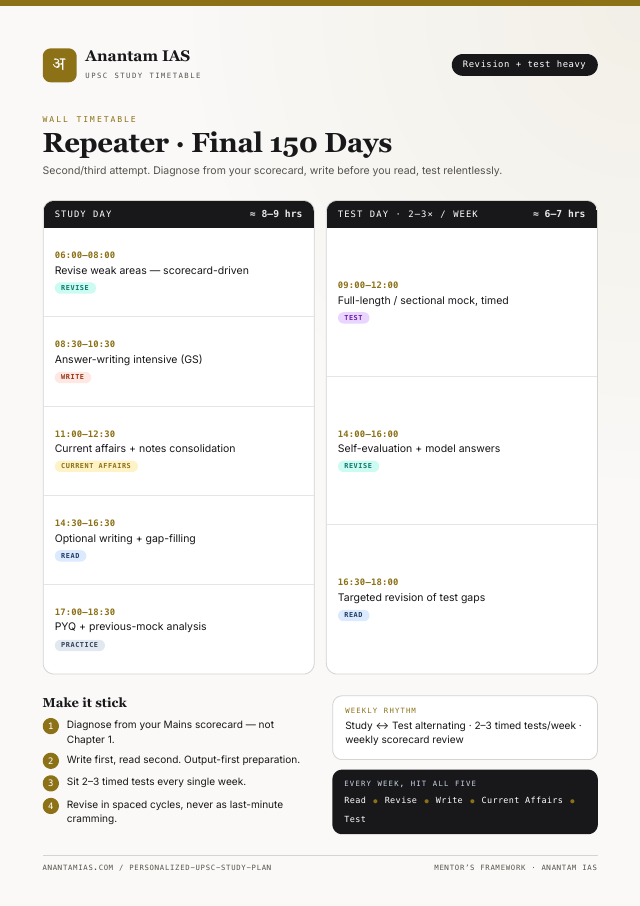
Wall timetables
Pick one · A4 print + phone + desktop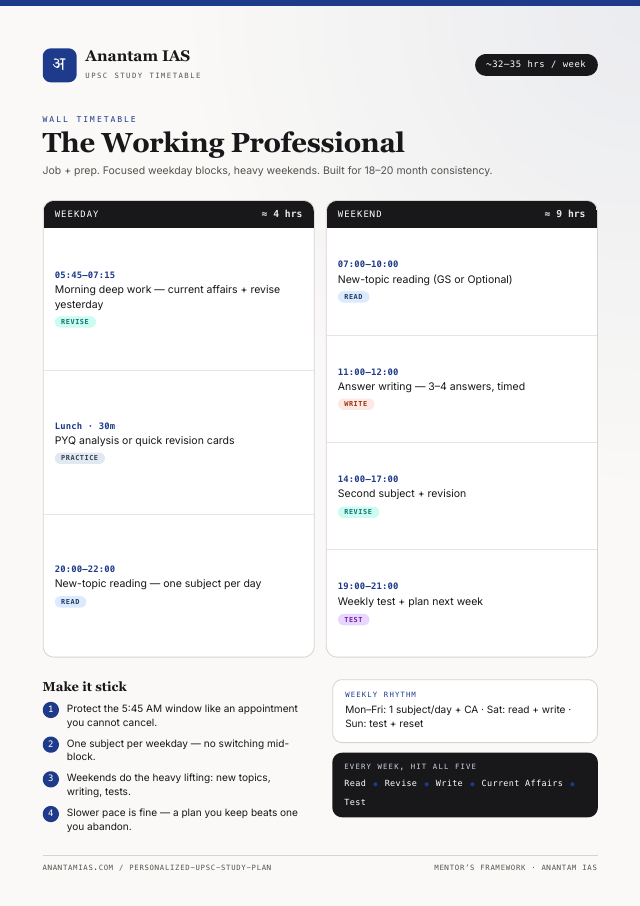
Why Generic Study Plans Fail
The "standard" UPSC study plan floating around online assumes: you are a full-time aspirant, you have 10-12 hours daily, you come from a humanities background, and this is your first attempt. If even one of these assumptions is wrong, the plan breaks down.
Working professionals cannot spend 5 hours on a single subject daily. They need a plan that fits focused 90-minute blocks.
Engineers and science graduates typically have stronger analytical skills but weaker writing foundations. They need more time on answer writing, not more time on content absorption.
Second-attempt aspirants already know the exam. They need gap-filling and intensification, not a fresh start from Chapter 1 of Laxmikanth.
The framework below adapts to all of these situations.
The 4-Variable Framework
Every personalized plan starts with four honest inputs:
Variable 1: Available hours per day. Not the aspirational number. The real one. After commute, meals, rest, and the inevitable 45 minutes of phone scrolling you will not admit to. Be brutally honest here.
Variable 2: Subject background. Your undergraduate and postgraduate degrees, your work experience, any competitive exams cleared. This determines which subjects need heavy investment and which you can move through quickly.
Variable 3: Attempt number. First attempt means building from scratch. Second or third means diagnosing specific failure points and addressing them. The preparation architecture is fundamentally different.
Variable 4: Target year. How many months do you have? 18 months allows a relaxed foundation phase. 10 months demands aggressive prioritization. 6 months is a triage operation.
Common student mistake: Overestimating available hours. I ask students to track their actual study hours for one week before we build a plan. The gap between "I study 8 hours" and what the time log shows is usually 3-4 hours. Build your plan around reality, not ambition.
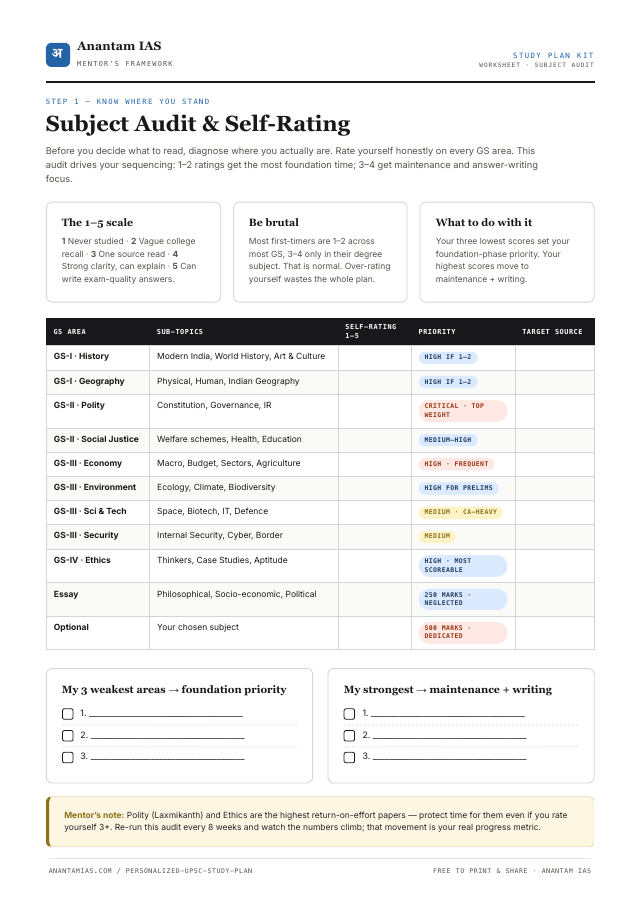
Step 1: Subject Audit
Before you decide what to read, you need to know where you stand. Rate yourself on each GS area on a scale of 1-5:
- 1 – Never studied, zero familiarity
- 2 – Studied in college or casually, vague recall
- 3 – Read one standard source, moderate understanding
- 4 – Strong conceptual clarity, can explain to others
- 5 – Can write exam-quality answers with current knowledge
Be honest. Most first-timers are 1-2 across most GS areas, 3-4 in their optional or degree-related subjects.
This audit drives your sequencing. Subjects rated 1-2 get the most time in the foundation phase. Subjects rated 3-4 get maintenance and answer writing focus. The 2025 question paper analysis can help you understand what "exam-quality" knowledge actually looks like for each paper.
| GS Area | Sub-Topics | Self-Rating (1-5) | Priority Level |
|---|---|---|---|
| GS-I: History | Modern India, World History, Art & Culture | Rate yourself | High if 1-2 |
| GS-I: Geography | Physical, Human, Indian Geography | Rate yourself | High if 1-2 |
| GS-II: Polity | Constitution, Governance, International Relations | Rate yourself | Critical – highest weightage |
| GS-II: Social Justice | Welfare schemes, Health, Education | Rate yourself | Medium-High |
| GS-III: Economy | Macro, Budget, Sectors, Agriculture | Rate yourself | High – frequently tested |
| GS-III: Environment | Ecology, Climate, Biodiversity | Rate yourself | High for Prelims, moderate for Mains |
| GS-III: Science & Tech | Space, Biotech, IT, Defense | Rate yourself | Medium – current affairs heavy |
| GS-III: Security | Internal Security, Cyber, Border | Rate yourself | Medium |
| GS-IV: Ethics | Thinkers, Case Studies, Aptitude | Rate yourself | High – most scoreable paper |
| Essay | Philosophical, Socio-economic, Political | Rate yourself | High – 250 marks, often neglected |
| Optional | Your chosen subject | Rate yourself | 500 marks – needs dedicated time |
→ Use it now: Download the Subject Audit & Self-Rating worksheet (PDF)
Step 2: Time Budget
Now calculate your actual weekly hours. Not daily, weekly. Daily fluctuates. Weekly is what matters for planning.
Working professionals (realistic): 4-5 hours on weekdays, 8-10 hours on weekends. That is 28-35 productive hours per week.
Full-time aspirants (realistic): 7-8 hours of focused study daily. That is 49-56 hours per week. Not 16 hours. Nobody sustains 16 hours of quality study. Anyone who claims otherwise is either lying or counting the time they spent staring at their phone with a book open.
Part-time (students in final year, etc.): 3-4 hours on weekdays, 6-8 on weekends. That is 21-28 hours per week.
Common student mistake: Planning for 12-14 hours daily and burning out in 3 weeks. Then spending the next 2 weeks recovering with zero study. A consistent 7-8 hour plan that you actually follow for 10 months beats a 14-hour plan that collapses in a month. Every single time.
→ Use it now: Open the Study Plan Workbook and fill in your weekly time budget (PDF)
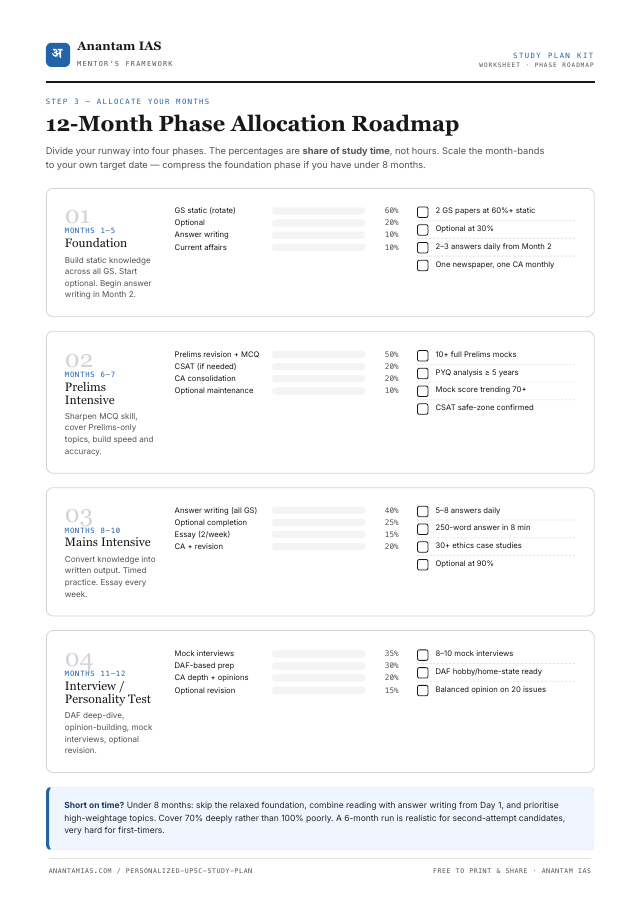
Step 3: Phase Allocation
Divide your available time into four phases. The exact months depend on your target exam date. I am using a 12-month cycle as the base.
Foundation Phase (Months 1-5)
Goal: Build static knowledge across all GS papers. Start optional. Begin answer writing.
- 60% time on GS static subjects (rotate across papers)
- 20% time on optional
- 10% time on answer writing (2-3 answers daily from Month 2)
- 10% time on current affairs (one newspaper, one monthly magazine)
This is where most of your reading happens. But notice: answer writing starts in Month 2, not Month 10. This is non-negotiable. The ethics case studies should enter your practice routine by Month 3.
Prelims Intensive (Months 6-7)
Goal: Sharpen MCQ skills, cover Prelims-specific topics, build speed.
- 50% time on Prelims-focused revision and MCQ practice
- 20% time on CSAT (if needed)
- 20% time on current affairs consolidation
- 10% time on optional maintenance (do not abandon completely)
Mains Intensive (Months 8-10)
Goal: Convert knowledge into answer-writing output. Timed practice. Essay practice.
- 40% time on answer writing across all GS papers
- 25% time on optional completion and practice
- 15% time on essay writing (2 full essays per week)
- 10% time on current affairs integration
- 10% time on revision
This is the phase where building strong GS paper strategy becomes critical. You are not learning new things here. You are learning to express what you know within 150-250 words per answer.
Interview Preparation (Month 11-12)
Goal: DAF preparation, personality test readiness, current affairs depth.
- Mock interviews (at least 8-10)
- DAF-based question preparation
- Current affairs depth (opinions, not just facts)
- Optional subject revision (questions often come from here)
→ Use it now: Download the 12-Month Phase Allocation Roadmap (PDF)
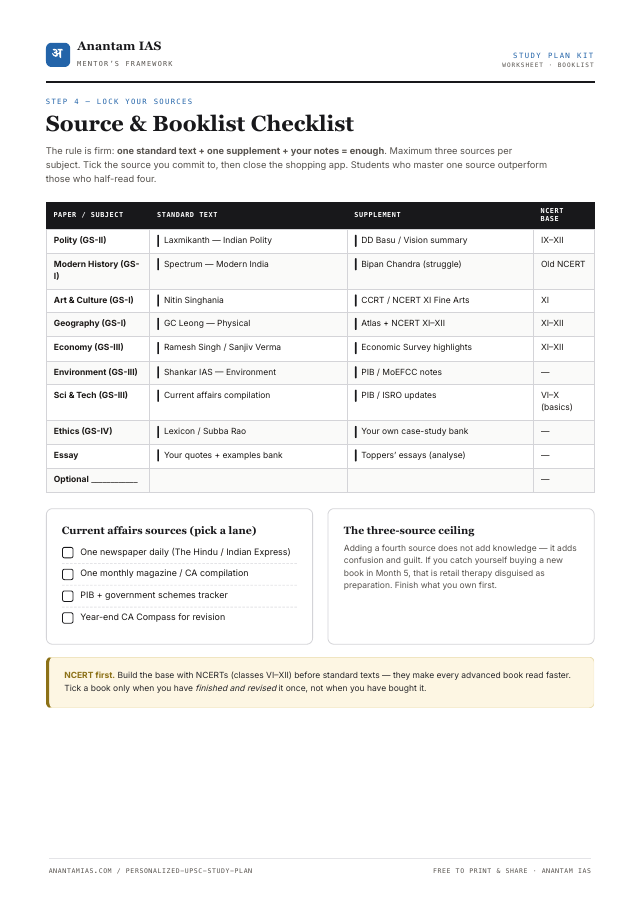
Step 4: Source Selection
Maximum 2-3 sources per subject. I am dead serious about this. Here is the principle: one standard text + one supplement + your notes = enough.
The moment you add a fourth source, you are not adding knowledge. You are adding confusion and guilt about not finishing everything. Students who master Laxmikanth outperform students who half-read Laxmikanth, DD Basu, and Subhash Kashyap combined.
Your mentor or a senior aspirant can help you pick the right sources for your background. But the quantity ceiling is firm: three sources maximum per subject.
Common student mistake: Buying every book recommended on every YouTube channel. I have seen students with 30+ books on their shelf who have not completed a single one. This is retail therapy disguised as preparation. Pick your sources, commit, and close the shopping app.
→ Use it now: Download the Source & Booklist Checklist (PDF)
Step 5: Weekly Structure Template
Here is where the abstract plan becomes a daily reality. The key principle: every week must include all five activities: reading, revision, answer writing, current affairs, and test/self-assessment.
Working Professional: The 4-Hour Weekday Plan
| Time Slot | Weekday (4.5 hours) | Weekend (9 hours) |
|---|---|---|
| Morning (before work) | 1.5 hrs: Current affairs + revision of previous topic | 3 hrs: New topic reading (GS or Optional) |
| Lunch break | 30 min: PYQ analysis or quick revision cards | 1 hr: Answer writing (3-4 answers) |
| Evening (after work) | 2.5 hrs: New topic reading (one subject per day) | 3 hrs: Second subject reading + revision |
| Night | — | 2 hrs: Weekly test/analysis + planning next week |
| Weekly Total | ~32-35 hours | |
The working professional plan works if you protect your morning slot ruthlessly. That 6:00-7:30 AM window before the world demands your attention is the most valuable time in your day. Treat it like an appointment you cannot cancel.
Full-Time Aspirant: The Structured 8-Hour Plan
| Time Slot | Activity | Duration |
|---|---|---|
| 6:00 – 7:30 AM | Revision of previous day’s topics | 1.5 hrs |
| 8:00 – 10:00 AM | Subject 1: New reading (GS) | 2 hrs |
| 10:15 – 11:15 AM | Answer writing (2-3 answers, timed) | 1 hr |
| 11:30 – 12:30 PM | Current affairs (newspaper + notes) | 1 hr |
| Break | Lunch, rest, walk | 2 hrs |
| 2:30 – 4:30 PM | Subject 2: New reading (GS or Optional) | 2 hrs |
| 5:00 – 6:00 PM | PYQ practice or test analysis | 1 hr |
| Evening | Light revision, next day planning | 30 min |
| Daily Total | ~8 hours focused |
Notice the 2-hour break in the afternoon. This is intentional. Your brain needs downtime to consolidate learning. Students who push through 10-12 hours without breaks show declining quality in everything they do after hour 6. Eight focused hours beat twelve distracted ones.
Common student mistake: Studying the same subject for 5-6 hours at a stretch. Your retention drops sharply after 2 hours on a single topic. Rotate subjects. Keep sessions at 1.5-2 hours maximum per subject.
→ Use it now: Pick your wall timetable above
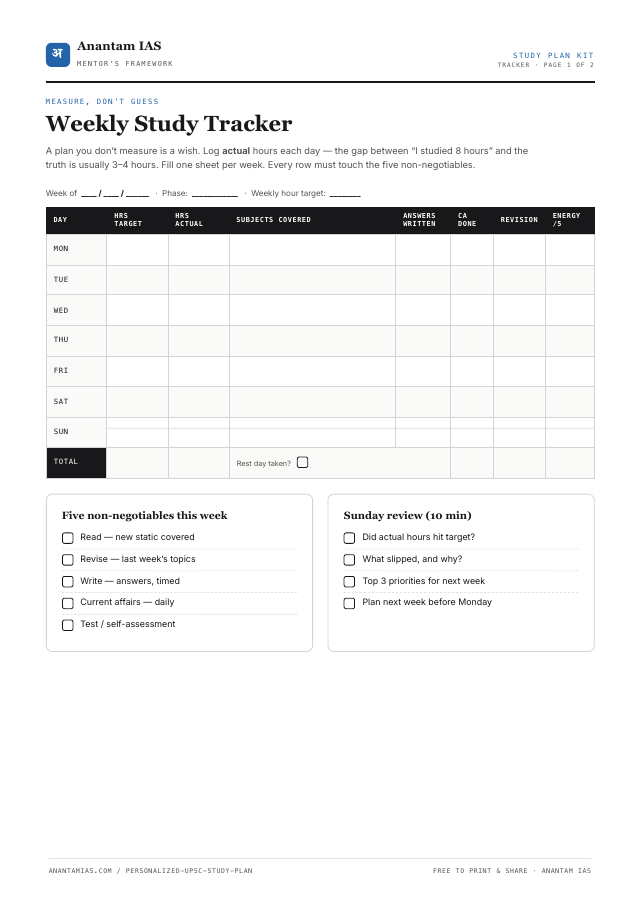
→ Use it now: Download the Weekly Tracker & Answer-Writing Log (PDF)
Revise or Forget: The Revision Cycle
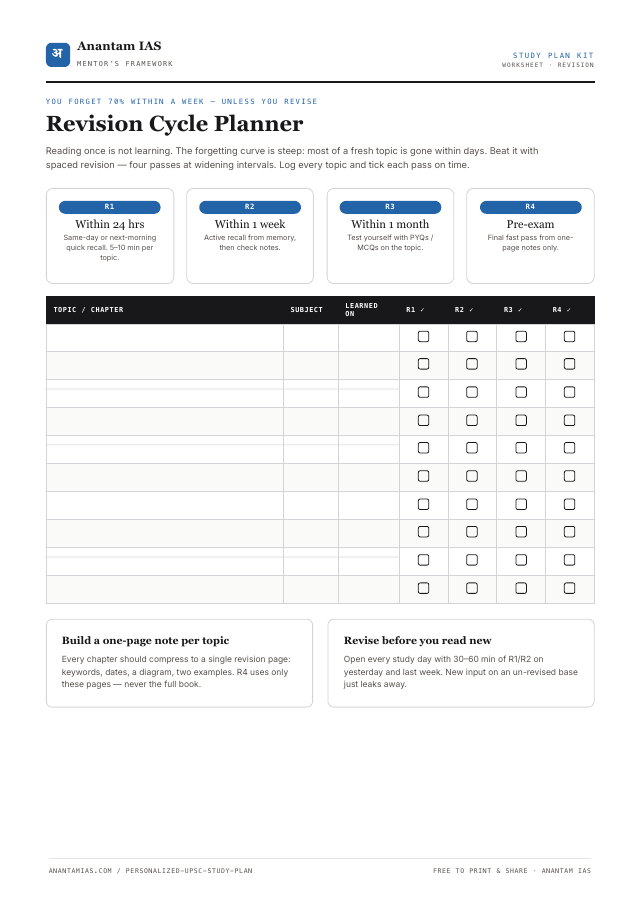
Reading a topic once is not learning it. Within a week you forget most of what you read unless you revise — the forgetting curve is steep, and it does not care how motivated you felt while reading. The aspirants who retain the syllabus are not the ones who read fastest; they are the ones who revise on schedule.
Build four spaced passes into every topic: a quick recall within 24 hours, an active recall from memory within a week, a PYQ or MCQ test within a month, and a fast one-page pass before the exam. Open each study day with 30–60 minutes of revision before any new input. New material stacked on an un-revised base just leaks away.
→ Use it now: Download the Revision Cycle Planner (PDF)
Monthly Milestones: What Completion Looks Like
Your plan means nothing if you cannot measure progress against it. Here is what reasonable milestone achievement looks like:
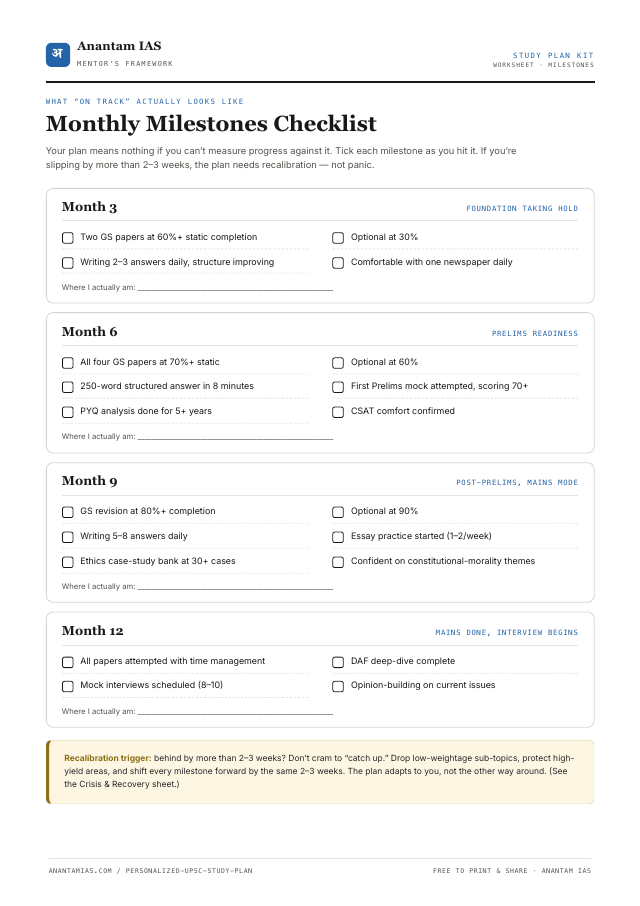
Month 3: Two GS papers at 60%+ static completion. Optional at 30%. Writing 2-3 answers daily with improving structure. Comfortable with one newspaper daily.
Month 6: All four GS papers at 70%+ static completion. Optional at 60%. Can write a structured 250-word answer in 8 minutes. First Prelims mock attempted, scoring 70+. PYQ analysis completed for at least 5 years.
Month 9: Post-Prelims. GS revision at 80%+ completion. Optional at 90%. Writing 5-8 answers daily during Mains intensive. Essay practice started (1-2 per week). Ethics case study bank at 30+ practiced cases. You should be able to tackle ethics-human interface questions and constitutional morality themes with confidence by now.
Month 12: Mains written. All papers attempted with time management. Interview preparation begins. DAF deep-dive. Mock interviews scheduled.
If you are falling behind these milestones by more than 2-3 weeks, your plan needs recalibration. This is where having a mentor or at least a structured GS strategy check-in matters.
→ Use it now: Download the Monthly Milestones Checklist (PDF)
The Personalization Layer
Everything above is a framework. The personalization comes from adjusting these variables based on your specific situation:
If you are a humanities graduate: You likely need less time on History/Polity reading but more time on Economy and Science & Tech. Shift your foundation phase accordingly.
If you are an engineer: Your analytical ability is an asset for GS-III and GS-IV. But you probably need more investment in History, Art & Culture, and essay writing. Prioritize writing practice earlier than the standard timeline.
If this is your second attempt after clearing Prelims but failing Mains: You do not need a foundation phase. Jump directly into answer writing intensive + gap-filling based on your Mains scorecard analysis. Focus on the 2-3 papers where you scored lowest.
If you are targeting the exam in less than 8 months: Skip the relaxed foundation phase. Combine reading with answer writing from Day 1. Prioritize high-weightage topics. Accept that you will not cover everything and focus on covering enough to score well in 3-4 papers rather than covering everything poorly across all papers.
Common student mistake: Following someone else's personalized plan. A topper's strategy worked for that topper's specific background, availability, and aptitude. Your plan needs to account for your variables, not theirs.
When the Plan Breaks: Your Recovery Protocol
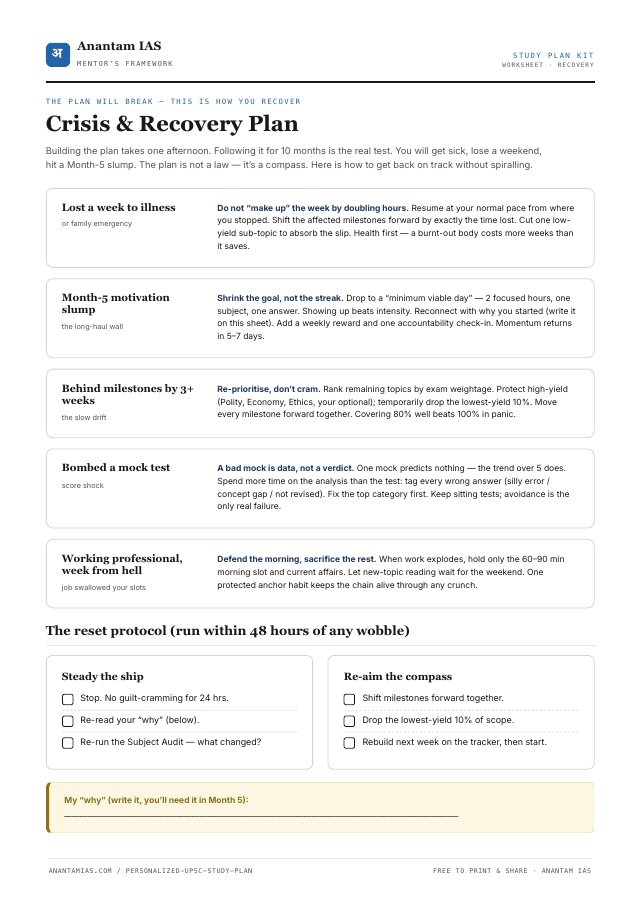
Here is what nobody tells you: the plan will break. You will get sick for a week. A family event will eat a critical study weekend. You will hit a motivation wall around Month 5. This is not failure — it is the normal physics of a 10-month marathon, and every successful candidate has lived it.
The rule for every wobble is the same: re-prioritise, don’t cram. Do not try to “make up” lost time by doubling hours — that is precisely how burnout starts. Rank what is left by exam weightage, protect the high-yield papers, temporarily drop the lowest-yield 10%, and shift every milestone forward together. A bad mock is data, not a verdict: spend more time on the analysis than on the test. One protected anchor habit — your morning slot — keeps the chain alive through any crisis.
→ Use it now: Download the Crisis & Recovery Plan (PDF)
The complete free toolkit
Workbook + 7 worksheets · grab all 12 PDFs as a ZIP ↓
Building the Plan Is the Easy Part
Here is the truth nobody wants to hear: building the plan takes one afternoon. Following it for 10 months is the actual challenge. The plan will break. You will get sick for a week. A family event will eat into a critical study weekend. You will hit a motivation slump in Month 5.
The plan is not a law. It is a compass. When you deviate (and you will), the plan tells you how to get back on track. That is its value. Not rigid adherence, but consistent direction.
Students who succeed are not the ones with the most detailed plan. They are the ones who follow a reasonable plan consistently, measure progress honestly, and adjust when the data says so. If you want to understand how faculty-guided strategy makes this adjustment process easier, that is exactly what structured mentorship at Anantam provides.
Frequently Asked Questions
How many hours per day do I really need for UPSC?
For full-time aspirants, 7-8 hours of focused study is the sweet spot. For working professionals, 4-5 hours on weekdays and 8-10 on weekends. These are focused hours with phone away, no distractions. Quality matters more than quantity every single time.
Should I follow a daily timetable or a weekly one?
Weekly. Daily timetables crumble when one session goes long or an unexpected interruption hits. A weekly plan gives you flexibility to shift sessions around while still hitting your total targets. Review every Sunday and plan the next week.
When should I start optional preparation?
After 2-3 months of GS foundation building. Start optional when you have covered at least 50-60% of GS static content. Exception: if your optional is closely related to a GS paper (like PSIR with GS-II), you can start earlier since the overlap reinforces both.
How do I handle a study plan when I have a full-time job?
Protect two non-negotiable slots: early morning (before work starts) and a post-work evening block. Use weekends for heavy lifting (new topics, answer writing, tests). Accept that your pace will be slower, but consistency over 18-20 months can absolutely get you there.
What if I fall behind my study plan by 2-3 weeks?
Do not panic and try to u0026quot;catch upu0026quot; by cramming. Instead, re-prioritize. Drop lower-weightage sub-topics temporarily. Focus on high-yield areas. Adjust your milestones forward by the same 2-3 weeks. The plan should adapt to you, not the other way around.
Should I take a day off from studying every week?
Yes. One full rest day per week is non-negotiable in my plans. Your brain consolidates learning during rest. Students who study 7 days a week for months show declining performance after Month 3-4. Take Sunday off (or any one day). Come back Monday sharper.
How do I know if my study plan is actually working?
Two metrics: PYQ performance and answer quality. Every month, attempt 10-15 PYQs from covered topics under timed conditions. If your accuracy is improving, the plan is working. If your answer evaluations show improving structure and content depth, the plan is working. If neither is moving after 8 weeks, recalibrate.
Can I prepare for UPSC in 6 months?
Technically possible but extremely difficult for a first-timer. Realistic for second or third-attempt candidates who already have the foundation and need focused revision and answer writing practice. If you have 6 months, do not try to cover everything. Cover 70% of the syllabus deeply and score well on that, rather than touching 100% superficially.
Tell Google you want more of this.
Add Anantam IAS as a preferred sourceOne tap, and this site shows up more often in your own Top Stories, AI Overviews and AI Mode. Remove it any time.