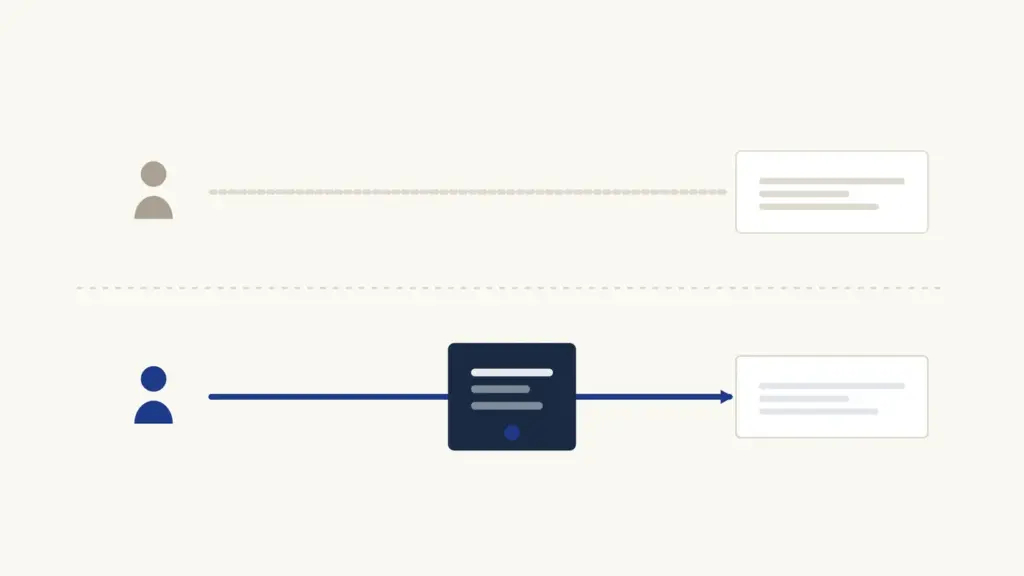
The Transgender Persons (Protection of Rights) Amendment Act, 2026 came into force on 25 May 2026 and changed how a person is legally recognised as transgender in India. The Transgender Persons Amendment Act 2026 removes the statutory right to self-perceived gender identity and requires a District Magistrate to consider a medical board’s recommendation before issuing a certificate of identity. That single change reopens a question the Supreme Court had appeared to settle in 2014.
The Position Before the Amendment
- NALSA v. Union of India (2014) recognised transgender persons as a third gender, held gender identity to be integral to dignity under Article 21, and expressly rejected surgery or medical proof as a precondition of recognition.
- The Transgender Persons (Protection of Rights) Act, 2019 gave that statutory form. Section 4(2) recognised a right to self-perceived gender identity.
- A certificate of identity was issued by the District Magistrate on the person’s own application, and a revised certificate followed gender-affirming surgery.
- K. S. Puttaswamy (2017) placed decisional autonomy inside the Article 21 privacy guarantee, strengthening the constitutional footing of self-identification.
What the 2026 Amendment Changes
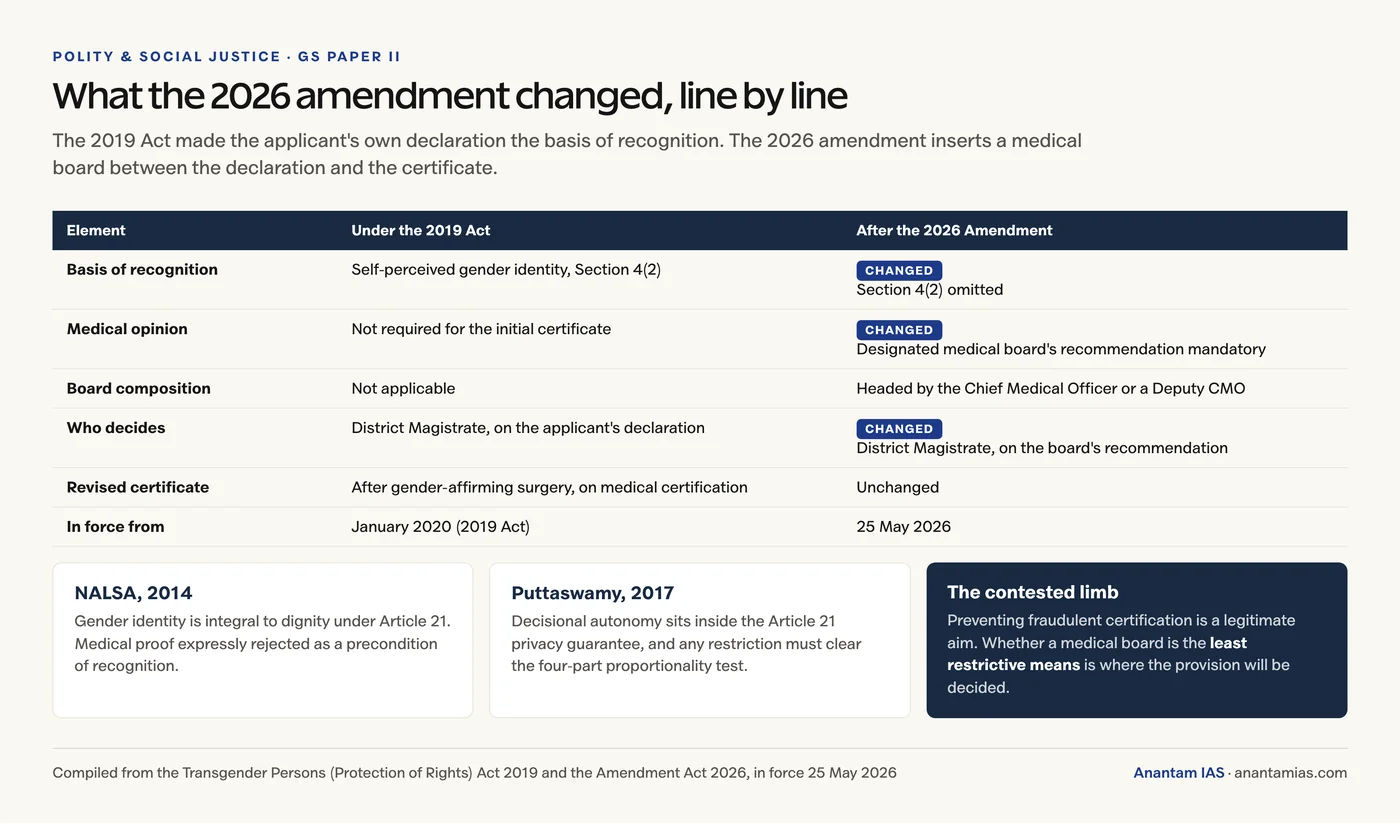
| Element | Before | After the 2026 Amendment |
|---|---|---|
| Basis of recognition | Self-perceived gender identity under Section 4(2) | Section 4(2) omitted |
| Role of medical opinion | None required for the initial certificate | District Magistrate must consider a designated medical board’s recommendation |
| Composition of the board | Not applicable | Headed by the Chief Medical Officer or a Deputy CMO |
| Decision-maker | District Magistrate on the applicant’s declaration | District Magistrate on the board’s recommendation |
| Date of effect | 2019 Act in force from January 2020 | Amendment in force from 25 May 2026 |
The Constitutional Objection
- Autonomy. Requiring an expert body to validate identity converts self-determination into an administrative-clinical finding, which sits uneasily with the decisional autonomy recognised in Puttaswamy.
- Consistency with NALSA. The Supreme Court had forbidden medical proof as a condition of recognition. A statutory reversal invites the argument that the legislature has overridden a constitutional declaration.
- Proportionality. Under the four-part Puttaswamy test the state must show legitimate aim, rational connection, necessity and balance. Preventing fraudulent certification is a legitimate aim; whether a medical board is the least restrictive means is the contested step.
- Process harm. Board-based certification adds cost, travel and delay, and exposes applicants to precisely the scrutiny the 2019 Act sought to end. The dignity injury lies in the procedure, not only the outcome.
- Article 14. No other identity document requires a medical board, which raises a classification question.
The Case the State Makes
- Certificates carry entitlements — reservation in some states, welfare access, changes to official records — so some verification has an administrative rationale.
- A documented procedure can reduce arbitrary refusal by individual magistrates.
- Medical involvement may assist in cases where the applicant seeks a revised certificate after gender-affirming care.
Why It Matters Beyond This Statute
The amendment is a test case for a wider question: when the Supreme Court reads a right into Article 21 and Parliament later legislates in the opposite direction, which prevails? The answer is that Parliament may legislate, but the legislation is testable against the same Article 21 standard the Court applied. That is why the proportionality analysis, rather than the policy argument, is where this provision will be decided. Related reading: Article 21 and LGBTQ+ rights in India.
Frequently Asked Questions
What did the Transgender Persons Amendment Act 2026 change?
It removed Section 4(2) of the 2019 Act, which recognised the right to self-perceived gender identity, and made it mandatory for the District Magistrate to consider the recommendation of a designated medical board before issuing a certificate of identity. It came into force on 25 May 2026.
Who heads the medical board under the 2026 amendment?
The designated medical board is headed by the Chief Medical Officer or a Deputy Chief Medical Officer of the district.
Does the 2026 amendment override the NALSA judgment?
That is the central legal controversy. NALSA (2014) held that gender identity is integral to dignity under Article 21 and expressly rejected medical proof as a precondition of recognition. Critics argue the amendment reverses that holding; the government’s position is that verification is an administrative requirement attached to the entitlements the certificate carries.
What is the proportionality test and how does it apply here?
From K. S. Puttaswamy (2017), a restriction on a fundamental right must have a legitimate aim, a rational connection to that aim, be necessary in the sense of being the least restrictive means, and be balanced against the harm caused. The contested limb here is necessity: whether a medical board is the least restrictive way to prevent fraudulent certification.
Why is self-identification considered part of the right to privacy?
Puttaswamy recognised decisional autonomy — the right to make intimate choices about one’s own life — as part of the privacy guarantee under Article 21. Gender identity is treated as one such core choice, which is why placing it under external validation raises a privacy question rather than only a policy one.
Is a certificate of identity necessary for transgender persons in India?
It is the document through which many entitlements are accessed, including changes to official records, welfare schemes and, in some states, reservation. That is precisely why the procedure for obtaining it carries constitutional weight.
Practice Questions
Prelims MCQs
1. The Transgender Persons (Protection of Rights) Amendment Act, 2026 came into force on:
- (a) 1 January 2026
- (b) 25 May 2026
- (c) 15 August 2026
- (d) 2 October 2026
Answer: (b) 25 May 2026
2. Which provision of the 2019 Act, recognising self-perceived gender identity, was omitted by the 2026 amendment?
- (a) Section 3
- (b) Section 4(2)
- (c) Section 6
- (d) Section 7
Answer: (b) Section 4(2)
3. The NALSA judgment recognising transgender persons as a third gender was delivered in:
- (a) 2009
- (b) 2014
- (c) 2017
- (d) 2018
Answer: (b) 2014
4. Under the 2026 amendment, the designated medical board is headed by:
- (a) The District Magistrate
- (b) A District Judge
- (c) The Chief Medical Officer or a Deputy CMO
- (d) The Superintendent of Police
Answer: (c) The Chief Medical Officer or a Deputy CMO
5. The four-part proportionality test in Indian constitutional law derives principally from:
- (a) Maneka Gandhi (1978)
- (b) K. S. Puttaswamy (2017)
- (c) Kesavananda Bharati (1973)
- (d) Indra Sawhney (1992)
Answer: (b) K. S. Puttaswamy (2017)
Mains Questions
- Right to privacy relating to self-identity is well protected under Article 21. In this context, examine the effect of the 2026 amendment to the Transgender Persons (Protection of Rights) Act, 2019.
- “When a court reads a right into Article 21 and Parliament legislates in the opposite direction, the legislation is testable against the same standard.” Discuss.
- Examine the application of the proportionality test to statutory conditions on gender recognition.
- Assess the adequacy of India’s legal framework for transgender rights beyond the question of identity certification.
- Discuss the relationship between decisional autonomy, dignity and the right to privacy in Indian constitutional jurisprudence.
Tell Google you want more of this.
Add Anantam IAS as a preferred sourceOne tap, and this site shows up more often in your own Top Stories, AI Overviews and AI Mode. Remove it any time.