Emotions look like a single phenomenon from a distance, but the closer one looks the more they multiply. Fear is not anxiety; anxiety is not dread; dread is not horror. Joy is not contentment; contentment is not pride; pride is not gratitude. The taxonomy of emotions matters for two reasons. It tells us how the human mind organises its evaluative responses to the world, and it gives the civil servant a vocabulary precise enough to read the citizens she serves.
This article works through the major typologies of emotion — Ekman's basic six, the positive-negative distinction, complex and self-conscious emotions — and shows what each type means for administration.
Why typology matters
A typology is not just labelling. The category an emotion falls into tells us something about how it arises, what bodily pattern it produces, what action tendency it carries, and what response it invites from others. Confusing fear with anger leads to wrong intervention. The collector who reads an MLA's anger as a threat, when the underlying emotion is fear of constituent backlash, will misjudge the situation entirely.
Ekman's six basic emotions
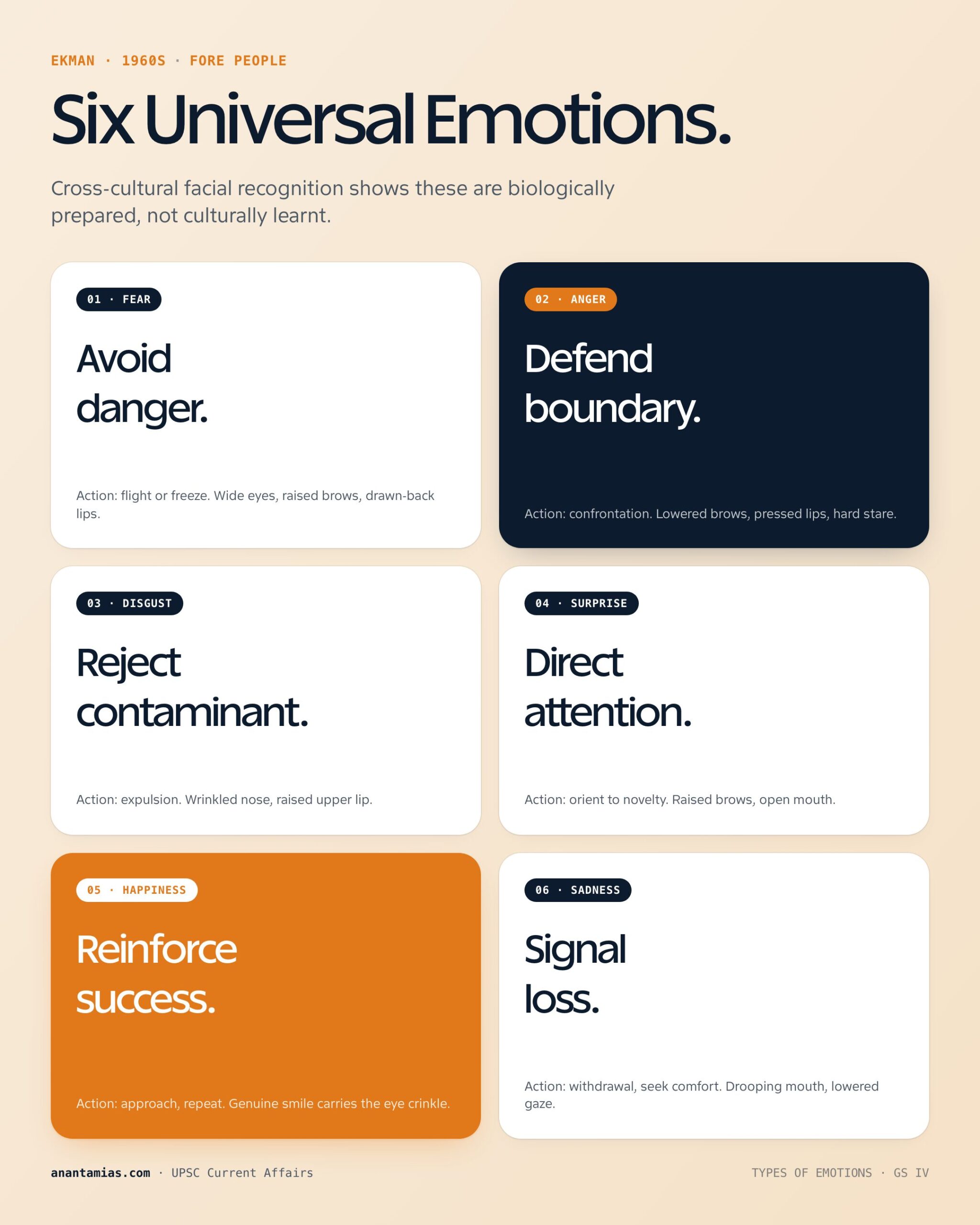
Paul Ekman's research, beginning in the 1960s and famously involving cross-cultural studies including the Fore people of Papua New Guinea, established that six emotions are universally recognised through facial expression — that is, they appear to be biologically prepared rather than culturally learnt.
| Emotion | Function | Action tendency | Recognisable signal |
|---|---|---|---|
| Fear | Avoid danger | Flight or freezing | Wide eyes, raised eyebrows, drawn-back lips |
| Disgust | Reject contaminant | Rejection, expulsion | Wrinkled nose, raised upper lip |
| Anger | Defend boundary, address obstacle | Fight, confrontation | Lowered eyebrows, pressed lips, hard stare |
| Surprise | Direct attention to novelty | Orienting, attention | Raised eyebrows, open mouth |
| Happiness | Reinforce successful behaviour | Approach, repeat | Smile (with eye crinkle in genuine smile) |
| Sadness | Signal loss, elicit support | Withdrawal, seek comfort | Drooping mouth, lowered gaze, slow movement |
Each basic emotion is both a personal experience and a social signal. The action tendency primes the body for a specific response, and the facial signal communicates that priming to others. A happy officer signals approachability; an angry officer signals "do not approach now."
Later in his career, Ekman expanded the list to include embarrassment, excitement, contempt, shame, pride, satisfaction and amusement — emotions that meet some but not all of the criteria for full universality. These are sometimes called secondary basic emotions.
Plutchik's wheel — primary emotions and their combinations
Robert Plutchik proposed eight primary emotions arranged on a wheel: joy, trust, fear, surprise, sadness, disgust, anger, anticipation. Adjacent emotions combine — anticipation plus joy yields optimism; trust plus joy yields love; fear plus surprise yields awe. Plutchik's framework is useful for thinking about emotional complexity as combinations of simpler elements.
Positive emotions
Beyond the basic six, a vast vocabulary of positive emotions describes states that feel good and that broadly produce approach behaviour. Barbara Fredrickson's "broaden-and-build" theory argues that positive emotions widen the scope of attention and cognition and build durable personal resources (relationships, skills, resilience).
- Confidence — the felt sense of being able to handle what comes; a steady, action-oriented positivity.
- Calmness — low arousal positive state; baseline of well-functioning judgement.
- Poise — controlled grace under pressure; calmness performed.
- Enthusiasm — high-arousal positive state; energy directed at task.
- Exhilaration — peak positive arousal; sometimes from achievement, sometimes from collective action.
- Contentment — settled satisfaction; the positive emotion of "enough."
For the civil servant, positive emotions are not luxuries. Confidence makes decisions firmer; calmness makes decisions wiser; enthusiasm sustains the long, often thankless work of public service.
Negative emotions
Negative emotions are evolved alarms. They direct attention to threats, losses, social violations and unmet needs. They feel bad for a reason — to motivate change.
- Depression — chronic sadness with loss of interest, energy and self-esteem; clinically distinct from situational sadness.
- Frustration — emotion of blocked goals; arises when effort meets obstruction.
- Anxiety — anticipatory fear; fear of something not yet present.
- Resentment — sustained anger directed at perceived injustice.
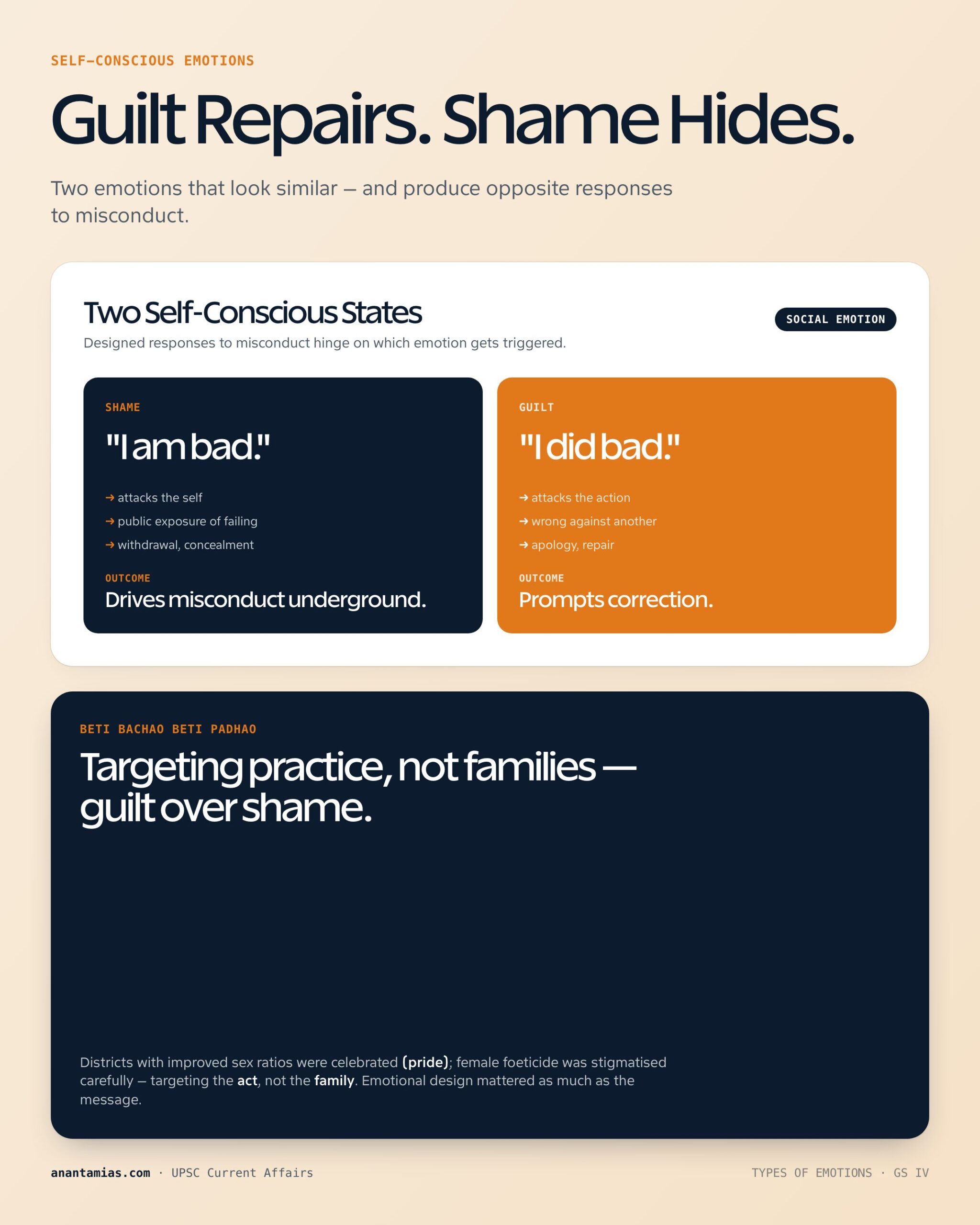
- Shame — negative self-evaluation as a person; "I am bad."
- Guilt — negative self-evaluation of an action; "I did something bad."
Shame and guilt sound similar but operate very differently. Shame collapses the self; guilt prompts repair. The shamed person hides; the guilty person apologises. Public-administration responses to misconduct should ideally trigger guilt (which prompts correction) rather than shame (which prompts concealment).
Self-conscious emotions
A subset of emotions are self-conscious — they require a sense of self and of how one appears to others. Pride, shame, embarrassment, guilt and contempt are the classic examples. They emerge later in development than the basic emotions and depend on the capacity for self-reflection.
| Emotion | What triggers it | What it does |
|---|---|---|
| Pride | Achievement, virtue | Reinforces standards, signals worth |
| Shame | Public exposure of failing | Withdrawal, concealment |
| Embarrassment | Minor social violation | Repair, mild withdrawal |
| Guilt | Wrong action against another | Apology, repair |
| Contempt | Judgement of inferiority of another | Distancing, exclusion |
Civil servants encounter the social emotions constantly. The petitioner who feels embarrassed asking for help, the officer who feels guilt over a delayed file, the colleague who shows contempt — all are operating in the social-emotion register.
Two Indian case studies
Case study 1 — fear and anger during the 2020 lockdown announcement
The sudden announcement of the COVID-19 lockdown in March 2020 produced a textbook combination of emotions. Fear — of disease, of starvation, of losing income. Anger — at the abruptness, at being trapped far from home. Sadness — at separation. The behaviour tendencies followed: fear produced flight (the migrant exodus on foot); anger produced confrontation (clashes with police); sadness produced collapse (deaths along the routes home). An emotionally literate state response would have been built around recognising each emotional layer and addressing it. Where district administrations did this — providing food, shelter, transport — outcomes were measurably better.
Case study 2 — pride and shame in the Beti Bachao Beti Padhao campaign
The campaign deliberately used self-conscious emotions. Districts with improved sex ratios were celebrated publicly (pride); families that achieved early registration of their daughters were honoured (pride); the practice of female foeticide was stigmatised, but carefully — targeting the practice, not the families, to avoid shame-driven concealment and prompt guilt-driven change. The emotional design mattered as much as the message.
Civil services application
Emotion typology turns into administrative practice in five places.
- Disaster communication. Different emotions need different messages. Fear needs information and reassurance; anger needs acknowledgement; sadness needs solidarity.
- Behaviour change. Choosing the emotional lever — guilt, pride, fear, hope — determines whether the change sticks. Pride-based campaigns durably shift attitudes; shame-based ones often produce concealment.
- Conflict resolution. Naming the emotion in the room is often the first move toward de-escalation. "I can see this has been frustrating" does more than ten procedural sentences.
- Leadership. The emotional climate of the office is set by the senior. An officer who routinely models calmness produces a calmer team; one who models contempt produces a fearful one.
- Self-care. Recognising one's own emotions — naming the frustration before it leaks into a meeting — is the first move of emotional regulation.
UPSC past-year question references
- 2017 GS IV: "Anger is a harmful negative emotion." Discuss with reference to anger management for a civil servant.
- 2018 GS IV: "What does emotional intelligence mean?" — types of emotions implicit in the answer.
- 2014 GS IV: case study involving an officer overwhelmed by negative emotions in a stressful posting.
- 2020 GS IV: discussion of compassion and empathy as positive emotional dispositions.
Mains answer hook
Emotions divide along several axes. Ekman's six basic emotions — fear, disgust, anger, surprise, happiness, sadness — appear to be biologically universal. Beyond these lie the positive emotions that build resilience and the negative emotions that signal threats. A further set, the self-conscious emotions of pride, shame, guilt and embarrassment, requires social awareness and operates as moral signals. For a civil servant, the typology is not optional knowledge. The right emotional lever, applied to the right citizen at the right moment, is often the difference between a policy that works and one that fails despite formal correctness.
Prelims pointers
- Paul Ekman — six basic emotions; cross-cultural facial expression research.
- Robert Plutchik — wheel of emotions, eight primaries.
- Barbara Fredrickson — broaden-and-build theory of positive emotions.
- Self-conscious emotions — pride, shame, guilt, embarrassment, contempt.
- Shame attacks the self; guilt attacks the action.
FAQ
What is the difference between an emotion and a feeling?
An emotion is the full multi-component response (subjective + physiological + behavioural). A feeling is the conscious experience of that emotion.
Are positive emotions always good for civil servants?
Generally yes, but excessive enthusiasm without judgement can lead to over-confidence; excessive contentment can produce complacency. Calibration matters.
Why do guilt and shame matter for governance?
Guilt prompts repair; shame prompts concealment. Public-administration responses to misconduct should aim to trigger guilt (which produces correction) and minimise shame (which drives misconduct underground).
Which emotion is most dangerous for a civil servant?
Contempt — it converts a person into a category, justifies neglect, and erodes the foundational value of empathy. Anger is uncomfortable but at least keeps the other person as a person.
Are emotions a sign of weakness?
No. Emotions are evaluative information. The mature civil servant uses emotional information without being controlled by it.
Knowing the types of emotions is the start. Recognising them in oneself and others, in real time, under pressure — that is the daily practice of emotional intelligence in administration. The vocabulary set out here is a tool; the work is in the using.
Tell Google you want more of this.
Add Anantam IAS as a preferred sourceOne tap, and this site shows up more often in your own Top Stories, AI Overviews and AI Mode. Remove it any time.