Disclosure: this guide contains Amazon affiliate links. As an Amazon Associate, Anantam IAS earns from qualifying purchases — at no extra cost to you.
So you’ve decided to prepare for the UPSC Civil Services Examination. Good. But if you’ve been staring at the syllabus for an hour and wondering where on earth to begin, welcome to the club. Almost every serious aspirant feels that paralysis in week one. This roadmap is the map I wish someone had handed me on day one — no hype, no selling, just the phases that actually work.
The UPSC CSE is a 12–15 month project for most candidates, split across Prelims (June), Mains (September), and Interview (January–April). Treat it as a staged build, not a sprint, and the mountain becomes a staircase.
Phase 1: Orientation (Weeks 1–3)
Before you touch Laxmikanth or Spectrum, read the syllabus end to end. Print the Prelims and Mains syllabi, highlight unfamiliar terms, and spend a weekend going through a UPSC topper’s interview transcript on YouTube (Anudeep Durishetty’s blog is still the gold standard). Then solve one full Prelims paper from 2023 without preparation — just to feel the level.
- Download the UPSC notification PDF and read all 60 pages
- Read NCERTs from Class 6 to Class 12 for History, Geography, Polity, Economy (skip if you remember them well)
- Pick one newspaper: The Hindu or Indian Express (not both)
- Avoid coaching material in this phase — it will overwhelm you
Phase 2: Foundation Building (Months 2–6)
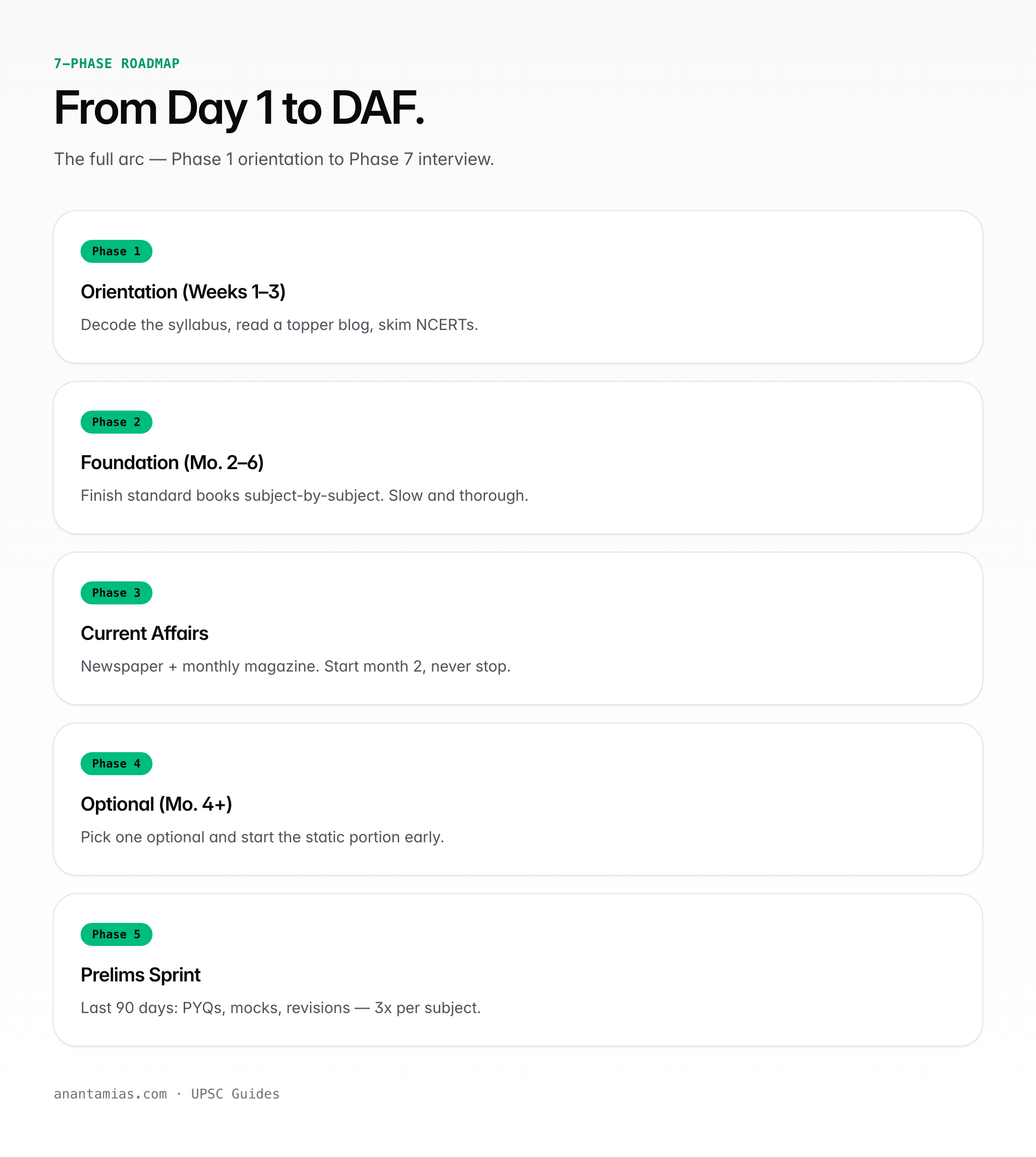
This is where you move from NCERTs to standard references. Go subject by subject. Do not touch five books at once. The goal is one complete reading of each standard book with underlining, followed by a second reading in which you make short notes.
| Subject | Foundation Book | Time |
|---|---|---|
| Polity | Laxmikanth — Indian Polity | 3 weeks |
| Modern History | Spectrum — Brief History of Modern India | 2 weeks |
| Ancient & Medieval | Tamil Nadu Class 11 History / Old NCERT | 2 weeks |
| Geography | G.C. Leong + NCERT Class 11 | 3 weeks |
| Economy | Ramesh Singh or Sanjeev Verma | 3 weeks |
| Environment | ShankarIAS Environment | 2 weeks |
| Art & Culture | Nitin Singhania | 2 weeks |
| Science & Tech | Current Affairs + ShankarIAS S&T | ongoing |
Phase 3: Current Affairs Habit (From Month 2, Forever)
Start current affairs parallel to foundation — do not postpone it to month 8 like many do. Thirty minutes of newspaper daily, a monthly compilation (Vision IAS or ForumIAS works), and one weekly editorial summary is enough. Keep it boring and consistent.
Phase 4: Optional Subject (Month 4 onwards)
Choose your Optional only after you have touched 4–5 GS subjects — otherwise you’ll mis-judge your own interest. Popular choices: PSIR, Sociology, Anthropology, Geography, Public Administration, and literature optionals. There is no ‘scoring’ optional; there is only the optional where you can write 250 pages of notes without wanting to quit.
Phase 5: Prelims Sprint (Last 90 Days)
From March onwards, shift to Prelims mode. CSAT must not be ignored — 33% in CSAT is mandatory and around 40% of aspirants fail here every year. Solve one sectional test every alternate day and one full-length mock every Sunday. Analyse more than you attempt. Your mock analysis notebook is worth more than any coaching module.
Phase 6: Mains Writing (Post-Prelims)
The 80 days between Prelims and Mains are the most important of the whole journey. Write 2 answers daily minimum. Join one test series — Vision IAS or ForumIAS or InsightsIAS — and finish 8 full-length GS tests and 4 Essay tests before the exam. Answer writing is a motor skill; no amount of reading substitutes for writing.
Phase 7: Interview
If you clear Mains, you get 2–3 months. Get your DAF (Detailed Application Form) analysed by at least 3 mock panels. Read one news magazine weekly (Frontline, Yojana, Kurukshetra). Work on clarity, not quotations.
Common Beginner Mistakes
- Buying 40 books before finishing 4
- Ignoring CSAT until April — then panicking
- Starting an Optional in month 1 (too early)
- Making notes before reading twice
- Watching 8 hours of YouTube strategy videos daily
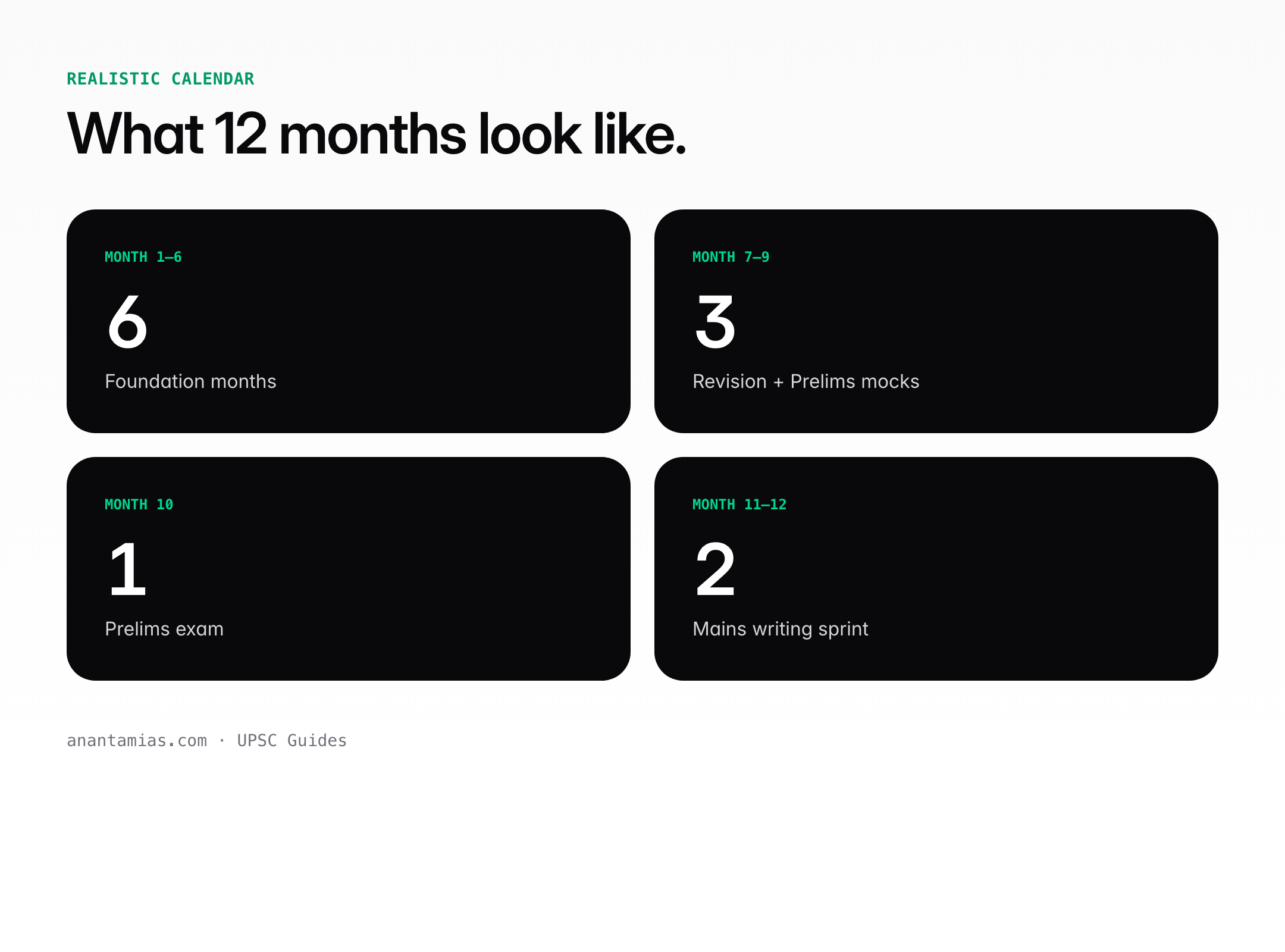
A Realistic 12-Month Calendar
| Month | Focus |
|---|---|
| 1 | Syllabus, NCERTs, newspaper habit |
| 2–3 | Polity, Modern History |
| 4–5 | Geography, Economy, Optional start |
| 6–7 | Environment, Culture, Mains answer writing begins |
| 8–9 | GS full revision + Optional revision |
| 10 | Prelims mock marathon + CSAT |
| 11 | PRELIMS |
| 12 | Mains full-length tests |
Close your tabs. Pick up one NCERT. Start reading. The roadmap only works if you walk it.
Frequently Asked Questions
How long does UPSC preparation take for a beginner?
Most beginners need 12–15 months of serious preparation for a first attempt. Working professionals may need 18–24 months with 3–4 hours daily. The key is consistency, not duration.
Can I clear UPSC without coaching?
Yes. Many toppers — Anudeep Durishetty (AIR 1, 2017) and Tina Dabi (AIR 1, 2015) among them — used self-study with a test series. Coaching helps structure but is not mandatory if you can self-discipline.
Which book should I read first?
Start with NCERTs from Class 6–12, especially Polity, History, and Geography. Then move to Laxmikanth for Polity — it is the single most-referenced book for CSE.
When should I choose my Optional subject?
Around months 3–4, after you have sampled Polity, History, Geography, and Sociology/Public Admin lite reading. Never pick an Optional on day one based on ‘scoring potential’.
Is 6 hours of study enough per day?
Six focused hours beats ten distracted hours. Aspirants preparing while working often study 4–5 hours on weekdays and 8 on weekends and still clear.
Tell Google you want more of this.
Add Anantam IAS as a preferred sourceOne tap, and this site shows up more often in your own Top Stories, AI Overviews and AI Mode. Remove it any time.