Terror funding is the supply of money that sustains terrorist organisations, and cutting it is often more effective than intercepting weapons, because money is harder to replace than a rifle. In India it moves through counterfeit currency, hawala, trade mis-invoicing, narcotics and increasingly crypto-assets, and the counter-architecture is built on both an international standard and a domestic enforcement stack.
Why It Is Distinct From Money Laundering
The two are related and they are not the same, and confusing them produces bad enforcement design.
- Money laundering takes illicit money and makes it look legitimate. The source is criminal, the destination is legal.
- Terror financing frequently takes legitimate money — donations, business income, charitable contributions — and directs it to an illegal purpose. The source may be clean, the destination is not.
- Implication. Source-based investigation alone will not catch terror financing, which is why suspicious transaction reporting has to look at destination and pattern, not only at origin.
- Scale. Terrorist operations are cheap. Major attacks have been mounted on sums small enough to fall below most reporting thresholds, which is the enforcement difficulty in a sentence.
Our note on money laundering covers the placement, layering and integration cycle in detail.
Fake Indian Currency Notes
- High-quality counterfeit notes, frequently printed outside India and routed through Nepal, Bangladesh, Myanmar and Gulf channels.
- Dual purpose: financing terrorist modules, and damaging confidence in the currency itself. This is why it is treated as economic warfare rather than ordinary counterfeiting.
- The 2016 demonetisation had disruption of FICN networks as a stated objective. New security features interrupted circulation in the short run, though counterfeiting has since adapted.
- Enforcement runs through the FICN Coordination Group (FCORD) under the Ministry of Home Affairs and the National Investigation Agency’s dedicated cell.
- Sections 489A to 489E of the Indian Penal Code, now carried into the Bharatiya Nyaya Sanhita, criminalise counterfeiting, and the Unlawful Activities (Prevention) Act treats high-quality counterfeiting as a terrorist act.
See our current-affairs note on fake currency in India for the recent seizure pattern.
The Other Channels
- Hawala. An informal value transfer system based on trust and offsetting balances between brokers, leaving no bankable trail. Banking-based surveillance does not reach it.
- Trade-based laundering. Under-invoicing and over-invoicing of imports and exports to move value across borders. It is the most widespread method and the hardest to detect, because it hides inside legitimate commerce.
- Narco-terrorism. Drug trafficking along the Punjab border and the Arabian Sea route, increasingly with drone-based cross-border delivery of both narcotics and weapons.
- Shell companies and fake invoicing, and misuse of charitable organisations and non-profits, which is why the Foreign Contribution (Regulation) Act was tightened.
- Real estate, gold and diamond trade, which absorb cash at scale with weak provenance requirements.
- Crypto-assets, which move across borders pseudonymously. India brought virtual digital asset service providers under the anti-money-laundering regime in 2023.
- Extortion and levies in insurgency-affected areas, historically a significant income stream for left-wing extremist and north-eastern groups.
The International Architecture
- Financial Action Task Force (FATF), established in 1989, is the global standard-setter. Its 40 Recommendations cover anti-money-laundering and counter-terrorist-financing obligations, and its grey and black lists create genuine economic pressure through correspondent banking costs and investor caution. India has been a full member since 2010, and its 2024 Mutual Evaluation Report placed India in the regular follow-up category, the highest tier.
- Asia Pacific Group on Money Laundering, the FATF-style regional body of which India is a member.
- UN Security Council Resolution 1267 and its sanctions committee, which lists individuals and entities and requires asset freezes, travel bans and arms embargoes. India secured the listing of Masood Azhar through this route in 2019.
- UNSC Resolution 1373 (2001), which obliges all states to criminalise terrorist financing, and the International Convention for the Suppression of the Financing of Terrorism, 1999.
- Egmont Group, the network of financial intelligence units, which India’s FIU-IND joined in 2007.
- Basel Committee customer due diligence standards, and automatic exchange of financial information under the Common Reporting Standard.
- India’s own initiatives: the No Money for Terror ministerial conference hosted in New Delhi in 2022, and the long-standing push for a Comprehensive Convention on International Terrorism, which remains stalled for want of an agreed definition of terrorism.
India’s Domestic Stack
- Prevention of Money Laundering Act, 2002, enforced by the Enforcement Directorate, with powers of attachment, search and prosecution.
- Unlawful Activities (Prevention) Act, whose 2019 amendment allows individuals, not only organisations, to be designated as terrorists, and which criminalises raising funds for terrorist acts.
- Financial Intelligence Unit – India (FIU-IND), the central recipient of suspicious transaction reports and cash transaction reports.
- National Investigation Agency, with a dedicated terror funding and fake currency cell and expanded jurisdiction after the 2019 amendment to its parent Act.
- RBI know-your-customer and anti-money-laundering directions, extended to virtual digital asset service providers in 2023.
- Foreign Contribution (Regulation) Act controls on foreign funding of associations, and Narcotic Drugs and Psychotropic Substances Act enforcement against narco-terror linkages.
Where Enforcement Falls Short
- Hawala is informal and trust-based, so surveillance built on the banking system does not reach it.
- Trade-based laundering needs customs data and financial intelligence to be integrated, and that integration remains weak.
- Crypto regulation is inconsistent globally, so value moves to whichever jurisdiction is most permissive.
- Conviction rates under the PMLA are low relative to attachment rates, which raises the question of whether the statute is being used to prosecute or to pressure.
- FATF pressure is political. Listing decisions have been applied unevenly, and the 1267 committee is subject to a veto, which has repeatedly delayed designations India sought.
- Small sums evade thresholds. Because attacks are cheap, the transactions that matter most are often the ones least likely to trigger a report.
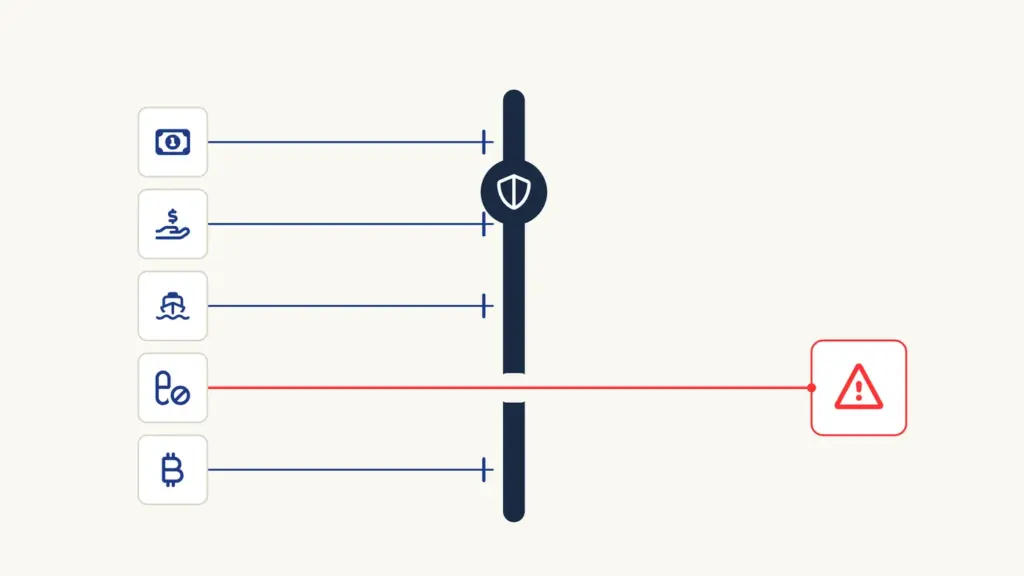
The structural point is that every channel closed pushes value into the next one. Enforcement therefore has to advance across banking, trade, narcotics and crypto simultaneously, or it simply relocates the flow.
Frequently Asked Questions
What is terror funding?
The supply of money that sustains terrorist organisations and operations. Unlike money laundering, it often takes legitimate money — donations, business income, charitable contributions — and directs it to an illegal purpose, which is why source-based investigation alone does not detect it.
How is terror financing different from money laundering?
Money laundering takes criminal money and makes it appear legitimate, moving from an illegal source to a legal destination. Terror financing frequently moves in the opposite direction, taking clean money to an illegal destination. Detection therefore has to focus on destination and pattern, not only on origin.
What is FATF and why does it matter to India?
The Financial Action Task Force, established in 1989, is the global standard-setter for anti-money-laundering and counter-terrorist-financing, with 40 Recommendations and grey and black lists that impose real economic costs. India has been a full member since 2010 and was placed in the regular follow-up category, the highest tier, in its 2024 Mutual Evaluation Report.
What are Fake Indian Currency Notes and why are they a security threat?
High-quality counterfeit notes, often printed outside India and routed through neighbouring countries. They serve a dual purpose: financing terrorist modules and damaging confidence in the currency, which is why they are treated as economic warfare rather than ordinary counterfeiting.
What is UN Security Council Resolution 1267?
A resolution establishing a sanctions committee that lists individuals and entities associated with designated terrorist organisations and requires member states to freeze their assets, impose travel bans and enforce arms embargoes. India secured the listing of Masood Azhar through this mechanism in 2019.
Which Indian laws address terror funding?
Principally the Prevention of Money Laundering Act, 2002, enforced by the Enforcement Directorate, and the Unlawful Activities (Prevention) Act, whose 2019 amendment permits individuals to be designated as terrorists. FIU-IND collects suspicious transaction reports, and the National Investigation Agency runs a dedicated terror funding and fake currency cell.
Practice Questions
Prelims MCQs
1. The Financial Action Task Force was established in:
- (a) 1979
- (b) 1989
- (c) 1999
- (d) 2001
Answer: (b) 1989
2. How many Recommendations form the core FATF standard?
- (a) 20
- (b) 30
- (c) 40
- (d) 49
Answer: (c) 40
3. India became a full member of the FATF in:
- (a) 2006
- (b) 2008
- (c) 2010
- (d) 2014
Answer: (c) 2010
4. UN Security Council Resolution 1267 relates primarily to:
- (a) Nuclear non-proliferation
- (b) A sanctions committee listing terrorists and entities
- (c) Maritime piracy
- (d) Cross-border cyber crime
Answer: (b) A sanctions committee listing terrorists and entities
5. The 2019 amendment to the Unlawful Activities (Prevention) Act allows the designation as terrorists of:
- (a) Only organisations
- (b) Only foreign nationals
- (c) Individuals as well as organisations
- (d) State actors
Answer: (c) Individuals as well as organisations
Mains Questions
- Discuss counterfeit currency and money laundering as major sources of terror funding in India and the international actions taken to check them. (15 marks, 250 words)
- Examine the role of the Financial Action Task Force and the methods of compliance by member states in preventing terror funding. (15 marks, 250 words)
- “Terror financing often moves clean money to a dirty purpose.” Discuss the implications of this for enforcement design. (10 marks, 150 words)
- Discuss trade-based money laundering and narco-terrorism as emerging channels of terror funding in India. (10 marks, 150 words)
- Critically assess India’s domestic legal architecture against terror financing, with reference to the PMLA and the UAPA. (15 marks, 250 words)
Tell Google you want more of this.
Add Anantam IAS as a preferred sourceOne tap, and this site shows up more often in your own Top Stories, AI Overviews and AI Mode. Remove it any time.