History optional PYQ analysis is the cheapest preparation you will ever do, because the paper tells you what it wants and most candidates never sit down and count. We took the four History Paper 1 question papers UPSC currently publishes, 2023 through 2026, and tagged all 96 questions to the syllabus unit each one came from. That is 1,600 marks of evidence. What comes out is not the paper most booklists prepare you for.
Two findings reset the whole strategy. The map question alone is 200 of those 1,600 marks. And the eighteenth century, a unit that sits at the very end of Paper 1 and gets read last if at all, is the highest-scoring textual unit in the paper.
What Paper 1 actually asks you to do
Before any weightage table, get the format right, because a surprising number of aspirants prepare for the wrong paper.
- Eight questions, printed in Hindi and English, divided into two sections
- You attempt five questions in all, for 250 marks in three hours
- Question 1 and Question 5 are compulsory
- Of the remaining six, you attempt three, choosing at least one from each section
- Section A is ancient India, Section B is medieval India
- Question 1 is always the map. Question 5 is always five short notes of 150 words each
The paper therefore prints 400 marks of questions and you answer 250 of them. Every question is worth exactly 50 marks, either as one 50-mark block or split into parts.
That split matters more than it looks. Across the four papers, Paper 1 used 48 questions worth 15 marks, 24 worth 20 marks, 20 worth 10 marks and 4 map questions worth 50. The 15-marker is the unit of this paper. If you have trained on 250-word answers, you have trained for the wrong length.
The map question is 12.5 per cent of Paper 1
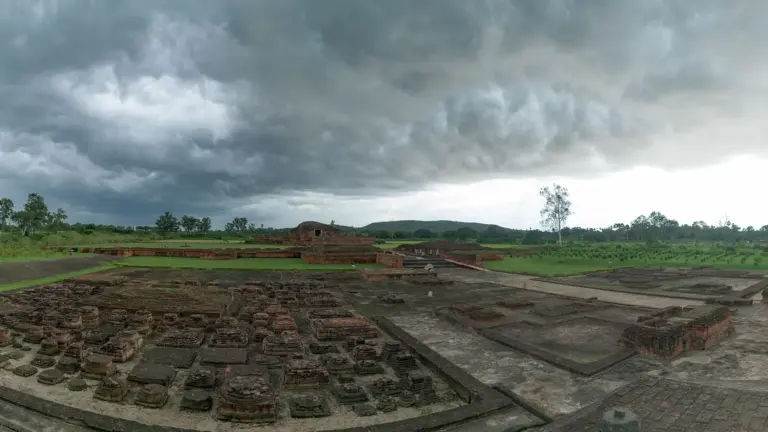
Question 1 is 50 marks every single year. Over four years that is 200 marks, more than any syllabus unit in the paper. You cannot skip it, because Question 1 is compulsory.
UPSC does not name the site. It gives you a locational hint and a marked point, and you supply the name plus a 30-word note. Twenty of them.
We categorised all 80 hints from 2023 to 2026 by what they ask you to recognise.
| What the hint points to | 2023 | 2024 | 2025 | 2026 | Total |
|---|---|---|---|---|---|
| Stone Age and proto-historic sites | 9 | 8 | 7 | 8 | 32 |
| Trade, ports and urban sites | 3 | 2 | 2 | 5 | 12 |
| Inscriptions and coins | 3 | 4 | 4 | 0 | 11 |
| Temples and art | 3 | 4 | 1 | 3 | 11 |
| Buddhist and Jain sites | 1 | 3 | 1 | 4 | 9 |
| Mauryan and Asokan sites | 2 | 1 | 5 | 1 | 9 |
| Harappan sites | 1 | 1 | 3 | 2 | 7 |
Read that top row again. Forty per cent of every map is Palaeolithic, Mesolithic, Neolithic, Chalcolithic and Megalithic sites. Stone Age archaeology is the single densest thing on the map, and it is the unit most candidates treat as a two-day read before moving on to the Guptas.
The hints are also getting more specific. In 2023 you got “Neolithic site”. By 2026 you got “Neolithic ash mound site”, “Chalcolithic and early historic site with five occupational phases” and “Harappan site with radial town planning”. The hint is now doing the work of a descriptor, which means a candidate who has memorised a bare list of site names without knowing what each site is famous for cannot use it.
The payoff: an atlas of 150 sites, each with one line on why it is excavated and what phase it belongs to, is worth more marks per hour than any other single artefact in History optional preparation.
Topic weightage for Paper 1, 2023 to 2026
Every figure below is marks actually printed on the paper, tagged to the UPSC syllabus unit.
| Syllabus unit | Section | Marks | Share | Questions | Years asked |
|---|---|---|---|---|---|
| The map question | A | 200 | 12.5% | 4 | 4 of 4 |
| The Eighteenth Century | B | 165 | 10.3% | 10 | 4 of 4 |
| Cultural Traditions in India, 750-1200 | A | 100 | 6.2% | 6 | 4 of 4 |
| Culture in the Mughal Empire | B | 95 | 5.9% | 6 | 3 of 4 |
| Economy and Society, 16th-17th centuries | B | 85 | 5.3% | 6 | 3 of 4 |
| The Fourteenth Century | B | 80 | 5.0% | 7 | 4 of 4 |
| Early Medieval India, 750-1200 | A | 75 | 4.7% | 5 | 4 of 4 |
| Indus Valley Civilization | A | 65 | 4.1% | 4 | 4 of 4 |
| Mauryan Empire | A | 65 | 4.1% | 4 | 3 of 4 |
| Akbar | B | 65 | 4.1% | 4 | 3 of 4 |
| The Mughal Empire in the 17th Century | B | 65 | 4.1% | 4 | 3 of 4 |
| The Fifteenth and Early Sixteenth Century | B | 60 | 3.8% | 4 | 2 of 4 |
| Pre-history and Proto-history | A | 50 | 3.1% | 3 | 3 of 4 |
| Period of Mahajanapadas | A | 50 | 3.1% | 3 | 2 of 4 |
| Post-Mauryan Period | A | 50 | 3.1% | 3 | 3 of 4 |
| Bhakti and Sufi developments | B | 50 | 3.1% | 5 | 4 of 4 |
| Aryans and Vedic Period | A | 45 | 2.8% | 3 | 3 of 4 |
| Regional States during Gupta Era | A | 45 | 2.8% | 3 | 3 of 4 |
| Themes in Early Indian Cultural History | A | 40 | 2.5% | 2 | 2 of 4 |
| Society, Culture and Economy, 13th-15th centuries | B | 40 | 2.5% | 3 | 2 of 4 |
| Eastern India, Deccan and South India | A | 35 | 2.2% | 2 | 2 of 4 |
| Sources | A | 30 | 1.9% | 2 | 2 of 4 |
| Megalithic Cultures | A | 15 | 0.9% | 1 | 1 of 4 |
| Guptas, Vakatakas and Vardhanas | A | 15 | 0.9% | 1 | 1 of 4 |
| The Thirteenth Century | B | 15 | 0.9% | 1 | 1 of 4 |
The eighteenth century is the highest-yield unit in the paper
Set the map aside and the eighteenth century is the biggest block on the table: 165 marks, 10 questions, present in all four papers. Nothing else comes close.
What UPSC asks from it is remarkably consistent:
- The Marathas, from Shivaji’s polity to the Third Battle of Panipat and its aftermath, in 2023, 2024, 2025 and 2026
- The successor states, with Haidar Ali and Tipu in 2023 and the Asaf Jahi dynasty of Hyderabad in 2024
- Ranjit Singh and the rise of the Sikhs in 2023
- The dark age debate, whether the century was economic decline or growth, in 2023 and again in 2026
The 2026 paper asked both a Maratha question and the dark age question in the same paper, for 35 marks.
Contrast that with the Guptas. The Gupta, Vakataka and Vardhana unit, which occupies whole chapters in every standard book and which almost every candidate revises twice, produced one 15-mark question in four years. Under one per cent of the paper.
The payoff: the last unit of your syllabus is worth eleven times what the unit you revise most is worth. Read Paper 1 backwards at least once.
Section A and Section B are exactly equal, and that is a choice
Across four papers, Section A took 800 marks and Section B took 800 marks. Not approximately. Exactly.
That symmetry is structural, not accidental, and it has a direct consequence. Because you must attempt at least one question from each section, and because Question 1 (ancient, the map) and Question 5 (medieval, short notes) are both compulsory, you cannot build a strategy on abandoning either half of the paper.
Candidates try anyway. The usual version is to prepare ancient India properly and treat medieval as a reading subject. That plan loses you the compulsory 50-mark short-note question in Section B, and it caps your Section B choice at exactly one question that you will answer badly.
Culture outscores politics in the medieval half
Section B’s three biggest units are cultural and economic, not dynastic:
- Culture in the Mughal Empire, 95 marks, on painting, architecture, Hindi literature under patronage and Persian influence
- Economy and Society in the sixteenth and seventeenth centuries, 85 marks, on karkhanas, revenue administration, Indian Ocean trade and textiles
- The Fourteenth Century, 80 marks, mostly Alauddin Khalji’s and Muhammad-bin-Tughlaq’s economic measures rather than their campaigns
Meanwhile The Thirteenth Century, the foundation of the Delhi Sultanate that every booklist front-loads, produced one 15-mark question on Balban in four years.
The pattern holds on the ancient side too. Cultural Traditions 750-1200, at 100 marks, outscores the Mauryan Empire and the Guptas put together.
Six questions crossed the ancient-medieval line
Something the section headings hide. Six of the 96 Paper 1 questions drew on Section A syllabus units but were printed in Section B, and the crossing always ran the same way:
- Proponents of Indian feudalism, 2023
- Alberuni’s assessment of Indian society, 2023
- Vesara style temple architecture, 2024
- The Acharya Triumvirate and Indian Vedanta, 2024
- The Cholas as an imperial power, 2026
- Theories on the origin of the Rajputs, 2026
UPSC’s Section B formally begins at the thirteenth century. All six of these belong to Early Medieval India 750-1200 or Cultural Traditions 750-1200, which sit in Section A of the syllabus.
The payoff: the 750 to 1200 window is the hinge of Paper 1. It is examined from both sides, and its two units together carry 175 marks, the largest stretch of textual marks anywhere in the paper. The eighteenth century is the biggest single unit; the 750 to 1200 window is the biggest period.
Historiography is now a standing feature
A quiet shift across these four papers: UPSC keeps asking you to evaluate the source rather than narrate from it.
- Alberuni’s assessment of Indian society and its defects, 2023
- Barani’s Fatwa-i-Jahandari as a lament rather than an account, 2025
- Barani’s Tarikh-i-Firoz Shahi and its shortcomings, 2026
- Greek, Chinese and Arab writers and their differing lenses, 2026
- Domingo Paes on Krishnadevaraya, 2026
Four of these five are from the last two papers. A candidate who knows what Barani said but not what Barani was doing cannot write these.
What this means for how you prepare
Concrete, in order of marks returned per hour:
- Build the site atlas first. Twenty places a year, 40 per cent Stone Age, with descriptor-level hints. This is 12.5 per cent of the paper and it is the most learnable thing in it.
- Read the eighteenth century as a core unit, not an epilogue. Marathas, successor states, and the dark age debate with both sides of the argument.
- Train at 15 marks. That is 48 of the 96 questions. Roughly 150 to 180 words, one clear stance, two pieces of evidence.
- Prepare culture and economy ahead of dynastic narrative in the medieval half.
- Learn five to eight historians well enough to critique them. Alberuni, Barani, the Greek and Chinese accounts, the Portuguese travellers.
- Do not over-invest in the Guptas. One question in four years.
A note on why this covers four years
UPSC publishes previous question papers on its own website, and it currently keeps the last four Civil Services Main examinations there. Older History optional papers were removed as newer ones went up. Every number on this page comes from those four papers as UPSC published them, transcribed question by question and checked against the printed marks, so each paper totals 400 and each question totals 50.
Longer runs of History optional data circulate online, but they rest on third-party compilations rather than on the papers themselves. Four years you can open and check beats eleven you have to take on trust, and four years is enough to see a pattern this consistent.
Frequently asked questions
How many questions are there in UPSC History optional Paper 1?
Paper 1 prints eight questions in two sections, and you attempt five of them for 250 marks in three hours. Question 1 and Question 5 are compulsory. Of the remaining six you attempt three, choosing at least one question from each section. Because every question carries 50 marks, the paper offers 400 marks of questions for a 250-mark answer script.
Is the map question compulsory in History optional Paper 1?
Yes. Question 1 is the map question every year and it is compulsory, so you cannot avoid it. It carries 50 marks, which works out to 12.5 per cent of Paper 1 across 2023 to 2026, more than any syllabus unit in the paper. You are given twenty marked points with a locational hint for each, and you supply the site name plus a note of about 30 words.
Which topic carries the most marks in History optional Paper 1?
Excluding the map, the eighteenth century is the highest-scoring unit, with 165 marks from ten questions across all four papers from 2023 to 2026. It covers the Marathas from Shivaji to Panipat, the successor states such as Mysore and Hyderabad, Ranjit Singh, and the debate over whether the century was economic decline or growth.
How many marks is each question worth in History optional Paper 1?
Across the 2023 to 2026 papers, Paper 1 used 48 questions worth 15 marks, 24 worth 20 marks, 20 worth 10 marks and four map questions worth 50 marks. The 15-mark answer of roughly 150 to 180 words is the working unit of this paper, which is different from Paper 2 where no 15-markers appear at all.
What kind of places come in the History optional map question?
Across 80 hints from 2023 to 2026, Stone Age and proto-historic sites were the largest group at 32 placements, or 40 per cent. Trade, ports and urban sites accounted for 12, inscriptions and coins for 11, temples and art for 11, Buddhist and Jain sites for 9, Mauryan and Asokan sites for 9, and Harappan sites for 7. The hints have also grown more specific, naming features such as radial town planning or an ash mound rather than just the period.
Is ancient or medieval history more important in History optional Paper 1?
Neither. Across the four papers Section A, which is ancient India, carried exactly 800 marks and Section B, which is medieval India, carried exactly 800 marks. Because Question 1 sits in Section A, Question 5 sits in Section B, both are compulsory, and you must choose at least one more question from each section, no strategy that abandons half the syllabus can work.
Which History optional Paper 1 topics are asked least?
Three units produced a single 15-mark question each between 2023 and 2026: Megalithic Cultures, the Guptas, Vakatakas and Vardhanas, and the Thirteenth Century. Each is under one per cent of the paper. The Gupta result is the one worth noting, because it is a unit that most candidates revise more than almost any other.
How many years of History optional question papers does UPSC publish?
UPSC keeps previous question papers on its own website and currently hosts the last four Civil Services Main examinations, which is 2023 to 2026 for the History optional. Older papers were taken down as newer ones went up. This analysis uses only those four papers, transcribed question by question and checked so that each paper totals 400 marks and each question totals 50.
Tell Google you want more of this.
Add Anantam IAS as a preferred sourceOne tap, and this site shows up more often in your own Top Stories, AI Overviews and AI Mode. Remove it any time.