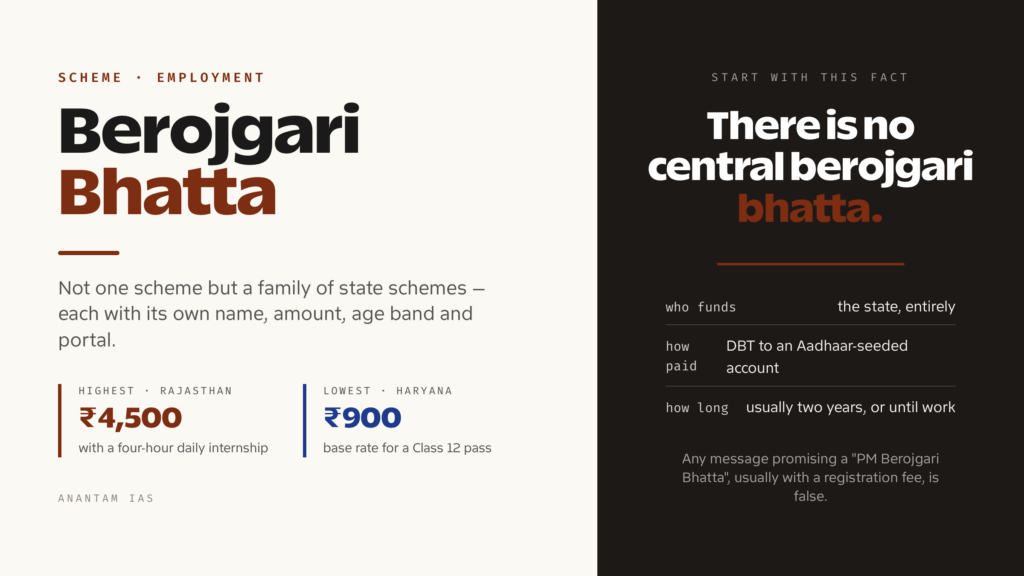
Berojgari bhatta is a monthly cash allowance paid to educated, registered, unemployed young people while they look for work. It is not one scheme. It is a family of state schemes, each with its own name, its own amount, its own age band and its own portal — which is exactly why the search results for it are such a mess.
Start with the single most important fact: there is no central berojgari bhatta. The Union government does not run a national unemployment allowance, and any message promising one — a “PM Berojgari Bhatta” of ₹3,500 a month, a link asking for a registration fee — is false. What exists is a set of state schemes, from Rajasthan’s ₹4,000-₹4,500 a month down to Haryana’s ₹900 for a Class 12 pass, each administered by the state’s employment or labour department.
Because the allowance is state-run, verify the scheme against a government directory and the state portal before you submit personal details. The Government of India’s myScheme entry provides a useful starting point, while the official Chhattisgarh page and the Bihar scheme entry show why the rules differ by state.
What the Scheme Offers
The design logic is similar everywhere. A state’s employment department maintains a live register of job seekers. If you are on that register, are within a defined age band, hold a minimum qualification, and your family income is below a ceiling, the state pays you a monthly transfer directly into an Aadhaar-linked bank account for a capped period — almost always two years, or until you find work, whichever comes first.
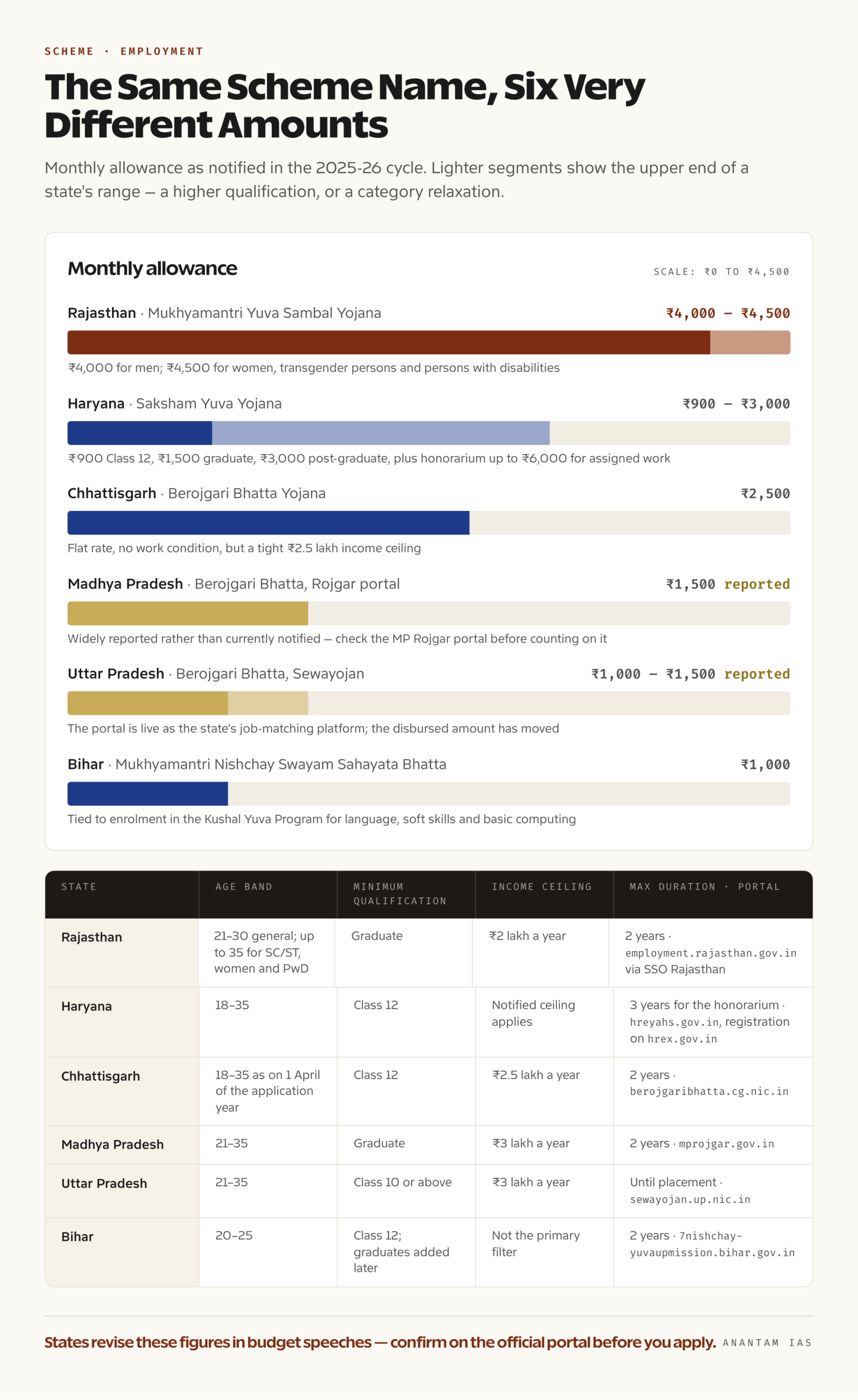
What differs is generosity and what the state asks in return. Rajasthan pays the most but demands four hours of daily internship service in a government office. Haryana pays a small base allowance but layers a much larger honorarium on top of it for up to 100 hours of assigned work a month. Chhattisgarh pays a flat ₹2,500 with no work condition but a tight income ceiling. Bihar pays ₹1,000 and ties it to a mandatory soft-skills and computer course.
That distinction matters more than the headline number. A pure allowance is income support. A work-linked allowance is a stipend for public service, and it constrains what else you can do with your day — including whether you can hold the part-time work that most job seekers actually rely on.
The money is almost always paid by Direct Benefit Transfer, so a working bank account seeded with Aadhaar is not optional. It is the single most common reason a sanctioned allowance never arrives. Funding sits entirely with the state — Chhattisgarh budgeted ₹550 crore in the scheme’s first year, 2023-24 — and that fiscal exposure is why states cap beneficiary numbers, tighten income ceilings and, occasionally, quietly stop taking new applications.
State-Wise Allowance Amounts Compared
The table below sets out the six schemes people search for most. Figures are the amounts notified as of the 2025-26 cycle; states revise them in budget speeches, so confirm on the official portal before you apply.
| State | Scheme name | Monthly amount | Age band | Minimum qualification | Family income ceiling | Max duration | Official portal |
|---|---|---|---|---|---|---|---|
| Rajasthan | Mukhyamantri Yuva Sambal Yojana | ₹4,000 (men); ₹4,500 (women, transgender persons, persons with disabilities) | 21-30 general; up to 35 for SC/ST, women and PwD | Graduate | ₹2 lakh a year | 2 years | employment.rajasthan.gov.in (via SSO Rajasthan) |
| Chhattisgarh | Berojgari Bhatta Yojana | ₹2,500 | 18-35 as on 1 April of the application year | Class 12 | ₹2.5 lakh a year | 2 years | berojgaribhatta.cg.nic.in |
| Haryana | Saksham Yuva Yojana | ₹900 (Class 12); ₹1,500 (graduate); ₹3,000 (post-graduate), plus honorarium up to ₹6,000 for assigned work | 18-35 | Class 12 | Notified ceiling applies | 3 years for the honorarium component | hreyahs.gov.in, with registration on hrex.gov.in |
| Madhya Pradesh | Berojgari Bhatta (Rojgar portal) | Reported at ₹1,500 | 21-35 | Graduate | ₹3 lakh a year | 2 years | mprojgar.gov.in |
| Uttar Pradesh | Berojgari Bhatta (Sewayojan) | Reported at ₹1,000-₹1,500 | 21-35 | Class 10 or above | ₹3 lakh a year | Until placement | sewayojan.up.nic.in |
| Bihar | Mukhyamantri Nishchay Swayam Sahayata Bhatta | ₹1,000 | 20-25 | Class 12 (graduates added later) | Not the primary filter | 2 years | 7nishchay-yuvaupmission.bihar.gov.in |
Two rows in that table need a caveat, and it is better to say so than to guess.
Madhya Pradesh has restructured its youth support repeatedly, and its flagship youth transfer is now the Mukhyamantri Sikho-Kamao Yojana, which pays a training stipend to youngsters placed with employers rather than an allowance to job seekers at home. Uttar Pradesh’s position is similar: the allowance exists in the employment-exchange rules and the Sewayojan portal is very much live — it is the state’s main job-matching platform, now branded Rojgar Sangam — but state energy has shifted towards apprenticeship and placement drives. In both cases, treat the amount as widely reported rather than currently notified, register anyway, and check the state portal before counting on the cash.
Who Is Eligible
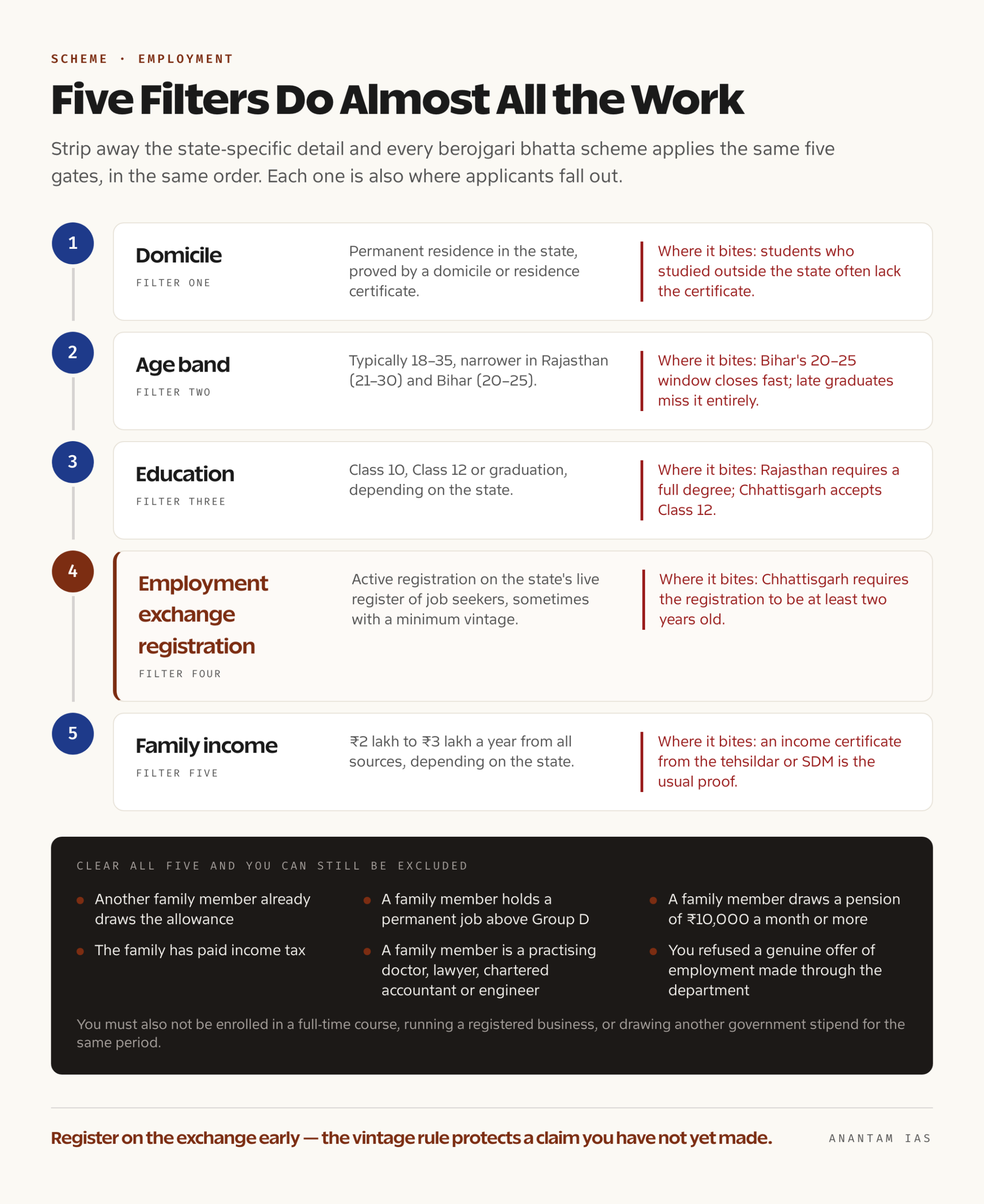
Strip away the state-specific detail and five filters do almost all the work.
| Filter | What it usually means | Where it bites |
|---|---|---|
| Domicile | Permanent residence in the state, proved by a domicile or residence certificate | Students who studied outside the state often lack the certificate |
| Age band | Typically 18-35, narrower in Rajasthan (21-30) and Bihar (20-25) | Bihar’s 20-25 window closes fast; late graduates miss it entirely |
| Education | Class 10, Class 12 or graduation depending on the state | Rajasthan requires a full degree; Chhattisgarh accepts Class 12 |
| Employment exchange registration | Active registration on the state’s live register, sometimes with a minimum vintage | Chhattisgarh requires the registration to be at least two years old |
| Family income | ₹2 lakh to ₹3 lakh a year from all sources | An income certificate from the tehsildar or SDM is the usual proof |
On top of these, states exclude specific categories. Chhattisgarh’s list is the most explicit and is a fair template for the rest. You are out if any of the following applies: another member of your family is already drawing the allowance; a family member holds a permanent government or private job above Group D; a family member draws a pension of ₹10,000 a month or more; the family has paid income tax; a family member is a practising professional such as a doctor, lawyer, chartered accountant or engineer; the family includes a sitting or former elected representative above a defined level; or you refused a genuine offer of employment or self-employment made through the department.
That last one is worth pausing on. The allowance is legally a job-search support, not a grant, and refusing a placement offered through the exchange can end it. Two further conditions catch people out almost everywhere: you must not be enrolled in a full-time course, and you must not be running a registered business or drawing any other government stipend for the same period.
How to Apply, Step by Step
Every state runs its own portal, but the sequence is nearly identical.
- Register on the state employment portal first. This is the step people skip. In Rajasthan you create an SSO ID at the state single sign-on portal and reach the employment department module from there. In Haryana you register on the employment exchange site and then log in to the Saksham portal. In Chhattisgarh and Uttar Pradesh you register directly with the district employment and self-employment guidance centre through the state portal. Your registration number is the key to everything that follows.
- Wait out the vintage requirement if your state has one. Chhattisgarh will not process an application unless your employment registration, at the qualifying education level, is at least two years old as on 1 April of the application year. Registering now protects your claim later.
- Fill the unemployment allowance application in the application window. Some states accept applications year-round; Rajasthan has historically opened its window between 1 April and 30 June. Check the portal notice before assuming it is open.
- Upload documents. The standard set is Aadhaar, a domicile or residence certificate, the education marksheet or degree, the employment exchange registration certificate, an income certificate from the competent revenue officer, a bank passbook page showing an Aadhaar-seeded account, a caste certificate where a relaxation is claimed, and a recent photograph. Some states require an affidavit or self-declaration of unemployment.
- Complete verification. Bihar is the clearest case: after the online application you must visit the District Registration and Counselling Centre within 60 days with original documents. Other states verify through the district employment officer, sometimes with a physical appearance, sometimes on the record alone.
- Accept the conditions attached. Rajasthan requires four hours of daily internship service in a state government department or undertaking. Bihar requires enrolment in the Kushal Yuva Program for language, soft skills and basic computing. Skipping these stops the payment.
- Track status and keep the account alive. Portals carry an application status or payment status link keyed to your registration or application number. If the sanction shows as approved but no money has landed, the problem is almost always Aadhaar-bank seeding at your branch, not the department.
- Renew or report a change. Getting a job, joining a course or crossing the income ceiling must be reported. Continuing to draw the allowance after employment is recoverable and, in several states, punishable.
Where It Stands on the Ground
The macro case for these schemes is easy to make. The Periodic Labour Force Survey monthly bulletin for June 2026 put the urban unemployment rate at 6.6 per cent, down from 7.1 per cent a year earlier, with urban labour force participation at 50.1 per cent. Those headline numbers look manageable. The youth figure does not — unemployment among 15-29-year-olds stays stubbornly in double digits, concentrated among exactly the educated young people these schemes target. A graduate in a small town is more likely to be unemployed than a school dropout, because the dropout takes whatever work exists and the graduate waits for work that matches the degree.
Uptake tells you which states mean it. Chhattisgarh transferred roughly ₹250 crore to about 1.33 lakh beneficiaries within eight months of launching its ₹2,500 allowance in April 2023. Rajasthan has run its internship-linked model at scale, with over 1.85 lakh beneficiaries recorded as active interns across government departments, against an annual cap of two lakh. Elsewhere the record is thinner: several states carry the scheme on the statute book and on the portal while sanctioning very few new cases, which is why aggregator websites confidently quote amounts that no longer move.
Challenges and What to Watch
The amounts are small relative to the problem. ₹1,000 a month does not fund a job search that involves travel, application fees and coaching. ₹4,500 in Rajasthan is meaningful, but it comes bundled with a four-hour daily commitment that competes with the very preparation and part-time work it is meant to enable.
Documentation excludes the people who need it most. A domicile certificate, an income certificate and a two-year-old exchange registration are three separate encounters with the revenue and employment bureaucracy. Households without literate intermediaries fall out at each step.
The income ceiling is measured badly. Family income from all sources, certified by a revenue officer, is a soft number in an economy where most families earn informally. It excludes some genuinely poor households and admits some comfortable ones.
Two-year caps do not match how long joblessness lasts. When the allowance expires the state has no follow-up instrument, and the beneficiary rejoins the queue with nothing changed.
Fiscal durability is the real question. These are pure state transfers with no central co-funding. When a state’s finances tighten, the unemployment allowance is a soft target — easier to slow down than to formally scrap, which is how schemes end up notified but dormant.
Cash without placement is a holding pattern, not a policy. The states with the better record — Haryana pairing the allowance with paid honorary work, Bihar pairing it with a training course — at least attempt to convert idle time into something a résumé can carry. The rest simply pay and wait. Broader context on how India measures joblessness is worth reading alongside this at https://anantamias.com/unemployment-rate-in-india/ and https://anantamias.com/periodic-labour-force-survey-plfs/.
FAQ
Is there a central PM Berojgari Bhatta Yojana? No. Unemployment allowance is run entirely by state governments. There is no Union scheme paying a monthly unemployment allowance to job seekers, and viral messages announcing one — usually with a form asking for a fee — are fraudulent. Verify anything you see against your state’s own employment department portal.
Which state pays the highest unemployment allowance? Rajasthan, under the Mukhyamantri Yuva Sambal Yojana, at ₹4,000 a month for men and ₹4,500 for women, transgender persons and persons with disabilities. The catch is a mandatory four-hour daily internship in a government department for the two-year benefit period.
Do I need to register at an employment exchange before applying? Almost always, yes. The allowance is paid to people on the state’s live register of job seekers, and some states impose a minimum vintage — Chhattisgarh requires the registration to be at least two years old at the qualifying education level. Register early even if you do not plan to apply immediately.
How long is the allowance paid? Typically up to two years, or until you find employment, whichever comes first. Haryana’s honorarium component runs longer. Getting a job, joining a full-time course or crossing the family income ceiling ends the entitlement, and you are expected to report it.
My application shows approved but I have not received money. What now? Check that your bank account is seeded with Aadhaar and active — that is the most common failure point in any Direct Benefit Transfer. If seeding is fine, raise a grievance through the portal’s status or grievance link and follow up with the district employment officer, quoting your registration and application numbers.
Practice Questions
Prelims MCQs
- With reference to unemployment allowance schemes in India, consider the correct statement. (a) They are funded jointly by the Centre and states in a 60:40 ratio (b) They are designed and funded by individual state governments (c) They are administered by the Ministry of Labour and Employment through a single national portal (d) They are statutory entitlements under the Code on Social Security, 2020 — Answer: (b) Unemployment allowance is a state subject in practice, with each state designing, funding and administering its own scheme.
- The Mukhyamantri Yuva Sambal Yojana is associated with which state? (a) Madhya Pradesh (b) Haryana (c) Rajasthan (d) Chhattisgarh — Answer: (c) It is Rajasthan’s unemployment allowance scheme, paying ₹4,000-₹4,500 a month with a mandatory internship condition.
- Under Chhattisgarh’s unemployment allowance scheme, the applicant’s employment exchange registration must be at least how old? (a) Six months (b) One year (c) Two years (d) Three years — Answer: (c) The registration must be at least two years old at higher secondary level or above, as on 1 April of the application year.
- Which scheme pairs an unemployment allowance with a monthly honorarium for up to 100 hours of assigned work? (a) Saksham Yuva Yojana, Haryana (b) Nishchay Swayam Sahayata Bhatta, Bihar (c) Berojgari Bhatta Yojana, Chhattisgarh (d) Rojgar Sangam, Uttar Pradesh — Answer: (a) Haryana’s Saksham Yuva Yojana adds an honorarium of up to ₹6,000 a month on top of the base allowance.
- Bihar’s Mukhyamantri Nishchay Swayam Sahayata Bhatta requires beneficiaries to do which of the following? (a) Serve four hours daily in a government office (b) Enrol in a skills programme covering language, soft skills and basic computing (c) Deposit a refundable security amount (d) Complete 100 hours of community service — Answer: (b) The allowance is tied to enrolment in the Kushal Yuva Program.
Mains Practice Questions
- “Unemployment allowance schemes address the symptom of joblessness rather than its cause.” Critically examine this claim with reference to state berojgari bhatta schemes in India. (15 marks, 250 words)
- Discuss the design differences between pure cash unemployment allowances and work-linked or training-linked allowances. Which model is better suited to India’s youth employment problem, and why? (15 marks, 250 words)
- Examine the reasons why educated youth in India record higher unemployment rates than less-educated workers, and assess whether state allowance schemes are targeted at the right group. (15 marks, 250 words)
- Documentation requirements such as domicile certificates, income certificates and employment exchange vintage rules create exclusion errors in welfare delivery. Suggest reforms to reduce these errors without weakening targeting. (10 marks, 150 words)
- Evaluate the fiscal sustainability of state-funded unemployment allowance schemes and suggest whether a national framework for unemployment support is desirable in India. (15 marks, 250 words)
Tell Google you want more of this.
Add Anantam IAS as a preferred sourceOne tap, and this site shows up more often in your own Top Stories, AI Overviews and AI Mode. Remove it any time.