
For decades the world has known how to pay for a forest’s carbon and not the forest. A company could buy a credit for the tonne of carbon a tree stores, while the tiger, the orchid and the soil fungi living under that tree counted for nothing on any balance sheet. Biodiversity credits are the attempt to fix that blind spot. The idea is deceptively simple: create a tradable unit that stands for a measurable, independently verified gain in nature itself — a hectare of degraded grassland brought back to life, a wetland protected from drainage, a population of a threatened species nudged upward — and let governments, companies and investors buy those units to fund the recovery. If a carbon credit prices the climate, a biodiversity credit tries to price life.
And the timing is not an accident. The living world is in steep decline — wildlife populations have collapsed by an average of around two-thirds over the past half-century, and a million species are at risk of extinction — yet the money flowing into nature falls hundreds of billions of dollars short of what protecting it would cost. In 2022 the world’s governments signed a landmark deal to halt and reverse that loss by 2030, and almost immediately ran into the same wall: who pays? Biodiversity credits have emerged as one market-based answer, championed by some as the missing engine of nature finance and attacked by others as a licence to keep destroying. For a UPSC aspirant, this sits squarely at the meeting point of environment, economy and ethics — a topic that rewards anyone who can explain both the promise and the trap in clear terms.
What a Biodiversity Credit Actually Is
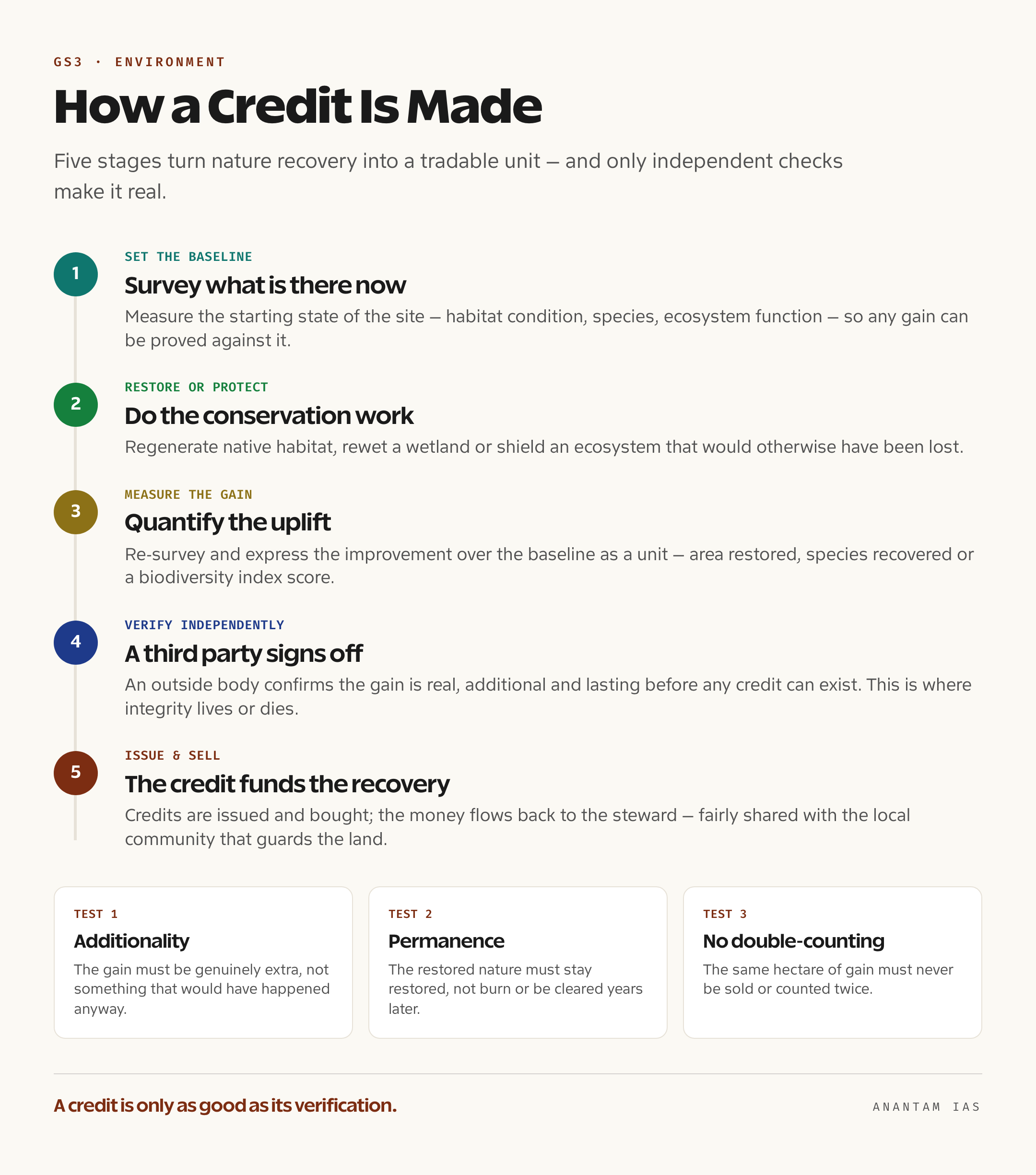
Strip away the jargon and a biodiversity credit is a certificate of nature gain. Someone does verified, additional work to improve biodiversity in a particular place — restoring a wetland, regenerating native forest, protecting a habitat that would otherwise have been cleared — and an independent body measures that gain and issues credits for it. A buyer then purchases the credit, and the money funds the conservation work. The buyer gets a documented, third-party-checked claim that they have channelled finance into nature recovery; the land steward gets a revenue stream for keeping an ecosystem healthy rather than converting it to something more profitable. The credit is, in essence, a way of turning the otherwise invisible value of a thriving ecosystem into something that can be paid for.
The unit itself is the hard part, because biodiversity has no natural currency. Carbon has one — a tonne of carbon dioxide is a tonne anywhere on Earth. Nature has nothing so neat, so different schemes measure credits in different ways: area-based units such as one hectare of land restored or protected; species-based indicators tracking the recovery of particular plants or animals; or composite “biodiversity health” scores that bundle together habitat condition, species richness and ecosystem function into a single index. The Wallacea Trust method, one of the more widely used, defines a credit as a measured uplift in such an index over a fixed area and time. There is, deliberately, no single global “biodiversity tonne” — and as you will see, that absence is both the honest reflection of how nature works and the central problem the whole market has to solve.
It also helps to separate two things that are easy to confuse. A biodiversity credit funds a positive gain in nature — it is finance for recovery, with no requirement that the buyer has harmed anything. A biodiversity offset is different and older: it lets a developer who is destroying habitat in one place compensate by protecting or restoring habitat elsewhere, aiming for “no net loss.” Offsets are about cancelling out damage; credits, at their best, are about adding to nature beyond any damage — what the policy world calls “nature-positive.” The line between the two blurs in practice, and much of the controversy around credits comes from the fear that they will simply become offsets by another name, a point worth holding onto for any answer.
Why the World Is Building Nature Markets Now
The engine behind all this is money, or rather the lack of it. Protecting and restoring nature at the scale scientists say is needed would cost far more than the world currently spends, and the difference has a name: the biodiversity finance gap, estimated at roughly $700 billion a year. That figure is the sum of two things — the extra investment nature needs, around $200 billion a year, plus the $500 billion a year that governments still spend on subsidies that actively harm nature, from cheap fuel to subsidies that encourage over-fishing and forest clearing. Closing a gap that large with public budgets alone is widely seen as impossible, which is precisely why attention has turned to private capital, and to markets that might mobilise it.
The political anchor for this is the Kunming-Montreal Global Biodiversity Framework, the deal nearly 200 countries adopted in December 2022 at the COP15 summit. It is often called the “Paris Agreement for nature,” and two of its commitments matter most here. The first is the headline “30×30” goal — protecting at least 30 per cent of the planet’s land and sea by 2030, alongside restoring 30 per cent of degraded ecosystems. The second is Target 19, on resource mobilisation, which calls for at least $200 billion a year for biodiversity from all sources by 2030, including at least $20 billion a year flowing from rich countries to developing ones by 2025 and $30 billion by 2030. Crucially, Target 19 explicitly names the stimulation of “innovative schemes such as biodiversity offsets and credits” as one route to that money. The framework, in other words, didn’t just set a target for nature; it pointed at credits as a tool for paying for it.
How They Differ From Carbon Credits
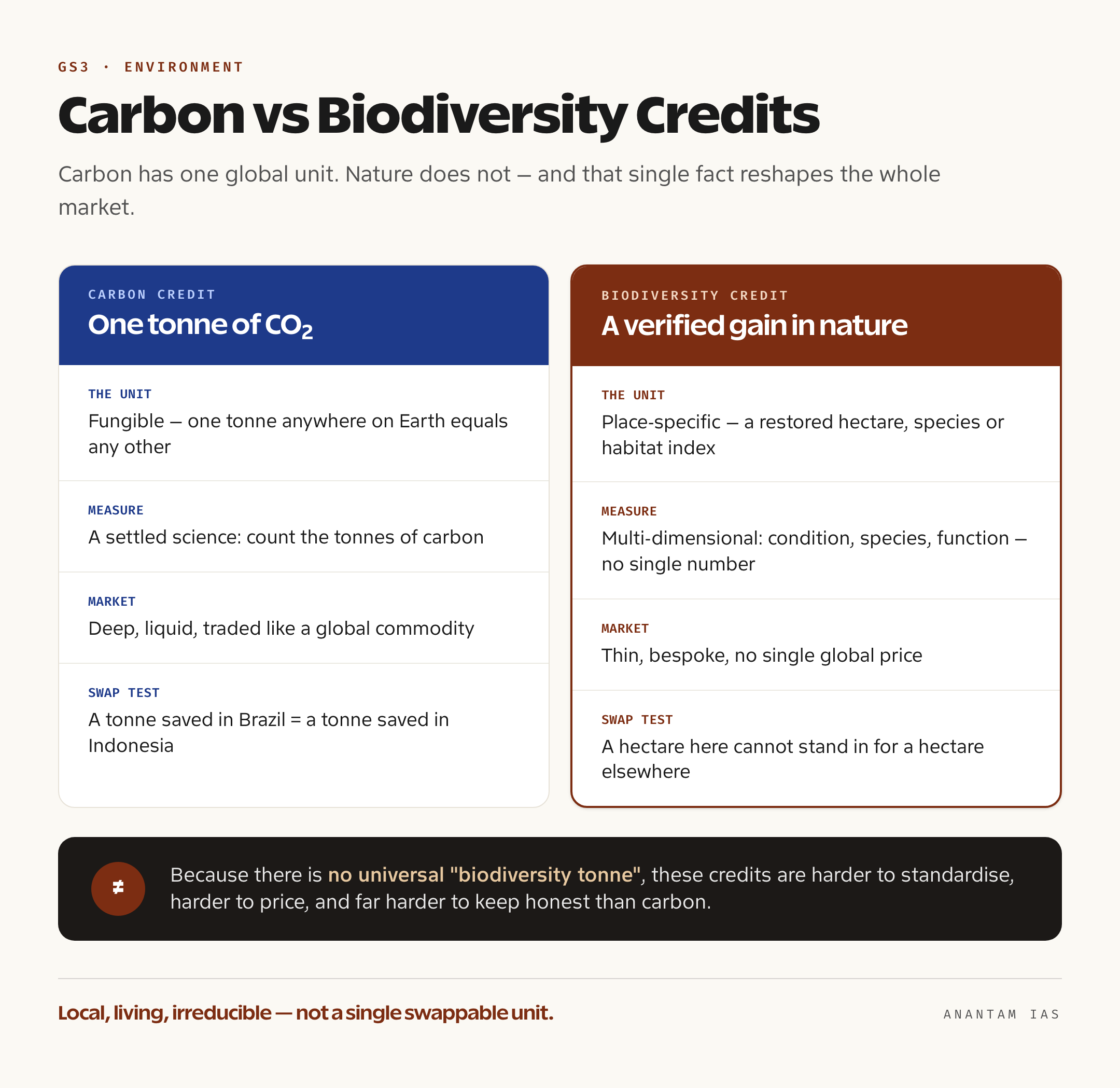
The cleanest way to understand biodiversity credits is to put them next to carbon markets, which they superficially resemble and fundamentally don’t. The defining feature of a carbon credit is fungibility — one credit equals one tonne of carbon dioxide kept out of the atmosphere, and because the climate doesn’t care where that tonne is avoided, a tonne saved in Brazil is interchangeable with a tonne saved in Indonesia. That single, global, swappable unit is what lets carbon trade on exchanges like any commodity. Biodiversity has no such luxury. Nature is irreducibly local and multi-dimensional: the soils, species and ecological relationships of a mangrove coast in Gujarat are nothing like those of a cloud forest in the Andes, so a “unit” of one cannot stand in for a unit of the other. As researchers bluntly put it, if a company destroys five hectares of habitat in one country it cannot make up for it by funding five hectares in another — the ecosystems simply aren’t the same.
This non-fungibility cascades into every practical difference. Because there is no universal unit, there can be no single global price or deep, liquid exchange the way there is for carbon; biodiversity credits tend to be bespoke, place-specific and traded in smaller, thinner markets. Measurement is far harder too — counting tonnes of carbon is a settled science, but capturing the health of a whole living system means tracking many variables at once, none of which collapses neatly into one number. And the temptation to over-simplify is dangerous: a metric simple enough to trade easily may be too crude to mean anything ecologically, while a metric rich enough to be honest may be too complex and costly to trade at all. That tension — between a liquid market and a meaningful one — is the knot at the heart of the whole enterprise, and it has no fully satisfying solution yet.
There is one more difference that cuts the other way, in biodiversity’s favour. Carbon markets have spent years fighting accusations that their credits are hollow — projects that claim to avoid deforestation that would never have happened, double-counted tonnes, ghost forests. Biodiversity credit designers are watching those failures closely and trying to build integrity in from the start, with robust baselines, independent verification and explicit benefit-sharing rules. The lesson the better schemes have taken is simple: a credit with weak rules is worse than no credit at all, because it lets a buyer claim nature gains that never happened.
The Design Problems That Could Sink Them
Every serious objection to biodiversity credits comes down to integrity — whether a credit really represents the nature gain it claims. The first test is additionality: the conservation funded by a credit must be genuinely extra, something that would not have happened anyway. Paying a landowner to “protect” a forest that was never under threat creates a credit on paper while changing nothing on the ground, exactly the failure that haunted early carbon offsets. The second is permanence: a restored wetland is only a real gain if it stays restored, yet a credit might be sold today for a forest that burns, is logged or is cleared a decade later. The third is the no-double-counting rule — the same hectare of recovery must not be sold twice, or counted both by the company that funds it and the country that hosts it toward separate targets.
Then there is the problem that has drawn the fiercest criticism: the risk that credits become a smokescreen. Environmental groups warn that biodiversity offsetting and crediting can hand corporations a “licence to destroy” — a way to keep clearing habitat while pointing to credits bought elsewhere, with the comforting language of “no net loss” papering over the fact that a complex, ancient ecosystem cannot be recreated to order. Restoration is slow, uncertain and often fails to rebuild what was lost, so a market that lets damage in one place be cancelled by a promise in another can end up greenwashing destruction rather than preventing it. So the distinction between funding genuine gains and merely offsetting losses is not academic — it decides whether the whole instrument helps nature or harms it.
The deepest concern is about people. The richest biodiversity on Earth sits on lands that Indigenous peoples and local communities have stewarded for generations, and a market that prices that nature can all too easily price those communities out — through land grabs dressed up as conservation, restricted access to forests they depend on, or schemes that capture their traditional knowledge of plants and ecosystems without consent or fair payment, a practice known as biopiracy. Done badly, nature markets repeat colonial patterns: outsiders profit from local nature while the locals lose their livelihoods. Done well, they channel real money to the communities actually protecting biodiversity. The difference lies in governance — free, prior and informed consent, secure land rights, and benefit-sharing rules that put a fair share of the revenue in local hands. Without those, a biodiversity credit is just a new way to enclose a commons.
Where India Fits — Green Credits, CAMPA and the Law
India hasn’t launched a dedicated biodiversity-credit market, but it has built several instruments that point in the same direction, and they make a rich comparison for an answer. The most direct is the Green Credit Programme, notified by the Environment Ministry in October 2023 as a first-of-its-kind market-based scheme to reward voluntary environmental action. It issues tradable “green credits” across eight activities — tree plantation, water conservation, sustainable agriculture, waste management, air-pollution reduction, mangrove conservation, the Ecomark label and sustainable infrastructure — with the Indian Council of Forestry Research and Education acting as the nodal verifier and credits issued after evaluation. The credits can be traded on a planned domestic platform and used to meet obligations such as compensatory afforestation or corporate ESG commitments. It is, in spirit, a cousin of biodiversity credits — though its early tree-plantation methodology drew sharp criticism from experts who feared it could reward monoculture planting that delivers little real ecological value, the very integrity trap the global debate keeps returning to.
Alongside it sits an older, offset-style mechanism: compensatory afforestation, run through the Compensatory Afforestation Fund Management and Planning Authority, or CAMPA. When forest land is diverted for a road, mine or dam, the user must pay for afforestation on equivalent land plus the value of the lost ecosystem services, and that money — running into tens of thousands of crores — flows through national and state CAMPA funds to plant compensating forests. It is India’s long-standing answer to “no net loss,” and it carries exactly the criticisms levelled at offsets everywhere: that a freshly planted plantation cannot replace a felled natural forest, and that the funds are often underused or poorly spent. Studying CAMPA is the quickest way to see why ecologists distrust the offset logic that biodiversity credits must avoid.
The legal backbone is the Biological Diversity Act and its 2023 amendment, which govern how India’s living resources may be used and, vitally, how the benefits must be shared. Built around the Convention on Biological Diversity and its Nagoya Protocol, the law requires access-and-benefit-sharing payments when biological resources or associated traditional knowledge are used commercially, channelled through the National Biodiversity Authority and state boards down to local biodiversity management committees. That access-and-benefit-sharing architecture is precisely the kind of safeguard the global credit debate says is essential — a legal route for ensuring that when someone profits from nature, the communities who conserved it are paid. India’s coastal restoration push, including the MISHTI scheme for mangroves, shows the same ecosystem-services thinking in action. India’s challenge, and opportunity, is to fuse these pieces — credible measurement, genuine additionality, and the country’s existing benefit-sharing law — into nature finance that funds recovery without becoming a licence to destroy.
For Your Mains Answer
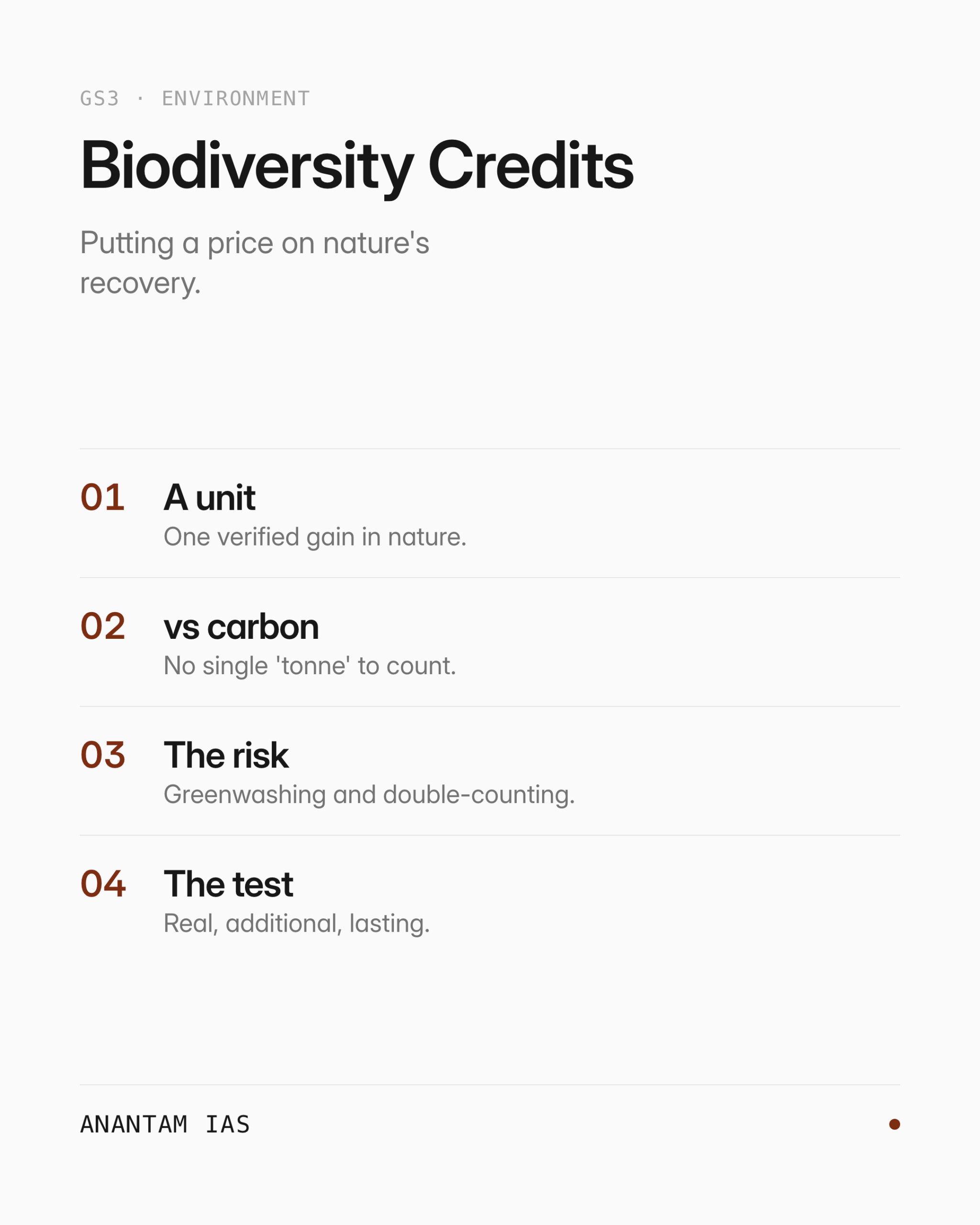
This is a high-value topic for GS Paper 3, which covers conservation, environmental pollution and the economy — particularly the mobilisation of resources and market-based environmental instruments. It also reaches into GS Paper 2 on international agreements like the Kunming-Montreal Global Biodiversity Framework, and offers a thoughtful Essay theme on whether nature can or should be priced. The skill examiners reward here is balance: show that you understand both why nature finance is desperately needed and why turning nature into a tradable commodity is risky, then land a measured verdict.
How to Build the Answer
Open with the gap, not the credit — define the biodiversity finance gap (~$700 billion a year) and the Kunming-Montreal Framework’s Target 19, so the reader sees why markets are being tried at all. Then define a biodiversity credit cleanly as a verified, tradable unit of nature gain, and immediately contrast it with carbon credits to make the non-fungibility point. Spend the middle of the answer on the design problems — additionality, permanence, no double-counting, greenwashing and Indigenous rights — because that is where the marks are. Bring it home with India: the Green Credit Programme 2023, CAMPA, and the Biological Diversity Act’s benefit-sharing rules. Close with a balanced judgement. That arc — gap, definition, contrast, risks, India, verdict — fits almost any version of the question.
Common Mistakes to Avoid
Don’t treat biodiversity credits as just “carbon credits for nature” — the non-fungibility point is the whole intellectual core, and missing it flattens the answer. Don’t confuse credits with offsets; explain that a credit funds a positive gain while an offset compensates for damage, and that the danger is credits sliding into offsets. Don’t present markets as a clean solution — name the integrity risks explicitly. And don’t forget people; an answer that ignores Indigenous and local-community rights misses the topic’s ethical heart, which is where the strongest scripts separate themselves.
A Compact Answer Spine
Nature in steep decline + ~$700 bn/yr finance gap → Kunming-Montreal Framework: 30×30 goal + Target 19 names “credits” as a tool → biodiversity credit = verified, tradable unit of nature gain (area/species/index-based) → unlike carbon, biodiversity is local + multi-dimensional → no single global unit, no deep liquid market, hard measurement → design risks: additionality, permanence, double-counting, greenwashing (“licence to destroy”), Indigenous rights + biopiracy → India: Green Credit Programme 2023 (ICFRE), CAMPA offsets, Biological Diversity Act benefit-sharing → verdict: a potential engine for nature finance only if integrity and equity come first.
Diagram or Flowchart Idea
Draw a simple two-column contrast — “Carbon credit: one global tonne, fungible, liquid market” versus “Biodiversity credit: local, multi-dimensional, place-specific, thin market” — beside a short five-step chain showing how a credit is made: baseline → restore/protect → measure → independently verify → issue and sell. The two visuals together capture both what makes these credits distinctive and how integrity is supposed to be built in.
A Balanced-Conclusion Line
A line that lands the marks: “Biodiversity credits could turn the world’s stated love of nature into actual money for its recovery — but only if they fund genuine, lasting, additional gains and pay the communities who guard that nature; built carelessly, they risk becoming a licence to destroy dressed as a tool to conserve.”
How to Use Data Without Cramming
You need only a few anchors, not a database: the ~$700 billion-a-year finance gap, the Kunming-Montreal Framework of December 2022 with its 30×30 goal and Target 19’s $200 billion-a-year aim, and India’s Green Credit Programme notified in October 2023 with its eight activities. Drop those into the right sentences and attribute them plainly — “under the Kunming-Montreal Global Biodiversity Framework” — rather than scattering numbers loose.
Frequently Asked Questions
What is a biodiversity credit in simple terms?
It is a tradable certificate that represents a measurable, independently verified gain in nature in a specific place — for example a hectare of degraded land restored, a habitat protected, or a species population recovered. A buyer purchases the credit, and the money funds the conservation or restoration work. The aim is to create a revenue stream for keeping ecosystems healthy, much as carbon credits create one for cutting emissions.
How are biodiversity credits different from carbon credits?
Carbon credits are fungible — one credit equals one tonne of carbon dioxide anywhere on Earth, so they trade like a commodity. Biodiversity is local and multi-dimensional, so there is no single universal “biodiversity tonne”; a unit of nature in one ecosystem cannot stand in for a unit in another. That makes biodiversity credits harder to measure, harder to standardise and traded in thinner, more bespoke markets than carbon.
Why are biodiversity credits controversial?
Because of integrity and equity. Critics fear credits will fail tests like additionality and permanence, be double-counted, or become “offsets” that let companies keep destroying habitat while claiming gains elsewhere — a “licence to destroy” and a form of greenwashing. There is also deep concern that markets could harm the Indigenous peoples and local communities who steward the richest biodiversity, through land grabs, lost access or biopiracy, unless strong consent and benefit-sharing rules are in place.
Does India have a biodiversity credit market?
Not a dedicated one yet, but it has related instruments. The Green Credit Programme of 2023 issues tradable green credits for voluntary environmental actions like tree plantation and mangrove restoration. Compensatory afforestation through CAMPA is an older offset-style mechanism. And the Biological Diversity Act, amended in 2023, provides the access-and-benefit-sharing framework — the safeguard that any credible nature market needs.
Practice Questions
Prelims MCQs
- With reference to biodiversity credits, which statement is most accurate?
(a) Each credit represents one tonne of carbon dioxide removed
(b) Each credit represents a measurable, verified gain in biodiversity in a specific place
(c) They can be freely swapped between any two ecosystems worldwide
(d) They are issued only by the International Monetary Fund
Answer: (b) A biodiversity credit stands for a verified gain in nature — such as a restored or protected area — and is place-specific, not a universal carbon unit. - The Kunming-Montreal Global Biodiversity Framework, adopted in 2022, includes which of the following?
(a) A “30×30” goal to protect 30 per cent of land and sea by 2030
(b) Target 19 on mobilising at least $200 billion a year for biodiversity
(c) Explicit mention of biodiversity offsets and credits as financing tools
(d) All of the above
Answer: (d) The framework sets the 30×30 goal, Target 19 on resource mobilisation, and names credits and offsets among innovative financing schemes. - Why are biodiversity credits considered harder to standardise than carbon credits?
(a) Because biodiversity loss is not measurable at all
(b) Because nature is local and multi-dimensional, with no single global unit like a tonne of carbon
(c) Because they are banned under international law
(d) Because only carbon affects the climate
Answer: (b) Carbon is fungible — one tonne anywhere is equivalent — whereas ecosystems differ from place to place, so a single universal biodiversity unit does not exist. - India’s Green Credit Programme, notified in 2023, is best described as which of the following?
(a) A tax on carbon-emitting industries
(b) A market-based scheme issuing tradable credits for voluntary environmental actions
(c) A ban on forest diversion
(d) A subsidy for fossil fuels
Answer: (b) The Green Credit Programme rewards voluntary actions such as tree plantation and mangrove conservation with tradable green credits, verified through the ICFRE. - The principle of “additionality” in nature and carbon markets means which of the following?
(a) Credits must be added to a stock exchange
(b) The conservation funded must be genuinely extra, beyond what would have happened anyway
(c) More credits must be issued each year
(d) Buyers must add their names to a public register
Answer: (b) Additionality requires that the nature gain a credit represents would not have occurred without the funding; without it, a credit changes nothing on the ground.
Mains Practice Questions
- “Biodiversity credits attempt to do for nature what carbon markets did for the climate.” Examine how biodiversity credits work and why their non-fungibility makes them fundamentally harder to standardise than carbon credits. (15 marks, 250 words)
- Discuss the biodiversity finance gap and the role of the Kunming-Montreal Global Biodiversity Framework in driving market-based instruments such as biodiversity credits. (15 marks, 250 words)
- Critically analyse the design challenges — additionality, permanence, double-counting and the risk of greenwashing — that biodiversity credit schemes must overcome to retain integrity. (15 marks, 250 words)
- “Nature markets can either fund the communities that protect biodiversity or price them out of it.” In light of the rights of Indigenous and local communities, evaluate the equity concerns surrounding biodiversity credits. (10 marks, 150 words)
- Assess India’s market-based environmental instruments — the Green Credit Programme, compensatory afforestation under CAMPA, and the access-and-benefit-sharing framework of the Biological Diversity Act — as foundations for credible nature finance. (15 marks, 250 words)
Tell Google you want more of this.
Add Anantam IAS as a preferred sourceOne tap, and this site shows up more often in your own Top Stories, AI Overviews and AI Mode. Remove it any time.