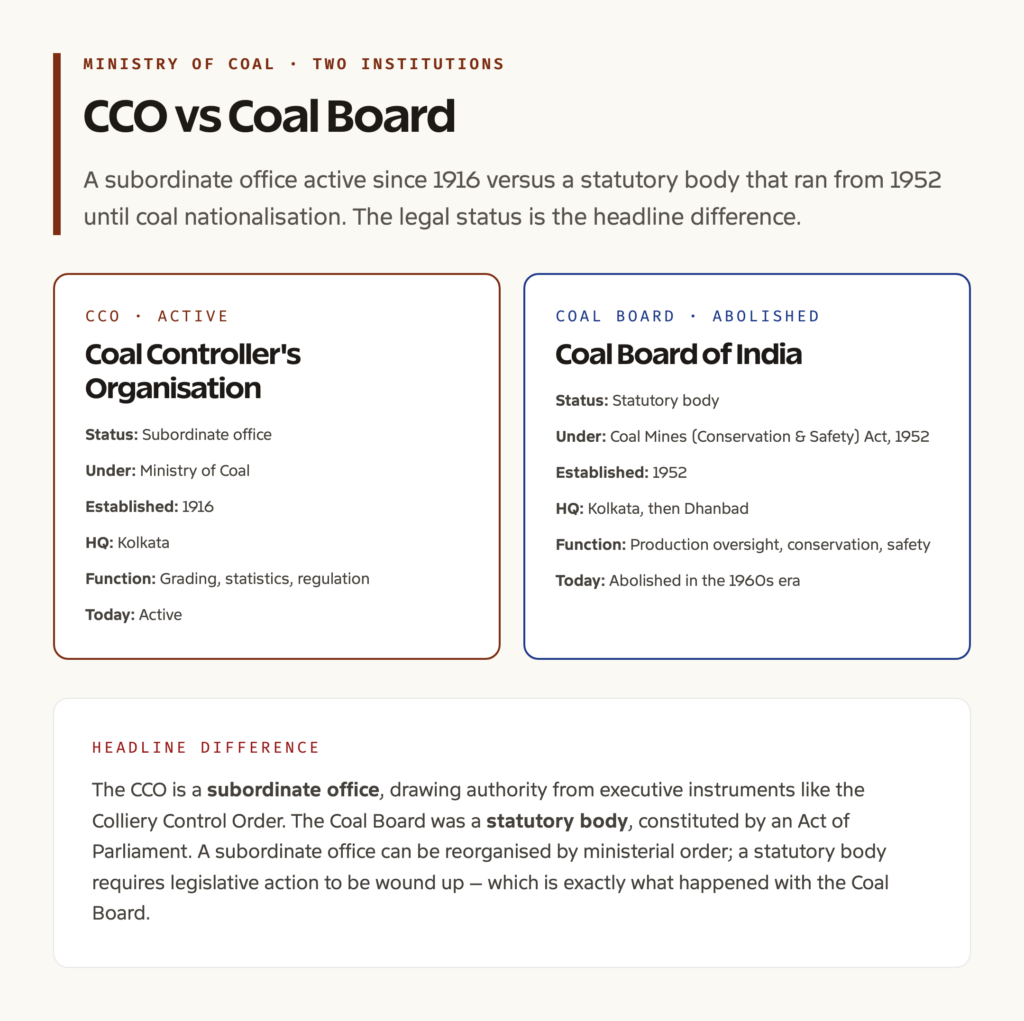
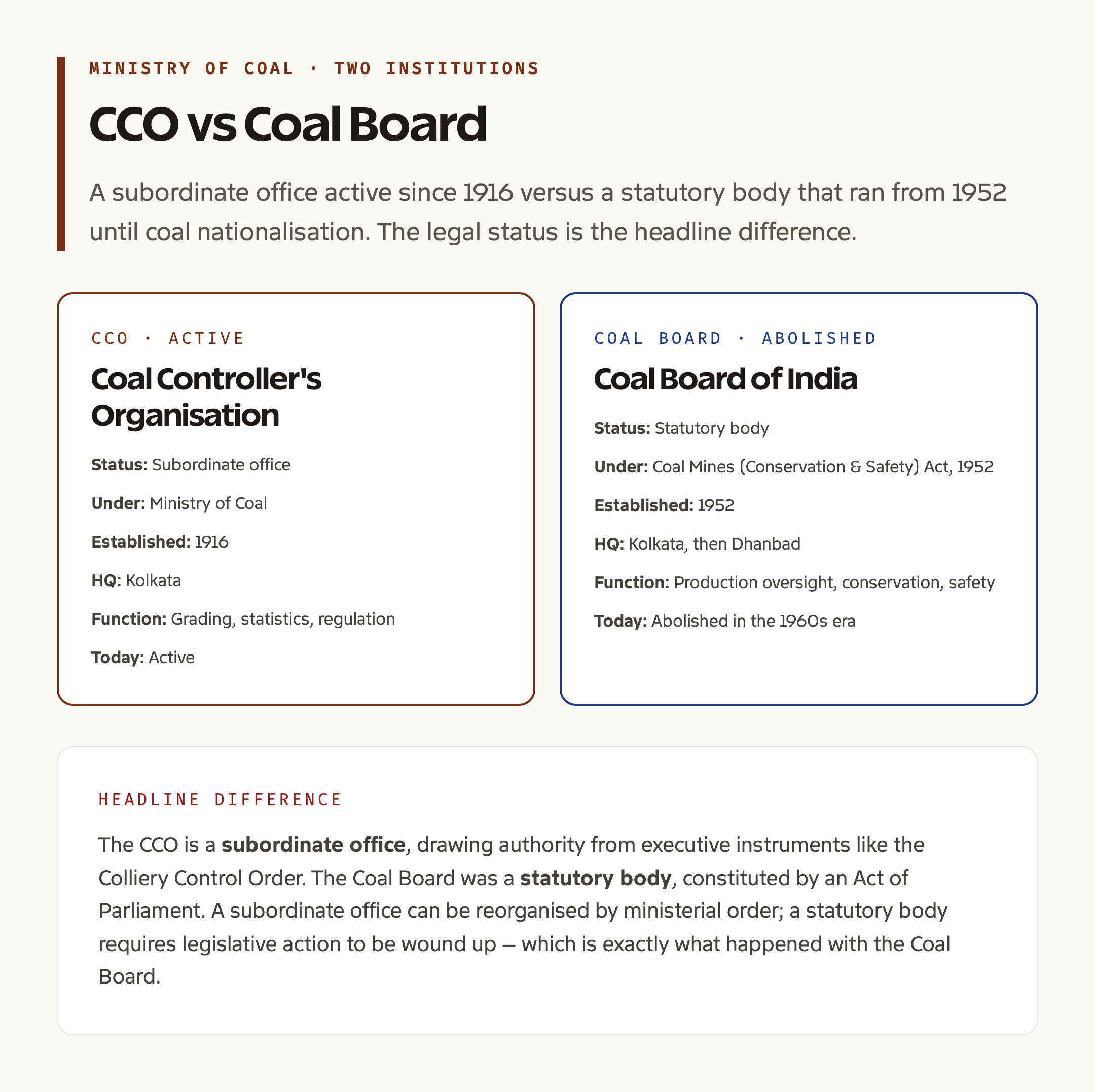
Indian coal has had two principal regulatory institutions across a century. The Coal Controller’s Organisation, founded in 1916, is alive and active today as a subordinate office under the Ministry of Coal. The Coal Board of India, set up in 1952 under the Coal Mines (Conservation and Safety) Act, was the dominant statutory body in the pre-nationalisation era and was wound up after the coal mines were nationalised in the early 1970s. The two are separated by 36 years of common existence, by a difference in legal status, and by a sharp difference in mandate. UPSC questions periodically test the distinction, and a clean comparison is the easiest way to retain it.
For aspirants, this is a multi-paper topic. It sits in GS-III for energy security and statutory bodies, in GS-I for the economic geography of coal, and in essay-type mains writing on resource governance. The Coal Controller’s Organisation is also in current affairs because of recent online auction reforms, the GST regime impact, and the data work the office has taken on under the Ministry of Coal.
This guide unpacks both institutions, lays out the comparison, traces the history, and connects the regulatory architecture to the wider energy policy frame.
Quick Facts
- Coal Controller’s Organisation (CCO): Subordinate office under Ministry of Coal
- CCO established: 1916, under British administration
- CCO headquarters: Kolkata
- CCO current status: Active
- CCO main functions: Regulation, monitoring, statistics on coal
- Coal Board of India: Statutory body
- Statute: Coal Mines (Conservation and Safety) Act, 1952
- Coal Board established: 1952
- Coal Board status: Abolished in the 1960s after coal nationalisation
- Coal nationalisation: Coking coal 1971, non-coking coal 1973
- Successor entities to Coal Board functions: Directorate General of Mines Safety, Coal India Limited, Ministry of Coal
- Both bodies sit under: Ministry of Coal (CCO directly; Coal Board historically through industries and labour)
What the Coal Controller’s Organisation Is
The Coal Controller’s Organisation is a small but consequential office located in Kolkata that handles a defined set of regulatory and data functions on Indian coal. It is a subordinate office of the Ministry of Coal, which means it is not autonomous like a statutory authority but operates under direct ministerial supervision. Its history goes back to the First World War, when the British government created a coal control office to manage strategic supplies for the war effort. The office continued through the interwar period, expanded during the Second World War for similar reasons, and was retained after Independence as part of the new central government’s coal management structure.
The CCO’s modern functions cluster into four areas. The first is grading. Indian coal is classified by grade based on calorific value, ash content, moisture, and other parameters; the CCO is the central authority for confirming the declared grade and resolving disputes between producers and consumers. The second is excise and statistics, including the collection of the Stowing Excise Duty (in earlier decades) and the maintenance of the central database on coal production, despatch, stocks, and consumption. The third is regulation of trade practices, including the enforcement of the Colliery Control Order and the Coal Mines Regulations regime in coordination with other agencies. The fourth is dispute resolution, where the CCO acts as a neutral party in grade slippage and quality disputes.
In recent years, the CCO has modernised substantially. Coal grade declaration has shifted to a digital platform, the despatch reporting has moved to integrated software, and the office has joined the broader Coal Sector Digitisation Programme run by the ministry. The office still serves as the standard-setting authority for grade verification and the official statistical custodian for the Indian coal sector.
What the Coal Board of India Was
The Coal Board of India was a statutory body created under the Coal Mines (Conservation and Safety) Act, 1952. It was set up to address two problems that had become acute in the late colonial and early post-Independence years: poor mine safety and rapid resource depletion through wasteful mining practices. The board was vested with powers to oversee coal production, ensure conservation of the resource, and improve safety standards in the mines. It worked alongside the Directorate General of Mines Safety, the older safety regulator that traces back to the Indian Mines Act, 1901.
The Coal Board operated through a combination of policy formulation, technical guidance, and limited enforcement. It funded conservation and safety work through a stowing excise duty levied on coal, which it used to support the filling of mined-out areas with sand to prevent surface subsidence and underground fires. It also commissioned studies on mining methods, ventilation, water management, and rescue infrastructure.
Its lifespan was tied to the pre-nationalisation era. When the coal industry was nationalised — coking coal in 1971 under the Coking Coal Mines (Nationalisation) Act and non-coking coal in 1973 under the Coal Mines (Nationalisation) Act — the institutional landscape changed dramatically. The newly created Coal India Limited (1975) absorbed most production, the Ministry of Coal took central policy responsibility, and the Directorate General of Mines Safety continued as the statutory safety regulator. The Coal Board’s role narrowed and it was eventually wound up. Some of its conservation functions migrated to Coal Mines Provident Fund Organisation, others to the Coal Conservation and Development Account managed by the ministry.
Side by Side Comparison
The cleanest way to remember the two bodies is in a single comparison.
| Feature | Coal Controller’s Organisation (CCO) | Coal Board of India |
|---|---|---|
| Status | Subordinate office under Ministry of Coal | Statutory body under the Coal Mines (Conservation & Safety) Act, 1952 |
| Established | 1916 | 1952 |
| Current Existence | Active | Abolished in the 1960s era after coal nationalisation |
| Main Function | Regulatory, monitoring, data and statistics authority for coal | Oversight of coal production, safety, and conservation pre-nationalisation |
| Headquarters | Kolkata | Kolkata, then Dhanbad |
| Source of authority | Executive instruction of the Ministry of Coal | Coal Mines (Conservation and Safety) Act, 1952 |
| Funding | Government budget | Statutory levy (stowing excise duty) |
| Scale | Small office | Larger technical and policy organisation |
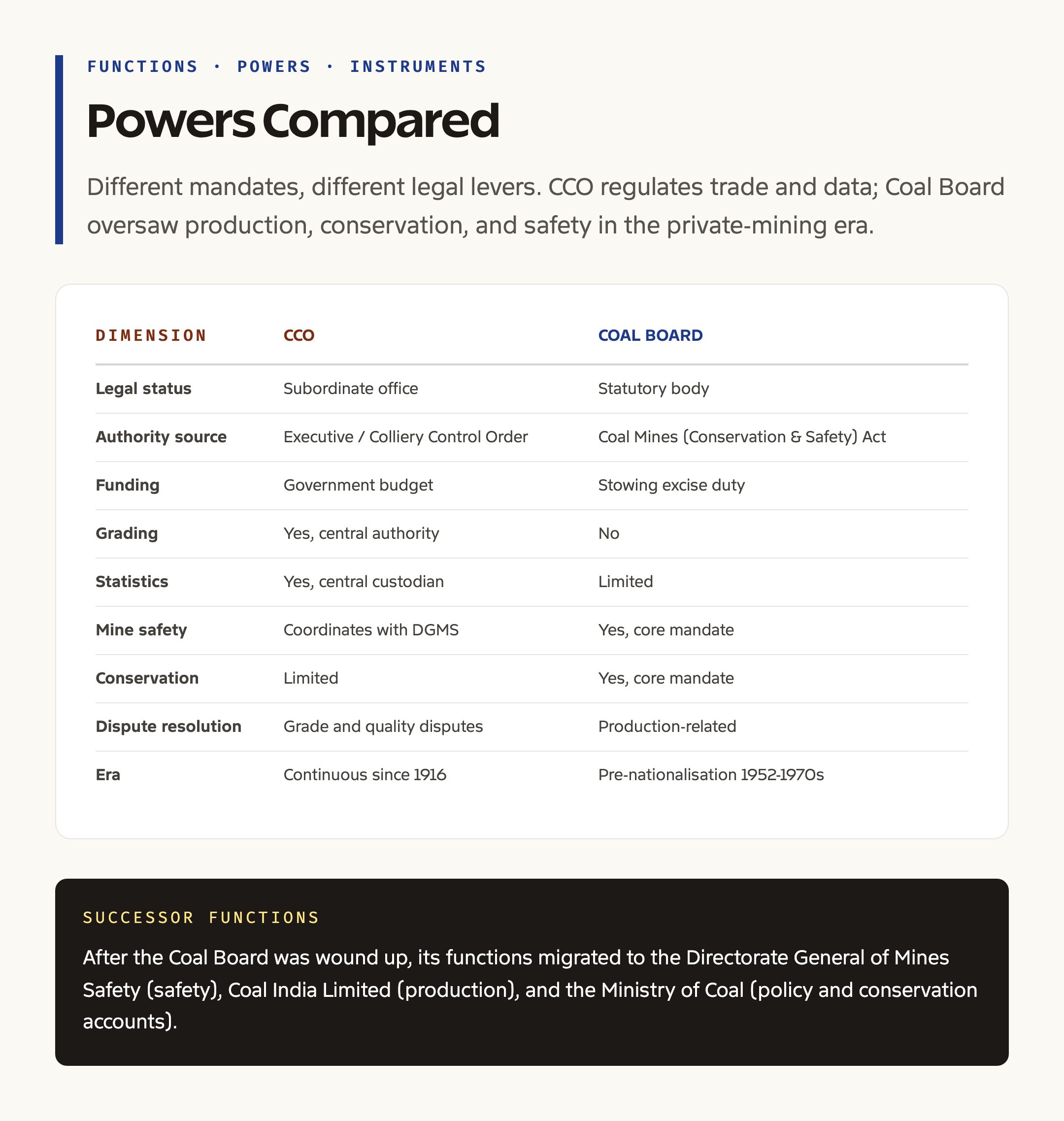
| Successor or parallel | Continues today | Functions migrated to DGMS, CIL, Ministry of Coal |
The headline distinction for prelims is the legal status. The CCO is a subordinate office, not a statutory body. The Coal Board was a statutory body created by an Act of Parliament. The headline distinction for mains is the era. The Coal Board belongs to the pre-nationalisation regulatory era, when private producers required external conservation and safety oversight; the CCO belongs to a continuing tradition of central coal data and grading regulation that has persisted across colonial, pre-nationalisation, post-nationalisation, and de-monopolised eras.
Historical Context
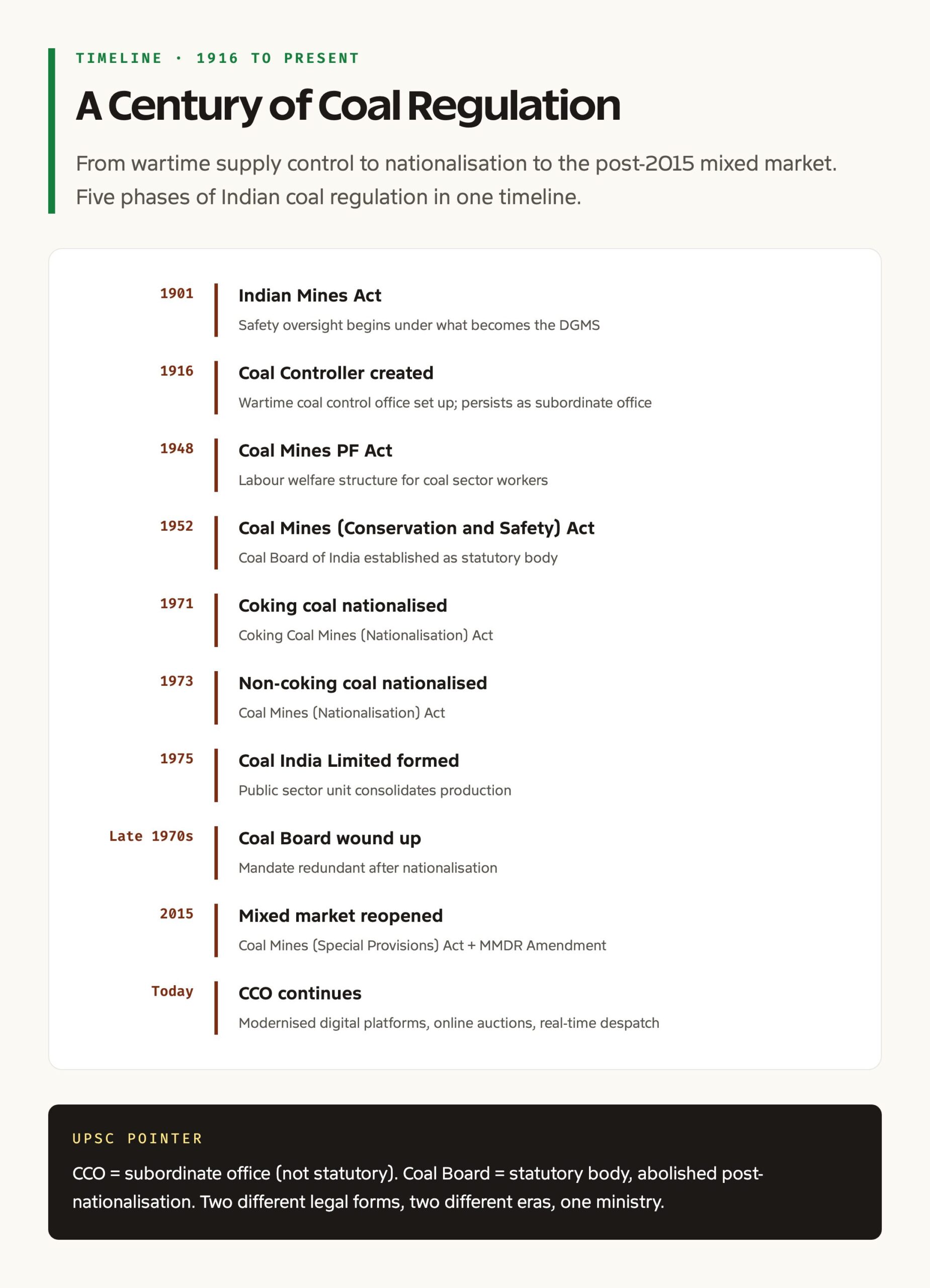
The history of Indian coal regulation runs in five phases. The first phase, before 1900, saw private coal mining in Bengal, Bihar, and the Central Provinces under minimal regulation. The Indian Mines Act of 1901 (and its successor of 1923) introduced safety oversight under what became the Directorate General of Mines Safety.
The second phase, from 1916, brought the Coal Controller into existence to manage wartime supply. After the First World War, the office continued as a peacetime coal coordinator, and during the Second World War, it again expanded for strategic supply.
The third phase, from 1952 to nationalisation, layered the Coal Board of India on top of the existing structures, addressing conservation and safety. The Coal Mines Provident Fund Act of 1948 had already created a labour welfare structure. The Coal Mines (Conservation and Safety) Act of 1952 added the resource and safety mandate. Together, these laws gave India a multi-agency coal regulation framework.
The fourth phase, nationalisation between 1971 and 1973, fundamentally restructured the sector. With private mining ending and Coal India Limited taking over production, the regulator-versus-producer distinction collapsed. The Coal Board’s mandate became redundant. Its functions either ceased (for private oversight) or migrated to the new ministry and the new public sector unit.
The fifth phase, after the Coal Mines (Special Provisions) Act of 2015 and the Mines and Minerals (Development and Regulation) Amendment Act of 2015, reopened commercial coal mining to private participation. The CCO’s role expanded again to handle a wider universe of producers, larger volumes of trade, and more complex grade verification. The current online platforms, electronic auctions, and real-time despatch monitoring trace to this phase.
Why the Difference Matters
The difference in legal status matters in three ways. First, in accountability: a statutory body answers to Parliament through annual reports laid on the table; a subordinate office answers through the ministry alone. Second, in stability: a statutory body cannot be wound up by executive order; it requires legislative action, which is what eventually happened with the Coal Board. A subordinate office can be reorganised by ministerial instruction, which gives the executive flexibility but reduces independence. Third, in scope: a statutory body usually has a wider mandate including standard-setting, dispute adjudication, and rule-making powers; a subordinate office typically administers existing rules.
For India’s coal regulation, this difference shaped the institutional choices. After nationalisation, when the government became the producer, the case for an independent statutory body to oversee that production weakened. Subordinate office governance under the ministry was sufficient. After 2015, when private mining returned, the question of whether India needs a coal sector regulator (akin to the Petroleum and Natural Gas Regulatory Board) was raised again. The 2013 Coal Regulatory Authority Bill was discussed but did not pass; the function instead distributed across the CCO, the Coal India structure, and ad hoc committees.
Linkages and Multi-Topic Connections
The CCO sits at the centre of the coal data ecosystem and connects to many UPSC themes. See coal controller’s organisation for the dedicated CCO note, facts about coal mines in India for the production geography, and types of coals based on carbon content for the grading background. The DGMS, the Singareni Collieries Company Limited, and Coal India Limited round out the institutional picture.
The post-nationalisation coal regulation landscape connects to broader debates on resource governance, public sector reform, and energy transition. With India’s commitments under the UNFCCC and the just transition agenda, the CCO’s data work has become more important rather than less, since transition planning depends on accurate, granular coal sector statistics.
Powers and Functions in Detail
The Coal Controller’s Organisation today exercises powers under several legal instruments. The Colliery Control Order, 2000 (and its predecessors back to 1945) gives the CCO authority to issue directions on coal grade declaration, coal price advice, and despatch information. The Coal Mines Regulations, 2017, administered jointly by DGMS and the CCO, deal with mine-level operations. The Mines and Minerals (Development and Regulation) Act provides the underlying statutory frame for mining leases, royalty, and lease conditions, with state government implementation.
The historical Coal Board of India exercised powers under the Coal Mines (Conservation and Safety) Act, 1952. Its main legal levers were the imposition and use of the stowing excise duty, technical directions on conservation methods, and the funding of safety research and rescue infrastructure. The duty was abolished after the act was repealed; remnants of the conservation account survive in the Ministry of Coal’s accounting structure.
Way Forward
The way forward for India’s coal regulation has three pieces. First, consolidate the data and grading authority of the CCO with stronger digital infrastructure and a clearer statutory backing. Second, decide whether a separate coal sector regulator is needed for the post-2015 mixed market and, if so, design it with explicit independence and a clear scope. Third, integrate coal regulation with the broader just transition framework, since the medium-term policy direction is to reduce coal dependence even while near-term volumes rise.
UPSC Relevance
For prelims, remember: the CCO is a subordinate office (not statutory) under the Ministry of Coal, established 1916, headquartered in Kolkata, currently active. The Coal Board of India was a statutory body under the Coal Mines (Conservation and Safety) Act, 1952, established 1952, abolished after coal nationalisation in the 1970s. Coking coal was nationalised in 1971; non-coking coal in 1973. Coal India Limited was created in 1975.
For mains, the comparison fits into answers on the institutional architecture of resource regulation, the difference between subordinate offices and statutory bodies, and the evolution of coal governance from colonial control to nationalisation to mixed market. Cross-reference with energy security, climate transition, and just transition framings.
Frequently Asked Questions
Is the Coal Controller’s Organisation a statutory body?
No, the Coal Controller’s Organisation is a subordinate office under the Ministry of Coal. It is not constituted by an Act of Parliament. It draws its authority from executive instruments such as the Colliery Control Order and ministerial direction.
When was the Coal Board of India established?
The Coal Board of India was established in 1952 under the Coal Mines (Conservation and Safety) Act, 1952. It was a statutory body with a mandate to oversee coal production, conservation, and safety in the pre-nationalisation era.
Why was the Coal Board of India abolished?
The Coal Board of India was wound up after the coal mines were nationalised. Coking coal mines were nationalised in 1971 and non-coking coal mines in 1973. With Coal India Limited taking over production and the Ministry of Coal absorbing policy functions, the Coal Board’s mandate became redundant.
When was the Coal Controller’s Organisation founded?
The Coal Controller’s Organisation was set up in 1916 under the British administration to manage wartime coal supply. It was retained after Independence and has continued to function under the Ministry of Coal.
What is the headquarters of the CCO?
The Coal Controller’s Organisation is headquartered in Kolkata, with regional offices in coal-producing regions of India.
What is the main function of the CCO today?
The main functions of the CCO today are coal grade verification, central statistics on coal production and despatch, administration of the Colliery Control Order, and dispute resolution between coal producers and consumers on grade and quality.
Did the Coal Board of India deal with mine safety?
Yes, mine safety was one of the Coal Board’s three core mandates, alongside production oversight and resource conservation. After its abolition, mine safety functions consolidated under the Directorate General of Mines Safety, which had been the older statutory regulator since the early twentieth century.
Tell Google you want more of this.
Add Anantam IAS as a preferred sourceOne tap, and this site shows up more often in your own Top Stories, AI Overviews and AI Mode. Remove it any time.