The Russell viper, properly Russell’s viper (Daboia russelii), is the snake behind the largest share of snakebite deaths in India, and snakebite kills tens of thousands of Indians every year. Most aspirants know it only as one name in the Big Four list. That’s where the confusion starts, because the Big Four aren’t equally dangerous and the death toll depends on which study you read.
The Big Four are the four species that cause most snakebites in India: Russell’s viper, the spectacled cobra, the common krait and the saw-scaled viper. The standard Indian antivenom is a polyvalent serum made against exactly these four. Polyvalent simply means one vial carries antibodies against several species, so treatment can start without anyone having to identify the snake.
India’s Big Four Venomous Snakes
India’s Big Four are Russell’s viper, the spectacled cobra, the common krait and the saw-scaled viper, and the Union Health Ministry says they cause about 90 percent of snakebites in the country. They come from two families whose venoms act on the body in very different ways.
- Elapids (cobras and kraits): short, fixed front fangs and venom that is mainly neurotoxic, meaning it paralyzes. The warning sign is drooping eyelids, called ptosis, followed by weakness that can reach the breathing muscles.
- Vipers (Russell’s viper and saw-scaled viper): long fangs, thick bodies and venom that is mainly hemotoxic (the treatment guidelines also say vasculotoxic), meaning it wrecks blood clotting. The signs are painful swelling, bleeding from the gums and bite site, and blood that won’t clot.
Most bites aren’t venomous at all. India has about 310 snake species, of which 66 are venomous and 42 mildly venomous, according to the figures the national action plan cites, and the Health Ministry’s treatment guidelines note that around 70 percent of all snakebites are from non-venomous species. That’s why the first line of first aid is to reassure the person.
How to tell the Big Four apart
Identification matters less to a doctor than symptoms do, but it matters a great deal for prevention, because each snake bites in a different setting.
| Snake | Scientific name | Family | Identifying trait | When bites happen | Main effect |
|---|---|---|---|---|---|
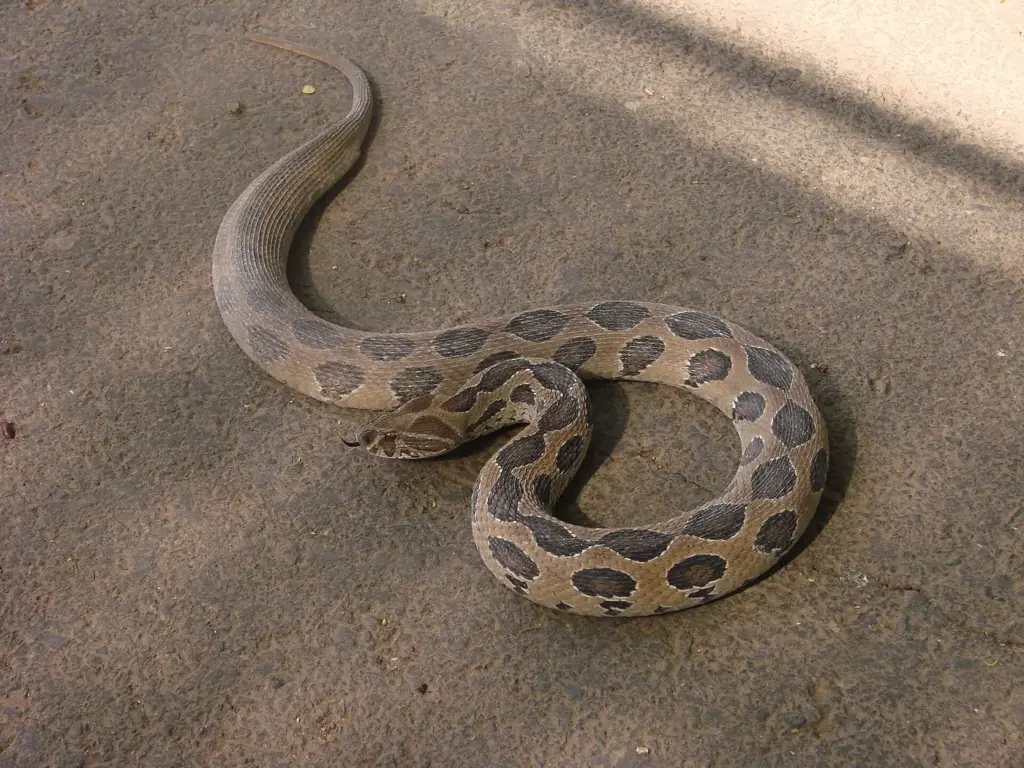
| Russell’s viper | Daboia russelii | Viperidae | Rows of large, dark-rimmed, pale-centered spots; loud blowing hiss | Day or early darkness, in fields and grass | Bleeding, clotting failure, acute kidney injury |
| Saw-scaled viper | Echis carinatus | Viperidae | Grating, rasping warning sound | Day or early darkness | Bleeding, clotting failure, painful swelling |
| Spectacled cobra | Naja naja | Elapidae | Rears up, spreads a hood with a spectacle mark, hisses | Day or early darkness | Paralysis, painful swelling and local tissue death |
| Common krait | Bungarus caeruleus | Elapidae | Bite may leave no visible mark | At night, often biting people sleeping on the floor | Paralysis with few local signs |
The timing column is the one that saves lives. Viper and cobra bites mostly happen during the day or at dusk, while people water crops or walk barefoot through tall grass. Krait bites happen at night, indoors.
Russell’s Viper Up Close
Russell’s viper is a thick-bodied viper recognized by longitudinal rows of large, dark-rimmed, pale-centered spots and by the loud blowing hiss it gives when threatened. WHO’s South-East Asia guidelines describe both as distinctive enough to identify the snake, the hiss even in the dark.
A Russell viper bite is dangerous because of where the snake lives and what its venom does. It shares farmland and grassland with the people who work in them, often barefoot. Its bites fall in the working hours of the day and early evening.
What a Russell viper bite does
Russell’s viper venom is strongly procoagulant, which means it switches clotting on. That sounds like the opposite of bleeding, so here’s the mechanism in order:
- The venom activates clotting pathways throughout the bloodstream at once.
- The body uses up its clotting factors forming clots it doesn’t need.
- With those factors exhausted, blood can no longer clot where it should, and the patient bleeds from the gums, nose and bite site.
Doctors call this venom-induced consumption coagulopathy. The bedside check is the 20-minute whole blood clotting test (20WBCT), which shows whether the patient’s blood clots within 20 minutes. Under the Health Ministry’s 2017 treatment guidelines, this coagulopathy can show up on the test as early as 30 minutes after a bite.
- Acute kidney injury: the guidelines note that Russell’s viper frequently causes it, with falling urine output.
- Painful progressive swelling: prominent after Russell’s viper bites, with blistering and local tissue death.
- Long-term damage: pituitary insufficiency is listed as a long-term sequel of Russell’s viper bites.
- Paralysis in some regions: in Tamil Nadu and some other areas, Russell’s viper envenoming commonly causes paralysis, because the venom varies across its range.
One species, many venoms
That last point is the one most notes miss. Russell viper venom isn’t the same across India. A 2021 study by Senji Laxme and colleagues in PLOS Neglected Tropical Diseases compared venoms from five biogeographic zones and found marked differences in composition. It also found a concerning lack of antivenom efficacy against the north Indian population from semi-arid Punjab in preclinical tests.
The reason it matters is supply. Indian antivenom makers primarily source venom from one place, the Irula Snake Catchers Industrial Cooperative Society in Tamil Nadu, according to the same research group’s 2019 study. An antivenom raised mostly against southern venom is being used against snakes in Punjab and the Gangetic plain.
The Snakebite Burden: Why Every Number Differs
India’s snakebite deaths are estimated at around 50,000 to 60,000 a year by the Million Death Study and the Health Ministry, while official records show about 2,000. The gap isn’t a typo. It’s the size of the problem that never gets recorded.
| Source | Year | Estimate | What it measures |
|---|---|---|---|
| Million Death Study (Suraweera et al., eLife) | 2020 | 1.2 million deaths from 2000 to 2019, an average of 58,000 a year | Nationally representative verbal autopsies |
| Union Health Ministry, at the NAP-SE launch | 2024 | About 50,000 deaths from an estimated 3 to 4 million bites a year | Ministry estimate |
| CBHI reports for 2016 to 2020, cited by the Health Ministry | 2024 | About 3 lakh cases and 2,000 deaths a year | Officially reported cases |
| WHO fact sheet | Current | 81,410 to 137,880 deaths and 5.4 million bites a year worldwide | Global estimate |
The Million Death Study counts deaths through verbal autopsy, meaning trained surveyors ask families how a relative died. That catches deaths at home and deaths after a visit to a traditional healer. Routine reporting catches only what reaches a hospital and gets written down. The study found the routine system captured only about 10 percent of the deaths expected in government hospitals, and research cited in the national action plan puts official reporting of snakebite deaths at 7.23 percent.
The same 2020 study also shows who dies:
- Rural: about 94 percent of deaths were in rural areas.
- Monsoon: half of all deaths occurred from June to September, during the southwest monsoon.
- Eight states: about 70 percent of deaths were in Bihar, Jharkhand, Madhya Pradesh, Odisha, Uttar Pradesh, Andhra Pradesh, Rajasthan and Gujarat, which hold about 55 percent of India’s population.
- Age: about 47 percent of deaths were at ages 30 to 69, and over 28 percent were children under 15.
- Species: in the published studies it reviewed, Russell’s viper accounted for 43 percent of cases, kraits 18 percent and cobras 12 percent, and the species was unknown in 21 percent.
WHO’s 2019 strategy aims to halve deaths and disability from snakebite by 2030. WHO had listed snakebite envenoming as a priority neglected tropical disease in June 2017. Applied to the Million Death Study’s average, halving means going from about 58,000 deaths a year to about 29,000.
India’s Response: NAP-SE, Notification and Antivenom
India’s response now runs on a national action plan, a push for mandatory reporting and wider access to antivenom, and each part fixes a different weakness.
The National Action Plan (NAP-SE)
The National Action Plan for Prevention and Control of Snakebite Envenoming is the Health Ministry’s framework for halving snakebite deaths by 2030.
- Launched: 12 March 2024, by Union Health Secretary Apurva Chandra.
- Vision: halve the deaths and cases of disability caused by snakebite envenoming by 2030.
- Approach: One Health, with human, wildlife, tribal and animal-health components run by the respective stakeholders.
- Nature: a framework, with each state and UT expected to prepare its own action plan.
- Helpline: 15400, launched as a pilot in five states and UTs: Puducherry, Madhya Pradesh, Assam, Andhra Pradesh and Delhi.
- Awareness material: a booklet, posters on dos and don’ts and a 7-minute awareness video.
- Background: a national consultation in July 2022, and the National Snakebite Management Protocol issued with WHO in 2009 and updated in 2016.
The One Health approach is the part worth quoting in an answer. Snakebite sits where people, animals and habitat meet: the snake is protected wildlife, the victim is usually a farmer and the solution needs health, forest and tribal departments to act together. That’s also why it belongs in any discussion of human-wildlife conflict.
Making snakebite notifiable
On 30 November 2024, Union Health Secretary Punya Salila Srivastava asked all states and UTs to make snakebite cases and deaths a notifiable disease under their public health laws. Once notified, government and private health facilities, including medical colleges, must report suspected and probable cases and deaths.
Notification is the fix for the 10 percent problem above, because it turns scattered hospital visits into a dataset. Snakebite is already reported under the Integrated Disease Surveillance Programme, and case-based reporting has begun on the IHIP platform. Maharashtra’s 2026 notification, covered in the note on Maharashtra making snakebite notifiable, extends the duty to individual practitioners too. The legal mechanics are explained in notifiable diseases in India.
Antivenom works, but not everywhere
Polyvalent anti-snake venom (ASV) is the only specific treatment, and it covers the Big Four.
- Effectiveness: the Health Ministry says it works in about 80 percent of snakebite cases.
- Supply: states include ASV in their essential drug lists, and procurement is supported under the National Health Mission.
- Potency: each vial neutralizes 6 mg of Russell’s viper venom, according to the 2017 treatment guidelines.
- Gaps: no specific antivenom is available in India for sea snake or pit viper bites.
The 20 percent it doesn’t cover is where the Big Four idea starts to break. The national action plan lists 23 medically important species, the Big Four among them. The 2019 study by Senji Laxme and colleagues found that commercial Indian antivenoms poorly recognized venom from neglected species such as the monocled cobra, Sochurek’s saw-scaled viper, the banded krait and the Sind krait. One product failed to neutralize even the north Indian population of the common krait.
The honest position for an answer is this. Polyvalent ASV saves most of the people it reaches, but it’s a product built largely on southern venom and used across a country with very different snakes. Region-specific antivenoms are the logical next step, and the evidence for them is already on record.
Legal protection
Russell’s viper is protected wildlife. After the 2022 amendment to the Wild Life (Protection) Act, 1972, Daboia russelii is listed by name in Part C (Reptiles) of Schedule I, the highest level of protection, along with all Indian cobras (genus Naja) and the king cobra. Every other viper falls under Schedule II, which covers all species of the family Viperidae except those in Schedule I. So the snake that kills more Indians than any other is also one the law forbids you to kill. The 2022 amendment is worth reading for how the schedules were reorganized.
First Aid: What Works and What Harms
The Health Ministry’s 2017 Standard Treatment Guidelines are blunt: get the person to a health facility fast and keep the limb still. Every traditional remedy should be skipped.
What should be done:
- Immobilize the bitten limb like a fracture, with a splint along its full length, without blocking blood supply.
- Keep the person nil by mouth.
- Move them to the nearest PHC or hospital at once, by ambulance (102 or 108) or any available vehicle. The person shouldn’t run or drive.
- Remove rings, watches, shoes and tight clothing near the bite before swelling starts.
What should never be done:
- Trying to kill or catch the snake.
- Cutting, sucking, washing or rubbing the wound, or applying herbs or chemicals.
- Tying a tourniquet, which can cause gangrene.
- Relying on black stones, scarification or other traditional remedies, which have no proven benefit and waste the time antivenom needs.
Krait bites need a special warning. Kraits bite at night, often people sleeping on the floor, and the bite may leave no visible mark. A victim may wake up with severe abdominal pain and develop paralysis hours later without knowing a snake was involved. Sleeping off the floor is the prevention this pattern points to.
How It’s Tested and How to Revise It
Snakebite is tested as facts in Prelims and as a governance and health-systems case in Mains, and both need the same small set of anchors.
- Prelims anchors: the Big Four names and families, neurotoxic versus hemotoxic venom, the WHO listing of 2017, the NAP-SE of 2024 with its 2030 target and the 15400 helpline.
- Traps: the king cobra isn’t one of the Big Four, kraits bite at night and polyvalent ASV covers four species, not every venomous snake.
- GS2 angle: health surveillance, notifiable diseases, Centre-state coordination and access to emergency care. The WHO dimension is covered in the note on the World Health Organization, and access questions link to universal health coverage.
- GS3 angle: One Health, human-wildlife conflict and the conservation of venomous species, including the role of bodies such as the Wildlife Institute of India, which contributed to the national plan.
- Numbers rule: every death figure should carry its study and year. “58,000 a year (Million Death Study, 2020)” is an answer; “lakhs die” isn’t.
- Revision card: Daboia russelii (the Russell viper), consumption coagulopathy, acute kidney injury, 43 percent in the study review, 58,000 deaths a year, NAP-SE on 12 March 2024, halve by 2030, helpline 15400, notifiable request on 30 November 2024, ASV effective in about 80 percent of cases, Irula cooperative.
Final Remarks
The Russell viper is the right entry point to the whole snakebite question because it shows every weakness at once. It’s a common snake of farmland, its venom changes from region to region, the antivenom is built largely on southern venom and the deaths it causes mostly never reach the official count.
The policy direction since 2024 is sound, and notification is the step that matters most. A problem that shows up as 2,000 deaths in the records will never get the ambulances, antivenom and trained doctors that a 58,000-death problem needs.
Frequently Asked Questions
What are the Big Four venomous snakes of India?
They are Russell’s viper (Daboia russelii), the spectacled cobra (Naja naja), the common krait (Bungarus caeruleus) and the saw-scaled viper (Echis carinatus). The Union Health Ministry says they cause about 90 percent of snakebites in India, and the standard polyvalent antivenom is made against these four.
Why is Russell’s viper considered so dangerous?
It lives in farmland and grassland where people work, and its venom disrupts blood clotting and frequently causes acute kidney injury. In the studies reviewed by the Million Death Study (2020), Russell’s viper accounted for 43 percent of snakebite cases, the largest share of any species.
How many people die of snakebite in India each year?
The Million Death Study (Suraweera et al., eLife, 2020) estimated 1.2 million deaths from 2000 to 2019, an average of 58,000 a year. The Health Ministry cited about 50,000 deaths a year in 2024, while official CBHI reports for 2016 to 2020 recorded only about 2,000 deaths a year.
What is NAP-SE?
The National Action Plan for Prevention and Control of Snakebite Envenoming was launched by the Union Health Ministry on 12 March 2024. It aims to halve snakebite deaths and disability by 2030 through a One Health approach and asks each state and UT to prepare its own action plan.
What is the snakebite helpline number in India?
The snakebite helpline 15400 was launched with NAP-SE in March 2024 and piloted in Puducherry, Madhya Pradesh, Assam, Andhra Pradesh and Delhi. It provides guidance and helps people reach medical care quickly.
Is snakebite a notifiable disease in India?
On 30 November 2024 the Union Health Ministry asked all states and UTs to make snakebite cases and deaths notifiable under their public health laws. Notification is decided by each state, and Maharashtra issued its own notification in 2026.
What is anti-snake venom and does it work against all snakes?
Indian anti-snake venom is polyvalent, meaning it contains antibodies against all four Big Four species, and the Health Ministry says it works in about 80 percent of cases. It is not made for sea snakes or pit vipers, and studies show weak performance against several neglected species and some regional venom populations.
What should be done immediately after a snakebite?
Reassure the person, immobilize the bitten limb like a fracture, keep them nil by mouth and take them to the nearest health facility at once, using 102 or 108 where available. Do not cut or suck the wound, tie a tourniquet or waste time on traditional remedies.
Practice Questions
Prelims MCQs
Q1. Which one of the following is NOT among the Big Four venomous snakes of India?
(a) Common krait
(b) King cobra
(c) Saw-scaled viper
(d) Russell’s viper
Answer: (b) The Big Four are Russell’s viper, spectacled cobra, common krait and saw-scaled viper; the king cobra is not one of them.
Q2. Consider the following statements: 1. Russell’s viper venom commonly causes clotting failure and acute kidney injury. 2. Common krait bites occur mostly in the daytime in open fields. 3. The polyvalent anti-snake venom used in India targets the Big Four species. Which of the statements given above are correct?
(a) 1 and 2 only
(b) 1 and 3 only
(c) 2 and 3 only
(d) 1, 2 and 3
Answer: (b) Kraits are active at night and often bite people sleeping on the floor, so statement 2 is wrong.
Q3. In which year did the World Health Organization list snakebite envenoming as a priority neglected tropical disease?
(a) 2009
(b) 2015
(c) 2017
(d) 2019
Answer: (c) WHO listed it in June 2017; its strategy to halve deaths and disability by 2030 followed in 2019.
Q4. According to the Million Death Study (Suraweera et al., 2020), the average annual number of snakebite deaths in India between 2000 and 2019 was approximately:
(a) 2,000
(b) 15,000
(c) 58,000
(d) 1,20,000
Answer: (c) The study estimated 1.2 million deaths over 2000 to 2019, an average of about 58,000 a year; 2,000 is the officially reported figure.
Q5. In snakebite management, the 20-minute whole blood clotting test (20WBCT) is used to detect:
(a) Neurotoxic paralysis
(b) Venom-induced coagulopathy
(c) Allergic reaction to antivenom
(d) Myotoxic muscle damage
Answer: (b) Blood that fails to clot in 20 minutes signals consumption coagulopathy, typical of viper bites such as Russell’s viper.
Mains Questions
- Snakebite is a major cause of death in rural India that official data barely records. Discuss the causes of this underreporting and the role of notifiable status in correcting it. (15 marks, 250 words)
- Examine the National Action Plan for Prevention and Control of Snakebite Envenoming (2024) through the lens of the One Health approach. (10 marks, 150 words)
- Regional variation in venom composition challenges India’s reliance on a single polyvalent antivenom. Discuss with reference to Russell’s viper and neglected venomous species. (15 marks, 250 words)
- Snakebite deaths in India are concentrated among rural working populations during the monsoon. Suggest a community-level prevention and emergency-care strategy. (10 marks, 150 words)
- Protecting venomous snakes under the Wild Life (Protection) Act while reducing snakebite deaths is a governance challenge. Discuss how both goals can be reconciled. (10 marks, 150 words)
Tell Google you want more of this.
Add Anantam IAS as a preferred sourceOne tap, and this site shows up more often in your own Top Stories, AI Overviews and AI Mode. Remove it any time.