Disclosure: this guide contains Amazon affiliate links. As an Amazon Associate, Anantam IAS earns from qualifying purchases — at no extra cost to you.
CGPSC full form: Chhattisgarh Public Service Commission — the state's constitutional recruitment body under Articles 315–323, established in 2000 and headquartered at Raipur. Its flagship exam is the State Service Examination (SSE), which fills posts such as Deputy Collector, DSP, and other Group A and B state services.
The Chhattisgarh Public Service Commission (CGPSC) conducts the State Service Examination to recruit officers for Chhattisgarh’s civil administration. Established after Chhattisgarh’s formation as a separate state in 2000, CGPSC operates under Articles 315-323 of the Indian Constitution and has become one of the key state-level recruitment bodies in central India.
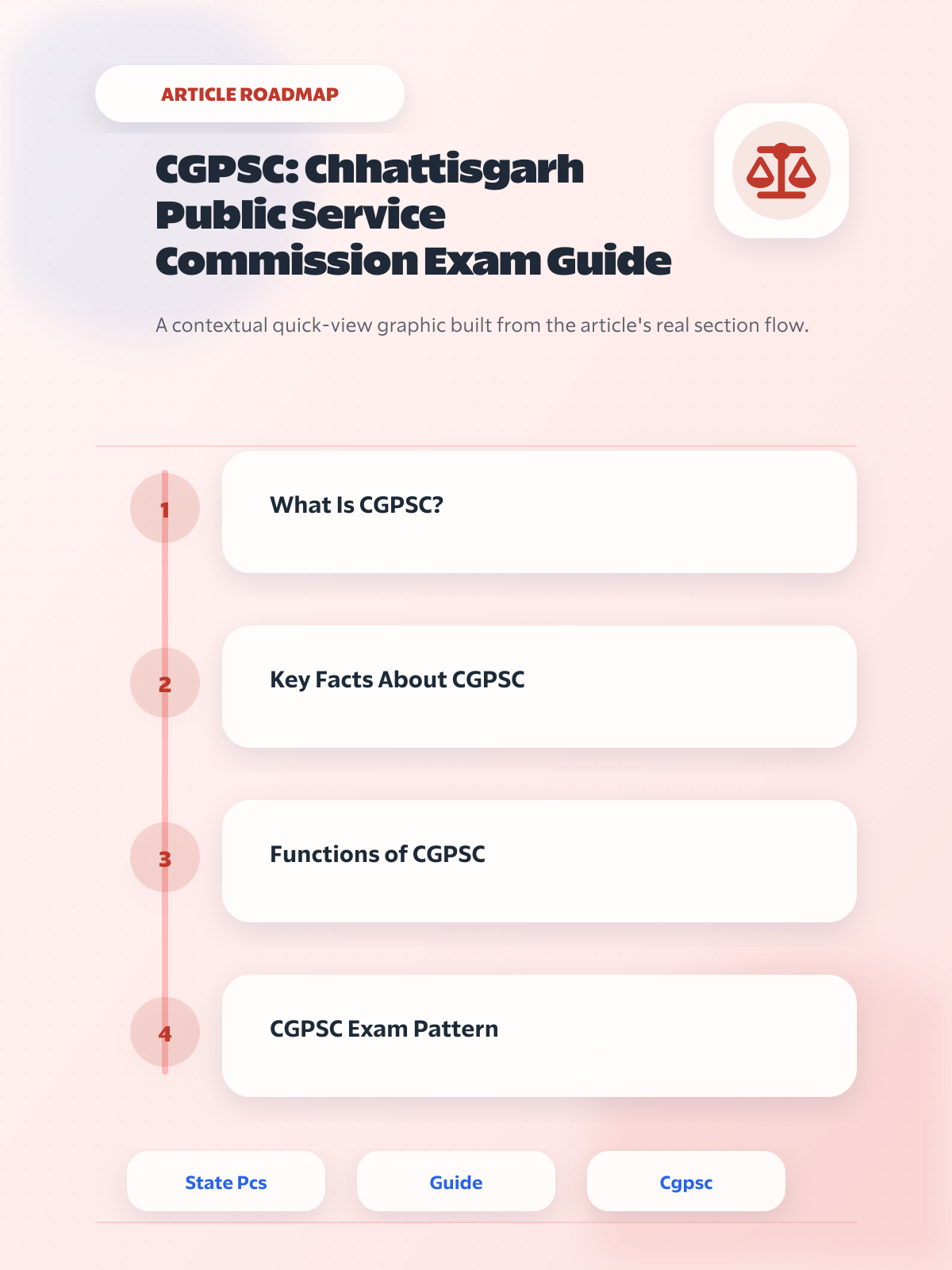
What Is CGPSC?
CGPSC is a constitutional body that functions as the state-level equivalent of UPSC for Chhattisgarh. It conducts recruitment examinations, advises the state government on appointment policies, and handles disciplinary and promotion matters for state services.
Key Facts About CGPSC
| Feature | Detail |
|---|---|
| Full Form | Chhattisgarh Public Service Commission |
| Established | 2000 (after formation of Chhattisgarh state) |
| Headquarter | Raipur, Chhattisgarh |
| Constitutional Basis | Articles 315–323 |
| Official Website | psc.cg.gov.in |
| Major Exam | State Service Examination (SSE) |
| Recent Exam | CGPSC SSE 2023–24 |
| Exam Frequency | Annual (approximately) |
Functions of CGPSC
- Conducting the State Service Examination for civil and allied services
- Recruiting officers for Chhattisgarh State Engineering Service, Forest Service, and other technical posts
- Advising the state government on recruitment and promotion policies
- Handling disciplinary matters referred by the state government
- Conducting departmental examinations for state employees
CGPSC Exam Pattern
The State Service Examination follows a three-tier structure: Preliminary, Mains, and Interview.
Preliminary Examination
| Parameter | Detail |
|---|---|
| Papers | 2 (General Studies + Aptitude Test) |
| Questions | 100 MCQs per paper |
| Marks | 200 per paper (400 total) |
| Duration | 2 hours per paper |
| Negative Marking | Yes (one-third deduction) |
| Nature | Screening/Qualifying |
The General Studies paper covers Indian history, polity, economy, geography, general science, current affairs, and Chhattisgarh-specific topics. The Aptitude Test paper covers comprehension, reasoning, quantitative ability, and analytical skills.
Mains Examination
| Paper | Subject | Marks | Duration |
|---|---|---|---|
| Paper I | Language (Hindi) | 200 | 3 hours |
| Paper II | Essay | 200 | 3 hours |
| Paper III | General Studies I | 200 | 3 hours |
| Paper IV | General Studies II | 200 | 3 hours |
| Paper V | General Studies III | 200 | 3 hours |
| Paper VI | General Studies IV | 200 | 3 hours |
| Paper VII | General Studies V | 200 | 3 hours |
Total Mains Marks: 1400
The GS papers cover history, geography, polity, economy, science and technology, environment, ethics, and Chhattisgarh-specific administration. The Language paper tests formal Hindi writing including essay, precis, and translation. The Essay paper tests clarity and structure on topics of state and national relevance.
Interview: 100 marks
Final Merit: 1400 (Mains) + 100 (Interview) = 1500
CGPSC vs UPSC: Exam Structure Comparison
| Parameter | CGPSC | UPSC CSE |
|---|---|---|
| Prelims Papers | 2 | 2 |
| Prelims MCQs | 100 + 100 | 200 (GS) + 80 (CSAT) |
| Mains Papers | 7 (all counted) | 7 + 2 qualifying |
| Optional Subjects | None (all GS-based) | 2 papers of 1 optional |
| Interview Marks | 100 | 275 |
| Total Merit Marks | 1500 | 2025 |
| Vacancies/Cycle | 150–400 | 800–1000 |
| Difficulty Level | High | Very High |
| Syllabus Focus | Chhattisgarh-centric | Pan-India |
The absence of an optional subject paper is a major structural difference. CGPSC relies entirely on General Studies for ranking, which means breadth matters more than deep specialization.
Related: BPSC: Bihar Public Service Commission Exam Guide
CGPSC Eligibility Criteria
| Criterion | Requirement |
|---|---|
| Nationality | Indian citizen |
| Age (General) | 21–40 years |
| Age (OBC) | 21–43 years |
| Age (SC/ST) | 21–45 years |
| Education | Bachelor's degree from recognized university |
| Attempts | No limit (within age bracket) |
| Domicile | Not mandatory for General; required for reserved categories |
Chhattisgarh offers a higher upper age limit than many other state PCS exams. The 40-year General category limit is significantly more generous than UPSC's 32-year cap.
CGPSC Syllabus: Detailed Overview
Prelims Syllabus
The General Studies paper covers:
- General Science: Physics, Chemistry, Biology fundamentals
- Current Events: National and international developments
- Indian History: Ancient, Medieval, Modern with Chhattisgarh history emphasis
- Geography: Physical geography of India, Chhattisgarh's geography and natural resources
- Indian Polity: Constitution, governance, Panchayati Raj
- Indian Economy: Planning, economic reforms, Chhattisgarh's economic profile
- Chhattisgarh-Specific: Tribal demography, mineral resources, forest cover, state administration
Mains Syllabus
General Studies I covers Indian history and culture, with special emphasis on Chhattisgarh's history, tribal heritage, and cultural traditions.
General Studies II covers Indian Constitution, governance, social justice, and Chhattisgarh's administrative structure.
General Studies III covers technology, economic development, biodiversity, environment, and Chhattisgarh's mineral and forest economy.
General Studies IV covers ethics, integrity, and aptitude — similar in scope to UPSC GS Paper IV.
General Studies V focuses on Chhattisgarh-specific knowledge: state geography, economy, tribal groups, cultural practices, state government schemes, and administrative challenges.
CGPSC Preparation Strategy
Step 1: Understand Chhattisgarh's Weight in the Exam
Chhattisgarh-specific content appears across multiple papers and can account for 30–40% of total scoring potential. Key areas include tribal communities (Gond, Baiga, Halba, Kamar), the state's mineral wealth (coal, iron ore, bauxite, limestone), forest coverage (over 44% of state area), and Chhattisgarh's role in the independence movement.
Step 2: Build the GS Foundation
Essential Books:
- NCERT textbooks (Class 6–12) for Science, History, Geography, Polity
- Laxmikanth's Indian Polity for constitutional topics
- Ramesh Singh or Sanjeev Verma for Indian Economy
- Chhattisgarh state-specific publications and government reports
Step 3: Master the State Layer
This is the rank-maker. Focus on:
- District profiles and administrative divisions (33 districts)
- Tribal demography and scheduled areas
- Mineral resources and industrial geography
- Forest and biodiversity (Indravati National Park, Barnawapara, Kanger Valley)
- State government schemes and budget priorities
- Local history, art forms (Panthi, Raut Nacha), and cultural traditions
Step 4: Answer Writing Practice
CGPSC Mains is entirely descriptive with 7 papers. Start answer writing practice early — before Prelims. Practice 150-word and 250-word answers with Chhattisgarh-specific data and examples integrated into general topics.
Step 5: Previous Year Analysis
Analyzing the last 5–7 years of CGPSC question papers reveals recurring themes, particularly around tribal welfare, forest rights, mineral extraction policy, and Naxal-affected governance challenges.
Related: UPSC vs State PCS: Which Is Right for You?
CGPSC Cutoff Trends
Cutoffs vary by cycle depending on vacancy count, difficulty level, and applicant numbers. As a general trend:
| Exam | Category | Prelims Cutoff Range (approx.) |
|---|---|---|
| Recent Cycles | General | 55–65% |
| Recent Cycles | OBC | 50–60% |
| Recent Cycles | SC/ST | 40–50% |
Mains cutoffs depend on the total marks obtained across all 7 papers. The interview stage often reshuffles rankings significantly — candidates within 50–100 marks of each other in Mains frequently see position changes after the personality test.
Services Offered Through CGPSC
Successful candidates are allocated to:
- Chhattisgarh Administrative Service (CAS)
- Chhattisgarh Police Service (CPS)
- Chhattisgarh Finance Service
- Chhattisgarh Cooperative Service
- Chhattisgarh Revenue Service
- Other Group A and Group B state services
Top rankers receive the CAS posting, which handles district-level administration in Chhattisgarh. CAS officers serve as Sub-Divisional Magistrates, Additional Collectors, and can rise to senior state government positions.
Challenges and Controversies
CGPSC has faced delays in exam scheduling and result declaration across several cycles. Court interventions on reservation policies and vacancy calculations have disrupted timelines. The commission has also dealt with allegations regarding transparency in the interview process. Despite these issues, CGPSC remains the primary gateway to Chhattisgarh's civil services, and the state government has taken steps to regularize exam frequency and improve administrative processes.
Books for CGPSC
Most of what you read for UPSC transfers to CGPSC: polity, economy, modern history and the NCERT base. What does not transfer is the Chhattisgarh section, and that is where the selection is decided. One state book, read three times, beats five read once.

Know Your State: Chhattisgarh 2026 — Arihant
- 504 pages, Arihant, revised 2026 edition
- Chhattisgarh history, tribes, geography, economy and polity
- Coloured maps and chapter MCQs

Lucent's General Knowledge 2026 — English (15th revised edition)
- 460 pages, Lucent Publications
- Static GK in the compressed, list-heavy format state PSC prelims reward
- Overrated for UPSC, right for this exam
- Indian Polity, M. Laxmikanth (Amazon.in). The polity questions are the same exam everywhere.
- Lucent’s General Knowledge (Amazon.in). Overrated for UPSC, right for the static questions here.
- Indian Economy, Ramesh Singh (Amazon.in). Read the concept chapters; the state budget goes on top.
- A Brief History of Modern India, Spectrum (Amazon.in). The freedom-struggle questions come straight from here.
- Know Your State: Chhattisgarh 2026 — Arihant (Amazon.in): the Chhattisgarh-specific section for CGPSC.
- NCERTs, Classes 6 to 12, for history, geography and science. Free from NCERT; nothing to buy.
Skip the coaching compilations until you have finished these. They summarise books you have not read yet.
Frequently Asked Questions
What is the CGPSC exam pattern?
The CGPSC State Service Examination follows a three-stage structure: Prelims (2 objective papers of 200 marks each), Mains (7 descriptive papers totaling 1400 marks), and Interview (100 marks). Final merit is calculated from Mains and Interview scores, giving a maximum of 1500 marks.
Is CGPSC easier than UPSC?
CGPSC is narrower in scope than the UPSC Civil Services Examination, but competition is intense relative to available vacancies (typically 150–400 per cycle). The Chhattisgarh-specific content — covering tribal demography, mineral resources, and state governance — demands dedicated preparation that generic UPSC notes cannot substitute.
Does CGPSC require Chhattisgarh-specific study?
Yes, and this is the single biggest differentiator. Chhattisgarh-specific topics — history, tribal society, mineral geography, forests, state schemes, and administrative challenges — appear across Prelims and multiple Mains papers. Candidates who skip this layer consistently underperform.
How long does CGPSC preparation take?
Most successful candidates prepare for 10–14 months of dedicated study. Aspirants already preparing for UPSC CSE can adapt in 4–6 months by adding Chhattisgarh-specific content. The 7-paper Mains structure demands consistent answer writing practice alongside content preparation.
Can UPSC and CGPSC be prepared together?
The static GS core — polity, history, economy, geography, science — overlaps substantially between UPSC and CGPSC. Dual preparation is viable if you add a dedicated Chhattisgarh layer covering state geography, tribal demographics, mineral economy, and local governance. Many aspirants in Raipur coaching centers follow this dual-track approach.
Tell Google you want more of this.
Add Anantam IAS as a preferred sourceOne tap, and this site shows up more often in your own Top Stories, AI Overviews and AI Mode. Remove it any time.