

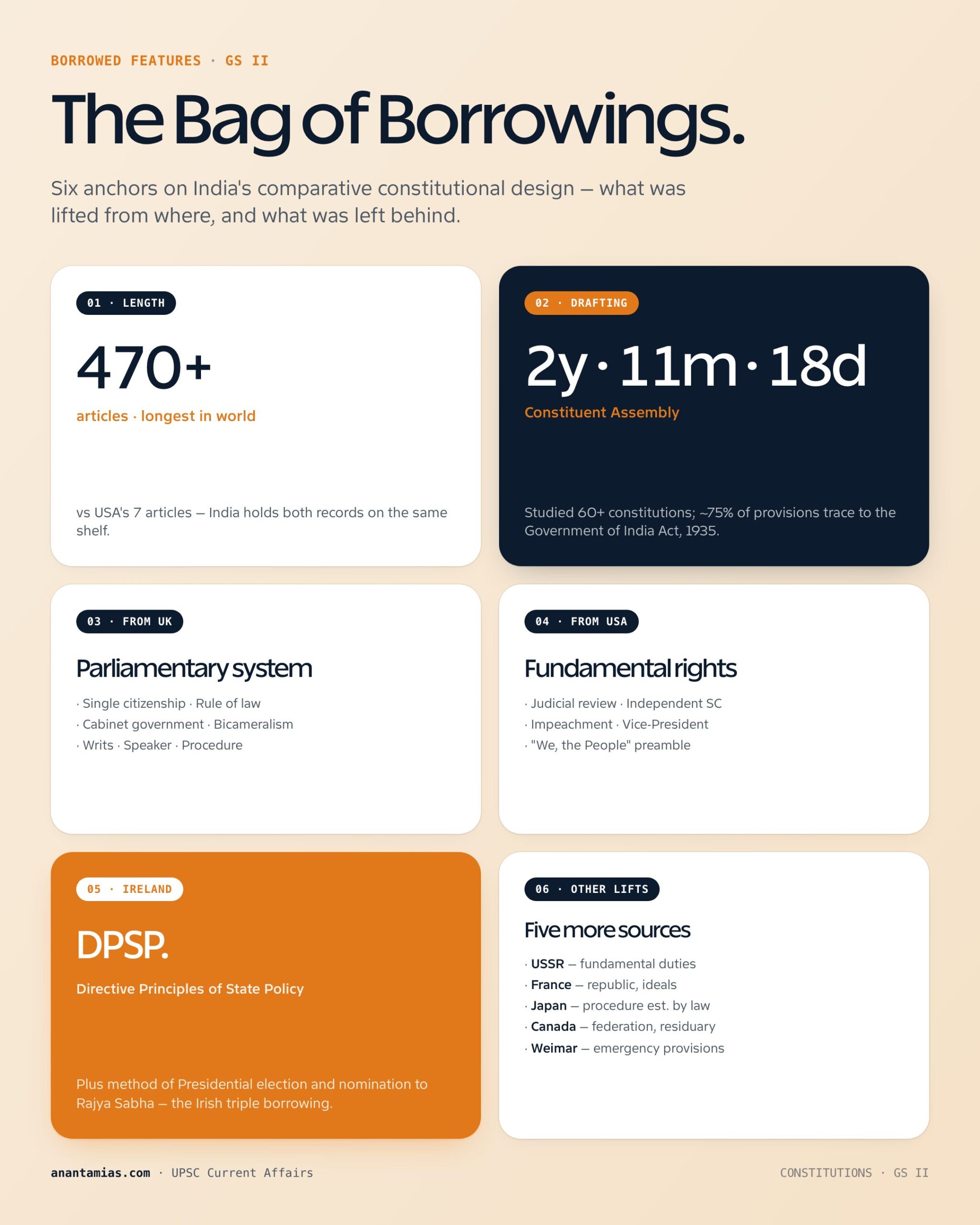
The Indian Constitution is famously described as a "bag of borrowings" — Granville Austin called it the world's most borrowed and most original constitution at the same time. Dr B.R. Ambedkar defended this comparative method in the Constituent Assembly: when other democracies had already debated and tested constitutional ideas for over 150 years, India was right to study them and adopt what fit. The result is a document that is written and lengthy like the American constitution, parliamentary like the British, federal with a strong centre like the Canadian, and rights-based like the Irish and Japanese.
For UPSC aspirants, the comparison of constitutions is more than a list of borrowed features. It tests the candidate's ability to analyse why India chose particular models, where the Indian adaptation differs from its source, and how recent debates — on basic structure, judicial review, federalism, presidential reference, and impeachment — reshape the comparison.
This guide compares the Indian Constitution with the UK, USA, Russia, Japan, and France across structural, functional, and rights-based parameters, and surfaces the 2024-26 context — the One Nation One Election debate, Article 370 verdict, simultaneous-elections committee report, and the new Parliament House transition — that bring this old comparison into living relevance.
Why a comparative reading matters for UPSC
The Constituent Assembly framed the document over 2 years 11 months 18 days, drawing from over 60 constitutions. Members studied the Government of India Act, 1935 as the structural skeleton (75% of provisions trace to it), and selectively grafted features from outside.
- GS-II syllabus mapping: "Comparison of the Indian constitutional scheme with that of other countries." This is an explicit syllabus item.
- Mains question patterns: Compare federalism in India and the US (2014); examine parliamentary vs presidential systems (multiple years); discuss judicial review and judicial supremacy (2017, 2022).
- Prelims: factual questions on borrowed features (e.g., directive principles from Ireland, fundamental duties from USSR) recur almost every alternate prelims.
Headline comparison — at a glance
| Feature | India | UK | USA | Russia | Japan | France |
|---|---|---|---|---|---|---|
| Written/Unwritten | Written | Unwritten (conventions + statutes) | Written | Written | Written | Written |
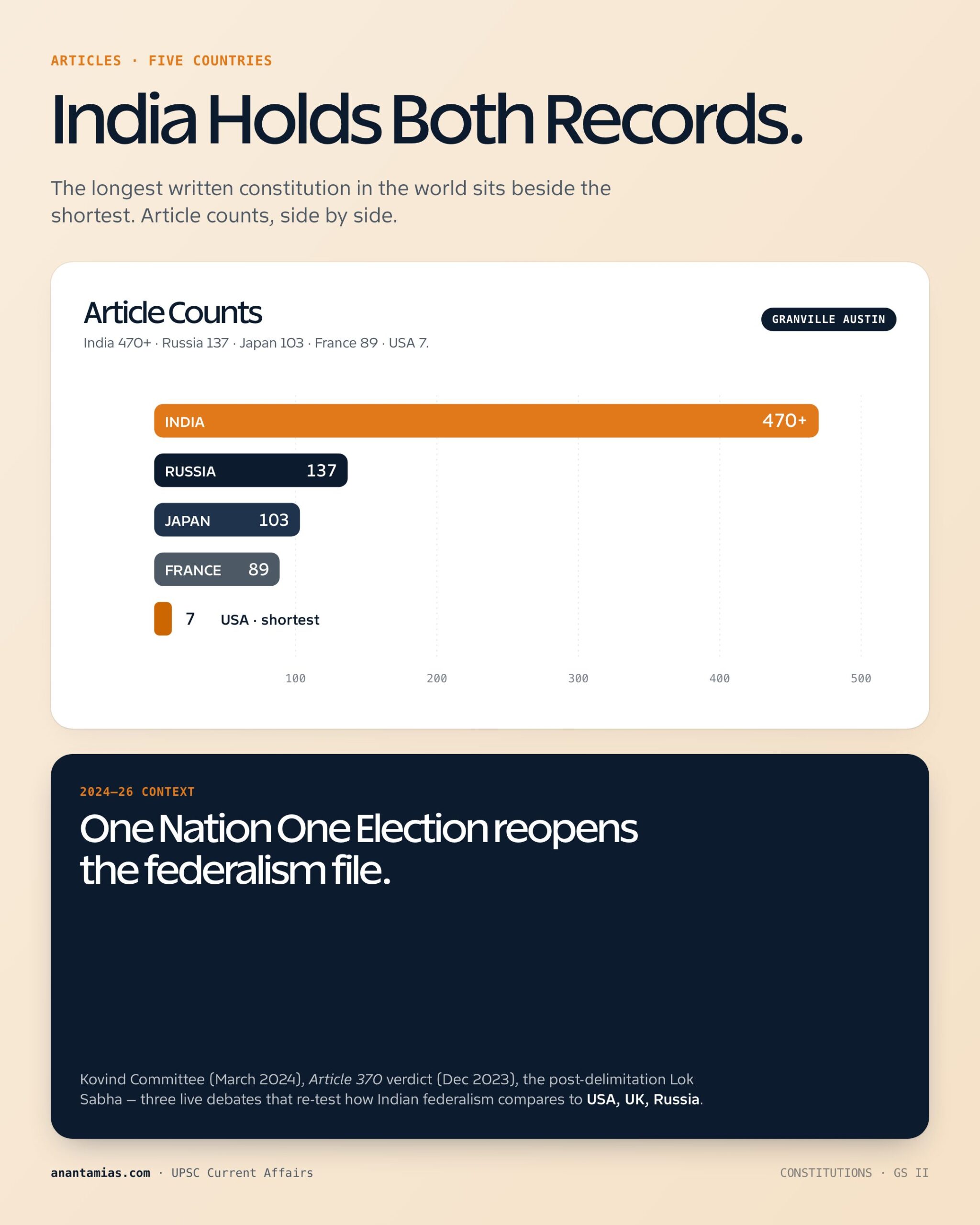
| Length (Articles) | 470+ (longest) | NA | 7 (shortest) | 137 | 103 | 89 |
| Flexible/Rigid | Both (Art 368) | Flexible | Rigid | Rigid | Rigid | Rigid |
| Federal/Unitary | Federal with unitary bias | Unitary | Federal | Federal (asymmetric) | Unitary | Unitary |
| Parliamentary/Presidential | Parliamentary | Parliamentary (cradle) | Presidential | Semi-presidential | Parliamentary | Semi-presidential |
| Sovereignty | Supremacy of Constitution | Supremacy of Parliament | Supremacy of Constitution | Supremacy of Constitution | Supremacy of Constitution | Supremacy of Constitution |
| Republic/Monarchy | Republic | Constitutional Monarchy | Republic | Republic | Constitutional Monarchy | Republic |
| Head of State | Ceremonial President | Ceremonial Monarch | Executive President | Executive President | Ceremonial Emperor | Executive President |
| Fundamental Rights | Yes (Part III) | Yes (HRA 1998) | Yes (Bill of Rights) | Limited | Yes | Yes (Declaration 1789) |
| Judicial Review | Yes | Limited | Strong | Limited | Yes | Constitutional Council |
| Citizenship | Single | Single | Dual (state + federal) | Single | Single | Single |
India vs the United Kingdom
The British system was the most direct influence on Indian institutional design, because India inherited the bureaucracy, legislature, and judicial structure from colonial rule.
What India borrowed from the UK
- Parliamentary system of government — Westminster model with a Cabinet responsible to the Lower House.
- Single citizenship — unlike federal USA's dual citizenship.
- Rule of law — A.V. Dicey's three pillars (no arbitrary power, equality before law, predominance of legal spirit).
- Bicameral legislature — Lok Sabha (House of Commons) and Rajya Sabha (House of Lords).
- Office of the Speaker and parliamentary procedures.
- Writs — habeas corpus, mandamus, prohibition, certiorari, quo warranto under Article 32.
- Cabinet government with collective responsibility (Article 75(3)).
Where India departs from the UK
- Written, codified Constitution — UK has none; constitutional law sits in statutes (Magna Carta, Bill of Rights 1689), conventions, and judicial decisions.
- Constitutional supremacy — Indian Parliament cannot violate basic structure (Kesavananda Bharati, 1973); UK Parliament can theoretically pass any law.
- Republic — India has an elected President; UK retains hereditary monarchy.
- Judicial review — Indian courts can strike down laws; UK courts can only "declare incompatibility" under the Human Rights Act, 1998.
- Federal structure — India has a federation of states; UK is unitary (devolution to Scotland, Wales, NI is statutory, not constitutional).
India vs the United States
The American Constitution gave India its conceptual framework for fundamental rights, judicial review, an independent judiciary, and a written supreme law.
What India borrowed from the USA
- Fundamental Rights (Part III) modelled on the Bill of Rights.
- Judicial review — Marbury v Madison (1803) doctrine adopted, refined in Kesavananda Bharati.
- Independent judiciary with power to interpret the Constitution.
- Impeachment of the President — Articles 61 (India) borrowed procedural elements from Article II Section 4 (USA).
- Removal of judges of the Supreme Court and High Courts (Article 124(4)).
- Office of Vice-President as ex-officio Chairman of the Upper House.
- Preamble structure — "We, the People."
Where India departs from the USA
- Parliamentary, not presidential — executive emerges from the legislature.
- Single citizenship vs US dual.
- Federalism: India is "federal with unitary bias" — Article 3 lets Parliament alter state boundaries unilaterally; the US states have stronger constitutional autonomy.
- Due process vs procedure established by law — Article 21's "procedure established by law" was a Japanese borrowing, not American "due process," though Maneka Gandhi (1978) effectively read due process into Article 21.
- Bill of Rights amendment: US Bill of Rights cannot be amended easily; Indian fundamental rights are amendable subject to basic structure.
India vs Russia (USSR)
The Soviet model influenced India's socio-economic vision more than its institutional design.
Borrowings from the Soviet Union
- Fundamental Duties (Article 51A) inserted by 42nd Amendment, 1976.
- Five-Year Plans (since dismantled in 2014; replaced by NITI Aayog).
- Ideal of social, economic, political justice — Preamble.
- Procedure for constitutional amendment — partial inspiration.
Departures
- Federalism: Russia is asymmetrically federal (89 federal subjects post-2022); India's federalism is constitutional, not contractual.
- Semi-presidential system: Russia's President wields enormous executive power; Indian President is ceremonial.
- Single-party dominance vs multi-party democracy: structural difference in political competition.
India vs Japan
Japan's post-war constitution (1947) is sometimes called the "MacArthur Constitution," and was a peer-influence for Indian framers.
Borrowings from Japan
- "Procedure established by law" in Article 21 — directly adapted from Article 31 of the Japanese Constitution.
- Conferment of Indian citizenship by birth — partial inspiration.
Departures
- Constitutional monarchy — Japan has the Emperor as a symbol of the State; India is a republic.
- Renunciation of war — Article 9 of the Japanese Constitution forbids war as a sovereign right; India has no parallel.
- Bicameral legislature with similar structure but different electoral systems.
India vs France
The French inspiration is concentrated in the Preamble, ideals, and the office of the President.
Borrowings from France
- Republic — head of state elected, not hereditary.
- Ideals of Liberty, Equality, Fraternity in the Preamble.
- Republican spirit post-1789.
Departures
- Semi-presidential vs parliamentary — French President shares power with Prime Minister (cohabitation possible); Indian President is ceremonial.
- Constitutional Council vs Supreme Court — France's apex court for constitutional review is the Conseil Constitutionnel, with limited powers; Indian Supreme Court has plenary review powers.
Borrowed features — quick recall table
| Country | Borrowed feature |
|---|---|
| UK | Parliamentary system; single citizenship; rule of law; bicameralism; cabinet system; writs; legislative procedure |
| USA | Fundamental rights; judicial review; independent judiciary; removal of judges; impeachment; Vice-President; Preamble; written constitution |
| Ireland | Directive Principles of State Policy; nomination to Rajya Sabha; method of Presidential election |
| Canada | Federation with strong centre; residuary powers in centre; appointment of Governors by President; advisory jurisdiction of SC |
| Australia | Concurrent List; Joint sitting (Article 108); freedom of trade and commerce (Article 301) |
| USSR | Fundamental duties; ideals of social, economic, political justice |
| France | Republic; ideals of liberty, equality, fraternity |
| Germany (Weimar) | Suspension of fundamental rights during emergency |
| South Africa | Procedure for amendment; election of Rajya Sabha members |
| Japan | Procedure established by law (Article 21) |
| GoI Act 1935 | Federal scheme; Office of Governor; judiciary; PSCs; emergency provisions; administrative details |
Federalism — three models compared
- USA — true federation: states existed before the Union; constitution distributes powers; states ratify amendments; dual citizenship.
- India — "indestructible Union of destructible states" (Sajjan Singh, 1965); states created by Parliament; single citizenship; strong centre but federal in spirit.
- Russia — asymmetric federation with 89 subjects (post-Crimea/Donbas annexation); republics, krais, oblasts, autonomous okrugs.
The 2024-26 debate: the One Nation One Election report of the High-Level Committee (Kovind Committee, 2024) has triggered fresh discussion on whether simultaneous elections strengthen federalism or undermine it. Critics argue it pushes India closer to a unitary character.
Sovereignty — Parliament vs Constitution
- UK — Parliament is sovereign; no court can strike down its statutes (though HRA 1998 changed this in spirit).
- India — Constitution is sovereign; Parliament cannot violate basic structure. The Article 370 verdict (2023, In Re: Article 370) reaffirmed this principle.
- USA — Constitution is sovereign; even the President cannot violate it (Marbury v Madison).
Judicial review — three intensities
- USA — strongest; Marbury v Madison (1803) established it.
- India — strong but checked by basic structure; Kesavananda mediates.
- UK — weakest; only "declarations of incompatibility" under HRA 1998.
2024-26 context — why this comparison is alive
- Article 370 verdict (December 2023) — Supreme Court upheld abrogation; reasserted constitutional supremacy.
- Kovind Committee on One Nation One Election (March 2024) — recommended simultaneous Lok Sabha and State Assembly elections; opens the federalism debate.
- New Parliament House inauguration (May 2023) — symbolic shift in institutional architecture.
- Women's Reservation Act (Nari Shakti Vandan Adhiniyam, 2023) — comparative gender representation puts India closer to global benchmarks.
- First post-delimitation Lok Sabha election (likely 2029) — will reshape the federal balance between northern and southern states.
Mains-style answer hook
"The Indian Constitution is a synthesis of borrowed features adapted to Indian context. Its uniqueness lies not in originality of every provision but in how it harmonises a written constitution like the American with a parliamentary system like the British, while creating a federal structure with a strong centre suited to a diverse, post-colonial society. The 2023 Article 370 verdict and the 2024 simultaneous-elections debate reaffirm that the Indian model continues to evolve while preserving the basic structure doctrine."
Prelims pointers
- Longest written constitution — India (470+ articles, 12 schedules).
- Shortest written constitution — USA (7 articles, 27 amendments).
- Borrowed parliamentary system — UK.
- Borrowed fundamental rights — USA.
- Borrowed DPSP — Ireland.
- Borrowed fundamental duties — USSR.
- Borrowed emergency provisions — Weimar Germany (Article 352, 356, 360).
- Procedure established by law — Japan (Article 21).
- Article 21 reinterpreted — Maneka Gandhi (1978) read due process.
- Basic structure doctrine — Kesavananda Bharati (1973).
FAQ
Is the Indian Constitution truly federal?
It is "federal with unitary bias" — federation in form (Article 1: "Union of States") but unitary in spirit (Article 3, Article 356, Article 249).
Why did India choose parliamentary over presidential?
Familiarity (British precedent), preference for collective responsibility, fear of personality cult in a deeply diverse society, and Ambedkar's stated preference for stability over identity in the Drafting Committee debates.
Has the comparative method dated?
No. The basic structure doctrine, the Kesavananda line, and the 2023 Article 370 verdict show the comparative roots are still tested in real judicial reasoning.
Related: Federalism in India, Basic Structure Doctrine, Cabinet Mission.
Tell Google you want more of this.
Add Anantam IAS as a preferred sourceOne tap, and this site shows up more often in your own Top Stories, AI Overviews and AI Mode. Remove it any time.






