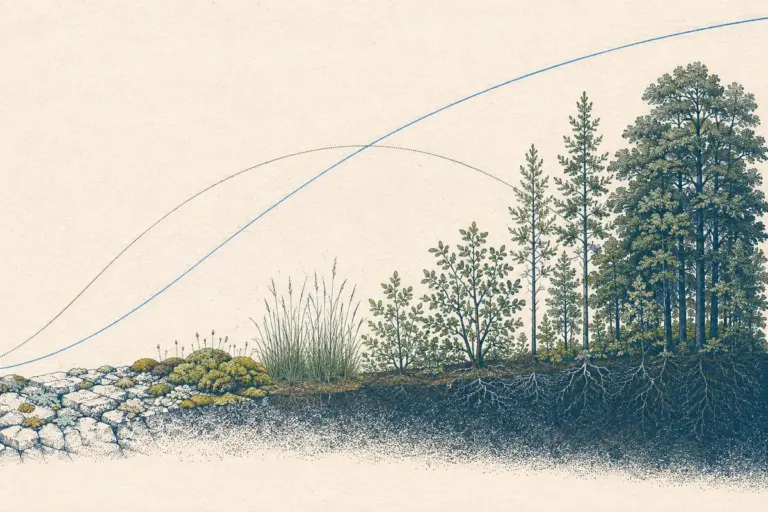
Stand at the edge of a village pond and you’re looking at a complete world. Sunlight drops into the water and green algae turn it into food. Tiny animals graze on the algae, small fish eat the animals, a kingfisher takes the fish, and when anything dies, bacteria on the muddy floor break it back down into the minerals the algae will use again tomorrow. Nothing in that scene was designed, yet it runs on its own, year after year. That self-running quality is the whole idea behind the word ecosystem.
For UPSC Environment and Ecology, the components of an ecosystem are the bedrock concept everything else rests on. Get this right and food chains, biogeochemical cycles, biodiversity loss and climate change all start to make sense as one connected story rather than separate chapters. Get it fuzzy and those later topics stay a list of definitions you can’t quite hold together. So it’s worth slowing down here and building the picture properly, from what an ecosystem actually is to why a disturbed one matters for every economy on earth.
What an Ecosystem Actually Is
The term itself has a precise birthday. The British botanist Arthur Tansley coined “ecosystem” in 1935, in a paper with the wonderfully grumpy title “The use and abuse of vegetational concepts and terms.” Tansley’s point was that you can’t study living communities in isolation from the rock, water and air they sit in. The organisms and their physical surroundings form, in his words, one physical system. So an ecosystem is a functional unit of nature in which living organisms interact among themselves and with their non-living environment, exchanging energy and matter in a roughly self-regulating way.
Two words in that definition do a lot of work. “Functional” means we care less about cataloguing what lives there and more about what the system does — how energy moves through it and how nutrients cycle. And “self-regulating” means the system tends to correct itself: if rabbits multiply, foxes eat better and multiply too, which pulls rabbit numbers back down. Nobody manages it.
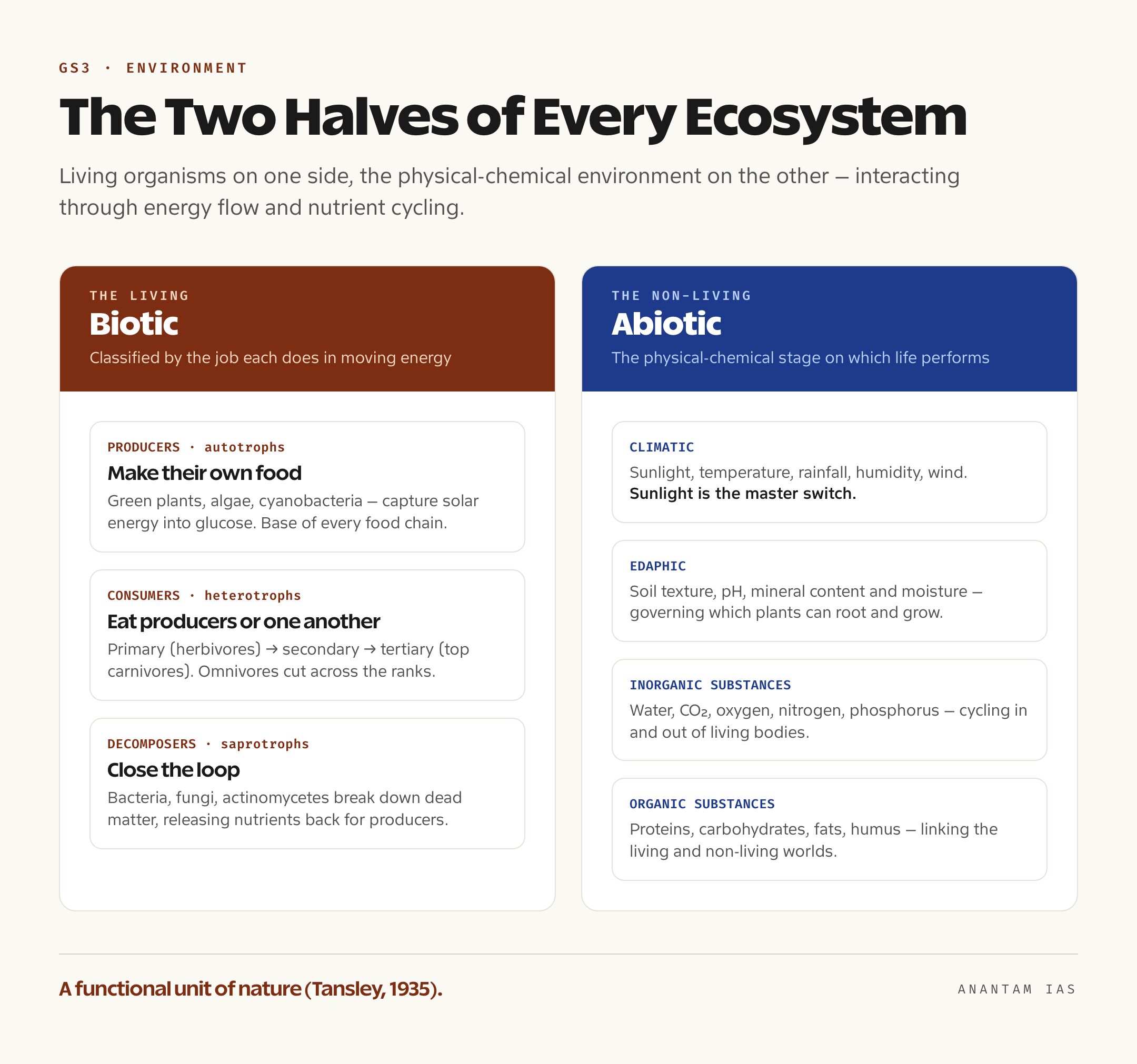
Ecologists usually describe an ecosystem along two axes. Its structure is how it’s put together — which species are present, how biomass is distributed, how the system is layered from canopy to forest floor. Its function is what flows through it — energy capture, nutrient cycling, productivity and the slow change of one community into another over time. Every ecosystem, whether a pond, a tropical forest, a desert, an ocean or a wheat field, is built from the same two sets of parts: the living, or biotic, and the non-living, or abiotic. Everything else in this article is a way of explaining how those two sets work together.
Biotic and Abiotic Components
Start with the non-living half, because it sets the stage on which life performs. Abiotic components are the physical and chemical factors that decide what can survive in a place and how well. They fall into a few groups. Climatic factors — sunlight, temperature, rainfall, humidity and wind — control photosynthesis, evaporation and which species can even establish themselves. Edaphic factors are everything to do with soil: its texture, pH, mineral content and moisture, which together govern what plants can root and grow. Then there are the raw chemical building blocks, split into inorganic substances such as water, carbon dioxide, oxygen, nitrogen and phosphorus that cycle in and out of living bodies, and organic substances such as proteins, carbohydrates, fats and humus that link the living and non-living worlds. Of all the abiotic factors, sunlight is the master switch, because almost every ecosystem on the planet ultimately runs on the energy it supplies.
The biotic components are the living organisms, and the smart way to classify them is not by what they look like but by the job they do in moving energy. There are three functional roles, and a tropical pond shows all three at once.
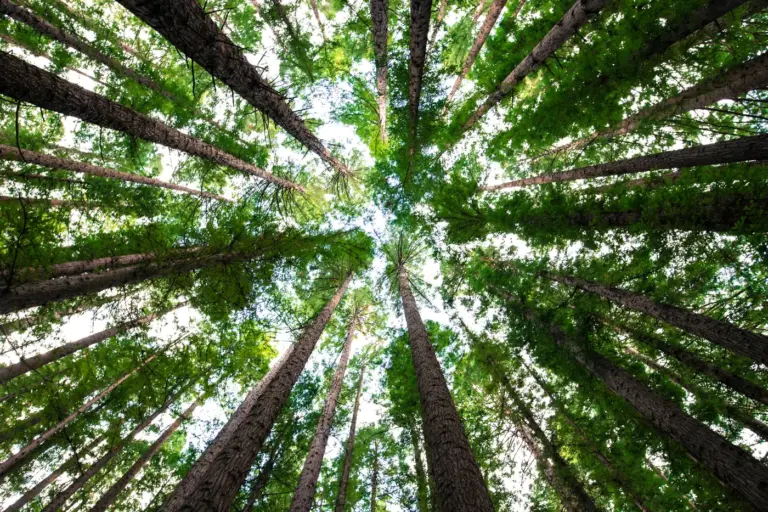
Producers, or autotrophs, make their own food and so feed everything else. Green plants, algae, cyanobacteria and photosynthetic bacteria capture solar energy and lock it into chemical energy — glucose — through photosynthesis. They form the base of every food chain. A few unusual ecosystems run on a different fuel: around deep-sea hydrothermal vents where no sunlight reaches, chemoautotrophs build food using the energy in chemicals like hydrogen sulphide instead. But sunlight-powered producers carry the overwhelming majority of life on earth.
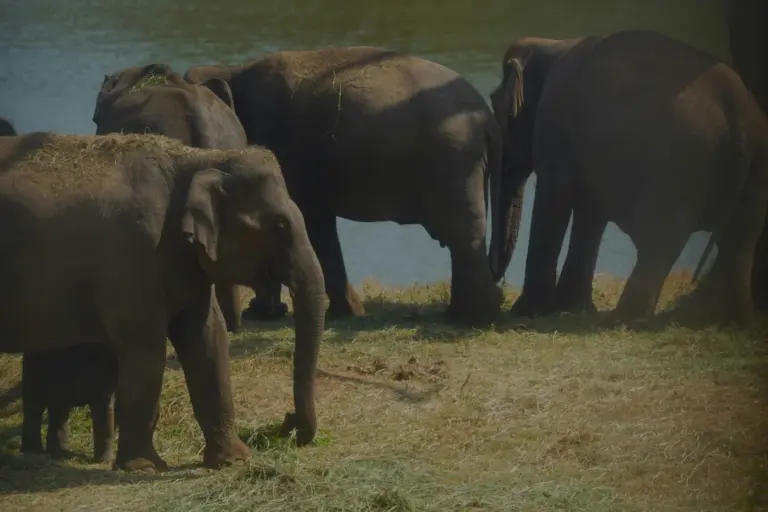
Consumers, or heterotrophs, can’t make their own food and so eat producers or one another. Ecologists rank them by how far they sit from the original plant energy. Primary consumers are herbivores that eat producers directly — deer, cattle, grasshoppers, the zooplankton in our pond. Secondary consumers eat the herbivores — frogs, small fish, foxes. Tertiary consumers, the top carnivores, eat the secondary ones — tigers, sharks, eagles. Omnivores such as humans, bears and crows cut across these neat ranks by eating both plants and animals.
Decomposers, or saprotrophs, are the unglamorous heroes that close the loop. Bacteria, fungi and actinomycetes break down dead bodies and waste, while detritivores such as earthworms and dung beetles physically shred the same material. Between them they release the locked-up nitrogen, phosphorus and other nutrients back into the soil and water, where producers take them up again. Without decomposers, every nutrient on earth would eventually be trapped inside corpses and the whole system would grind to a halt within a few generations. They are the reason an ecosystem can keep running on a fixed stock of matter.
How Energy Flows Through Trophic Levels
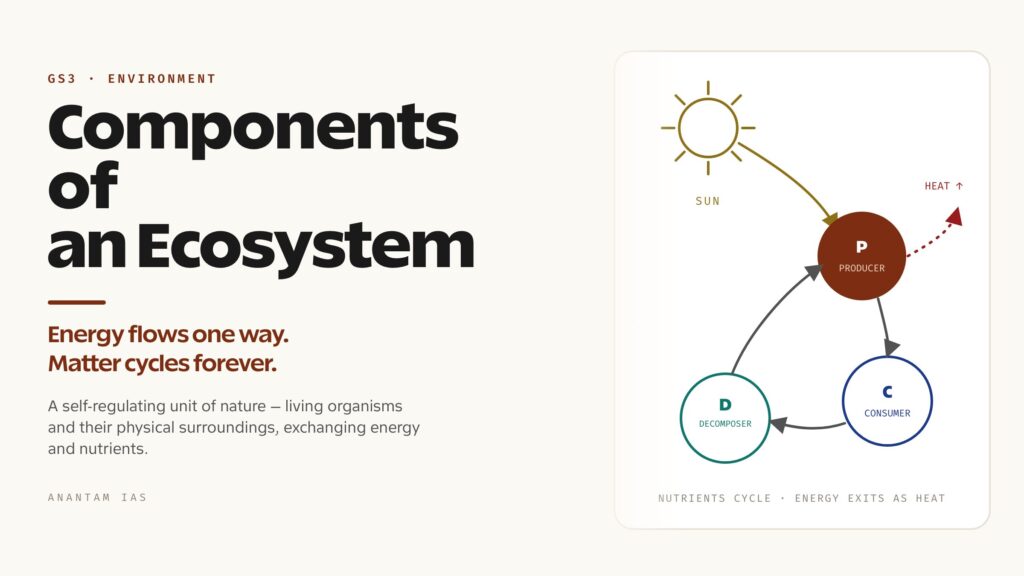
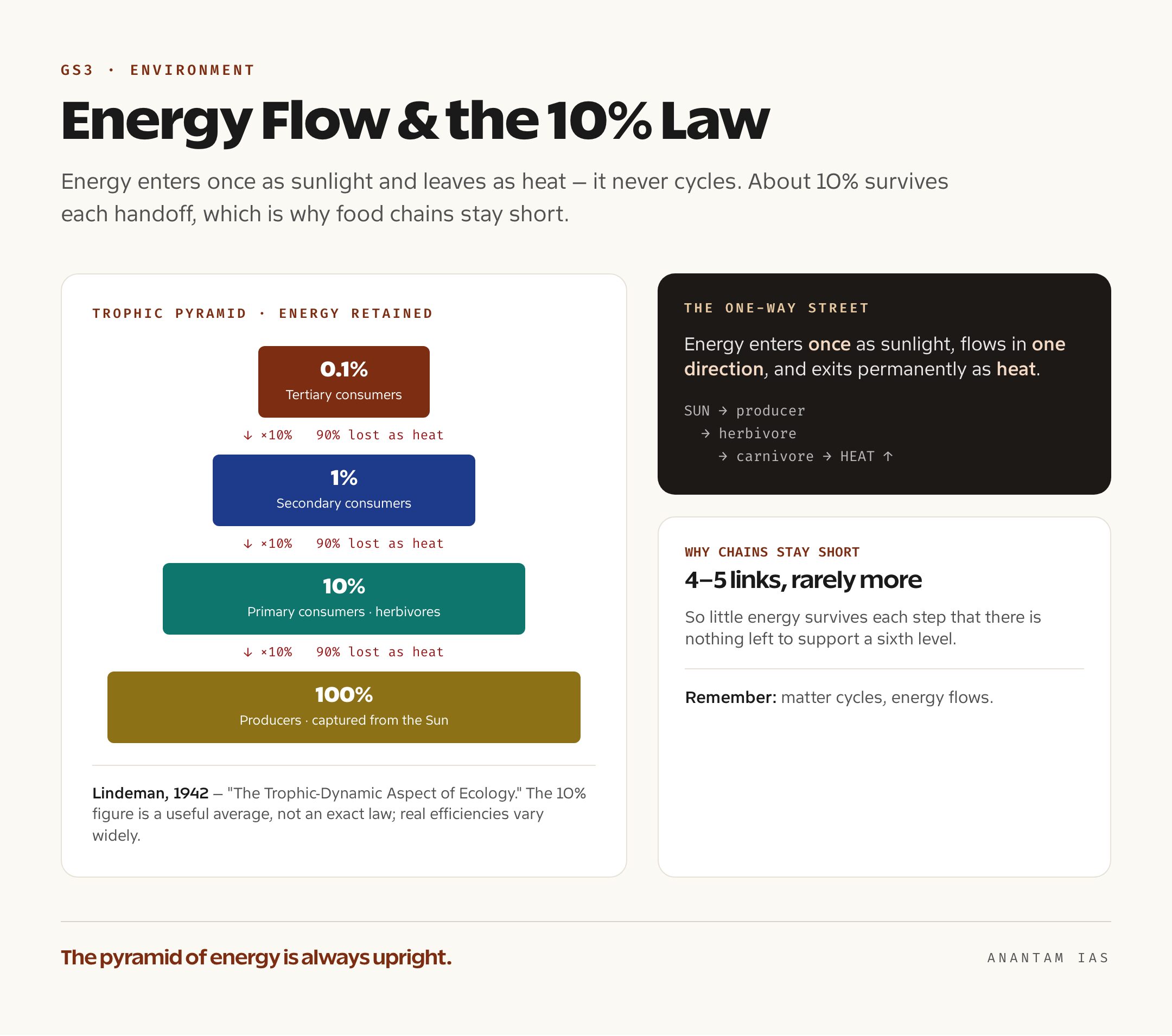
Here’s the single most important difference to fix in your head: matter cycles, but energy flows. Nutrients go round and round between the living and non-living compartments forever. Energy does not. It enters an ecosystem once, as sunlight, passes in one direction through the living organisms, and leaves permanently as heat. This one-way street is why ecosystems need a constant fresh supply of sunshine and can never run on recycled energy alone.
The path that energy takes is the food chain — a linear sequence such as grass to grasshopper to frog to snake to hawk. Each feeding step is a trophic level: producers occupy the first level, herbivores the second, and so on up. In the real world, organisms rarely eat just one thing, so food chains cross-link into a food web, an interconnected mesh of many chains. That tangle is a feature, not a mess: if one prey species crashes, predators in a web can switch to another, which is exactly why a rich, well-connected food web is more stable than a single fragile chain.
Ecologists recognise two ways a food chain can start. A grazing food chain begins with living green plants being eaten — the familiar grass-to-grasshopper kind that dominates grasslands and open water. A detritus food chain begins instead with dead organic matter being consumed by decomposers and detritivores. In a mangrove swamp or on a shaded forest floor, far more energy actually flows through the detritus chain than the grazing one, because most leaf litter falls and rots rather than being eaten alive.
Now the rule that governs how high any of this can climb. In 1942 the young American ecologist Raymond Lindeman published “The Trophic-Dynamic Aspect of Ecology,” which gave us what’s now taught as the ten percent law: on average only about 10% of the energy at one trophic level is passed up to the next. The other 90% is burned in respiration, lost as body heat or never digested. The honest caveat — worth knowing because examiners like nuance — is that Lindeman never called it a law, and measured efficiencies actually range widely; 10% is a useful rule of thumb, not a constant of nature. But the consequence is real and dramatic: because so little energy survives each handoff, food chains almost never stretch beyond four or five links. There simply isn’t enough energy left to support a sixth.
Ecological Pyramids and Nutrient Cycles
If you stack the trophic levels on top of each other and measure them, you get an ecological pyramid, a tool first developed by the British ecologist Charles Elton in the 1920s. There are three kinds, and the trick the examiners love is knowing which ones can flip upside down.
A pyramid of numbers counts how many organisms sit at each level. It’s usually upright — many grass plants, fewer deer, fewer tigers — but it inverts in a parasitic chain, where one big tree supports thousands of insects, which support even more parasites. A pyramid of biomass measures the total living weight at each level. On land it’s upright, but in the open ocean it famously inverts: the phytoplankton producers weigh far less at any single moment than the zooplankton and fish feeding on them. That sounds impossible until you realise phytoplankton reproduce every few hours, so a tiny standing weight turns over fast enough to feed a much heavier crowd above it. The third type, the pyramid of energy, plots energy flow per unit area per unit time, and it is always upright — never inverted — because an inverted energy pyramid would mean a higher level holds more energy than the level feeding it, which the laws of thermodynamics flatly forbid. If a question asks which pyramid can never be inverted, the answer is always the energy pyramid.
While energy marches one way and leaves, the chemical elements take the opposite path: they cycle endlessly between organisms and the environment through biogeochemical cycles, also called nutrient cycles. These split into two families by where the main reservoir sits. Gaseous cycles, such as those of carbon and nitrogen, hold their reserve in the atmosphere or oceans. In the carbon cycle, plants pull carbon dioxide from the air through photosynthesis, animals release it through respiration, and decomposition and fossil-fuel burning return still more — which is precisely the lever human activity has been pulling. In the nitrogen cycle, the huge pool of inert nitrogen gas in the air is fixed into usable form by lightning and by bacteria in the roots of legumes, passed through the food chain, and eventually returned to the air by denitrifying bacteria. Sedimentary cycles, such as those of phosphorus and sulphur, keep their reserve locked in rocks and soil and move far more slowly. Running underneath both is the ecosystem’s productivity: gross primary productivity (GPP) is the total energy producers capture, while net primary productivity (NPP) is what’s left after the plants’ own respiration — the genuine surplus, NPP equals GPP minus respiration, that everything higher up the chain gets to live on.
Why Ecosystem Components Matter
This is where a textbook concept turns into a policy question. Healthy interactions between biotic and abiotic components generate what we call ecosystem services — the free work nature does for us. Forests and oceans store carbon and steady the climate; soil microbes and decomposers recycle nutrients; insects pollinate crops; wetlands purify water and buffer floods. These aren’t sentimental extras. The World Economic Forum estimated in 2020 that 44 trillion dollars of economic value — more than half of global GDP — is moderately or highly dependent on nature and the services healthy ecosystems provide. When a component fails, the service fails with it, and the bill lands on the economy.
And we are pulling components out faster than ever. The landmark 2019 global assessment by the Intergovernmental Science-Policy Platform on Biodiversity and Ecosystem Services (IPBES) warned that around one million species now face extinction, many within decades, and that land degradation has already cut the productivity of nearly a quarter of the planet’s land surface. The pressures are familiar: habitat loss and land-use change, invasive alien species, pollution of air, water and soil, overexploitation of fish and forests, and climate change with its companion, ocean acidification. A subtler danger is the disruption of nutrient cycles — flooding rivers and coasts with excess nitrogen and phosphorus from fertiliser runoff, which triggers algal blooms, strips the water of oxygen and kills the very food webs we depend on.
Understanding the components is what makes intelligent repair possible. Biodiversity conservation works only when you protect producers, consumers and decomposers together, because removing any one role breaks the others. Climate mitigation leans on keeping carbon sinks — forests, soils, oceans — functional. And restoration ecology, the science of rebuilding damaged land, succeeds by re-establishing the relationships between components rather than just replanting trees and hoping. A forest is not a warehouse of timber; it’s a working system, and you can only fix what you understand as a system.
For Your Mains Answer
This topic anchors GS Paper 3 under “conservation, environmental pollution and degradation,” and the fundamentals feed directly into questions on biodiversity, climate change and pollution. The examiner rewards candidates who treat an ecosystem as a functioning machine — energy in, nutrients cycling, services out — rather than as a vocabulary list of producers and consumers.
How to Build the Answer
Open with the definition and the structure-versus-function distinction, because it frames everything. Then move in a logical chain: components (biotic and abiotic) → how they interact (energy flow plus nutrient cycling) → what that interaction produces (ecosystem services) → what happens when it breaks (degradation) → what to do about it. That arc lets you turn almost any ecosystem question into a tight, argued answer instead of a description.
Common Mistakes to Avoid
Don’t confuse energy flow with nutrient cycling — energy is one-way and lost, matter is cyclic and conserved; mixing them up is the single most common error. Don’t claim the 10% figure is an exact law; call it an average. Don’t say the energy pyramid can be inverted — it never can. And don’t list threats without linking each one back to the component or function it damages.
A Compact Answer Spine
Ecosystem as a self-regulating functional unit (Tansley, 1935) → abiotic stage (climatic, edaphic, chemical) plus biotic players (producers, consumers, decomposers) → energy flows one way and obeys Lindeman’s ~10% rule → matter cycles via biogeochemical cycles → output is ecosystem services worth over half of global GDP → IPBES warns of collapse → conservation, climate mitigation and restoration as the response.
Diagram or Flowchart Idea
Draw a single loop with an arrow entering from the Sun and a separate arrow of heat leaving — that captures one-way energy flow. Inside the loop, show the three biotic roles passing nutrients in a circle (producer → consumer → decomposer → back to soil). One clean figure that shows energy flowing through while matter cycles around is worth a paragraph of text.
A Balanced-Conclusion Line
Close on the idea that an ecosystem’s value lies not in its parts but in the relationships between them — which is why protecting an ecosystem means protecting a process, not just a place.
How to Use Data Without Cramming
You need only a handful of anchors: Tansley 1935 for the definition, Lindeman 1942 for the 10% rule, the WEF’s 44 trillion dollars / half of global GDP figure for nature’s economic weight, and the IPBES one-million-species warning for the scale of the threat. Four numbers, deployed precisely, beat a page of half-remembered statistics.
FAQ
What are the two main components of an ecosystem? Every ecosystem has biotic components — the living organisms, grouped by function into producers, consumers and decomposers — and abiotic components, the non-living physical and chemical factors such as sunlight, temperature, water, soil and the inorganic nutrients that life depends on. The two interact through energy flow and nutrient cycling.
Who coined the term “ecosystem” and when? The British botanist Arthur Tansley coined the term “ecosystem” in 1935, in his paper “The use and abuse of vegetational concepts and terms.” He argued that living organisms and their physical environment together form a single functional system that has to be studied as a whole.
What is the 10% law of energy transfer? The 10% law, attributed to Raymond Lindeman’s 1942 work, states that on average only about 10% of the energy at one trophic level is passed up to the next, with the rest lost mainly as heat through respiration. It explains why food chains rarely exceed four or five links — too little energy survives each step to support more.
Which ecological pyramid can never be inverted? The pyramid of energy is always upright and can never be inverted, because each level holds less energy than the one below it — an inverted energy pyramid would violate the laws of thermodynamics. The pyramids of numbers and biomass, by contrast, can invert: numbers in a parasitic food chain, and biomass in the open ocean where fast-reproducing phytoplankton support a heavier crowd above them.
Practice Questions
Prelims MCQs
- With reference to the components of an ecosystem, consider the following: which of these is correctly classified as an abiotic component?
(a) Cyanobacteria
(b) Soil pH
(c) Earthworm
(d) Phytoplankton
Answer: (b) Soil pH is an edaphic abiotic factor; the other three are living biotic components. - The term “ecosystem” was first introduced by which of the following?
(a) Charles Elton
(b) Raymond Lindeman
(c) Arthur Tansley
(d) Eugene Odum
Answer: (c) Arthur Tansley coined the term in 1935; Elton developed ecological pyramids and Lindeman the 10% rule. - Consider the following about energy flow in an ecosystem:
1. Energy flow is unidirectional.
2. Roughly 10% of energy is transferred between successive trophic levels.
3. Nutrients, unlike energy, are recycled. Which statements are correct?
(a) 1 and 2 only
(b) 2 and 3 only
(c) 1 and 3 only
(d) 1, 2 and 3
Answer: (d) All three are correct: energy flows one way and is lost, about 10% passes up each level, and matter cycles. - Which one of the following ecological pyramids is always upright?
(a) Pyramid of numbers
(b) Pyramid of biomass
(c) Pyramid of energy
(d) None of the above
Answer: (c) The pyramid of energy is always upright; numbers and biomass can be inverted in parasitic chains and ocean ecosystems respectively. - A detritus food chain is best described as one that:
(a) begins with living green plants
(b) begins with dead organic matter broken down by decomposers
(c) involves only top carnivores
(d) operates only in deserts
Answer: (b) A detritus food chain starts with dead organic matter and dominates systems like mangroves and forest floors, unlike the grazing food chain which starts with living plants.
Mains Practice Questions
- “Energy flows but matter cycles.” Explain this statement with reference to the functioning of an ecosystem. (10 marks, 150 words)
- Distinguish between the biotic and abiotic components of an ecosystem, and explain how the functional roles of producers, consumers and decomposers sustain it. (15 marks, 250 words)
- Discuss the three types of ecological pyramids, and explain why the pyramid of energy is always upright while pyramids of numbers and biomass can be inverted. (10 marks, 150 words)
- Healthy ecosystems underpin a large share of the global economy. Examine the concept of ecosystem services and the major threats that are degrading them. (15 marks, 250 words)
- Disruption of biogeochemical cycles is emerging as a serious environmental challenge. Analyse this with reference to the carbon and nitrogen cycles. (15 marks, 250 words)
Tell Google you want more of this.
Add Anantam IAS as a preferred sourceOne tap, and this site shows up more often in your own Top Stories, AI Overviews and AI Mode. Remove it any time.