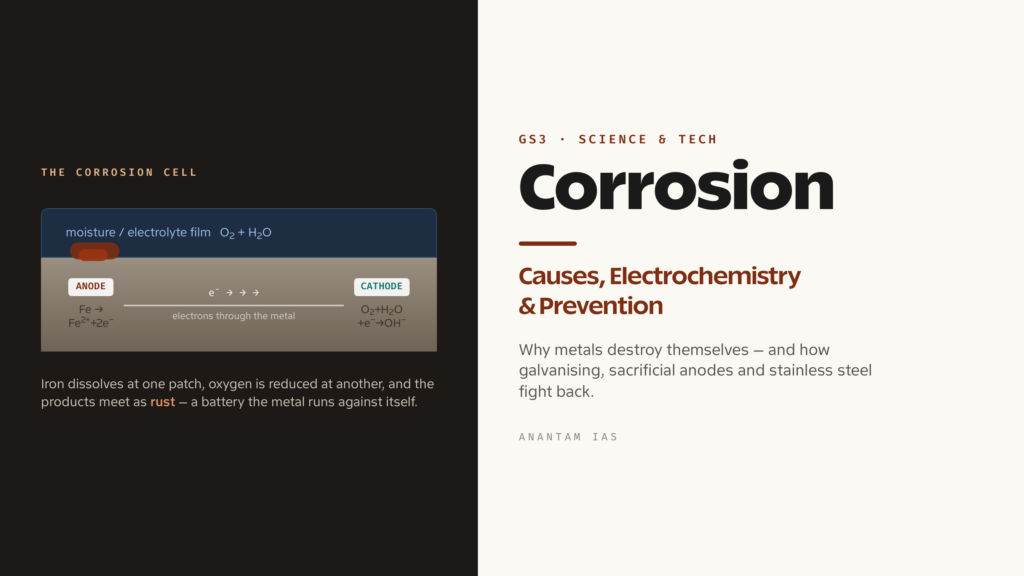
Leave a clean iron nail out in the open for a few damp weeks and it turns into a flaky orange ruin. Nobody plugged it into anything, nobody set it on fire — and yet the metal quietly destroyed itself. That slow, almost invisible self-destruction is corrosion, and it is one of the most expensive chemical processes on the planet. The metal didn’t simply “get old”. It ran a tiny battery against itself, dissolving at one spot and breathing in oxygen at another, until the iron you started with became iron oxide — rust.
For a UPSC aspirant, corrosion is a small topic that punches above its weight. It sits at the meeting point of basic electrochemistry, materials science and everyday economics, and examiners love it because a single nail can test whether you really understand oxidation, reduction and the cell reaction — or whether you’ve just memorised that “iron rusts in wet air”. So it is worth slowing down and seeing corrosion for what it actually is: not decay, but an electrochemical reaction you can write down, predict and stop.
What Corrosion Is: A Battery You Never Asked For
Corrosion is the gradual destruction of a metal by chemical or electrochemical reaction with its environment — usually its conversion into a more stable compound such as an oxide, hydroxide or sulphide. The key word is more stable. Most metals in daily use, iron above all, do not occur naturally as shiny metal; they occur as ores — oxides and sulphides dug out of the ground. Smelting forces those ores into pure metal by pumping huge amounts of energy in. Corrosion is simply that energy leaking back out. The metal is rolling downhill to the low-energy, oxidised state it “prefers”. This is why corrosion is sometimes called extractive metallurgy run in reverse.
And here is the idea that unlocks everything else: most corrosion is electrochemical, meaning it works exactly like a battery. A battery, or galvanic cell, has an anode where a metal gives up electrons (oxidation), a cathode where some species accepts those electrons (reduction), a metallic path for electrons to flow, and an electrolyte — a conducting liquid — to carry charge between the two. A corroding piece of metal has all four, often on a single surface. One patch of the metal becomes the anode and dissolves; another patch becomes the cathode where oxygen is reduced; the bulk metal carries the electrons; and a film of moisture acts as the electrolyte. The metal is its own short-circuited battery, and the “current” it generates is the rate at which it eats itself.
That single mental model explains the most counter-intuitive facts about corrosion. It explains why a perfectly dry nail in a sealed jar barely rusts at all — no electrolyte, no circuit. It explains why salty coastal air or road salt is so destructive — dissolved salt makes the electrolyte conduct far better, so the corrosion current surges. And, as you will see, it explains why a chemically purer metal often resists corrosion better than a metal laced with impurities, because impurities hand the metal ready-made anodes and cathodes to set up tiny local cells.
The Electrochemistry of Rusting Iron
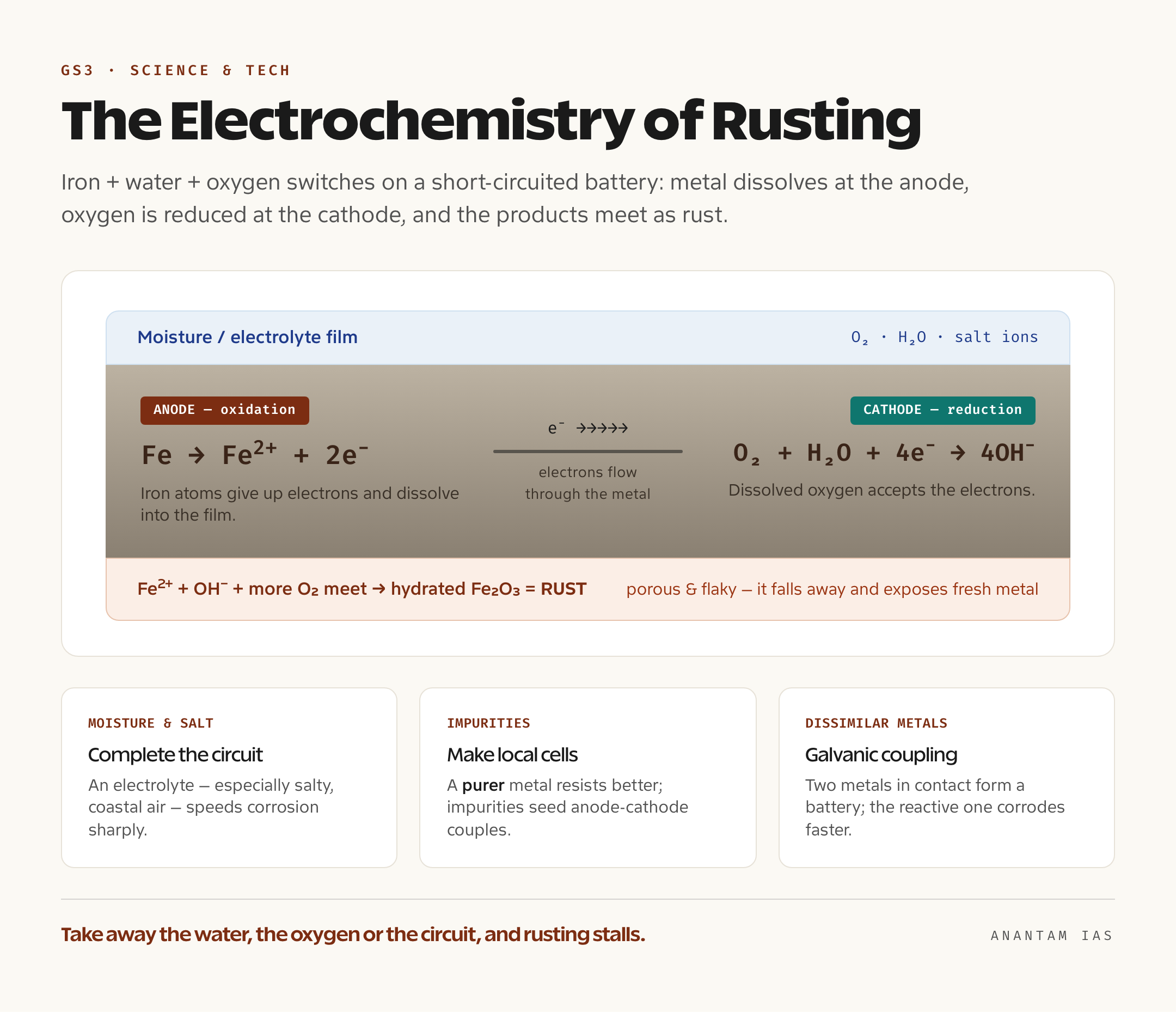
Rusting is the specific name for the corrosion of iron, and it is the textbook case because every step is visible and writable. For iron to rust you need three ingredients together — iron, water and oxygen. Take away the water (bone-dry air) or take away the oxygen (iron sealed under water with no dissolved air) and rusting stalls. Bring all three together and the electrochemical cell switches on.
At the anode — typically a slightly stressed, scratched or impure patch of the surface — iron atoms give up electrons and dissolve into the moisture film as iron ions. In the language of half-reactions, iron is oxidised: Fe becomes Fe²⁺ plus two electrons. Those electrons don’t escape; they travel through the metal itself to a different patch of the same surface. At that second patch, the cathode, the electrons are handed to dissolved oxygen in the presence of water, reducing it to hydroxide ions: oxygen plus water plus electrons become hydroxide (OH⁻). So one reaction releases electrons by destroying iron, and the other consumes them by reducing oxygen — the classic anode-cathode pairing of any cell.
The two products then meet. The Fe²⁺ ions floating in the moisture combine with the hydroxide and with more oxygen from the air, oxidising further to Fe³⁺, and precipitate as hydrated iron(III) oxide — the crumbly, reddish-brown solid we call rust, roughly Fe₂O₃·xH₂O. Two features of rust make it uniquely damaging. First, it is porous and flaky, not a sealed skin, so it constantly falls away and exposes fresh metal underneath to attack — rusting feeds on itself. Second, rust occupies a larger volume than the iron it came from, so it swells and lifts off in layers. This is why a rusting iron bridge or reinforcing bar keeps losing material indefinitely, while some other metals corrode once and then stop.
Three accelerants follow directly from this mechanism, and each is a favourite exam point. Moisture or any electrolyte speeds rusting up, because it completes the electrochemical circuit — and salts or acids dissolved in that moisture make it conduct better still, which is why corrosion is worst in coastal, industrial and de-iced-road environments. Impurities in the metal worsen corrosion: a purer metal resists better, whereas embedded impurities create local anode-cathode couples right on the surface that keep the cell running. And two dissimilar metals in contact corrode faster than either would alone, a special and important case worth its own name.
The Main Types of Corrosion
Corrosion is not one process but a family, and naming the type is half the battle in any answer. The simplest form is uniform or general corrosion, where the whole exposed surface corrodes at roughly the same rate — the even orange film on an old gate. It looks alarming but is the least dangerous kind, because it is predictable: engineers can measure the rate, add a “corrosion allowance” of extra metal thickness, and know how long a structure will last.
Galvanic corrosion is the dangerous, purely electrochemical one. When two dissimilar metals are in electrical contact in the presence of an electrolyte, they form a galvanic couple — a real battery. The more reactive metal (higher in the electrochemical series — say zinc, aluminium or ordinary steel) becomes the anode and corrodes faster than it ever would alone, while the less reactive, “nobler” metal (copper, brass, stainless steel) becomes the cathode and is protected. A steel screw in a copper sheet, an aluminium fitting bolted to a stainless frame, a brass pipe joined to a galvanised one — all set up this couple, and the reactive partner pays the price. This is why marine engineers obsess over which metals touch which. It is also, flipped on its head, the basis of the best protection method in the whole subject.
Then come the localised types, which are the real assassins because they concentrate damage in tiny spots while the rest of the surface looks fine. Pitting corrosion drills deep, narrow holes — often where the protective film is broken by a chloride ion from salt — and can perforate a tank wall while removing almost no overall weight, making it hard to detect and easy to underestimate. Crevice corrosion attacks the stagnant, oxygen-starved gap under a washer, gasket or bolt head, where a difference in oxygen concentration sets up its own cell. Stress-corrosion cracking combines a corrosive environment with mechanical tension to split metals that would survive either threat alone, and intergranular corrosion eats along the grain boundaries inside an alloy. The lesson for an answer is that “corrosion” can mean a slow even greying or a sudden hidden crack — and the hidden kinds cause most catastrophic failures.
The Economic and Engineering Cost
It is easy to treat corrosion as a chemistry-class curiosity until you see the bill. Global studies — most famously a major NACE (now AMPP) survey — have put the direct cost of corrosion at roughly 3 to 4 per cent of the world’s GDP every year, a staggering sum once you scale it to a large economy. That figure counts the metal lost, the structures rebuilt, the protective coatings and inhibitors bought, and the inspection and maintenance armies kept on payroll. It does not even count the indirect costs — the bridge closed for repair, the pipeline leak that spills oil, the factory halted while a corroded part is replaced.
The damage is not abstract for India. Corrosion silently weakens reinforced-concrete buildings and flyovers as the steel rebar inside rusts and swells, cracking the concrete from within; it pits ships and offshore rigs in the salty sea air; it attacks oil and gas pipelines, power-plant boilers and water-supply systems; and it degrades the electrical grid and railways. A humid, coastal, monsoon-soaked country with a fast-growing stock of steel-and-concrete infrastructure is, in effect, an ideal climate for corrosion to do its work.
But the same story carries a hopeful twist that examiners like to see acknowledged. A large slice of corrosion cost is avoidable — credible estimates suggest 15 to 35 per cent of it could be saved simply by applying corrosion-control knowledge that already exists. Choosing the right alloy, coating steel properly, designing out crevices and water traps, and fitting cheap sacrificial anodes are not exotic technologies; they are well-understood, often inexpensive measures that are skipped through ignorance or false economy. Corrosion, in other words, is one of those rare problems where the science is largely solved and the remaining challenge is mostly one of awareness, maintenance and governance.
How We Prevent Corrosion
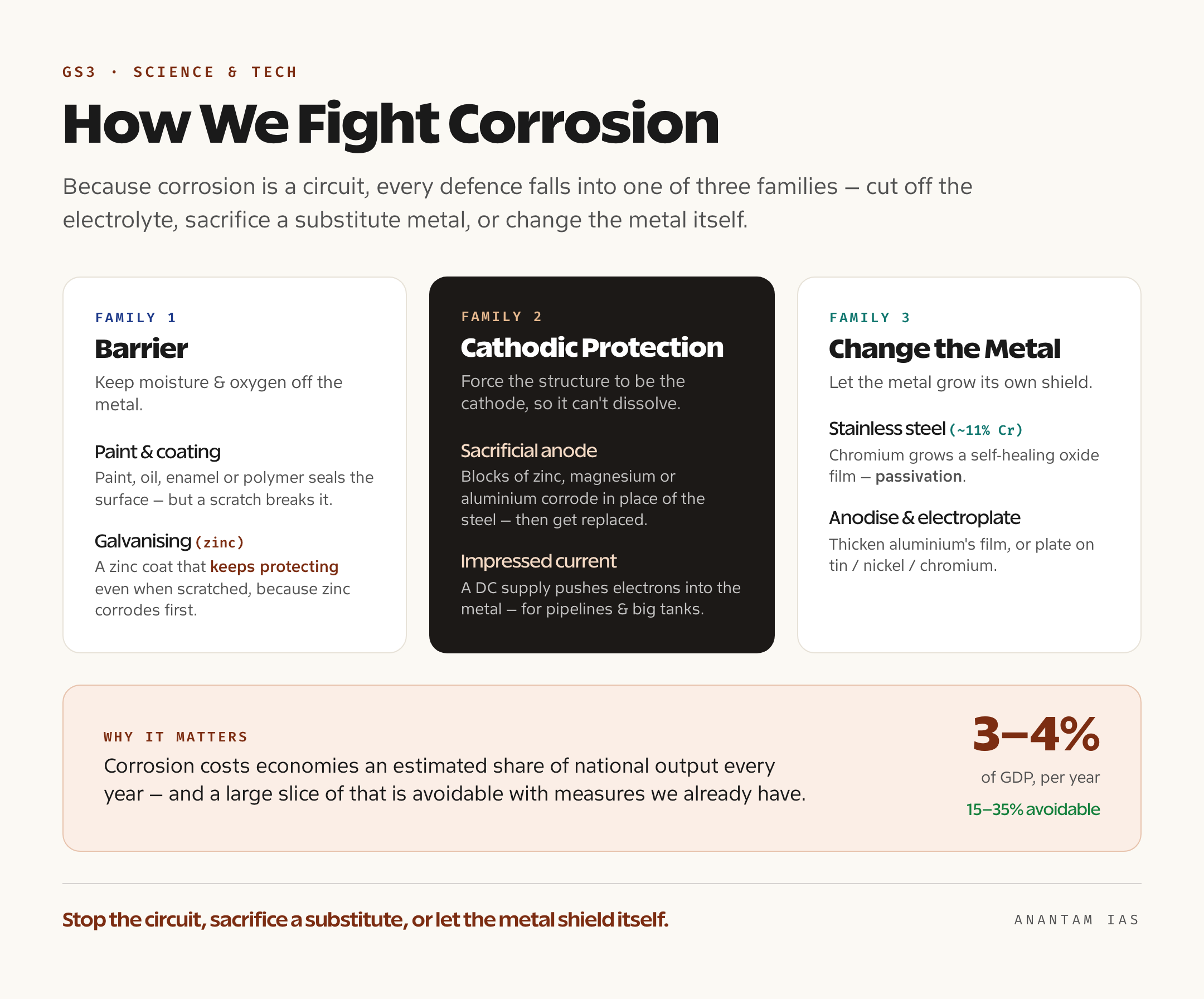
Because corrosion is an electrochemical circuit, every prevention method works by attacking one of the circuit’s parts — break the electrolyte’s contact with the metal, supply a different metal to corrode in its place, or change the metal so it protects itself. Sorting the methods into those three families makes the whole subject easy to recall.
The first family is barrier protection — keep moisture and oxygen off the metal. The everyday version is painting, greasing or coating: a film of paint, oil, enamel or polymer seals the surface so the electrolyte never touches the iron. Its weakness is that one scratch breaks the seal and rusting starts under the coat, which is why painted steel must be maintained. A smarter barrier is galvanisation — coating steel with a layer of zinc, usually by hot-dipping it in molten zinc. Galvanising does double duty, and that is the clever part. The zinc is a physical barrier, but even if the coat is scratched and the steel exposed, the zinc keeps protecting it, because zinc is more reactive than iron. The exposed steel becomes the cathode and the surrounding zinc becomes the anode that corrodes instead — the zinc is a sacrificial coating. This is why a galvanised bucket survives years of rain while a bare steel one rusts in a season.
That sacrificial idea is the second, and most elegant, family: cathodic protection, which deliberately turns galvanic corrosion into a defence. The whole structure to be saved is forced to become the cathode of a cell, so it cannot corrode. In the sacrificial-anode method, blocks of a more reactive metal — zinc, magnesium or aluminium — are bolted to a ship’s hull, an underground pipeline or an offshore platform. The reactive block corrodes away preferentially, feeding electrons into the steel and protecting it; the worn blocks are simply replaced periodically, a cheap trade. In the impressed-current method, an external DC power supply pushes electrons into the structure to hold it cathodic, used for very large assets like long pipelines and big storage tanks. Either way, the protected metal is kept “electron-rich” so it has no incentive to dissolve.
The third family changes the metal itself. Alloying blends iron with other elements to make it inherently corrosion-resistant — the headline example is stainless steel, iron alloyed with at least about 11 per cent chromium. The chromium reacts with oxygen to grow an ultra-thin, invisible, tightly-bonded layer of chromium oxide that seals the surface and, crucially, self-heals if scratched, because fresh chromium immediately oxidises again. This trick of forming a protective oxide skin is called passivation, and several metals do it naturally: aluminium, despite being very reactive, survives outdoors because it instantly grows a tough, sealing aluminium-oxide film, and that same film can be thickened deliberately by anodising. Finally, electroplating deposits a thin layer of a corrosion-resistant or decorative metal — chromium, nickel, tin — onto a cheaper base metal by electrolysis; the tin coating inside food cans is a classic example, sealing the steel from the acidic contents. Across all three families the logic never changes: stop the circuit, sacrifice a substitute, or let the metal grow its own shield.
For Your Mains Answer
Corrosion belongs to GS Paper 3, under science and technology and the basics of chemistry that appear in both Prelims and the science-and-tech portions of Mains. It connects naturally to infrastructure durability, materials for defence and shipbuilding, and the economics of maintenance. The examiner’s reward goes to the candidate who treats corrosion as an electrochemical process they can explain mechanically — anode, cathode, electrolyte — rather than a vague tale of metal “wearing out”, and who can then map each prevention method back to the part of the cell it disrupts.
How to Build the Answer
Start with the one-line definition — corrosion is the electrochemical conversion of a metal to a more stable compound — then immediately introduce the battery model: anode, cathode, electron path, electrolyte. Use rusting of iron as your worked example (iron + water + oxygen, oxidation at the anode, oxygen reduction at the cathode, porous rust as the product). From there branch into types (uniform, galvanic, pitting/crevice) and the cost, and finish with prevention sorted into the three families — barrier, cathodic protection, and changing the metal. That spine — define, mechanism, types, cost, cure — answers almost any framing.
Common Mistakes to Avoid
Don’t say a purer metal corrodes more — it corrodes less, because impurities create local cells. Don’t forget that both water and oxygen are needed for rusting; either one missing stalls it. Don’t confuse galvanic corrosion (the reactive metal corrodes) with cathodic protection (you exploit that on purpose to save the noble metal). Don’t describe galvanisation as just a physical coat — its sacrificial action when scratched is the whole point. And don’t muddle galvanising (zinc, sacrificial) with electroplating (a thin noble layer that gives no protection once breached).
A Compact Answer Spine
Corrosion = electrochemical oxidation of metal to a stable oxide → it is a battery on the metal: anode (Fe → Fe²⁺ + 2e⁻), cathode (O₂ + H₂O + e⁻ → OH⁻), moisture as electrolyte, rust = hydrated Fe₂O₃ (porous, self-feeding) → accelerated by moisture/electrolytes/salt, impurities, and dissimilar-metal contact → types: uniform, galvanic, pitting, crevice → cost ≈ 3-4% of GDP, much of it avoidable → prevention: barrier (paint, galvanising-zinc), cathodic protection (sacrificial anode, impressed current), alter the metal (stainless steel/chromium, passivation, anodising, electroplating).
Diagram or Flowchart Idea
Sketch a single iron bar with a film of water on top: mark one zone “ANODE: Fe → Fe²⁺” and another “CATHODE: O₂ + H₂O → OH⁻”, draw an arrow for electron flow through the metal between them, and show the two products meeting in the water to deposit rust. A second tiny diagram of a pipeline with a magnesium “sacrificial anode” block makes the prevention point instantly. Both are quick to draw and signal real understanding.
A Balanced-Conclusion Line
A line that lands: “Corrosion is not metal decaying but metal returning to its natural oxidised state through an electrochemical cell — which is exactly why it can be predicted and prevented, and why a problem costing the world some 3-4 per cent of GDP is, to a large degree, a failure not of science but of foresight.”
How to Use Data Without Cramming
You need only a handful of anchors: corrosion costs roughly 3-4 per cent of GDP and 15-35 per cent of that is avoidable; rusting needs iron + water + oxygen; stainless steel means about 11 per cent chromium; galvanising uses zinc as a sacrificial coat. Drop those into the right sentences and the answer reads as authoritative without turning into a data dump.
FAQ
What exactly is corrosion, and how is rusting different? Corrosion is the gradual destruction of a metal by an electrochemical or chemical reaction with its environment, usually turning it into a more stable compound such as an oxide. Rusting is simply the specific name for the corrosion of iron and steel, which produces hydrated iron(III) oxide — the familiar reddish-brown rust. So all rusting is corrosion, but corrosion also covers the tarnishing of silver, the green patina on copper and the white film on aluminium.
Why does iron need both water and oxygen to rust? Because rusting is an electrochemical cell. Oxygen is the species reduced at the cathode, and water (or any moisture film) is the electrolyte that completes the circuit and lets the iron ions and hydroxide ions move and meet. Remove the oxygen — iron sealed underwater with no dissolved air — or remove the moisture — bone-dry air — and the circuit cannot run, so rusting effectively stops. Salts or acids dissolved in the water make the electrolyte conduct better and speed everything up.
How does galvanising protect steel even when the coating is scratched? Galvanising coats steel with zinc, which is more reactive than iron. The zinc is first a physical barrier, but its real cleverness shows when scratched: the exposed steel and the surrounding zinc form a tiny galvanic cell in which the zinc, being more reactive, becomes the anode and corrodes in place of the iron. The zinc is “sacrificed” to keep the steel cathodic and protected — which is why galvanised steel resists rust far longer than painted steel, where a scratch lets rusting start.
What is cathodic protection and where is it used? Cathodic protection stops corrosion by forcing the whole metal structure to become the cathode of a cell, so it cannot dissolve. In the sacrificial-anode method, blocks of a more reactive metal like magnesium or zinc are attached to the structure and corrode away in its place; in the impressed-current method, an external power supply pushes electrons into the metal. It is used to protect ship hulls, underground and undersea pipelines, offshore platforms and large storage tanks — assets that are too big or buried to paint and re-paint.
Practice Questions
Prelims MCQs
- With reference to the electrochemical corrosion of iron, consider the following:
(a) Iron is oxidised at the cathode
(b) Oxygen is reduced at the cathode while iron is oxidised at the anode
(c) Rust forms only at the anode and protects the metal
(d) No electrolyte is required for rusting
Answer: (b) In rusting, iron is oxidised to Fe²⁺ at the anode and dissolved oxygen is reduced to hydroxide at the cathode; rust forms where the two products meet. - Which set of conditions is necessary for the rusting of iron?
(a) Iron and dry air only
(b) Iron, water and oxygen together
(c) Iron sealed under boiled, air-free water
(d) Iron in a vacuum
Answer: (b) Rusting needs iron, water and oxygen present together; removing either the water or the oxygen stalls the process. - Regarding electrochemical corrosion, which statements are correct? 1) Moisture or an electrolyte can accelerate corrosion. 2) The purer the metal, the greater the chance of corrosion. 3) Galvanic corrosion can occur when two dissimilar metals are in contact.
(a) 1 and 2 only
(b) 2 and 3 only
(c) 1 and 3 only
(d) 1, 2 and 3
Answer: (c) Moisture completes the circuit and dissimilar-metal contact creates a galvanic couple, so 1 and 3 are correct; a purer metal in fact resists corrosion better, so 2 is wrong. - In the galvanisation of iron, the metal used as a protective coating is:
(a) Tin
(b) Chromium
(c) Zinc
(d) Nickel
Answer: (c) Galvanisation coats steel with zinc, which acts as both a barrier and a sacrificial anode because it is more reactive than iron. - Stainless steel resists corrosion mainly because it contains:
(a) A high percentage of carbon
(b) At least about 11 per cent chromium, which forms a self-healing oxide film
(c) A coating of tin applied by electroplating
(d) Dissolved oxygen that prevents further reaction
Answer: (b) Chromium in stainless steel forms a thin, adherent, self-healing chromium-oxide layer (passivation) that seals the surface against corrosion.
Mains Practice Questions
- Explain corrosion as an electrochemical process, using the rusting of iron to identify the roles of the anode, cathode and electrolyte. (10 marks, 150 words)
- “Corrosion is extractive metallurgy run in reverse.” Discuss this statement and examine why moisture, dissolved salts and the contact of dissimilar metals accelerate the process. (15 marks, 250 words)
- Distinguish between galvanic corrosion and cathodic protection, and explain how the same electrochemical principle that causes the former is used to achieve the latter. (15 marks, 250 words)
- Compare the main methods of corrosion prevention — barrier coatings, galvanisation, cathodic protection and alloying — and assess their suitability for protecting India’s bridges, pipelines and ships. (15 marks, 250 words)
- Corrosion is estimated to cost economies around 3-4 per cent of GDP, much of it avoidable. Critically examine the economic and infrastructural significance of corrosion control for a humid, coastal economy like India. (15 marks, 250 words)
Tell Google you want more of this.
Add Anantam IAS as a preferred sourceOne tap, and this site shows up more often in your own Top Stories, AI Overviews and AI Mode. Remove it any time.