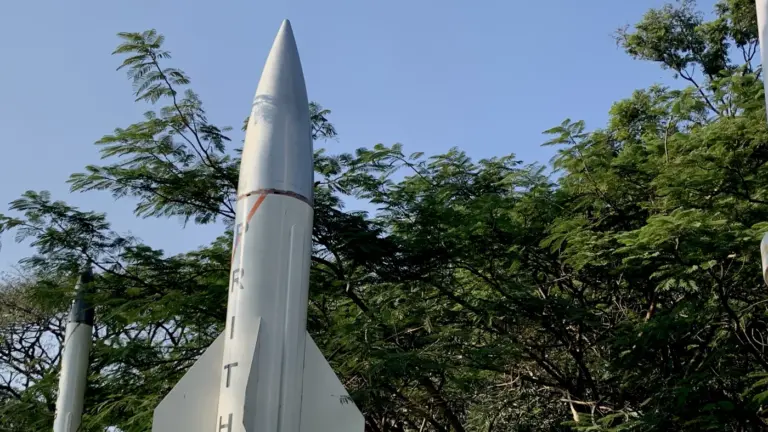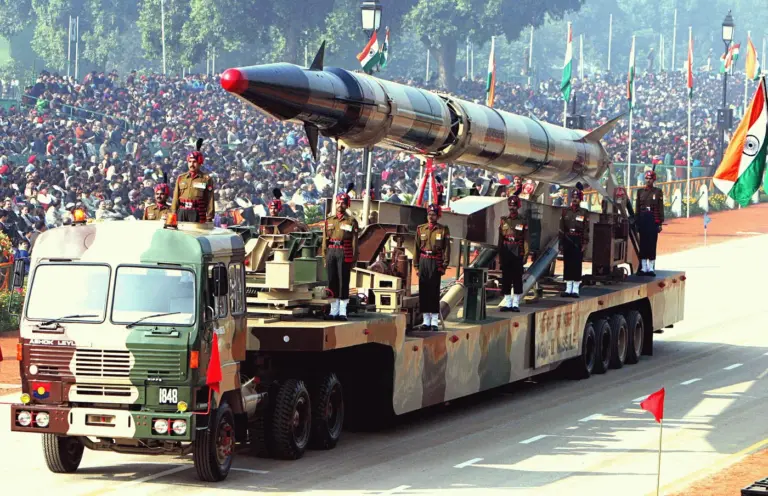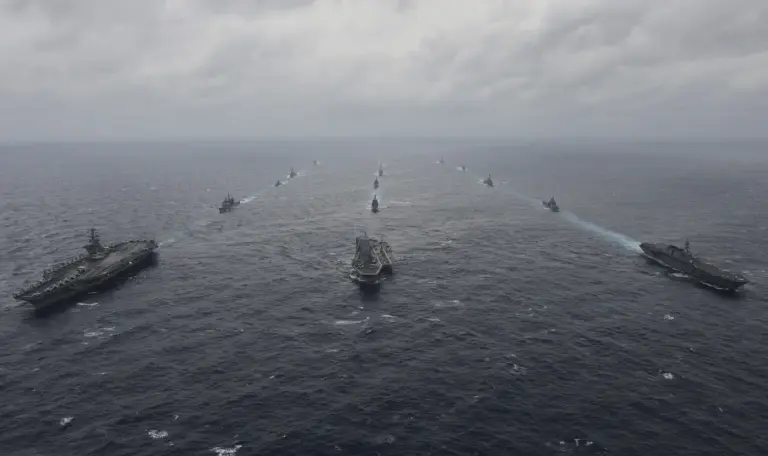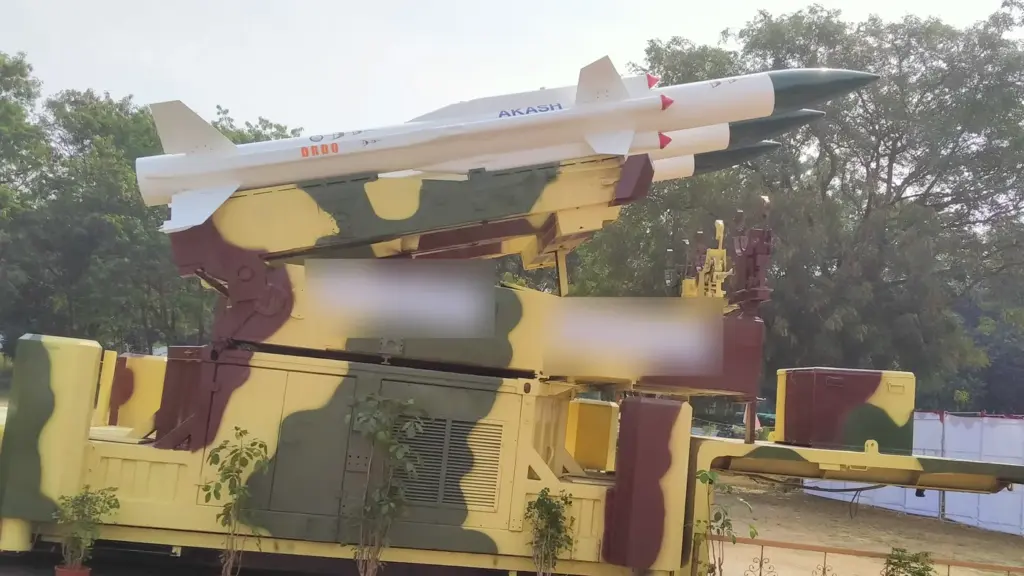
IADWS, the Integrated Air Defence Weapon System, is a multi-layered air defense system from the Defence Research and Development Organisation (DRDO) that puts two indigenous missiles and a high-power laser weapon under one command center. DRDO flew it for the first time on 23 August 2025 off the Odisha coast, where it destroyed three aerial targets at the same time. It matters because missiles and a laser fought as one system in that test, which the Defence Minister called unique, and he later named it the first step toward Mission Sudarshan Chakra, the national air defense shield promised by 2035.
Most readers file IADWS as India’s answer to Israel’s Iron Dome, or as Mission Sudarshan Chakra itself. It is neither. IADWS is one integrated package for the inner, short-range layers of air defense, flight-tested once so far, while Sudarshan Chakra is the much larger national plan it feeds. This note keeps the two apart and gives each component only the range an official source has published, including where the laser still falls short.
What Is IADWS?
IADWS is a system of systems. DRDO describes it as “a multi-layered air defence system” made of all-indigenous weapons, with their joint operation run from a Centralised Command and Control Centre. The facts below come from the Ministry of Defence release of 24 August 2025 and the Defence Minister’s statements after it.
| Fact | Detail |
|---|---|
| Full form | Integrated Air Defence Weapon System |
| Type | Multi-layered air defense system, all indigenous |
| Weapons integrated | Quick Reaction Surface to Air Missile (QRSAM), Advanced Very Short Range Air Defence System (VSHORADS) and a high-power laser-based Directed Energy Weapon (DEW) |
| Nodal laboratory | Defence Research and Development Laboratory (DRDL), Hyderabad, which also developed the command and control centre |
| Other developers | Research Centre Imarat (VSHORADS); Centre for High Energy Systems and Sciences, CHESS (laser) |
| Maiden flight test | About 12:30 pm on 23 August 2025, off the Odisha coast, with flight data recorded by the Integrated Test Range, Chandipur |
| Targets destroyed | 2 high-speed fixed-wing unmanned aerial vehicle targets and 1 multi-copter drone, engaged simultaneously |
| Stated purpose | To strengthen area defense for important facilities against enemy aerial threats |
| Link to national plan | Called the first step toward Mission Sudarshan Chakra by the Defence Minister on 30 August 2025 |
Read the table for what it leaves out. No release gives a combined range or an induction date for IADWS, and none gives its cost, so any note that prints one is guessing.
How Does IADWS Work?
IADWS works by matching each incoming threat to the cheapest weapon that can kill it, and by letting one command center see the whole sky for all three weapons. On its own, each weapon has its own sensors and its own crew. Integrated, they share one air picture, and the command center decides which weapon takes which target.
Command and control is the part that watches the sky and gives each weapon its target. Think of it as the triage desk of a hospital emergency ward, which sends each patient to the right specialist instead of sending everyone to the most expensive one. The analogy breaks on time: an air threat gives seconds, not minutes, so the desk has to be largely automated. According to the test release, every part performed as planned:
- the missile systems;
- the drone detection and destruction system;
- the command and control with its communication links and radars.
Here is how the layering would play out in practice, as an illustration rather than the recorded test. A fixed-wing drone approaching fast from a distance is a job for QRSAM. A low target that slips closer is a job for the shoulder-fired VSHORADS. A small multi-copter hovering near a facility is the laser’s job, because spending a missile on it wastes money. The release itself says only that the three weapons destroyed the three targets “at different ranges and altitudes”. It doesn’t pair each weapon with a target, and a careful answer shouldn’t either.
Each component already existed as a separate DRDO program before IADWS joined them. The table gives what official sources say about each one:
| Component | Role | Range class as officially stated | Developer |
|---|---|---|---|
| QRSAM | Mobile missile system that searches and tracks on the move and fires on a short halt | 5 to 30 km range and up to 6 km altitude (Bharat Dynamics Limited product sheet) | DRDO |
| Advanced VSHORADS | Man-portable missile fired by a 2-person crew against low-flying aircraft and drones | Very short range; no figure published | Research Centre Imarat, with production partners |
| High-power laser DEW | Damages or disables aerial targets with a focused beam of light | No figure published for the IADWS laser | CHESS |
| Centralised Command and Control Centre | Controls the integrated operation of all the weapons | Not applicable | DRDL, the nodal laboratory |
QRSAM: The Mobile Missile Layer
QRSAM is built to protect troops on the move. The 23 December 2019 test release describes a system that operates while moving, with a fully automated command and control system, two radars and a launcher. Both radars are active array radars, which steer their beams electronically instead of turning a dish, and both are four-walled, meaning they have faces on four sides for 360-degree coverage.
The missile is a single-stage, solid-fuelled design. It flies the middle of its path on inertial navigation, takes course corrections over a two-way data link and switches on its own radar seeker for the final approach. In September 2022 the Army completed six evaluation flight-tests, including a salvo of two missiles fired in quick succession, and DRDO declared the system ready for induction. Bharat Dynamics Limited, the Ministry of Defence company that makes it, lists a range of 5 to 30 km and the ability to engage 6 targets at once.
On 3 July 2025 the Defence Acquisition Council approved buying “Surface-to-Air Missiles” among 10 indigenous proposals worth about Rs 1.05 lakh crore. Press reports identified that item as QRSAM, but the release itself doesn’t name the system, so write it as reported rather than confirmed.
VSHORADS: The Shoulder-Fired Layer
VSHORADS is a Man Portable Air Defence System (MANPADS), a missile light enough for soldiers to carry and fire from the shoulder or a light stand. Research Centre Imarat designed it with other DRDO laboratories and industry. On 3 and 4 October 2024 DRDO flight-tested the fourth-generation, miniaturized version at Pokhran, proving interception at maximum range and maximum altitude in hit-to-kill mode, which means destroying the target by direct impact.
The trials of 1 February 2025 at Chandipur came closest to the IADWS mission. The targets had a reduced thermal signature, meaning they gave off little heat, the way small drones do, and two field operators handled readiness, target acquisition and firing. DRDO says the missile meets the needs of all three services.
The Laser: The Directed Energy Layer
A directed energy weapon hits with energy, here a concentrated beam of light, instead of a warhead. CHESS in Hyderabad leads India’s work on it. On 13 April 2025 at Kurnool, CHESS demonstrated a vehicle-mounted 30 kW laser, the Mk-II(A), which defeated a fixed-wing drone and swarm drones by causing structural damage and disabling their surveillance sensors. Officials said this put India among the few countries, with the US, China and Russia, to show the capability.
The IADWS release doesn’t say whether its laser is the same Mk-II(A) unit. Both come from CHESS, and it’s safer to describe the IADWS laser only as the release does: a high-power, laser-based DEW.
What Did the August 2025 Test Prove?
The test proved that three different weapons can fight three different targets at the same moment under one command center, and that India can build every part of that chain at home. Those are the real firsts of the test: integration and simultaneity, not any single weapon.
The record, from the release of 24 August 2025:
- Time and place: about 12:30 pm on 23 August 2025, off the coast of Odisha.
- Targets: 2 high-speed fixed-wing unmanned aerial vehicle targets and 1 multi-copter drone.
- Result: all three engaged simultaneously and destroyed completely.
- Evidence: flight data captured by range instruments of the Integrated Test Range, Chandipur.
- Witnesses: senior DRDO scientists and representatives of the armed forces.
The Defence Minister said the test “established the multi-layered air-defence capability of the country” and would strengthen area defense for important facilities. Area defense means protecting a zone around an asset, such as an air base or a refinery, rather than a single point.
The test also has edges, and naming them is part of understanding it:
- Target type: drones only. No cruise missile, aircraft or ballistic missile was engaged.
- Numbers: 3 targets, not a swarm of dozens.
- Setting: a coastal test range with instruments ready, not a battlefield.
- Frequency: a single event. No second IADWS flight test has appeared in a Ministry of Defence release up to September 2026.
None of this makes the test small. It makes it a first integration trial, which is exactly what the word “maiden” in the release means. The ministry’s year-end review for 2025 listed it among DRDO’s main achievements of the year.
What Can Laser Weapons Do, and What Can’t They?
Laser weapons are good at cheap, repeated shots against small, slow, nearby targets, and weak against bad weather, long ranges and large numbers arriving at once. That split explains why DRDO paired its laser with missiles instead of offering it as a replacement.
The best-documented public assessment is a US Congressional Research Service report on directed energy weapons, updated in July 2024. On the credit side it lists:
- Low cost per shot: close to the cost of the electricity used to fire it.
- Deep magazine: the weapon keeps firing as long as power and cooling last, unlike a launcher that runs out of missiles.
- Graduated response: a laser can warn, dazzle a sensor or destroy, depending on how long and how hard it fires.
The same report lists the limits:
- Line of sight: light travels straight, so a laser can’t hit a target beyond the horizon or behind a hill.
- Atmosphere: water vapor, sand, dust, salt and smoke absorb and scatter the beam, and lasers may not work well in rain or fog at all.
- Thermal blooming: a beam fired for long along one path heats the air, which spreads the beam; this hurts most against a target flying straight at the laser.
- Saturation: a laser attacks one target at a time and needs seconds on each, so enough targets arriving together can overwhelm it.
- Hardened targets: shielding, reflective surfaces or a spinning airframe reduce the damage from lower-power lasers.
Now apply that to India. Humid coasts and the dusty western desert are the hard cases for a laser, which is why trials in different terrain matter more than a single clear-day result. It’s a fair inference, not an official finding, that the laser in IADWS is there for the drone at the end of the queue, while the missiles take the targets it can’t reach in time.
DRDO is pushing power upward. Its chairman said in April 2025 that the organization was also working on high-energy microwaves and electromagnetic pulse systems. The site’s report on the DURGA-II laser weapon follows the next, higher-power laser; treat its power and range figures as reported until an official release confirms them.
The balanced view is simple. The laser is neither a gimmick nor a missile-killer. It is a cheap last layer that works best when something else covers its blind spots.
Where Does IADWS Fit in Mission Sudarshan Chakra?
IADWS is the first tested piece of Mission Sudarshan Chakra, not the mission itself. The Prime Minister announced the mission in his Independence Day address of 15 August 2025, describing it as aimed at “neutralising enemy defence infiltrations and enhancing India’s offensive capabilities”. His office said all public places would be covered by an expanded nationwide security shield by 2035.
Two official statements tie IADWS to it. On 30 August 2025 the Defence Minister called the IADWS test the first step toward the Prime Minister’s vision. On 12 June 2026, at DRDL in Hyderabad, he described Sudarshan Chakra as a “multi-level missile defence system of modern India” with “three-layered protection” that would protect military and civil infrastructure alike and could also strike back. The site’s note on Mission Sudarshan Chakra covers the plan as a whole.
No official document yet assigns IADWS a named layer. Its components are short-range weapons, so it belongs with the inner layers, and that placement is an inference from the component ranges. The table below shows how India’s air defense is built by range, with each system described as official sources describe it:
| Layer | System | What official sources say |
|---|---|---|
| Very short range | VSHORADS and the laser, both in IADWS | Man-portable missile; laser that damages drones and disables their sensors |
| Short range | QRSAM (in IADWS) and Akash | QRSAM 5 to 30 km; Akash is a short-range surface-to-air missile |
| Medium range | MRSAM | Developed jointly by DRDO and Israel Aerospace Industries |
| Long range | S-400 and Kusha | S-400 contracted from Russia on 5 October 2018; Kusha’s maiden flight on 23 July 2026 |
| Ballistic missile defense | Phase-II interceptors | Multi-layered tests on 10 and 11 June 2026, with capability up to intercontinental ballistic missiles |
Holding the layers together is the Integrated Air Command and Control System (IACCS) of the Indian Air Force, which the government credited with giving net-centric control during Operation Sindoor. On the night of 7 and 8 May 2025, drones and missiles aimed at military sites in northern and western India were neutralized by the Integrated Counter-UAS Grid and air defense systems. The site’s layered air defense of India note explains how the tiers hand over targets, and the S-400 Triumf note covers the imported long-range layer. The wider missile family, from the Akash-NG trials to Project Kusha, sits in the site’s list of missiles of India.
IADWS Today: Status and Recent Developments
IADWS is a development system that has passed its maiden flight test; no release up to September 2026 announces its induction as a whole. Its parts are further along than the package. QRSAM was declared ready for induction in 2022, and VSHORADS development was declared complete in 2024.
The dated record around it:
- 3 and 4 October 2024: fourth-generation VSHORADS proves maximum-range and maximum-altitude interception at Pokhran.
- 1 February 2025: VSHORADS destroys drone-like targets with a reduced heat signature.
- 13 April 2025: CHESS demonstrates the 30 kW Mk-II(A) laser at Kurnool.
- 7 and 8 May 2025: air defense systems and the counter-UAS grid neutralize drones and missiles during Operation Sindoor.
- 3 July 2025: the Defence Acquisition Council approves indigenous surface-to-air missiles.
- 15 August 2025: Mission Sudarshan Chakra is announced.
- 23 August 2025: the IADWS maiden flight test off Odisha.
- 12 June 2026: the Defence Minister describes Sudarshan Chakra as a three-layered, multi-level missile defense system.
The pattern is clear. The single weapons are maturing one by one, and IADWS is the first attempt to make them fight together. The counter-drone side of that story, from jammers to kinetic kills, is covered in the site’s note on drone swarms and counter-drone systems.
How to Study IADWS for Exams
IADWS sits in GS Paper III, under science and technology (indigenization of technology) and under security challenges and their management. In Prelims it’s a science and technology current-affairs item, where the likely hooks are which laboratory built which part and when the test took place. Mains tends to test air defense as a system rather than a single weapon: Mains 2021 GS Paper III asked “How is S-400 air defence system technically superior to any other system presently available in the world?“, a 10-mark question that rewards knowing where each system sits among India’s layers. Science and Technology accounts for 192 of the 1,403 questions in the site’s Prelims question bank.
Revise these until they’re automatic:
- Components: QRSAM, Advanced VSHORADS and a high-power laser DEW, run by a Centralised Command and Control Centre.
- Laboratories: DRDL is the nodal lab and built the command center; Research Centre Imarat built VSHORADS; CHESS built the laser.
- Maiden test: 23 August 2025, off Odisha; 2 fixed-wing drone targets and 1 multi-copter, all destroyed simultaneously.
- QRSAM: 5 to 30 km range, fires on the move with short halts, declared ready for induction in 2022.
- Laser milestone: 30 kW Mk-II(A) demonstrated at Kurnool on 13 April 2025.
- Sudarshan Chakra: announced 15 August 2025; nationwide shield by 2035; IADWS called its first step.
Four confusions cost marks:
- IADWS and Sudarshan Chakra: IADWS is one tested system; Sudarshan Chakra is the national plan.
- IADWS and Iron Dome: the comparison is popular, but Iron Dome is an Israeli interceptor system, while IADWS mixes missiles and a laser under one command.
- Nodal lab: DRDL, not CHESS, even though the laser draws the headlines.
- Defensive and offensive missiles: QRSAM and VSHORADS shoot down aerial threats; a surface-to-surface missile such as Prithvi is the kind of weapon a separate ballistic missile defense layer is built to stop.
The quickest way to keep the sibling topics apart:
| Topic | What it is | Origin | Status (September 2026) |
|---|---|---|---|
| IADWS | Integrated short-range package: 2 missiles and a laser under one command | DRDO, DRDL as nodal lab | Maiden flight test on 23 August 2025 |
| Mission Sudarshan Chakra | National multi-layered shield with a strike element | Announced by the Prime Minister, 15 August 2025 | Target of 2035 |
| Akash | Short-range surface-to-air missile system | DRDO, from the 1983 guided missile program | In service; used in Operation Sindoor |
| S-400 | Long-range air defense system | Imported from Russia, contract of 5 October 2018 | Bought from Russia; not an indigenous system |
IADWS is small in syllabus terms but useful out of proportion to its size. Learn it as the clearest example of layered air defense built at home, and every later test, of the laser or of Sudarshan Chakra, becomes an update to a map you already hold. An aspirant who can say why a laser needs a missile beside it has understood air defense better than one who can recite ranges.
Frequently Asked Questions
What is IADWS?
IADWS stands for Integrated Air Defence Weapon System. It is a multi-layered air defense system developed by DRDO that combines the Quick Reaction Surface to Air Missile, the Advanced Very Short Range Air Defence System and a high-power laser weapon under one centralized command and control center. It was flight-tested for the first time on 23 August 2025.
Which DRDO lab developed IADWS?
The Defence Research and Development Laboratory in Hyderabad is the nodal laboratory and developed the command and control center. Research Centre Imarat developed the VSHORADS missile, and the Centre for High Energy Systems and Sciences developed the laser weapon.
When and where was IADWS first tested?
DRDO carried out the maiden flight tests of IADWS at about 12:30 pm on 23 August 2025, off the coast of Odisha. The Integrated Test Range at Chandipur recorded the flight data, and the Ministry of Defence announced the result on 24 August 2025.
What targets did IADWS destroy in its first test?
It engaged three targets at the same time: two high-speed fixed-wing unmanned aerial vehicle targets and one multi-copter drone. All three were destroyed at different ranges and altitudes. The official release does not say which weapon destroyed which target.
Is IADWS the same as Mission Sudarshan Chakra?
No. Mission Sudarshan Chakra is the national air defense and strike shield announced on 15 August 2025, with a target of covering all public places by 2035. IADWS is one tested system within that effort, and the Defence Minister called its test the first step toward the mission.
What is the range of QRSAM?
Bharat Dynamics Limited, which makes the missile, lists a range of 5 to 30 km and an altitude of up to 6 km. QRSAM can search and track on the move, fire after a short halt and engage several targets at once. DRDO declared it ready for induction into the Army in 2022.
Can a laser weapon replace air defense missiles?
Not yet. Lasers offer a very low cost per shot and do not run out of ammunition while power lasts, but they need a clear line of sight, lose power in rain, fog and dust, and handle one target at a time. That is why IADWS pairs its laser with two kinds of missiles.
Practice Questions
Prelims
1. Consider the following statements about the Integrated Air Defence Weapon System (IADWS): 1. It integrates the Quick Reaction Surface to Air Missile, the Advanced Very Short Range Air Defence System and a laser-based Directed Energy Weapon. 2. The Centre for High Energy Systems and Sciences is the nodal laboratory of the program. Which of the statements given above is/are correct?
- (a) 1 only
- (b) 2 only
- (c) Both 1 and 2
- (d) Neither 1 nor 2
Answer: (a) DRDL is the nodal laboratory; CHESS developed only the laser weapon.
2. In the maiden flight test of IADWS in August 2025, which of the following targets were engaged?
- (a) One cruise missile and two fighter aircraft
- (b) Two high-speed fixed-wing unmanned aerial vehicle targets and one multi-copter drone
- (c) Three ballistic missile targets
- (d) A swarm of seven drones only
Answer: (b) The release names two fixed-wing UAV targets and one multi-copter drone, all destroyed simultaneously.
3. Consider the following pairs of system and developer: 1. VSHORADS and Research Centre Imarat 2. IADWS laser weapon and Centre for High Energy Systems and Sciences 3. IADWS command and control centre and Defence Research and Development Laboratory. Which of the pairs given above are correctly matched?
- (a) 1 and 2 only
- (b) 2 and 3 only
- (c) 1 and 3 only
- (d) 1, 2 and 3
Answer: (d) All three pairs match the Ministry of Defence release of 24 August 2025.
4. Consider the following statements about high energy laser weapons: 1. They are limited to line-of-sight engagements. 2. Rain, fog and dust can reduce their effectiveness. 3. A single laser can destroy many targets at the same instant. Which of the statements given above are correct?
- (a) 1 and 2 only
- (b) 2 and 3 only
- (c) 1 and 3 only
- (d) 1, 2 and 3
Answer: (a) A laser attacks one target at a time, which is why saturation attacks are its main weakness.
5. Mission Sudarshan Chakra, with a target year of 2035, was announced in which of the following?
- (a) The Union Budget speech of February 2025
- (b) The Prime Minister’s Independence Day address of 15 August 2025
- (c) A Defence Acquisition Council meeting of July 2025
- (d) The Ministry of Defence year-end review of 2025
Answer: (b) The Prime Minister announced it from the Red Fort on 15 August 2025.
Mains
- What is the Integrated Air Defence Weapon System (IADWS)? Explain how bringing missiles and a laser under one command center changes the effectiveness and cost of short-range air defense. (15 marks, 250 words)
- Directed energy weapons are often presented as the answer to drone swarms. Examine their advantages and limitations with reference to India’s recent laser weapon tests. (15 marks, 250 words)
- Discuss the place of IADWS within Mission Sudarshan Chakra and India’s layered air defense architecture. (10 marks, 150 words)
- Operation Sindoor showed the value of integrated counter-drone and air defense grids. Why does such a grid need both kinetic and non-kinetic weapons? (10 marks, 150 words)
- The IADWS test was described as a demonstration of all-indigenous air defense. Critically evaluate how far India has moved from imported to indigenous air defense systems. (15 marks, 250 words)
Tell Google you want more of this.
Add Anantam IAS as a preferred sourceOne tap, and this site shows up more often in your own Top Stories, AI Overviews and AI Mode. Remove it any time.