Opens in a new tab
Join Anantam IAS Channel on Telegram

Daily Digest · Saturday

1 November 2025 Current Affairs for UPSC

6 current affairs published on Saturday, 1 November 2025

1 November 2025 Current Affairs for UPSC — every Why-in-News article AnantamIAS published on Saturday, 1 November 2025, broken down with Why in News?, the exact GS paper it feeds, sub-topic mapping, MCQ-ready facts and a UPSC-style practice question. 6 articles in total, covering Polity, Economy, Environment, S&T, IR, Geography, History, Society and Internal Security — the same Why-in-News + GS-paper-mapping + practice-question format the Compass uses across every daily digest on the site.

Daily current affairs for UPSC is where new material enters your prep stream. Read this 1 November 2025 digest end-to-end in 25–35 minutes, attempt the practice question at the foot of each article (it's MCQ for some, 10/15-marker for others), then bookmark the entries that fall inside your active revision window. Everything stays cross-linked: tap any subject pill to jump to that subject's hub, or use the table of contents above to skip straight to a specific story.

Use this page three ways. Read sequentially for a one-sitting scan of everything that mattered on 1 November 2025. Download the 1 November 2025 PDF below for offline study or print revision. Or use the November 2025 Current Affairs compilation to see this day in the month's full context. For the previous day's reading, see 31 October 2025 Current Affairs; the next day's is 2 November 2025 Current Affairs.

Why we publish daily current affairs separately from the monthly compilation: daily is learning, monthly is revision. Use the daily page to add fresh material to your notes the day it breaks; come back to the November 2025 compilation 60 days before Prelims when the noise has settled and only the lasting takeaway is worth re-reading.

Supreme Court on Section 132 BSA: Shielding Advocates from Coercive Summons – A Landmark in Legal Rights

Open article →Download PDF
Screenshot 2025 11 01 at 11.47.58 AM

Context: In a landmark judgment delivered on October 31, 2025, the Supreme Court of India emphatically ruled that investigating agencies cannot directly summon a lawyer representing a client to disclose case-related details. The Court anchored its decision on Section 132 of the Bharatiya Sakshya Adhiniyam (BSA), 2023, asserting that legal communications are protected by privilege unless they fall under clearly defined exceptions.

This article explains the judgment, the law, the constitutional framework, global comparisons, and its significance for India’s legal system — tailored for UPSC aspirants.

Background of the Case

  • The case originated from a suo motu writ petition, following a Special Leave Petition by a Gujarat-based advocate who had secured bail for a client.
  • The police later summoned him under Section 179 of the BNSS to “elicit details” about the case.
  • The High Court upheld the summon. The Supreme Court took exception, terming such summons a serious threat to legal independence.

What Does Section 132 of BSA Say?

Under Section 132 of the Bharatiya Sakshya Adhiniyam, 2023:

“No advocate shall be compelled to disclose any communication made to him in the course of his employment as an advocate by or on behalf of his client…”

This privilege:

  • Belongs to the client.
  • Is invoked by the advocate.
  • Is rooted in the principle of non-self-incrimination under Article 20(3) of the Constitution.

Key Directions of the Supreme Court

  1. General Bar on Summons: An investigating officer cannot summon an advocate merely for appearing or advising a client.
  2. Exceptions Allowed with Safeguards:
    • Summons must cite facts showing the communication furthered a crime or fraud.
    • It must have written approval from a superior officer (SP rank or higher).
  3. Judicial Oversight: Any such summons is reviewable under Section 528 of the BNSS.
  4. In-house Counsel Not Protected: Full-time salaried legal employees cannot claim Section 132 privilege.
  5. Digital Devices and Documents: Must be opened only in court, with technical assistance for confidentiality.

Constitutional and Statutory Foundations

ProvisionProtection Offered
Article 20(3)No person accused of an offence shall be compelled to be a witness against himself
Article 21Due process and fair trial
Article 19(1)(g)Right to practice any profession
Advocates Act, 1961Code of legal ethics (Bar Council Rules)
Section 132, BSALegal privilege for professional communications

Why the Ruling Matters

  • Strengthens rule of law: Lawyers can’t be bullied to weaken an accused’s defense.
  • Promotes fairness: Upholds adversarial legal system’s neutrality.
  • Clarifies limits of state power: Prevents misuse of criminal procedure to intimidate legal professionals.

Distinction from Past Cases

The Court declined to frame new guidelines (as in Vishaka v. State of Rajasthan) noting:

  • No legislative vacuum exists.
  • The BSA’s provisions and exceptions are comprehensive.
  • Precedents like Jacob Mathew (on medical negligence) are not comparable.

In-House Counsel: Why They’re Not Covered

Based on Bar Council Rule 49:

  • Salaried employees cannot be practicing advocates.
  • SC cited the European Court of Justice’s Akzo Nobel case:
    • In-house lawyers lack independence due to employer control.
    • Hence, they are not entitled to privilege.

Global Legal Comparisons

CountryLegal PrincipleNotes
USAAttorney-Client PrivilegeProtected under Federal Rules; exceptions for crime/fraud
UKLegal Advice PrivilegeApplies to confidential advice in legal capacity
EUAkzo Nobel v. CommissionIn-house counsel not protected
UN HRC (ICCPR)Article 14Right to confidential legal aid

Critical Evaluation

Positives:

  • Curtails overreach by investigative agencies.
  • Gives clear enforcement structure for lawyer protections.
  • Preserves faith in legal institutions.

Cautions:

  • Cannot shield lawyers engaged in criminal conspiracy.
  • Over-broad reading of privilege may stall justice in genuine misuse.

Way Forward

  1. Capacity-building of law enforcement on legal boundaries.
  2. Codified SOPs for exceptions under Section 132 BSA.
  3. Protection for digital-age confidentiality (e.g. end-to-end encryption).
  4. Clarity on In-House Legal Ethics to prevent misuse while respecting corporate independence.

Conclusion

The 2025 Supreme Court ruling anchored in Section 132 BSA is a milestone in India’s constitutional jurisprudence. It reaffirms that legal advice is sacrosanct, and coercing lawyers into becoming agents of the state threatens the very edifice of justice and democracy.

For UPSC aspirants, this case offers insights into how constitutional rights, statutory frameworks, and judicial innovation intersect to safeguard fundamental freedoms.

Solid State batteries 

Open article →Download PDF
AD 4nXcjv29lwcrmGXEJqbSeoaxBlB0RJRfBy4Bh7F0P5oNyj3ggxAZd9zsxPfQrcdRdmuZekrnjaLJ0KDvKYx8OZCimnoAxqQrXwebIXAtBmYR 3L21s

Why in the News? 

JAPAN’S storied carmakers known for their reliable and efficient vehicle models – are pooling in resources and combining efforts as they struggle to regain ground lost to flashy EV offerings by upstarts from China. They’re pouring funds into new EV technology areas such as solid state batteries.

UPSC Relevance 

Prelims, Energy Technology is frequently asked.

PYQ

2024

With reference to radioisotope thermoelectric generators (RTGs), consider the following statements:

1. RTGs are miniature fission reactors.

2. RTGs are used for powering the onboard systems of spacecraft.

3. RTGs can use Plutonium-238, which is a by-product of weapons development.

Which of the statements given above are correct?

(a) 1 and 2 only

(b) 2 and 3 only

(c) 1 and 3 only

(d) 1, 2 and 3

Solid-State Batteries: The Next Generation of Energy Storage

Solid-state batteries (SSBs) are a revolutionary type of battery technology that uses a solid electrolyte instead of the liquid or gel polymer electrolytes found in conventional lithium-ion batteries. This fundamental change in composition promises significant improvements in safety, energy density, and performance.

  • Imagine a traditional lithium-ion battery like a sandwich where the bread slices are the electrodes (anode and cathode), and the filling is a wet, liquid electrolyte. This liquid electrolyte allows lithium ions to move back and forth between the electrodes, charging and discharging the battery.
  • Now, imagine a solid-state battery as a similar sandwich, but instead of a wet filling, it has a thin, solid slice of cheese or a ceramic wafer as its electrolyte. This solid material still allows the lithium ions to pass through, but without the fire risk, leakage issues, or degradation problems associated with liquids.

Example: Toyota has been a pioneer in solid-state battery research, developing prototypes that use a sulfide-based solid electrolyte. Another example is QuantumScape, which uses a proprietary ceramic solid electrolyte, targeting high-energy density and fast-charging capabilities for electric vehicles

Features of Solid-State Batteries:

  1. Enhanced Safety:
    • No Flammable Liquid Electrolyte: This is the most significant advantage. Liquid electrolytes are highly flammable and can catch fire or explode if the battery is overcharged, short-circuited, or physically damaged (thermal runaway). Solid electrolytes eliminate this risk
    • No Leakage: Solid components mean no risk of electrolyte leakage, which can damage devices and pose health hazards.
  2. Higher Energy Density:
    • Lithium Metal Anode: Solid electrolytes are compatible with a lithium metal anode, which has a much higher theoretical energy density compared to the graphite anodes used in current Li-ion batteries. This means more power in a smaller and lighter package.
    • Compact Design: The solid nature allows for more compact stacking of cells without the need for bulky separators or cooling systems required for liquid electrolytes
  3. Longer Cycle Life:
    • Reduced Degradation: The solid electrolyte is more stable and less prone to side reactions with the electrodes that typically degrade liquid electrolytes over time, leading to a longer battery lifespan
    • Less Dendrite Formation: While still a challenge, some solid electrolytes are better at suppressing the formation of lithium dendrites (needle-like structures that can cause short circuits) during charging, further improving safety and longevity
  4. Wider Operating Temperature Range and Stability: Solid materials are generally more stable across a broader range of temperatures, potentially allowing SSBs to operate more efficiently in extreme hot or cold conditions compared to liquid electrolyte batteries, which can become sluggish or unstable
  5. Faster Charging (Potential) and High Ionic Conductivity: Advanced solid electrolytes are being developed with high ionic conductivity, which can enable faster charging rates without compromising safety or battery life.

Difference with other batteries 

FeatureSolid-State Batteries (SSB)Conventional Lithium-Ion (Li-ion)Lead-Acid Batteries (e.g., Car Batteries)
ElectrolyteSolid (Ceramic, Polymer, or Sulfide)Liquid (Organic solvent with Lithium salts)Liquid (Sulfuric Acid & Water)
SafetyHighest. Non-flammable solid electrolyte; virtually eliminates risk of thermal runaway and fire.Moderate. Risk of thermal runaway/fire due to flammable liquid electrolyte and dendrite formation.Moderate. Contains corrosive acid; releases flammable hydrogen gas when charging.
Energy DensityHighest Potential ( 300 – 800 Wh/kg). Allows for smaller, lighter packs with longer range.High (150 – 250 Wh/kg). The current standard for EVs and electronics.Lowest ( 30 – 50 Wh/kg). Bulky and heavy for the energy stored.
Cycle LifeVery High Potential. Expected to last much longer due to chemical stability.High. Typically 500 – 2,000 cycles (degrades over time).Low. Typically 300 – 500 cycles (sensitive to deep discharge).
Charging SpeedUltra-Fast Potential. Less risk allows for higher current (prototypes show 80% charge in minutes).Fast (but often requires careful thermal management).Slow. Cannot be rapidly charged without damage.
Commercial StatusPrototypes/Pilot Production. High cost and manufacturing challenges (interfacial resistance, scale).Mature/Widespread. Established manufacturing and lower current cost.Mature/Widespread. Cheapest and simplest to manufacture.
ApplicationsNext-generation EVs, aerospace, high-end consumer electronics.Electric Vehicles (EVs), smartphones, laptops, grid storage.Car starting, uninterruptible power supplies (UPS), basic motive power.

Aabhar Online Store

Open article →Download PDF

Screenshot 20251101 063346 The Hindu e Paper

Why in News?

In a bid to promote local talent, the Indian Railways will patronise the newly launched ‘Aabhar’ online store that will showcase a range of exquisite gift items manufactured by indige-nous tribes, handloom weavers and others com-ing under the ambit of One District One Product (ODOP) and Geographical Indication (GI) products.

UPSC Relevance

Prelims, Government schemes and initiatives

Objective of the ‘Aabhar’ Initiative

  • Promotion of Local Talent: The primary goal is to encourage and promote local artisans, indigenous tribes, handloom weavers, and traditional industries.
  • Social Inclusion: The initiative seeks to promote social inclusion and create additional income opportunities for marginalized sections of society.
  • ‘Vocal for Local’ Campaign: The store is promoted under the government’s ‘Vocal for Local’ drive.
  • Promote Rich Heritage: It aims to showcase and promote India’s rich heritage through handlooms, handicrafts, and artisanal goods, while providing market access to local artisans, rural entrepreneurs, and women-led enterprises.

About the ‘Aabhar’ Online Store

  • Host: The store is hosted by the Government e-Marketplace (GeM).
  • Product Focus: It showcases gift items that fall under the ambit of One District One Product (ODOP) and Geographical Indication (GI) products.
  • Sourcing: Products are sourced exclusively from:
    • Central Cottage Industries Emporium (CCIE)
    • Khadi and Village Industries Commission (KVIC)
    • Various Central and State Handicraft and Handloom Emporiums
  • Usage: The store offers a variety of articles and hampers for use in official events, ceremonies, and functions of the Indian Railways.

Related Railways Initiative

  • ‘One Station One Product’ (OSOP): The railways previously launched the OSOP scheme across its network to provide a market for local/indigenous products, such as artifacts made by indigenous tribes, handlooms by local weavers, and handicrafts like chikankari.

Government e-Marketplace (GeM)

FeatureDetails/Information
Launch DateAugust 9, 2016
Parent MinistryMinistry of Commerce & Industry, Government of India
Objective/MissionTo create an open, transparent, efficient, and speedy platform for public procurement of common use Goods & Services by various Government Departments/Organizations/PSUs.
MandateProcurement of Goods & Services available on GeM is mandatory for Central Ministries/Departments as per Rule 149 of the General Financial Rules (GFR), 2017.
Core PillarsTransparent, Efficient, and Inclusive (Cashless, Contactless, Paperless)
Target BuyersCentral & State Government Ministries, Departments, Public Sector Undertakings (PSUs), Autonomous Bodies, Local Bodies, etc.
Target SellersAll businesses/individuals, including MSMEs (Micro, Small, and Medium Enterprises), Startups, Artisans, Weavers, and women entrepreneurs.
Key Procurement ToolsDirect Purchase, E-Bidding, Reverse E-Auction, and Demand Aggregation.
Cost SavingsIndependent studies (like one by the World Bank) have reported an average cost saving in government procurement of nearly 10% through GeM.
Special Initiatives for InclusivityGeM Start-up Runway (for startups) and SWAYATT (for Startups, Women, and Youth Advantage Through e-Transactions).
Payment SystemIntegrated with the Public Financial Management System (PFMS) for secure and timely payments.
Key AdvantageProvides a level playing field for small local sellers/MSMEs to participate in government procurement on a national scale.

Census in India: Legal Framework, Relevance & Population Trends

Open article →Download PDF
Screenshot 2025 11 01 at 12.13.30 PM

Context: The efficacy of the self-enumeration module for the first phase of Population Census 2027 will be tested from Saturday (November 1, 2025) with enumerators visiting the homes of prominent citizens in their areas and helping them fill the details on a website, a senior government official told The Hindu. This will be the first digital Census, and the first to enumerate caste in independent India.

What Is a Census?

A census is the official enumeration of the population, conducted periodically by the government. It provides critical data on the size, composition, socio-economic features, and geographical distribution of the population.

  • India’s first Census was held in 1881 under British rule.
  • Since then, it has been conducted every 10 years.
  • The exercise includes demographic, cultural, and economic information of the entire population.

Why Is the Census Important?

Evidence-Based Policy Making: Census data provides a solid foundation for planning public health, education, housing, and employment schemes.

Electoral and Political Utility: Census data supports delimitation of parliamentary and assembly constituencies, and helps implement reservation policies (e.g., one-third women’s reservation).

Welfare Delivery and Budget Allocation: Data disaggregation helps ensure targeted benefits to SCs, STs, OBCs, minorities, senior citizens, and other vulnerable groups.

Demographic and Social Analysis: It captures fertility, mortality, migration, urbanization, ageing, and literacy patterns, critical to understanding human development.

Benchmark for Surveys: Surveys like NFHS, NSSO, etc., use census data as a benchmark for extrapolating trends. Without the census, these surveys lack accuracy.


Legal Provisions for Census in India

ProvisionDescription
Entry 69, Union ListEmpowers only the Central Government to conduct the Census.
Census Act, 1948Provides legal framework for conducting and managing the Census.
Registrar General and Census CommissionerAuthority under Ministry of Home Affairs responsible for execution.
No constitutional mandateThe Constitution does not mandate a fixed periodicity; it is governed by statute.

Timeline and Status of India’s Upcoming Census

  • Census 2021 postponed due to COVID-19.
  • Next Census will be conducted in two phases:
    • Oct 2026: For snow-bound regions (e.g., J&K, Himachal, Ladakh).
    • March 2027: For rest of India.
  • Data Release expected by end of 2027.

What Is the National Population Register (NPR)?

The NPR is a register of all “usual residents” (living in a locality for 6+ months) of India, created under the Citizenship Act, 1955.

  • Managed by the Registrar General of India.
  • Includes foreigners.
  • Data from NPR feeds into National Register of Indian Citizens (NRIC/NRC).

NPR vs NRC: A Quick Comparison

FeatureNPRNRC
Who’s IncludedAll residents (incl. foreigners)Only Indian citizens
Legal BasisCitizenship Act, 1955Citizenship Act, 1955
PurposeResident databaseVerified citizenship registry
StatusNationwide (except Assam)Implemented only in Assam (so far)

Census and Caste Enumeration

  • The upcoming census will include caste and sub-caste data for the first time post-Independence.
  • Past censuses recorded only SC/ST data.
  • This enables:
    • Better welfare budgeting.
    • Assessment of access to schemes like PMAY, Skill India.
    • Improved social justice indicators.

Innovations in the 2026–27 Census

  • Digital data collection through mobile apps (in 16 languages).
  • Self-enumeration option for citizens.
  • Census Management & Monitoring System (CMMS) portal for real-time coordination.
  • Faster compilation and analysis with GIS mapping and real-time dashboards.

Determinants of Population Change

FactorIndicators
FertilityCrude Birth Rate, Total Fertility Rate, Son preference
MortalityCrude Death Rate, Infant Mortality Rate (IMR), Maternal Mortality Rate (MMR), Life Expectancy
MigrationImmigration and Emigration

Example:

  • India’s IMR declined from 37/1000 (2015) to 30/1000 (2019).
  • MMR improved from 8.1 (2015–17) to 7.3 (2016–18).

Factors Influencing Population Distribution in India

CategoryExamples
GeographicalWater availability (Doab), fertile soil (Ganga Plains), climate (Ladakh sparse)
EconomicUrbanization (Delhi NCR), industrial hubs (Mumbai, Jamshedpur)
Social & CulturalPilgrimage towns (Varanasi), areas of unrest (migration from Myanmar, Afghanistan)

Role in Tracking Sustainable Development Goals (SDGs)

Census data underpins progress monitoring in:

  • SDG 1 (No Poverty)
  • SDG 3 (Good Health and Well-being)
  • SDG 4 (Quality Education)
  • SDG 10 (Reduced Inequalities)

Regulation of ORS in India

Open article →Download PDF

Screenshot 20251101 065209 Indian Express

Why in News?

The DELHI High Court made it clear that it was not going to interfere with the FSSAI’s October 30 order, upholding its ban of ORS-labelled beverages, noting that such products have been flagged as a “health hazard” by the regulator and reiterated “public health considerations is of paramount”.

UPSC Relevance

Prelims, Health and Diseases

WHO Oral Rehydration Salts (ORS) Formulation

The World Health Organization (WHO) and UNICEF currently recommend a Low-Osmolarity ORS formulation for the prevention and treatment of dehydration due to diarrhea. This precise composition is essential for effective fluid and electrolyte absorption in the intestine.

The composition per 1 Litre of clean drinking water is as follows:

Key Role of Formulation: The $1:1$ molar ratio of glucose to sodium is crucial for activating the sodium-glucose co-transport mechanism in the small intestine, which facilitates the absorption of water into the body. High-sugar, non-compliant drinks can worsen diarrhea by drawing water into the intestines.

ComponentChemical NameConcentration (g/L)Concentration (mmol/L)
Glucose, Anhydrous (Sugar)C6H12O613.5g/L75 mmol/L
Sodium Chloride (Salt)NaCl2.6g/L75 mmol/L
Potassium ChlorideKCl1.5g/L20 mmol/L
Trisodium Citrate, DihydrateC6H5Na3O.2H2O2.9 g/L10 mmol/L (Citrate)
Total Osmolarity245 mOsm/L

Delhi High Court’s Stand on ORS-Labelled Beverages

  • Upholding the FSSAI Ban: The Delhi High Court made it clear that it would not interfere with the FSSAI’s order (dated October 30) banning the sale of beverages labelled with the term ‘ORS’.
  • Public Health is Paramount: The court firmly stated that “Public health considerations are paramount” and must take precedence over commercial interests.
  • Product Flagged as Health Hazard: Justice Sachin Datta noted that the FSSAI had flagged such non-compliant ORS-labelled products as a “health hazard” and “hazardous,” making an interim arrangement impossible.
  • Refusal to Exhaust Existing Stock: The court refused the plea by Dr. Reddy’s Laboratory (DRL) to permit the sale and exhaustion of its existing stock of the ‘Rebalanz VITORS’ product.
  • Pathway for Rebranding: The court orally proposed that DRL could approach the FSSAI for guidance on its existing stock and indicated it will allow DRL to rebrand its product (e.g., to ‘Rebalanz Vitenergy’) before continuing to sell it.
  • No Possibility of Interim Relief: The court clearly indicated that it would pass orders that would allow the FSSAI’s embargo to continue, stating, “I’m not disturbing it given the public health concerns.”

FSSAI Order:

  • Violation and Misleading Practice: The FSSAI orders (October 14 and 15) reasoned that using the term ‘ORS’ in trademarks or names for food products (like fruit-based, ready-to-drink beverages)—even with prefixes or suffixes—violates the Food Safety and Standards Act, 2006, by being “false, deceptive, ambiguous, and erroneous.”
    • ORS (WHO formula) is classified as a drug and is regulated under the Drugs and Cosmetics Act, 1940. Most high-sugar electrolyte drinks are classified as food and are regulated by FSSAI.
    • Food Business Operators (FBOs) were directed to immediately remove the word ‘ORS’ from all product packaging, advertisements, and brand names.
    • Non-compliance is punishable as misbranding and misleading consumers under the Food Safety and Standards Act, 2006.
  • Risk of High-Sugar Drinks: The FSSAI’s October 30 order specifically highlighted that the ingestion of high-sugar electrolyte drinks marketed as ORS can “worsen dehydration” by drawing water out of body cells, posing a “direct and immediate risk to human health.”

Note: This FSSAI directive withdrew previous FSSAI orders (from 2022 and 2024) that had temporarily permitted the use of ‘ORS’ in brand names provided they carried a mandatory disclaimer stating: “The product is NOT an ORS formula as recommended by WHO.”The new rule enforces a complete ban on the non-compliant use of the term.

Nuclear weapon technologies

Open article →Download PDF

image

WhatsApp Image 2025 11 01 at 10.45.09 aaea38cb

UPSC Relevance:

Science and technology

PYQ:

Q: Give an account of the growth and development of nuclear science and technology in India. What is the advantage of fast breeder reactor programme in India?

About Nuclear weapons:

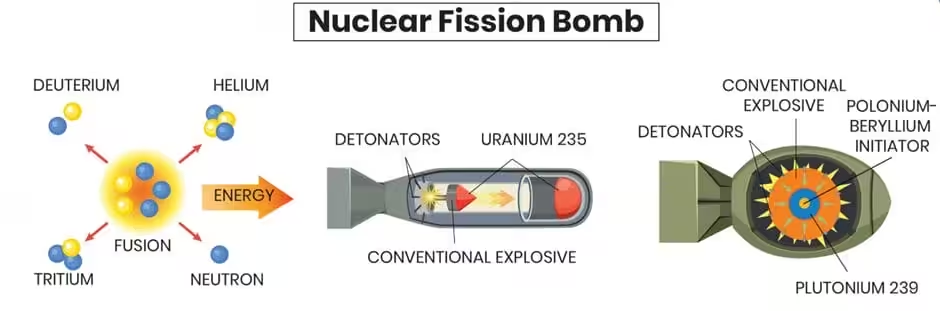
  • Nuclear weapon are devices designed to release energy in an explosive as a result of nuclear fission, nuclear fusion, or a combination of two processes.

Fission weapon:

  • Commonly referred to as atomic bombs
  • U-235 isotope of uranium serves as the primary fuel for the weapon.
  • Neutron absorption splits atom, releasing energy and neutrons for explosions.

image 1

Fusion weapon:

  • Referred to as thermonuclear bombs or more commonly as hydrogen bomb
  • Fission reaction initiates fusion of hydrogen, potentially causing more fission, releasing huge amount of energy.
  • Deuterium and tritium which are the isotopes of hydrogen, are used for the fusion process.
  • Releases more energy than fission weapons.

image 2

ParameterNuclear FissionNuclear Fusion
DefinitionFission is the splitting of a large atom into two or more smaller ones.Fusion is the combining of two or more lighter atoms into a larger one.
Natural Occurrence of ProcessFission reaction does not normally occur in nature.Fusion occurs naturally in stars, such as the Sun.
By-products of ReactionProduces many highly radioactive particles.Produces few radioactive particles.
ConditionsRequires high-speed neutrons to initiate the reaction.Requires extremely high density and temperature to overcome electrostatic repulsion between nuclei.
Energy RequirementTakes relatively little energy to split heavy nuclei.Requires extremely high energy to fuse light nuclei.
Energy ReleasedEnergy released is millions of times greater than in chemical reactions but less than fusion.Energy released is 3–4 times greater than that from fission.
Nuclear WeaponUsed in atomic bombs (fission bombs).Used in hydrogen bombs (fusion bombs) — often triggered by a fission reaction.
Energy ProductionUsed in nuclear power plants for controlled energy production.Still experimental; under research for clean power (e.g., ITER Project).
Fuel UsedUranium-235 or Plutonium-239.Hydrogen isotopes — Deuterium (²H) and Tritium (³H).
Waste GenerationProduces long-lived radioactive waste.Produces minimal waste (mostly Helium).
Environmental ImpactPotential radiation hazards and waste disposal issues.Clean energy source with no greenhouse gas emission.