
Opens in a new tab
Join Anantam IAS Channel on Telegram

Daily Digest · Saturday

11 April 2026 Current Affairs for UPSC

2 current affairs published on Saturday, 11 April 2026

11 April 2026 Current Affairs for UPSC — every Why-in-News article AnantamIAS published on Saturday, 11 April 2026, broken down with Why in News?, the exact GS paper it feeds, sub-topic mapping, MCQ-ready facts and a UPSC-style practice question. 2 articles in total, covering Polity, Economy, Environment, S&T, IR, Geography, History, Society and Internal Security — the same Why-in-News + GS-paper-mapping + practice-question format the Compass uses across every daily digest on the site.

Daily current affairs for UPSC is where new material enters your prep stream. Read this 11 April 2026 digest end-to-end in 25–35 minutes, attempt the practice question at the foot of each article (it's MCQ for some, 10/15-marker for others), then bookmark the entries that fall inside your active revision window. Everything stays cross-linked: tap any subject pill to jump to that subject's hub, or use the table of contents above to skip straight to a specific story.

Use this page three ways. Read sequentially for a one-sitting scan of everything that mattered on 11 April 2026. Download the 11 April 2026 PDF below for offline study or print revision. Or use the April 2026 Current Affairs compilation to see this day in the month's full context. For the previous day's reading, see 10 April 2026 Current Affairs; the next day's is 12 April 2026 Current Affairs.

Why we publish daily current affairs separately from the monthly compilation: daily is learning, monthly is revision. Use the daily page to add fresh material to your notes the day it breaks; come back to the April 2026 compilation 60 days before Prelims when the noise has settled and only the lasting takeaway is worth re-reading.

HC Justice Verma resigns: Judicial Accountability Gap

Open article →Download PDF

Why in News?

Justice Yashwant Varma, a former judge of the Allahabad High Court, who was facing a parliamentary motion for removal, has submitted his resignation to the President of India.

Under the Judges (Inquiry) Act, 1968, a panel constituted by the Lok Sabha Speaker was set to investigate allegations of burnt currency recovered from his official residence in Delhi. The Act contains no provision requiring an inquiry to continue after a judge vacates office.

UPSC Relevance: GS-2 Polity and Governance: Judiciary

Prelims: Removal & Impeachment process of Judges of High Court & Supreme Court. 

Resignation of a High Court Judge: 

  • A High Court judge may voluntarily resign by submitting a written resignation letter addressed to the President of India. This process is outlined under Article 217(1)(a) of the Indian Constitution. Resignation takes effect from the date specified in the letter. The judge is not required to give reasons.

Removal Process of a High Court Judge:

  • A judge of a High Court can be removed only by the President of India, after an address is passed by both Houses of Parliament in the same session, supported by a special majority:
    • A majority of not less than 2/3rd of members present and voting.
    • A majority of the total membership of the House, and
  • Grounds for Removal: Only two grounds are permitted: (i) Proved misbehaviour, (ii) Incapacity
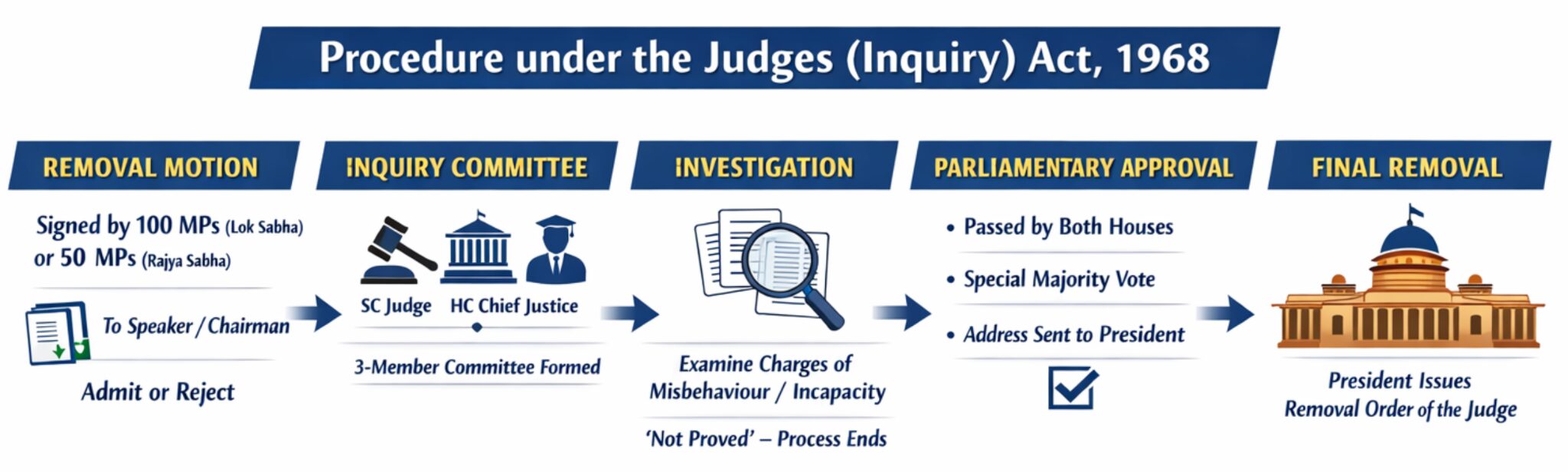
image 36

Procedure under the Judges (Inquiry) Act, 1968: 

  •  Motion for Removal: A removal motion signed by 100 members (Lok Sabha) or 50 members (Rajya Sabha) is to be given to the Speaker/Chairman. The Presiding Officer may admit or reject the motion.
  • Constitution of Inquiry Committee: If admitted, a 3-member committee is formed consisting of:
    • A Judge of the Supreme Court
    • A Chief Justice of a High Court
    • A distinguished jurist
  • Investigation: The committee examines charges of misbehaviour/incapacity. If charges are not proved, the process ends.
  • Parliamentary Approval: If charges are proved, each House must pass the motion by a special majority.  After the motion is passed, an address is presented to the President. 
  • Final Removal: The President issues the removal order of the judge.

The Judges (Inquiry) Act, 1968, contains no provision requiring an inquiry to continue after a judge vacates office.
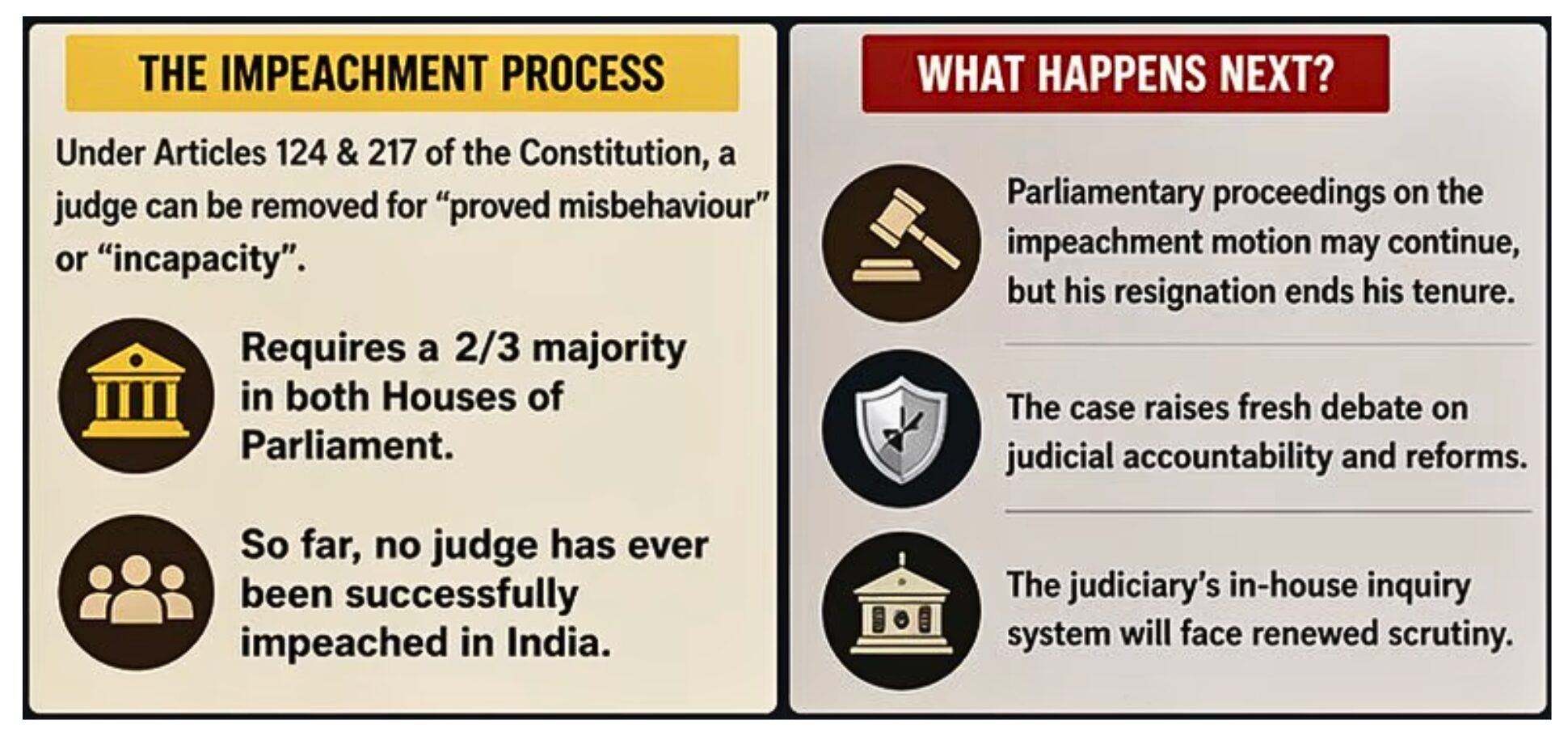
image 37 1

Provisions related to Judicial Accountability:

  • Constitutional Provisions:
    • Article 124(4) provides for the removal of Supreme Court judges on the grounds of proved misbehaviour or incapacity, through a special majority in Parliament.
    • Article 124(5) empowers Parliament to make laws regulating the procedure for investigation, which led to the enactment of the Judges (Inquiry) Act, 1968.
    • Article 217 deals with the appointment and conditions of office of High Court judges. Removal provisions of Supreme Court judges under Article 124(4) are made applicable to High Court judges through Article 218.
  • Statutory Provisions:
    • The Judges (Inquiry) Act, 1968: Establishes a mechanism for investigating allegations of misbehaviour or incapacity against SC and HC judges.
    • Contempt of Courts Act, 1971: Ensures authority, dignity, and independence of the judiciary by penalising acts that scandalise or obstruct the administration of justice. Indirectly contributes to judicial accountability by maintaining institutional integrity.
  • In-house Procedure, 1999: (Non-statutory/Internal Mechanism):
    • An internal mechanism evolved by the Supreme Court to examine complaints against judges of the higher judiciary for misconduct, corruption and ethical violations. 

The removal procedure of High Court judges is the same as that of Supreme Court judges. The Constitution does not explicitly use the word “impeachment” for judges; it uses the term removal (impeachment is commonly used in practice).

UPSC PYQ 2019

Q. Consider the following statements:

1. The motion to impeach a Judge of the Supreme Court of India cannot be rejected by the Speaker of the Lok Sabha as per the Judges (Inquiry) Act, 1968.

2. The Constitution of India defines and gives details of what constitutes incapacity and proven misbehaviour of the Judges of the Supreme Court of India.

3. The details of the process of impeachment of the Judges of the Supreme Court of India are given in the Judges (Inquiry) Act, 1968.

4. If the motion for the impeachment of a Judge is taken up for voting, the law requires the motion to be backed by each House of the Parliament and supported by a majority of total membership of that House and by not less than two-thirds of total members of that House present and voting.

Which of the statements given above is/are correct?

(a) 1 and 2 only

(b) 3 only

(c) 3 and 4 only

(d) 1, 3 and 4

Answer: (c)

Gaganyaan Mission: ISRO completes second Integrated Air Drop Test

Open article →Download PDF

Why in News?

Recently, the Indian Space Research Organisation (ISRO) completed the second Integrated Air Drop Test (IADT-02) at the Satish Dhawan Space Centre in Sriharikota, Andhra Pradesh. This marks an important milestone towards the readiness for the Gaganyaan mission. 

UPSC Relevance: GS-3 Science and Technology: Space Technology
Prelims & Mains: Gaganyaan Mission (Key facts & significance)

In 2025, ISRO accomplished the first Integrated Air Drop Test (IADT-01) for the Gaganyaan mission in Sriharikota.

image 39

Second Integrated Air Drop Test: 

  • Aim: End-to-end demonstration of the parachute-based deceleration system for the Gaganyaan Mission. 
  • In this test, a simulated Crew Module (the capsule in which astronauts sit during a human flight during re-entry and landing) was lifted by an Indian Air Force Chinook helicopter to an altitude of about 3 km, and released over a designated drop zone in the sea, near the Sriharikota coast. 
  • The simulated Crew Module weighs about 5.7 tonnes, which is equivalent to the mass of the Crew Module in the first uncrewed Gaganyaan mission (G1).
  • 10 parachutes of four types were deployed during the descent of the Crew Module, gradually reducing the velocity for safe touchdown.
  • Significance: The IADT-02 test validated the parachute-based deceleration systems in the Crew Module. The successful conduction is vital to ensure the safety of astronauts. 

What is Gaganyaan Mission?

  • Initiative of: Indian Space Research Organisation 
  • Human spaceflight mission to Low Earth Orbit  (400 kilometres). 
  • The mission aims to carry 3 astronauts (Vyomanauts) to LEO for a short-duration mission (~3–7 days), and bring them back safely to Earth by landing in the Indian waters. 
  • Launch: Crewed launch is scheduled for the first quarter of 2027. 
  • Crew members: Astronauts have been shortlisted by the Indian Air Force (IAF) & ISRO, and trained with international collaboration. The crew will perform microgravity, technology demonstrations and other scientific experiments. 
  • Launch Vehicle: Human-rated Launch Vehicle Mark 3 (LVM3)
  • Human Space Flight Centre will coordinate the implementation of the project. 
  • Upon completion, India will become the fourth nation to conduct an independent human spaceflight after Russia, the United States and China.

Components of Gaganyaan Mission: 

  • Crew Module (CM) and Service Module (SM): The Orbital Module of Gaganyaan consists of:
    • Crew Module (CM): Habitable capsule for astronauts.
    • Service Module (SM): Provides propulsion, power, avionics and thermal systems. 
  • Crew Module Atmospheric Re-entry Experiment (CARE): CARE (2014) was a key precursor experiment launched using LVM3 (then GSLV Mk III). It validated the full-scale thermal protection and parachute systems essential for surviving the extreme heat of a sub-orbital re-entry, i.e., the capsule’s ability to withstand extreme temperatures (~1600°C+) during atmospheric re-entry.
  • Crew Escape System (CES): CES is the emergency escape system to quickly separate the crew module from the rocket during launch failure. Pad Abort Test (PAT) successfully demonstrated the escape system. Further validated through Test Vehicle missions (TV-D1, TV-D2, etc.).
  • Environmental Control and Life Support System (ECLSS): Engineering models of ECLSS have already been developed and tested. ECLSS ensures a habitable environment inside the crew module: Functions include- Maintain cabin pressure, Regulate oxygen levels, Remove carbon dioxide, Control temperature & humidity, Detect and suppress fire, Manage waste and air purification. 
  • Vyom Mitra: ISRO’s female humanoid robot astronaut. Will fly in upcoming uncrewed mission before the crewed launch (~2027). It will test life-support systems and simulate human presence.

UPSC PYQ 2025

Q. Consider the following space missions: 

I. Axiom-4 

II. SpaDex 

III. Gaganyaan

How many of the space missions given above encourage and support microgravity research?

(a) Only one 

(b) Only two 

(c) All three 

(d) None 

Answer: (c)