
Opens in a new tab
Join Anantam IAS Channel on Telegram

Daily Digest · Friday

10 April 2026 Current Affairs for UPSC

2 current affairs published on Friday, 10 April 2026

10 April 2026 Current Affairs for UPSC — every Why-in-News article AnantamIAS published on Friday, 10 April 2026, broken down with Why in News?, the exact GS paper it feeds, sub-topic mapping, MCQ-ready facts and a UPSC-style practice question. 2 articles in total, covering Polity, Economy, Environment, S&T, IR, Geography, History, Society and Internal Security — the same Why-in-News + GS-paper-mapping + practice-question format the Compass uses across every daily digest on the site.

Daily current affairs for UPSC is where new material enters your prep stream. Read this 10 April 2026 digest end-to-end in 25–35 minutes, attempt the practice question at the foot of each article (it's MCQ for some, 10/15-marker for others), then bookmark the entries that fall inside your active revision window. Everything stays cross-linked: tap any subject pill to jump to that subject's hub, or use the table of contents above to skip straight to a specific story.

Use this page three ways. Read sequentially for a one-sitting scan of everything that mattered on 10 April 2026. Download the 10 April 2026 PDF below for offline study or print revision. Or use the April 2026 Current Affairs compilation to see this day in the month's full context. For the previous day's reading, see 9 April 2026 Current Affairs; the next day's is 11 April 2026 Current Affairs.

Why we publish daily current affairs separately from the monthly compilation: daily is learning, monthly is revision. Use the daily page to add fresh material to your notes the day it breaks; come back to the April 2026 compilation 60 days before Prelims when the noise has settled and only the lasting takeaway is worth re-reading.

Can an AI system claim sole authorship of an Artwork?

Open article →Download PDF

Why in News?

The Delhi High Court has directed the Copyright Office to decide on the application filed by an American computer scientist seeking authorship rights for an “autonomous” AI system (DABUS) he has developed. 

DABUS (Device for the Autonomous Bootstrapping of Unified Sentience) is claimed to independently generate creative outputs through artificial neural networks.

UPSC Relevance: GS-3 Science and Technology: Internet & Communications Technology 

Prelims and Mains: AI & Copyright issue (Concerns associated with AI).
image 32

Copyright law in India:

  • The Copyright Act, 1957, governs India’s copyright regime. The Copyright Office functions under the Department for Promotion of Industry and Internal Trade, Ministry of Commerce and Industry.
  • The Act grants copyright protection to:
    • Original literary works, Dramatic works, Musical works and Artistic works
    • Cinematograph films
    • Sound recordings
    • Computer programs
  • Copyright holders have exclusive rights over their works, including the right to reproduce, communicate to the public, perform, adapt, and translate the work. Section 52 of the Copyright Act provides exceptions such as fair dealing (allows the use of copyrighted works) for research, criticism and education.

AI Copyright Case in India: Co-authorship

  • In 2020, the Copyright Office granted copyright registration for an AI-assisted artwork titled “Suryast”. The AI tool RAGHAV AI was listed as a co-author along with a human author. 

Can an AI system claim sole authorship of an Artwork?

  • The Copyright Act currently recognises only human authors (natural persons) for copyright protection. As per the current provisions, there is no way a non-human can be granted sole authorship or copyright protection. 
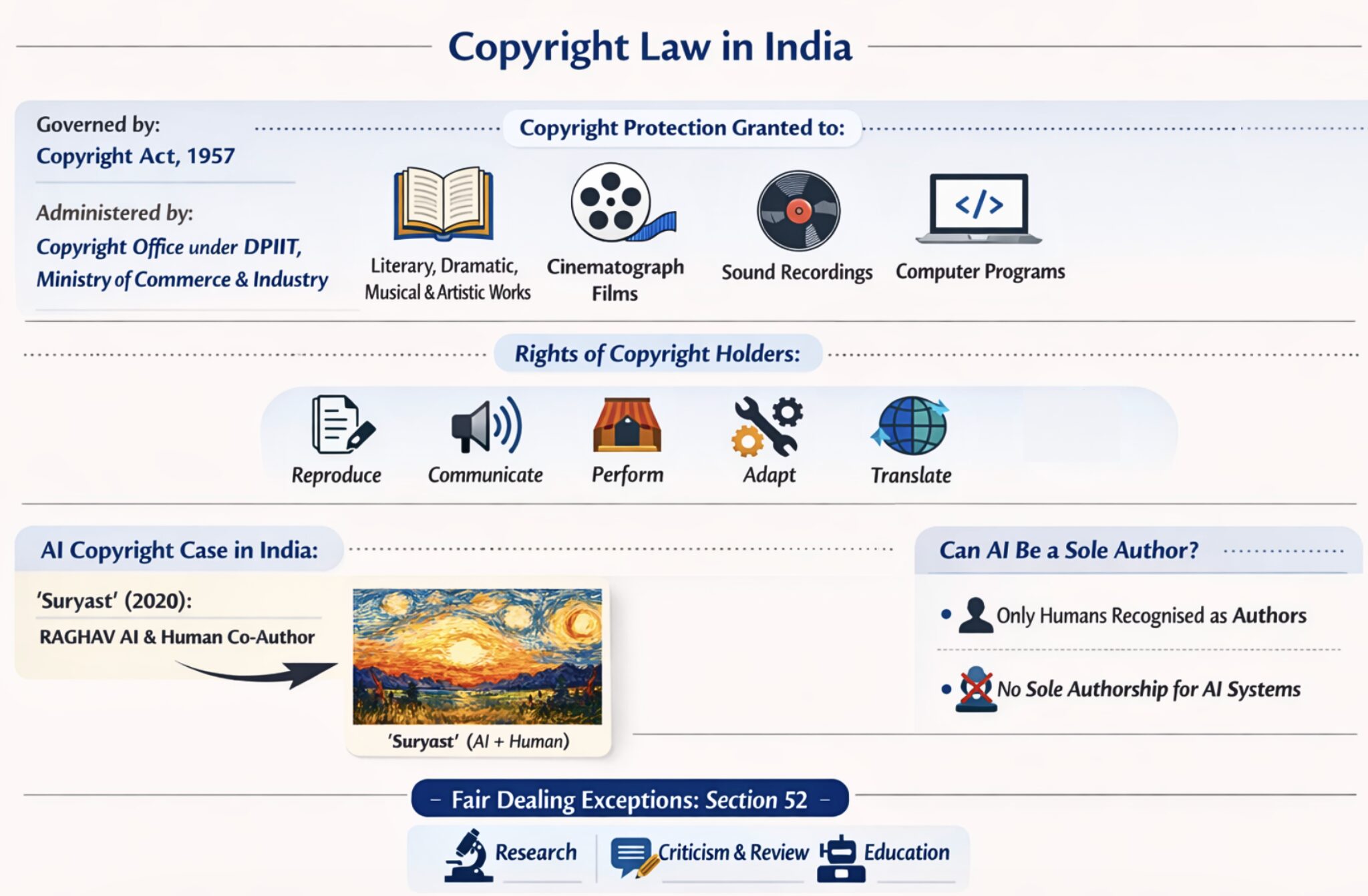
image 34

Global Legal Position on AI Authorship:

  • United States: The US Copyright Act requires human authorship for copyright protection.
  • United Kingdom & Ireland: Copyright law recognises authorship either as a natural person or the person making necessary arrangements for computer-generated works. 

Practice MCQ:

Q. With reference to copyright protection for AI-generated works in India, consider the following statements:

1. Under the Copyright Act, 1957, copyright protection is granted to original literary, artistic, musical and computer-generated works.

2. Indian copyright law explicitly recognises Artificial Intelligence as a legal person capable of holding authorship rights.

Which of the statements given above is/are correct?

(a) 1 only

(b) 2 only

(c) Both 1 and 2

(d) Neither 1 nor 2

Answer: (a) 
India successfully demonstrates 1000 Kms Quantum Communication Network

Open article →Download PDF

Why in News?

India has successfully demonstrated a 1000-kilometre quantum communication network in less than two years under the National Quantum Mission (NQM).

UPSC Relevance: GS-3 Science and Technology: Quantum Technology

Prelims & Mains: Quantum key distribution (Applications of Quantum Technology)

National Quantum Mission:

  • The Mission aims to accelerate quantum technology-led economic growth and nurture the quantum ecosystem.
  • Launched in 2023 with a budget of ~Rs 6000.65 crore for 2023-2031.
  • The mission aims to develop: 
    • Intermediate-scale quantum computers with 50-1000 physical qubits in 8 years. 
    • Satellite-based secure quantum communications between ground stations over a 2000 kms range within India. Long-distance secure quantum communications with other countries. 
    • Inter-city quantum key distribution over a 2000 km range. Multi-node quantum network.
    • Help develop magnetometers with high sensitivity in atomic systems, and atomic clocks for precision timing, communications and navigation.
    • Support design and synthesis of quantum materials (superconductors, novel semiconductor structures) and topological materials for the fabrication of quantum devices. 
  • Four Thematic Hubs (T-Hubs) to be set up in top academic and National R&D institutes on the domains of ‘quantum computing’, ‘quantum communication’, ‘quantum sensing and metrology’ and ‘quantum materials and devices’.

The Recent Breakthrough: 

  • India has successfully demonstrated a 1000-kilometre quantum communication network. It represents one of the longest quantum key distribution (QKD) deployments globally.
  • Developed using indigenous technology from QNu Labs (a startup). 

Quantum Communication:

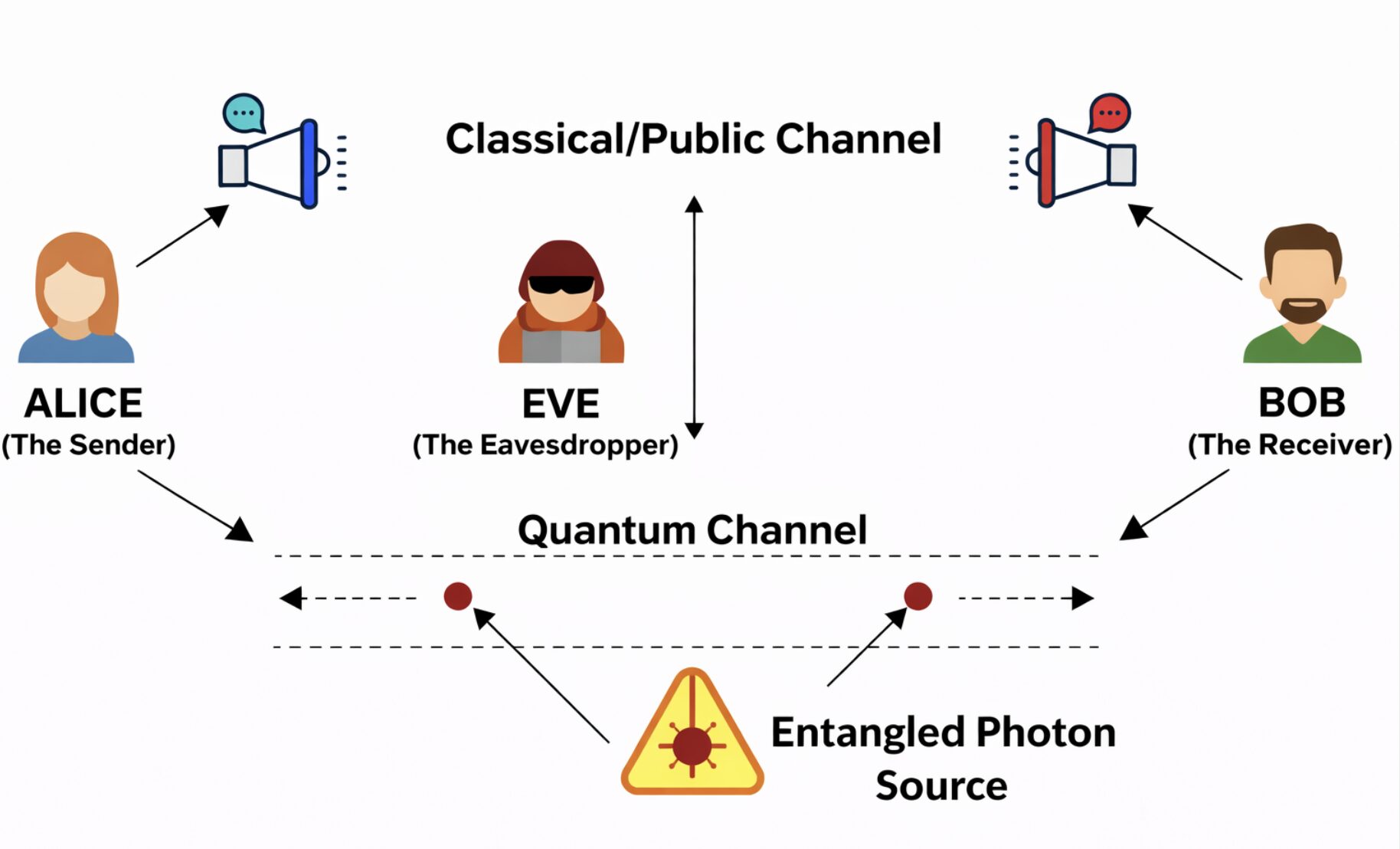
  • Quantum communication uses principles of Quantum Mechanics to enable ultra-secure transmission of information. It mainly relies on Quantum Key Distribution (QKD), where cryptographic keys are exchanged using quantum particles (photons).

What is Quantum Key Distribution? 

  • Quantum Key Distribution (QKD) is a secure communication method that uses quantum mechanics to exchange (create and distribute) cryptographic keys between two parties to prevent decryption of data, and thus ensure secure communication. 
  • Principle: QKD operates on principles like the Heisenberg uncertainty principle (observing or measuring the quantum system disturbs it) and the no-cloning theorem.
  • Working:
    • QKD uses photons (light particles) to securely generate a shared cryptographic key between two parties via an optical fibre or free space. 
    • The sender encodes information in quantum states of photons, which the receiver measures using randomly chosen bases.
    • Any attempt to intercept the photons (by an eavesdropper) disturbs their quantum properties, producing detectable errors. Thus, QKD ensures theoretically secure key exchange based on the laws of quantum mechanics.
  • Note: QKD is mainly used for secure key exchange, not for transmitting the actual message.
image 35

Benefits of Quantum Communication: 

  • Ultra-secure encryption: Practically impossible to hack by classical computers. Detects eavesdropping instantly. 
  • Dual-use technology: Applications in both civilian and strategic sectors, like defence, finance, telecommunications and governance. 

Challenges Associated with  Quantum Communication: 

  • Quantum Decoherence: Qubit systems are very fragile and susceptible to losing their quantum state. Decoherence occurs when the fragile quantum states interact with the environment, losing their quantum properties and becoming useless for key generation. This limits the transmission distances.  
  • High Cost: QKD requires high infrastructure costs, as qubits are only stable at very low temperatures or in a high vacuum or both, which are expensive to maintain. 
  • Building quantum-resistant cryptography: Present encryption methods can be easily broken (decrypted) by a quantum computer. 

The development is expected to strengthen secure communication capabilities across defence, financial systems and critical infrastructure, while advancing India’s broader push towards a secure digital ecosystem.

Practice MCQ:

Q. With reference to Quantum Key Distribution (QKD), consider the following statements:

1. QKD uses quantum states of photons to securely distribute cryptographic keys.

2. Any attempt to measure quantum information disturbs the quantum state, making eavesdropping detectable.

3. Quantum communication eliminates the need for classical communication channels.

Which of the statements given above are correct?

(a) 1 and 2 only

(b) 2 and 3 only

(c) 1 and 3 only

(d) 1, 2 and 3

Answer: (a) 

UPSC PYQ 2022:

Q. Which one of the following is the context in which the term “qubit” is mentioned?

(a) Cloud Services

(b) Quantum Computing

(c) Visible Light Communication Technologies

(d) Wireless Communication Technologies

Answer: (b)