Opens in a new tab
Join Anantam IAS Channel on Telegram

Daily Digest · Friday

12 September 2025 Current Affairs for UPSC

3 current affairs published on Friday, 12 September 2025

12 September 2025 Current Affairs for UPSC — every Why-in-News article AnantamIAS published on Friday, 12 September 2025, broken down with Why in News?, the exact GS paper it feeds, sub-topic mapping, MCQ-ready facts and a UPSC-style practice question. 3 articles in total, covering Polity, Economy, Environment, S&T, IR, Geography, History, Society and Internal Security — the same Why-in-News + GS-paper-mapping + practice-question format the Compass uses across every daily digest on the site.

Daily current affairs for UPSC is where new material enters your prep stream. Read this 12 September 2025 digest end-to-end in 25–35 minutes, attempt the practice question at the foot of each article (it's MCQ for some, 10/15-marker for others), then bookmark the entries that fall inside your active revision window. Everything stays cross-linked: tap any subject pill to jump to that subject's hub, or use the table of contents above to skip straight to a specific story.

Use this page three ways. Read sequentially for a one-sitting scan of everything that mattered on 12 September 2025. Download the 12 September 2025 PDF below for offline study or print revision. Or use the September 2025 Current Affairs compilation to see this day in the month's full context. For the previous day's reading, see 11 September 2025 Current Affairs; the next day's is 13 September 2025 Current Affairs.

Why we publish daily current affairs separately from the monthly compilation: daily is learning, monthly is revision. Use the daily page to add fresh material to your notes the day it breaks; come back to the September 2025 compilation 60 days before Prelims when the noise has settled and only the lasting takeaway is worth re-reading.

Vulture

Open article →Download PDF

image 36

Why in news:

WWF-India’s Director of Nature Conservation Programme, Ratul Saha, authored a detailed article highlighting how vultures, as nature’s scavengers, are critical to public health, especially in the context of pandemic preparedness. The article argues that protecting vultures is cheaper and more effective than tackling disease outbreaks post-facto. The discussion is linked to India’s National Action Plan on Vulture Conservation and global frameworks like the One Health approach.

UPSC Relevance:

UPSC CSE in prelims examination has focused on Species in news. Every year UPSC had asked at least one question related to species. A case in point is a following PYQ.

UPSC PYQ:

Q. Vultures which used to be very common in Indian countryside some years ago are rarely seen nowadays. This is attributed to (2012)

(a) the destruction of their nesting sites by new invasive species

(b) a drug used by cattle owners for treating their diseased cattle

(c) scarcity of food available to them

(d) a widespread, persistent and fatal disease among them.

About Indian Vulture:
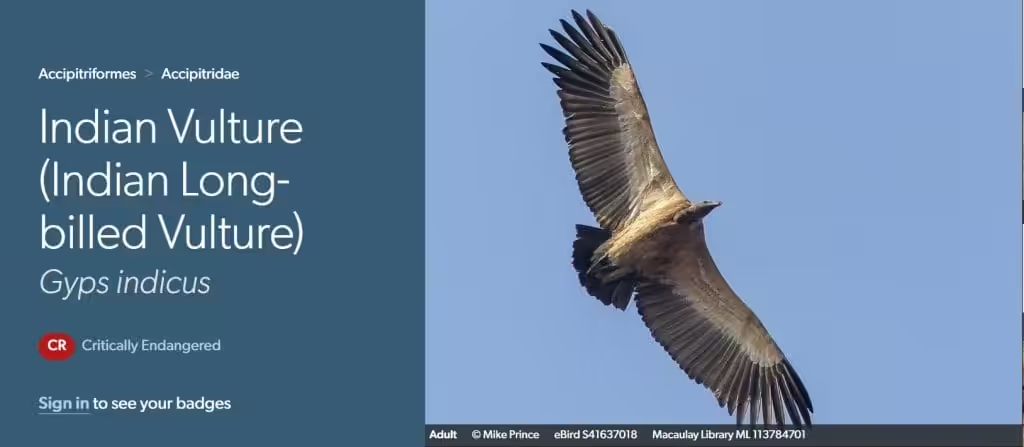
image 36 2
  • A light brown, medium-sized vulture. It has whitish feathers on a dark head and neck, a pale bill, and a pale collar which is more prominent behind the neck. 
  • Closely related to the European Griffon, the Indian Vulture is mainly found in forests, grasslands and shrublands. Like many other vulture species, it is also observed near human-occupied spaces like cities, towns and agricultural areas.

Distribution:
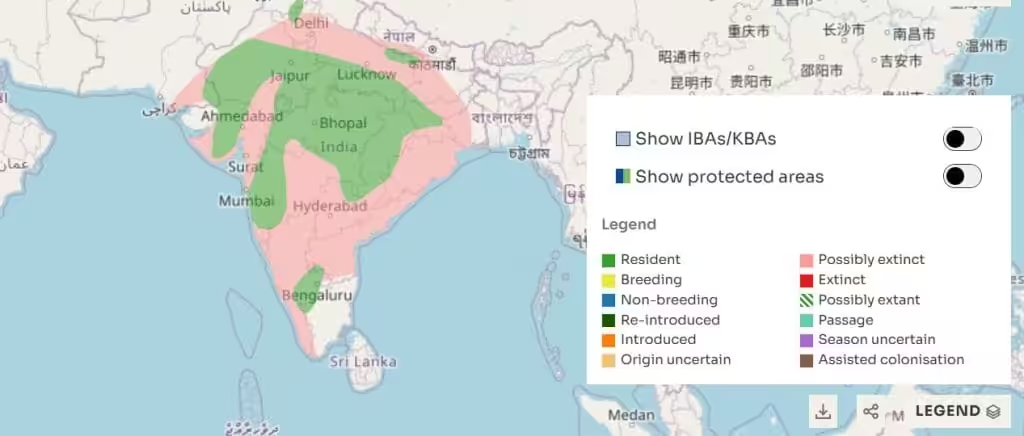
image 36 3
  • Gyps indicus breeds in south-east Pakistan and peninsular India south of the Gangetic plain, north to Delhi, east through Madhya Pradesh, south to the Nilgiris.
  •  This was first noticed in Keoladeo National Park, India .
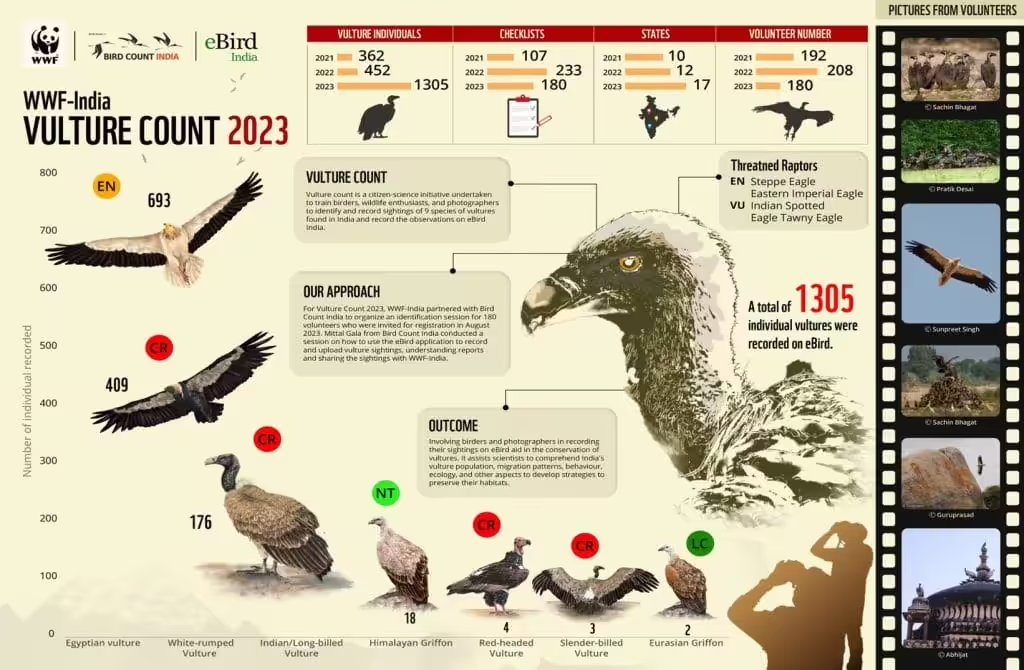
image 36 4

Conservation Efforts:

  • A Vulture Breeding Centre has been established at Pinjore, Haryana.
  • The Government of India has banned the veterinary use of Diclofenac.
  • An “Ex-situ Vulture Breeding Program” has been initiated.
  • Steps are being taken to strengthen in-situ conservation for the protection of the existing population.
India-Mauritius Relation

Open article →Download PDF

WhatsApp Image 2025 09 12 at 11.05.41 f57b3611

Why in news:

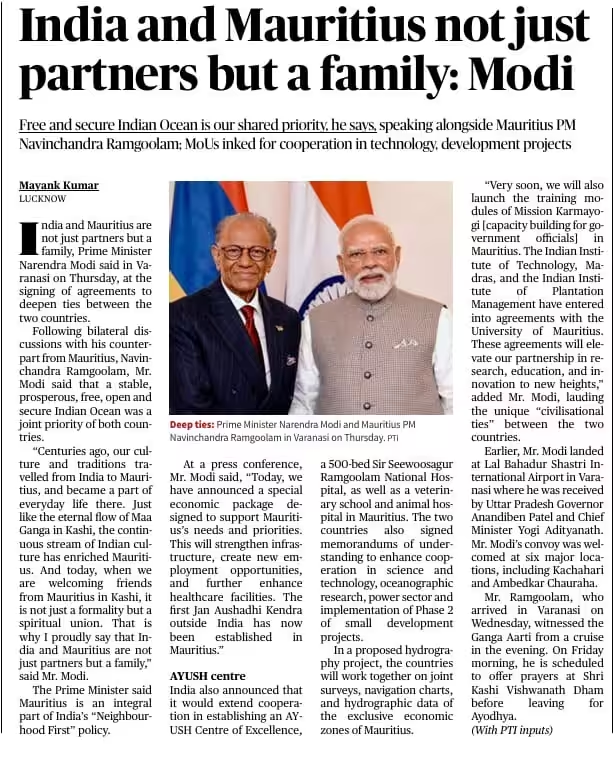
  • Prime Minister Narendra Modi met Mauritius PM Navinchandra Ramgoolam in Varanasi.

Both leaders signed several MoUs to strengthen cooperation in:

  • Technology and innovation
  • Healthcare and education
  • Development projects
  • Indian Ocean security

PM Modi emphasized that “India and Mauritius are not just partners but a family”, highlighting that a free, open, prosperous, and secure Indian Ocean is a shared priority.

UPSC Relevance:

India and its neighborhood- relations.

UPSC PYQ 2022:

Q: ‘India is an age-old friend of Sri Lanka.’ Discuss India’s role in the recent crisis in Sri Lanka in the light of the preceding statement.

India- Mauritius Relation Overview:

image 36 5

  • India has close, longstanding relations with Mauritius, an island nation in the Wester. Indian Ocean, owing to historic, demographic and cultural reasons. A key reason for the special ties is the fact that Indian origin people comprise nearly 70% of the island’s population of 1.2 million (28% Creole, 3% Sino-Mauritian, 1% Franco-Mauritian).
  • In his homage, the National Day of Mauritius is celebrated on March 12 (the date of Gandhiji’s Dandi Salt March).

Bilateral Relations:

  • Mauritius was one of the handful of important countries with which independent India established diplomatic relations in 1948, even before the independence of Mauritius.
  • The leadership of the two countries enjoys a high level of trust and mutual understanding, which is reflected in the continued high-level political engagement. These special ties have also resulted in uniquely close cooperation in maritime security, development partnership, capacity-building, cooperation in international fora and bilateral technical assistance through deputation of Indian experts to GOM.

Commercial Relations:

  • Since 2005, India has been among the largest trading partners of Mauritius. For the FY 2022-2023, Indian exports to Mauritius was USD 462.69 mn, Mauritian exports to India was USD 91.50 mn and Total trade was USD 554.19 mn. Trade has grown by 132% in the last 17 years, from USD 206.76 million in 2005-06 to USD 554.19 million in 2022-23.
  • FDI: Cumulative FDI worth USD 161 billion came from Mauritius to India in the two decades from 2000 – 2022 (26% of total FDI inflows into India), thanks largely to the Double Taxation Avoidance Convention (DTAC).
  • Comprehensive Economic Cooperation and Partnership Agreement (CECPA): Mauritius and India signed the CECPA on 22 February 2021, during the visit of EAM Dr. S. Jaishankar after nearly 15 years of negotiations. It came into force on 1 April 2021.
  • Indian Public Sector Undertakings (PSUs) in Mauritius: At present, 11 Indian PSUs are in Mauritius: Bank of Baroda, Life Insurance Corporation, New India Assurance Corporation, Telecommunications Consultant India Ltd, Indian Oil (Mauritius) Limited, Mahanagar Telephone (Mauritius) Ltd., State Bank of India (Mauritius) etc.

India-assisted Projects:

  • In May 2016, India provided a grant of USD 353 million to Mauritius as a Special Economic Package for five priority projects: (i) Metro Express Project; (ii) Supreme Court Building; (iii) New ENT Hospital; (iv) Social Housing project; (v) Digital Tablets for school children.
  • India extended a USD 500 mn Line of Credit (LoC) in 2017 to Mauritius to finance social/infrastructure projects. In October 2021, an LoC of USD 190 mn and USD 10 mn grant was approved by India for Phase III of the Metro Project.
  • Other completed India-assisted projects, include the Upadhyay Training Centre, the Jawaharlal Nehru Hospital, the Subramania Bharati Eye Centre, the Rajiv Gandhi Science Centre, the Swami Vivekananda International Conference Centre and the World Hindi.

Other institutions built with India’s assistance:

  • The Mahatma Gandhi Institute (MGI) was established in 1976 as a joint venture between India and Mauritius for promoting Indian culture. It also hosts the ICCR Chairs in Sanskrit & Indian Philosophy (currently Mr. JM Mishra) and Hindi (currently vacant). The Rabindranath Tagore Institute (RTI) was established with Indian assistance in 2000 as a Centre of Studies on Indian culture and traditions.
  • Mauritius also hosts the World Hindi Secretariat, an India-Mauritius bilateral organization which was constructed with Indian funding and inaugurated during the visit of President Kovind in March 2018.

Cultural Relations and people-to-people ties

  • Indira Gandhi Centre for Indian Culture holds classes in Hindustani music, Kathak, Tabla and Yoga for over 2,500 Mauritian students every year.
  • As part of ‘Azadi Ka Amrit Mahotsav’, for the very first time in August 2022, the National Cadet Corps (NCC) of India invited a 10-member Mauritian youth delegation to India for a special youth exchange programme.
  • Mauritius is one of the largest beneficiaries of the Indian Technical and Economic Cooperation (ITEC) programme and receives about 400 training slots every year for various courses.
  • There are approximately 17,403 Indian nationals and 11,600 OCI card holders currently in Mauritius.

Significance of Mauritius:

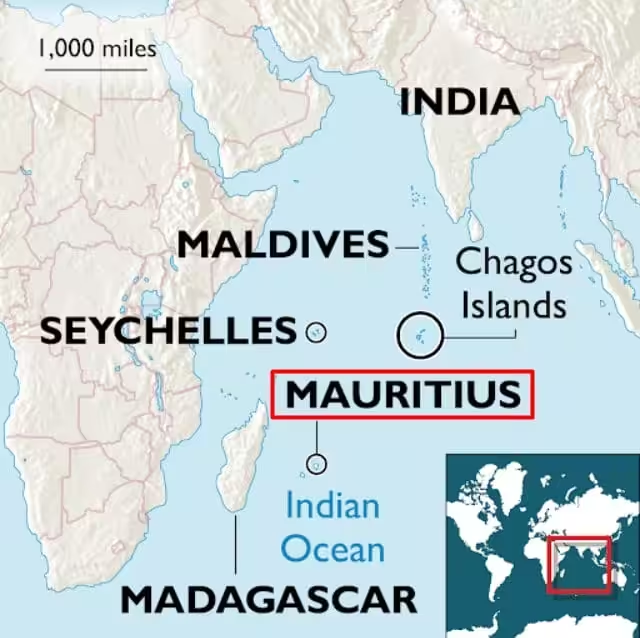
  • Mauritius holds a pivotal position in India’s maritime security calculus in the Indian Ocean. With an Exclusive Economic Zone (EEZ) of nearly 2.3 million sq. km, it provides India with significant strategic depth.
  • Mauritius has become a natural partner in realizing India’s SAGAR (Security and Growth for All in the Region) vision.
  • India has invested in Agaléga Island infrastructure, strengthening its maritime domain awareness and surveillance capacity.
  • Coastal radar systems set up with India’s assistance enhance real-time monitoring of regional waters.
  • New Delhi’s consistent backing of Mauritius’s sovereignty over the Chagos Archipelago further reflects India’s role in ensuring regional security and curbing external strategic influence.
  • Mauritius functions as a gateway for India’s outreach to Africa and the wider Global South.

Issues:

  • Beijing, in particular, has stepped up its role through infrastructure funding, port projects, and economic investments, creating a competitive diplomatic environment.
  • Despite the signing of the Comprehensive Economic Cooperation and Partnership Agreement (CECPA) in 2021, India–Mauritius trade volumes remain modest compared to India’s trade with larger African economies.
  • Limited Role of Indian Private Sector: While Indian public sector enterprises such as LIC, Bank of Baroda, SBI, and Indian Oil have a strong footprint in Mauritius, private sector involvement remains minimal.

Ades Mosquitoes-Dengue

Open article →Download PDF

image 36 6

Why in news:

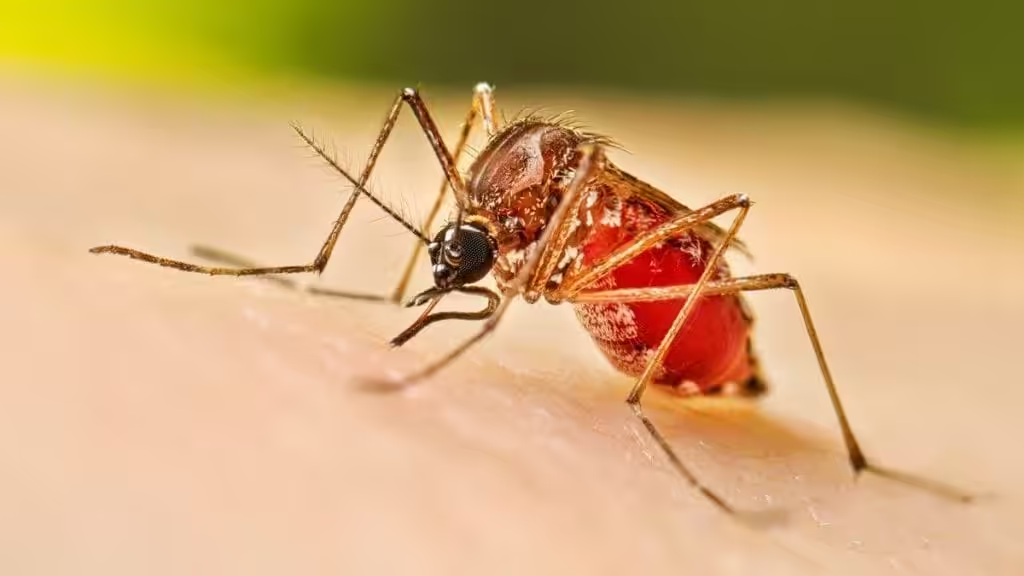
Aedes-borne viral diseases (ABVD) — dengue, Zika, and chikungunya — hurt India’s
productivity. Local governments and society focus their efforts on outdoor fumigation. This method persists, despite evidence that it is ineffective. It also does not have backing from national agencies as a routine measure.

UPSC Relevance:

Examination has tested our knowledge with respect to critical and emrging disease frequetly in Prelims as can be seen by the following questions:

Prelims 2013

Q: Which of the following diseases can be transmitted from one person to another through tattooing?

  1. Chikungunya
  2. Hepatitis B
  3. NW-AIDS

Select the correct answer using the codes given below.

A 1 only

B 2 and 3 only

C 1 and 3 only

D 1, 2 and 3

About Dengue:

image 36 7

  • Dengue is a viral infection caused by the dengue virus (DENV), which is transmitted to humans through the bite of infected mosquitoes.
  • The dengue virus is transmitted to humans through the bites of infected female mosquitoes, primarily the Aedes aegypti mosquito. 
  • Dengue is found in tropical and sub-tropical climates worldwide, mostly in urban and semi-urban areas.
  • Most people who get dengue do not have symptoms. For those who do, the most common symptoms are high fever, headache, body aches, nausea and rash. 
  • In severe cases, dengue can be fatal.
  • Dengue is treated through pain management as there is no specific treatment currently.
  • There is evidence, however, of the possibility of maternal transmission (i.e. from a pregnant mother to her baby).
  • The mosquitoes that spread dengue are active during the day.