Chinnaswami Subramania Bharati (1882-1921), popularly known as Mahakavi Bharati (“Great Poet Bharati”) or simply Bharati, was a Tamil poet, journalist, freedom fighter, and social reformer. His life — though tragically short at 39 years — transformed Tamil literature, pioneered modern Tamil poetry, and electrified the Indian independence movement in South India. His works combined fiery nationalism, feminist advocacy, caste reform, and spiritual mysticism. Bharati’s contributions make him a key figure in UPSC Prelims and GS Paper I (Modern Indian History, Indian Culture).
Early Life and Education
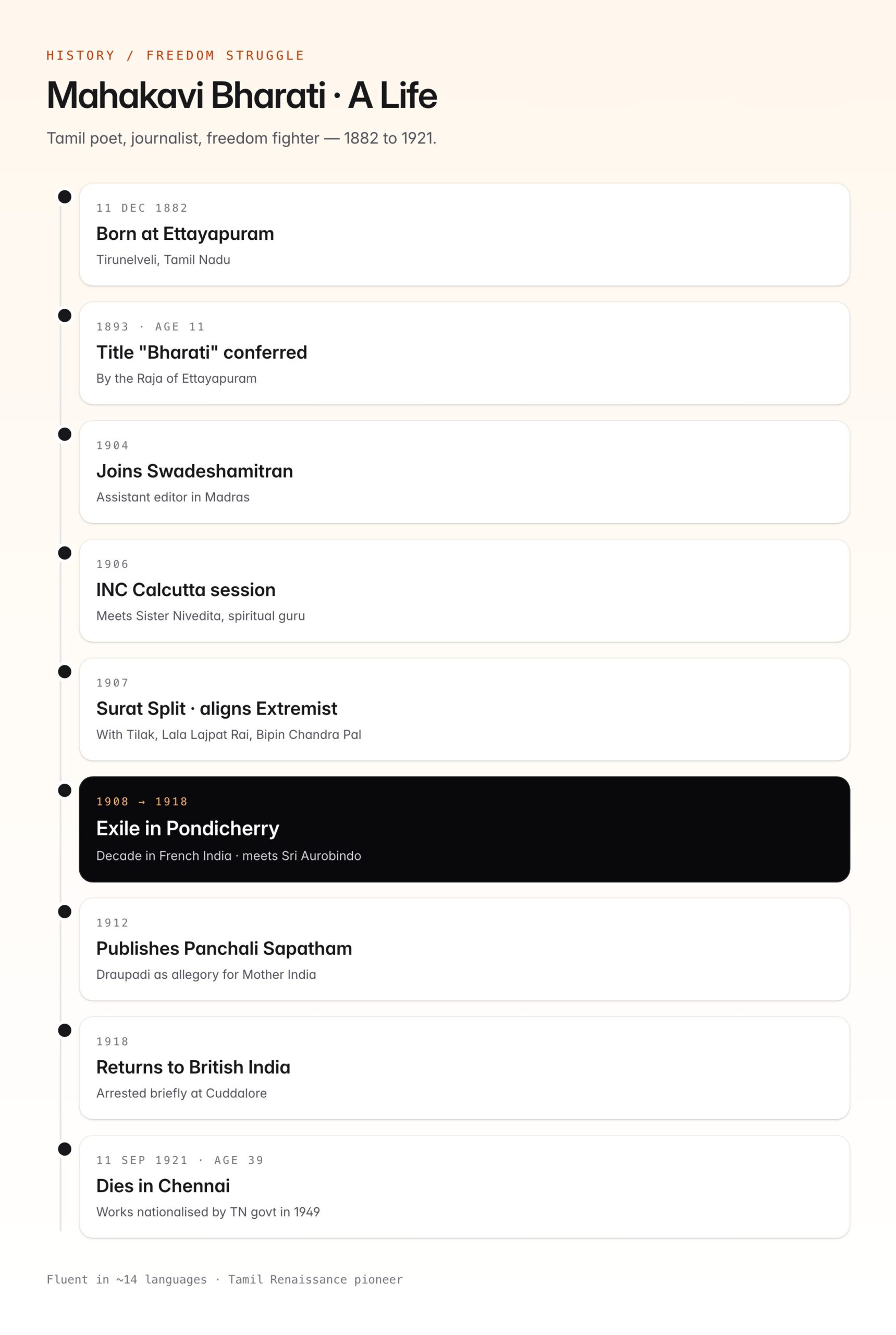
| Parameter | Details |
|---|---|
| Born | 11 December 1882, Ettayapuram, Tirunelveli district, Tamil Nadu |
| Birth name | Chinnaswami Subramania Iyer |
| Title "Bharati" | Conferred at age 11 by the Raja of Ettayapuram for his poetic talent; means "one blessed with the gift of Saraswati" |
| Father | Chinnaswami Iyer — court official in Ettayapuram |
| Mother | Lakshmi Ammal (died when Bharati was five) |
| Education | Hindu College, Tirunelveli; studied Tamil, Sanskrit, and English |
| Languages known | Tamil, English, Sanskrit, Hindi, French, Bengali, and others — proficient in ~14 languages |
| Died | 11 September 1921, Chennai (Madras), aged 39 |
Bharati lost his mother at five and his father at sixteen. He married Chellamma in 1897 at the age of 15. His precocious literary talent was recognised in his teens.
Journalism and Early Political Career
After brief work at the court of Ettayapuram, Bharati moved to Madras and began his career as a journalist:
| Publication | Role | Year |
|---|---|---|
| Swadeshamitran (Tamil daily) | Assistant Editor | 1904 |
| India (weekly journal) | Editor | 1906 |
| Bala Bharatam (English journal) | Editor | 1907 |
| Vijaya (Tamil weekly) | Editor | Later years |
Bharati's journalism was revolutionary in tone, directly attacking British rule, caste oppression, and social conservatism. The journals India and Bala Bharatam were key vehicles of extremist nationalist thought in South India.
Participation in the Freedom Movement
Bharati was influenced by the Extremist faction of the Indian National Congress led by Bal Gangadhar Tilak, Lala Lajpat Rai, and Bipin Chandra Pal (Lal-Bal-Pal).
Key Events
- 1906 INC Calcutta Session: Attended as a delegate; met prominent leaders including Sister Nivedita, whom he considered his spiritual mentor.
- 1907 INC Surat Session: Witnessed the Surat Split between Moderates and Extremists; aligned firmly with Extremists.
- 1908: After the British cracked down on the journal India, Bharati went into exile in Puducherry (then French-controlled Pondicherry).
- 1908-1918: Spent a decade in Pondicherry in self-imposed exile; met Sri Aurobindo, V.V.S. Aiyar, and other revolutionaries.
- 1918: Returned to British India; arrested briefly at Cuddalore; continued writing until death in 1921.
Bharati's revolutionary associations included V.V.S. Aiyar (who led the Tamil revolutionary group in Pondicherry), and he corresponded with Gandhi, Tagore, and other national leaders.
Major Literary Works
Bharati revolutionised Tamil poetry by breaking away from classical conventions, introducing simpler language, and addressing contemporary themes.
| Work | Year | Significance |
|---|---|---|
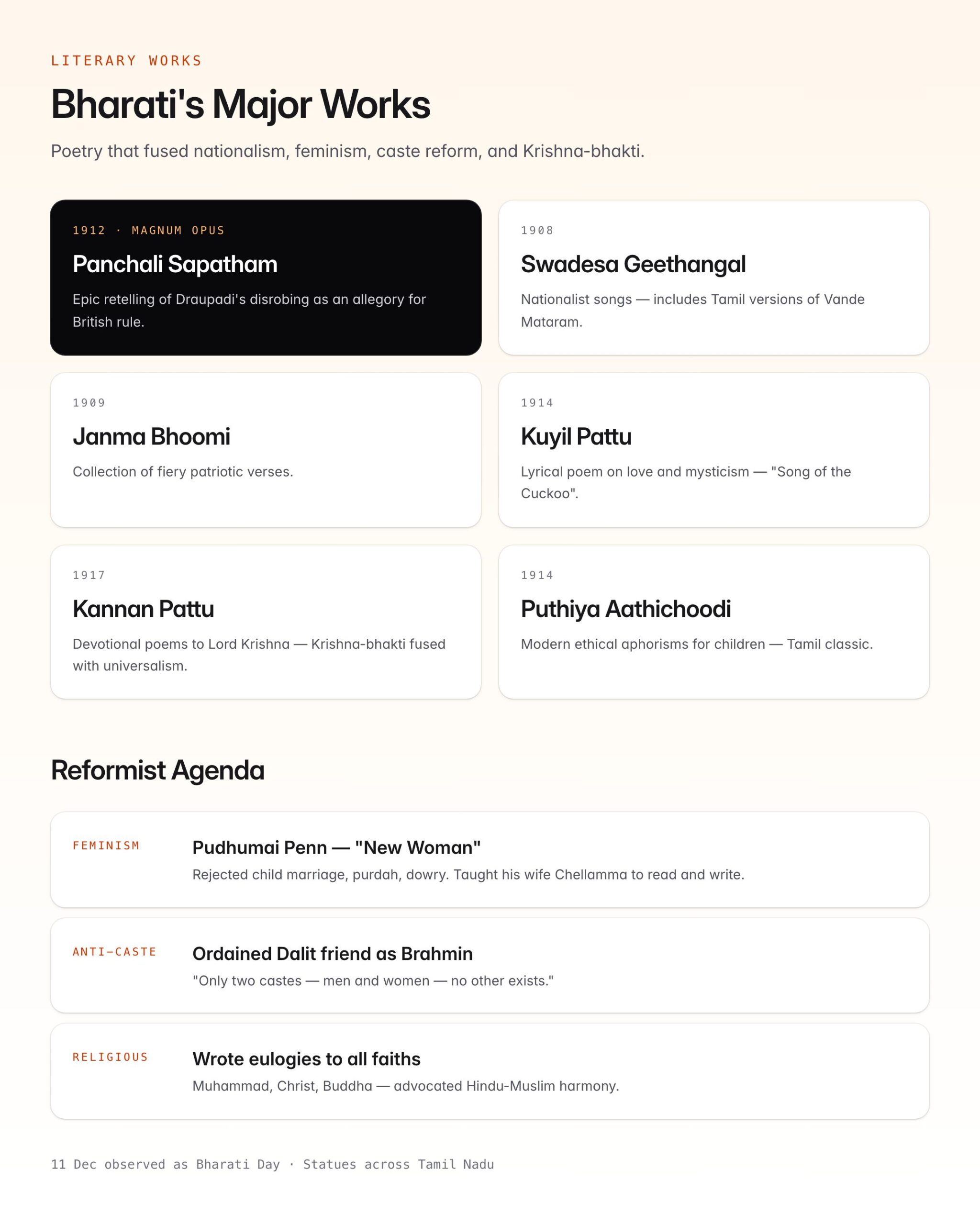
| Swadesa Geethangal (Nationalist Songs) | 1908 | Patriotic songs including "Vande Mataram" translations |
| Janma Bhoomi | 1909 | Collection of patriotic verses |
| Panchali Sapatham (The Vow of Panchali) | 1912 | Epic poem retelling the disrobing of Draupadi from the Mahabharata as an allegory for British oppression of India |
| Kuyil Pattu (The Song of the Cuckoo) | 1914 | Lyrical poem on love and mysticism |
| Kannan Pattu (Songs to Krishna) | 1917 | Collection of devotional and philosophical poems on Lord Krishna |
| Puthiya Aathichoodi | 1914 | Modern version of the classical ethical aphorisms for children |
| Chinnanchiru Kiliye | — | Famous lullaby-poem for his daughter |
Panchali Sapatham is his most celebrated work — Draupadi's humiliation is presented as a metaphor for Mother India's subjugation, and her call for justice becomes a call for national liberation.
Social Reform and Progressive Views
Bharati's social reform agenda was as revolutionary as his nationalism:
Feminism
- Rejected gender inequality — argued women must be free, educated, and economically independent.
- Wrote the iconic poem "Pudhumai Penn" ("New Woman"), imagining a confident, educated, unrestricted woman.
- Criticised child marriage, purdah, and dowry.
- His own life: he gave his wife Chellamma full intellectual freedom, taught her to read and write, and treated her as an equal.
Caste Reform
- Rejected untouchability and caste hierarchy in uncompromising terms.
- Famously ordained his young Dalit friend Kanakalingam as a Brahmin by giving him the sacred thread — a radical act for 1910s Tamil Nadu.
- Wrote: "Jati irandozhiya veru illai endru…" ("There are only two castes — men and women — no other exists").
Religious Synthesis
- Blended Hindu devotional traditions (especially Krishna-bhakti and Shakti-worship) with universalist spirituality.
- Celebrated Sister Nivedita as his spiritual guru.
- Advocated religious harmony between Hindus and Muslims — wrote eulogies to Prophet Muhammad, Jesus Christ, and the Buddha.
Contribution to Tamil Literature
Bharati is credited with launching the Tamil literary renaissance of the 20th century:
| Innovation | Impact |
|---|---|
| Simplified language | Moved away from classical, Sanskritised Tamil to colloquial Tamil |
| New genres | Introduced free verse, short prose, and journalistic essay to Tamil |
| Political poetry | Merged poetry with political consciousness |
| Feminist poetry | First major Tamil poet to write explicitly feminist verse |
| Children's literature | Wrote extensively for children — Chinnanchiru Kiliye, Puthiya Aathichoodi |
His poetic style influenced later Tamil writers including Bharathidasan, Kannadasan, and modern Tamil poets.
Death and Legacy
Bharati was trampled by a temple elephant at Parthasarathy Temple, Triplicane, Chennai in 1920. Though he recovered, his health had long been broken by poverty, imprisonment, and addiction. He died on 11 September 1921 at age 39.
At his death, only 14 mourners attended. His writings were later nationalised by the Tamil Nadu government in 1949 — the first writer in India whose works were acquired in full by a state government.
Honours and Commemorations
- Chennai Tamil University and countless institutions named after him.
- His birthplace Ettayapuram is a pilgrimage site for Tamil writers.
- 11 December (his birthday) is observed as Bharati Day.
- Statues installed across Tamil Nadu, India, and the Tamil diaspora worldwide.
Bharati's Famous Quotations (Paraphrased)
- "We shall live without shame, hold our heads high, and walk as free people."
- "India shall attain independence; only then will we rest."
- "Women's emancipation is the hallmark of civilisation."
Comparison with Contemporaries
| Poet/Reformer | Language | Role |
|---|---|---|
| Subramania Bharati | Tamil | Nationalist, feminist, reformer |
| Rabindranath Tagore | Bengali | Nobel laureate; nationalist, humanist |
| Bankim Chandra Chatterjee | Bengali | "Vande Mataram"; cultural nationalism |
| Muhammad Iqbal | Urdu/Persian | Progressive Muslim nationalism |
| Vallathol Narayana Menon | Malayalam | Cultural revival |
UPSC Relevance
GS Paper I: Modern Indian History — Personalities in Indian Freedom Struggle; Indian Culture — Literature.
Prelims key points:
- Subramania Bharati (1882-1921), titled "Mahakavi" — Tamil poet, journalist, freedom fighter.
- Editor of journals Swadeshamitran, India, Bala Bharatam, and Vijaya.
- Lived in exile in Pondicherry (French India) from 1908 to 1918, where he met Sri Aurobindo.
- Major works: Panchali Sapatham (1912), Kannan Pattu, Kuyil Pattu, Pudhumai Penn, Puthiya Aathichoodi.
- Panchali Sapatham uses Draupadi's disrobing as an allegory for colonial oppression.
- Pioneered feminism, anti-caste activism, and Tamil literary modernism.
- Sister Nivedita was his spiritual guru.
- Tamil Nadu government nationalised his works in 1949 — the first such nationalisation in India.
- Died on 11 September 1921; his birthday (11 December) is observed as Bharati Day.
Tell Google you want more of this.
Add Anantam IAS as a preferred sourceOne tap, and this site shows up more often in your own Top Stories, AI Overviews and AI Mode. Remove it any time.