
Opens in a new tab
Join Anantam IAS Channel on Telegram

Daily Digest · Saturday

14 February 2026 Current Affairs for UPSC

3 current affairs published on Saturday, 14 February 2026

14 February 2026 Current Affairs for UPSC — every Why-in-News article AnantamIAS published on Saturday, 14 February 2026, broken down with Why in News?, the exact GS paper it feeds, sub-topic mapping, MCQ-ready facts and a UPSC-style practice question. 3 articles in total, covering Polity, Economy, Environment, S&T, IR, Geography, History, Society and Internal Security — the same Why-in-News + GS-paper-mapping + practice-question format the Compass uses across every daily digest on the site.

Daily current affairs for UPSC is where new material enters your prep stream. Read this 14 February 2026 digest end-to-end in 25–35 minutes, attempt the practice question at the foot of each article (it's MCQ for some, 10/15-marker for others), then bookmark the entries that fall inside your active revision window. Everything stays cross-linked: tap any subject pill to jump to that subject's hub, or use the table of contents above to skip straight to a specific story.

Use this page three ways. Read sequentially for a one-sitting scan of everything that mattered on 14 February 2026. Download the 14 February 2026 PDF below for offline study or print revision. Or use the February 2026 Current Affairs compilation to see this day in the month's full context. For the previous day's reading, see 13 February 2026 Current Affairs; the next day's is 15 February 2026 Current Affairs.

Why we publish daily current affairs separately from the monthly compilation: daily is learning, monthly is revision. Use the daily page to add fresh material to your notes the day it breaks; come back to the February 2026 compilation 60 days before Prelims when the noise has settled and only the lasting takeaway is worth re-reading.

Kumar Bhaskar Varma Setu Adds to Assam’s Connectivity Push

Open article →Download PDF

Why in News?

On 14 February 2026, Kumar Bhaskar Varma Setu Adds to Assam's Connectivity Push emerged as an important current-affairs theme through an official communication linked to Press Information Bureau. For UPSC aspirants, the topic is valuable not only because it marks a specific event, but because it opens a wider window into how policy, institutions, and development processes are evolving in India.

The official anchor for the topic is Kumar Bhaskar Varma Setu Adds to Assam's Connectivity Push. That matters because serious preparation requires moving beyond headlines and asking three connected questions: what happened, why now, and what deeper historical, economic, political, or governance trend this event reflects.

UPSC Relevance

  • Prelims: projects, corridors, airports, metro systems, regulators, and regional connectivity facts
  • Mains: GS III on infrastructure, logistics, urban development, and regional integration
Easy to Remember
  • The bridge across the Brahmaputra was presented as a major infrastructure project for
  • It was expected to improve connectivity, comfort, commerce, and access to Kamakhya
  • Bridge building in the Northeast carries strategic and developmental value together

What Happened?

પ્રધાનમંત્રી શ્રી નરેન્દ્ર મોદીએ આજે આસામના ગુવાહાટીમાં બ્રહ્મપુત્રા નદી પર કુમાર ભાસ્કર વર્મા સેતુનું ઉદ્ઘાટન કર્યું. શ્રી મોદીએ જણાવ્યું હતું કે આ પુલ ગુવાહાટી અને તેની આસપાસના વિસ્તારો માટે એક મહત્વપૂર્ણ ઈન્ફ્રાસ્ટ્રક્ચર પ્રોજેક્ટ છે.

શ્રી મોદીએ ઉમેર્યું કે , " કનેક્ટિવિટી , સુવિધા અને વાણિજ્યમાં નોંધપાત્ર વધારો થશે. તે શ્રદ્ધાળુઓને વધુ સરળતા સાથે કામાખ્યા મંદિર જવા માટે સક્ષમ બનાવશે." પ્રધાનમંત્રીએ X પર પોસ્ટ કર્યું: " બ્રહ્મપુત્રા પરનો કુમાર ભાસ્કર વર્મા સેતુ ગુવાહાટી અને તેની આસપાસના વિસ્તારો માટે એક મહત્વપૂર્ણ ઈન્ફ્રાસ્ટ્રક્ચર પ્રોજેક્ટ છે.
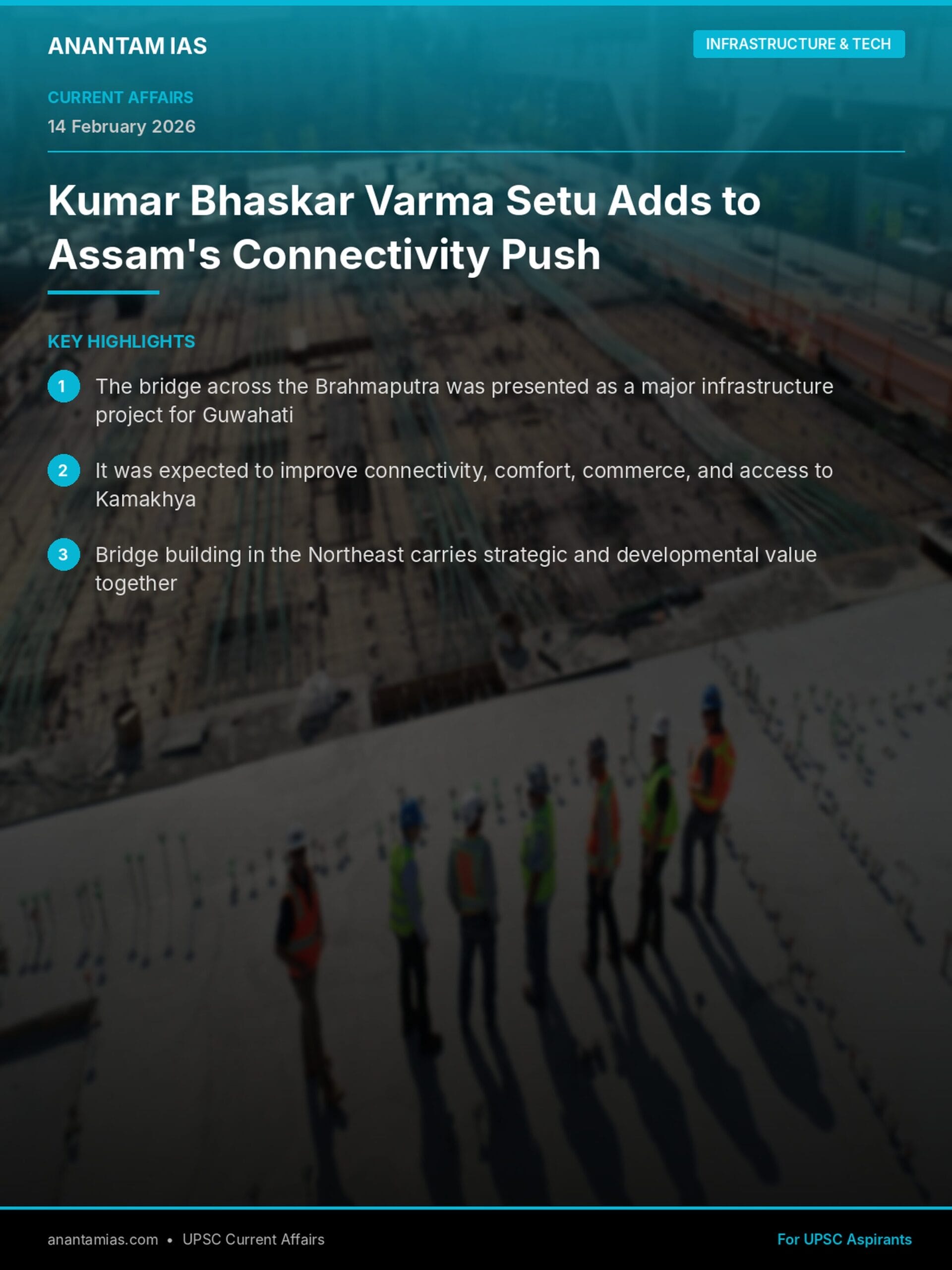
Kumar Bhaskar Varma Setu Adds to Assam's Connectivity Push infographic

Read together, the event can be understood through three immediate takeaways: The bridge across the Brahmaputra was presented as a major infrastructure project for Guwahati, It was expected to improve connectivity, comfort, commerce, and access to Kamakhya, and Bridge building in the Northeast carries strategic and developmental value together. These are the factual anchors, but the real UPSC value lies in connecting those facts with the broader story behind them.

Why it Matters

For UPSC, the significance of this topic lies in the fact that it sits at the intersection of current developments and structural change. Whether one looks at it from the lens of governance, economy, diplomacy, social policy, or strategic planning, the topic shows how day-to-day announcements often reveal larger shifts in India's state capacity and developmental priorities.

In answer writing, this makes the topic especially useful. It can serve as a factual illustration in Prelims preparation and as a layered example in Mains where the examiner expects candidates to connect institutions, outcomes, and wider policy direction.

What You Must Learn

0/5 completed

Bottom Line

Kumar Bhaskar Varma Setu Adds to Assam's Connectivity Push is important because it allows aspirants to move from a narrow event-based reading of current affairs to a broader understanding of how history, institutions, economy, politics, and governance intersect in contemporary India.

Exam Strategy

Use the topic to explain how physical connectivity influences regional growth and state capacity.

Related Current Affairs

Exam Oriented Questions

Why is this topic in the news?

It is in the news because an official development related to **Kumar Bhaskar Varma Setu Adds to Assam's Connectivity Push** was recorded on 14 February 2026.

Which official institution or source is associated with this topic?

The topic is anchored in an official source associated with **Press Information Bureau**, and aspirants should remember the source title **Kumar Bhaskar Varma Setu Adds to Assam's Connectivity Push**.

What is the core issue involved here?

The core issue revolves around the bridge across the brahmaputra was presented as a major infrastructure project for guwahati, along with its wider institutional and policy implications.

How is this topic relevant for UPSC Prelims?

It is relevant for Prelims because it covers projects, corridors, airports, metro systems, regulators, and regional connectivity facts.

How is this topic relevant for UPSC Mains?

It is relevant for Mains because it can be used in GS III on infrastructure, logistics, urban development, and regional integration.

What wider context should aspirants connect with this topic?

Aspirants should connect this event with the wider context of historically, infrastructure has been one of the clearest ways in which the indian state translates developmental intent into visible public outcomes.

Does this topic have an economic, political, or social angle?

Yes. Economically, better connectivity changes logistics costs, market access, labour mobility, and the geography of growth. Politically, infrastructure projects also reflect state capacity, regional prioritisation, and the promise of balanced development.

How can this topic be used in answer writing?

It can be used as a recent example to strengthen analytical arguments, especially where the question asks how policy intent translates into institutional or developmental outcomes.

What factual points should be revised first?

Revise the event date, the official source, and these quick points: The bridge across the Brahmaputra was presented as a major infrastructure project for Guwahati, It was expected to improve connectivity, comfort, commerce, and access to Kamakhya, Bridge building in the Northeast carries strategic and developmental value together.

What is the one-line exam takeaway?

Kumar Bhaskar Varma Setu Adds to Assam's Connectivity Push is important because it combines current relevance with a larger story about institutions, development, and public policy.
Urban Challenge Fund Signals a Market-Led Turn in Urban Transformation

Open article →Download PDF

Why in News?

On 14 February 2026, Urban Challenge Fund Signals a Market-Led Turn in Urban Transformation emerged as an important current-affairs theme through an official communication linked to Press Information Bureau. For UPSC aspirants, the topic is valuable not only because it marks a specific event, but because it opens a wider window into how policy, institutions, and development processes are evolving in India.

The official anchor for the topic is Cabinet approves Rs. One Lakh Crore Urban Challenge Fund to Drive Market-Led Urban Transformation. That matters because serious preparation requires moving beyond headlines and asking three connected questions: what happened, why now, and what deeper historical, economic, political, or governance trend this event reflects.

UPSC Relevance

  • Prelims: projects, corridors, airports, metro systems, regulators, and regional connectivity facts
  • Mains: GS III on infrastructure, logistics, urban development, and regional integration
Easy to Remember
  • The Union Cabinet chaired by the Prime Minister, Shri Narendra Modi, yesterday approved
  • CA will cover 25% of the project cost, subject to raising minimum 50% of the project
  • This will lead to a total investment of Rs.

What Happened?

The Union Cabinet chaired by the Prime Minister, Shri Narendra Modi, yesterday approved the launch of the Urban Challenge Fund (UCF) with a total Central Assistance (CA) of Rs. CA will cover 25% of the project cost, subject to raising minimum 50% of the project cost from market.

This will lead to a total investment of Rs. Four lakh crore in urban sector in next five years, marking a paradigm shift in India’s urban development approach from grant- based financing to market-linked, reform-driven and outcome-oriented infrastructure creation.

Urban Challenge Fund Signals a Market-Led Turn in Urban Transformation infographic

Read together, the event can be understood through three immediate takeaways: The Union Cabinet chaired by the Prime Minister, Shri Narendra Modi, yesterday approved the launch of the Urban Challenge Fund (UCF) with a total Central Assistance (CA) of Rs., CA will cover 25% of the project cost, subject to raising minimum 50% of the project cost from market., and This will lead to a total investment of Rs.. These are the factual anchors, but the real UPSC value lies in connecting those facts with the broader story behind them.

Why it Matters

For UPSC, the significance of this topic lies in the fact that it sits at the intersection of current developments and structural change. Whether one looks at it from the lens of governance, economy, diplomacy, social policy, or strategic planning, the topic shows how day-to-day announcements often reveal larger shifts in India's state capacity and developmental priorities.

In answer writing, this makes the topic especially useful. It can serve as a factual illustration in Prelims preparation and as a layered example in Mains where the examiner expects candidates to connect institutions, outcomes, and wider policy direction.

What You Must Learn

0/5 completed

Bottom Line

Urban Challenge Fund Signals a Market-Led Turn in Urban Transformation is important because it allows aspirants to move from a narrow event-based reading of current affairs to a broader understanding of how history, institutions, economy, politics, and governance intersect in contemporary India.

Exam Strategy

Use the topic to explain how physical connectivity influences regional growth and state capacity.

Related Current Affairs

Exam Oriented Questions

Why is this topic in the news?

It is in the news because an official development related to **Urban Challenge Fund Signals a Market-Led Turn in Urban Transformation** was recorded on 14 February 2026.

Which official institution or source is associated with this topic?

The topic is anchored in an official source associated with **Press Information Bureau**, and aspirants should remember the source title **Cabinet approves Rs. One Lakh Crore Urban Challenge Fund to Drive Market-Led Urban Transformation**.

What is the core issue involved here?

The core issue revolves around the union cabinet chaired by the prime minister, shri narendra modi, yesterday approved the launch of the urban challenge fund (ucf) with a total central assistance (ca) of rs, along with its wider institutional and policy implications.

How is this topic relevant for UPSC Prelims?

It is relevant for Prelims because it covers projects, corridors, airports, metro systems, regulators, and regional connectivity facts.

How is this topic relevant for UPSC Mains?

It is relevant for Mains because it can be used in GS III on infrastructure, logistics, urban development, and regional integration.

What wider context should aspirants connect with this topic?

Aspirants should connect this event with the wider context of historically, infrastructure has been one of the clearest ways in which the indian state translates developmental intent into visible public outcomes.

Does this topic have an economic, political, or social angle?

Yes. Economically, better connectivity changes logistics costs, market access, labour mobility, and the geography of growth. Politically, infrastructure projects also reflect state capacity, regional prioritisation, and the promise of balanced development.

How can this topic be used in answer writing?

It can be used as a recent example to strengthen analytical arguments, especially where the question asks how policy intent translates into institutional or developmental outcomes.

What factual points should be revised first?

Revise the event date, the official source, and these quick points: The Union Cabinet chaired by the Prime Minister, Shri Narendra Modi, yesterday approved the launch of the Urban Challenge Fund (UCF) with a total Central Assistance (CA) of Rs., CA will cover 25% of the project cost, subject to raising minimum 50% of the project cost from market., This will lead to a total investment of Rs..

What is the one-line exam takeaway?

Urban Challenge Fund Signals a Market-Led Turn in Urban Transformation is important because it combines current relevance with a larger story about institutions, development, and public policy.

Noida Metro Extension Shows How Urban Mobility is Becoming a Governance Priority

Open article →Download PDF

Why in News?

On 14 February 2026, Noida Metro Extension Shows How Urban Mobility is Becoming a Governance Priority emerged as an important current-affairs theme through an official communication linked to Press Information Bureau. For UPSC aspirants, the topic is valuable not only because it marks a specific event, but because it opens a wider window into how policy, institutions, and development processes are evolving in India.

The official anchor for the topic is Cabinet approves extension corridor from Noida Sector 142 to Botanical Garden (Noida) for a length of 11.56 Km with 8 stations. That matters because serious preparation requires moving beyond headlines and asking three connected questions: what happened, why now, and what deeper historical, economic, political, or governance trend this event reflects.

UPSC Relevance

  • Prelims: projects, corridors, airports, metro systems, regulators, and regional connectivity facts
  • Mains: GS III on infrastructure, logistics, urban development, and regional integration
Easy to Remember
  • The Union Cabinet chaired by the Prime Minister, Shri Narendra Modi, today yesterday the
  • On operationalization of this corridor, Noida and Greater Noida city will have 61.62 Km
  • Benefits and Bolstering Growth: The Extension Corridor from Noida Sector 142 to

What Happened?

The Union Cabinet chaired by the Prime Minister, Shri Narendra Modi, today yesterday the Extension Corridor from Noida Sector 142 to Botanical Garden (Noida) of Noida Metro Rail Project with corridor for a length of 11.56 Km with 8 elevated stations. On operationalization of this corridor, Noida and Greater Noida city will have 61.62 Km of active Metro Rail Network.

Benefits and Bolstering Growth: The Extension Corridor from Noida Sector 142 to Botanical Garden (Noida) of Noida Metro Rail Project represents a significant advancement in the city’s infrastructure development. This project acts as a major expansion of the Metro Rail Network in the city.

Noida Metro Extension Shows How Urban Mobility is Becoming a Governance Priority infographic

Read together, the event can be understood through three immediate takeaways: The Union Cabinet chaired by the Prime Minister, Shri Narendra Modi, today yesterday the Extension Corridor from Noida Sector 142 to Botanical Garden (Noida) of Noida Metro Rail Project with corridor for a length of 11.56 Km with 8 elevated stations., On operationalization of this corridor, Noida and Greater Noida city will have 61.62 Km of active Metro Rail Network., and Benefits and Bolstering Growth: The Extension Corridor from Noida Sector 142 to Botanical Garden (Noida) of Noida Metro Rail Project represents a significant advancement in the city’s infrastructure development.. These are the factual anchors, but the real UPSC value lies in connecting those facts with the broader story behind them.

Why it Matters

For UPSC, the significance of this topic lies in the fact that it sits at the intersection of current developments and structural change. Whether one looks at it from the lens of governance, economy, diplomacy, social policy, or strategic planning, the topic shows how day-to-day announcements often reveal larger shifts in India's state capacity and developmental priorities.

In answer writing, this makes the topic especially useful. It can serve as a factual illustration in Prelims preparation and as a layered example in Mains where the examiner expects candidates to connect institutions, outcomes, and wider policy direction.

What You Must Learn

0/5 completed

Bottom Line

Noida Metro Extension Shows How Urban Mobility is Becoming a Governance Priority is important because it allows aspirants to move from a narrow event-based reading of current affairs to a broader understanding of how history, institutions, economy, politics, and governance intersect in contemporary India.

Exam Strategy

Use the topic to explain how physical connectivity influences regional growth and state capacity.

Related Current Affairs

Exam Oriented Questions

Why is this topic in the news?

It is in the news because an official development related to **Noida Metro Extension Shows How Urban Mobility is Becoming a Governance Priority** was recorded on 14 February 2026.

Which official institution or source is associated with this topic?

The topic is anchored in an official source associated with **Press Information Bureau**, and aspirants should remember the source title **Cabinet approves extension corridor from Noida Sector 142 to Botanical Garden (Noida) for a length of 11.56 Km with 8 stations**.

What is the core issue involved here?

The core issue revolves around the union cabinet chaired by the prime minister, shri narendra modi, today yesterday the extension corridor from noida sector 142 to botanical garden (noida) of noida metro rail project with corridor for a length of 11.56 km with 8 elevated stations, along with its wider institutional and policy implications.

How is this topic relevant for UPSC Prelims?

It is relevant for Prelims because it covers projects, corridors, airports, metro systems, regulators, and regional connectivity facts.

How is this topic relevant for UPSC Mains?

It is relevant for Mains because it can be used in GS III on infrastructure, logistics, urban development, and regional integration.

What wider context should aspirants connect with this topic?

Aspirants should connect this event with the wider context of historically, infrastructure has been one of the clearest ways in which the indian state translates developmental intent into visible public outcomes.

Does this topic have an economic, political, or social angle?

Yes. Economically, better connectivity changes logistics costs, market access, labour mobility, and the geography of growth. Politically, infrastructure projects also reflect state capacity, regional prioritisation, and the promise of balanced development.

How can this topic be used in answer writing?

It can be used as a recent example to strengthen analytical arguments, especially where the question asks how policy intent translates into institutional or developmental outcomes.

What factual points should be revised first?

Revise the event date, the official source, and these quick points: The Union Cabinet chaired by the Prime Minister, Shri Narendra Modi, today yesterday the Extension Corridor from Noida Sector 142 to Botanical Garden (Noida) of Noida Metro Rail Project with corridor for a length of 11.56 Km with 8 elevated stations., On operationalization of this corridor, Noida and Greater Noida city will have 61.62 Km of active Metro Rail Network., Benefits and Bolstering Growth: The Extension Corridor from Noida Sector 142 to Botanical Garden (Noida) of Noida Metro Rail Project represents a significant advancement in the city’s infrastructure development..

What is the one-line exam takeaway?

Noida Metro Extension Shows How Urban Mobility is Becoming a Governance Priority is important because it combines current relevance with a larger story about institutions, development, and public policy.