
Opens in a new tab
Join Anantam IAS Channel on Telegram

Daily Digest · Sunday

15 February 2026 Current Affairs for UPSC

3 current affairs published on Sunday, 15 February 2026

15 February 2026 Current Affairs for UPSC — every Why-in-News article AnantamIAS published on Sunday, 15 February 2026, broken down with Why in News?, the exact GS paper it feeds, sub-topic mapping, MCQ-ready facts and a UPSC-style practice question. 3 articles in total, covering Polity, Economy, Environment, S&T, IR, Geography, History, Society and Internal Security — the same Why-in-News + GS-paper-mapping + practice-question format the Compass uses across every daily digest on the site.

Daily current affairs for UPSC is where new material enters your prep stream. Read this 15 February 2026 digest end-to-end in 25–35 minutes, attempt the practice question at the foot of each article (it's MCQ for some, 10/15-marker for others), then bookmark the entries that fall inside your active revision window. Everything stays cross-linked: tap any subject pill to jump to that subject's hub, or use the table of contents above to skip straight to a specific story.

Use this page three ways. Read sequentially for a one-sitting scan of everything that mattered on 15 February 2026. Download the 15 February 2026 PDF below for offline study or print revision. Or use the February 2026 Current Affairs compilation to see this day in the month's full context. For the previous day's reading, see 14 February 2026 Current Affairs; the next day's is 16 February 2026 Current Affairs.

Why we publish daily current affairs separately from the monthly compilation: daily is learning, monthly is revision. Use the daily page to add fresh material to your notes the day it breaks; come back to the February 2026 compilation 60 days before Prelims when the noise has settled and only the lasting takeaway is worth re-reading.

IndiaAI Mission Launches a Nationwide Campaign on Responsible AI Use

Open article →Download PDF

Why in News?

On 15 February 2026, IndiaAI Mission Launches a Nationwide Campaign on Responsible AI Use emerged as an important current-affairs theme through an official communication linked to Press Information Bureau. For UPSC aspirants, the topic is valuable not only because it marks a specific event, but because it opens a wider window into how policy, institutions, and development processes are evolving in India.

The official anchor for the topic is IndiaAI Mission Launches a Nationwide Campaign on Responsible AI Use. That matters because serious preparation requires moving beyond headlines and asking three connected questions: what happened, why now, and what deeper historical, economic, political, or governance trend this event reflects.

UPSC Relevance

  • Prelims: technologies, missions, innovation institutions, AI initiatives, and scientific applications
  • Mains: GS III on science and technology, innovation policy, digital public capacity, and future industries
Easy to Remember
  • A nationwide campaign was launched to promote ethical, inclusive, and responsible AI use
  • The campaign tied public awareness to the wider India AI Impact Summit moment
  • Responsible AI was framed as a citizen issue, not only a developer issue

What Happened?

JavaScript must be enabled in order for you to use the Site in standard view. However, it seems JavaScript is either disabled or not supported by your browser.

To use standard view, enable JavaScript by changing your browser options. Site is hosted by National Informatics Centre (NIC).
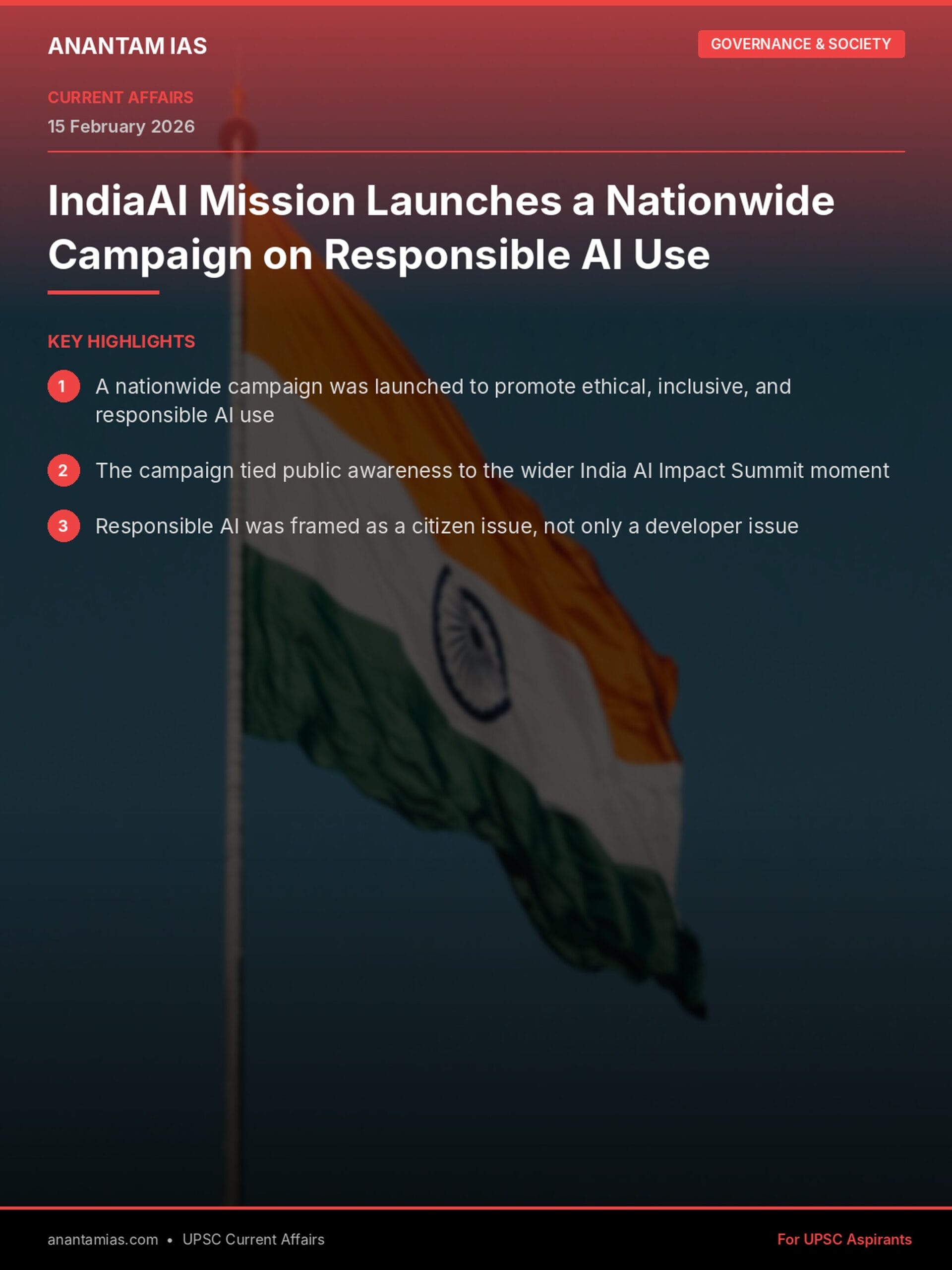
IndiaAI Mission Launches a Nationwide Campaign on Responsible AI Use infographic

Read together, the event can be understood through three immediate takeaways: A nationwide campaign was launched to promote ethical, inclusive, and responsible AI use, The campaign tied public awareness to the wider India AI Impact Summit moment, and Responsible AI was framed as a citizen issue, not only a developer issue. These are the factual anchors, but the real UPSC value lies in connecting those facts with the broader story behind them.

Why it Matters

For UPSC, the significance of this topic lies in the fact that it sits at the intersection of current developments and structural change. Whether one looks at it from the lens of governance, economy, diplomacy, social policy, or strategic planning, the topic shows how day-to-day announcements often reveal larger shifts in India's state capacity and developmental priorities.

In answer writing, this makes the topic especially useful. It can serve as a factual illustration in Prelims preparation and as a layered example in Mains where the examiner expects candidates to connect institutions, outcomes, and wider policy direction.

What You Must Learn

0/5 completed

Bottom Line

IndiaAI Mission Launches a Nationwide Campaign on Responsible AI Use is important because it allows aspirants to move from a narrow event-based reading of current affairs to a broader understanding of how history, institutions, economy, politics, and governance intersect in contemporary India.

Exam Strategy

Use the topic to show how innovation is becoming central to governance, growth, and strategic policy.

Related Current Affairs

Exam Oriented Questions

Why is this topic in the news?

It is in the news because an official development related to **IndiaAI Mission Launches a Nationwide Campaign on Responsible AI Use** was recorded on 15 February 2026.

Which official institution or source is associated with this topic?

The topic is anchored in an official source associated with **Press Information Bureau**, and aspirants should remember the source title **IndiaAI Mission Launches a Nationwide Campaign on Responsible AI Use**.

What is the core issue involved here?

The core issue revolves around a nationwide campaign was launched to promote ethical, inclusive, and responsible ai use, along with its wider institutional and policy implications.

How is this topic relevant for UPSC Prelims?

It is relevant for Prelims because it covers technologies, missions, innovation institutions, AI initiatives, and scientific applications.

How is this topic relevant for UPSC Mains?

It is relevant for Mains because it can be used in GS III on science and technology, innovation policy, digital public capacity, and future industries.

What wider context should aspirants connect with this topic?

Aspirants should connect this event with the wider context of historically, technology policy in india has moved from state-led scientific capacity building to a more networked model involving startups, private industry, and global partnerships.

Does this topic have an economic, political, or social angle?

Yes. Economically, frontier technologies now influence productivity, industrial upgrading, public service delivery, and employment patterns. Politically and socially, science and technology issues matter because they raise questions of access, regulation, ethics, and national capability.

How can this topic be used in answer writing?

It can be used as a recent example to strengthen analytical arguments, especially where the question asks how policy intent translates into institutional or developmental outcomes.

What factual points should be revised first?

Revise the event date, the official source, and these quick points: A nationwide campaign was launched to promote ethical, inclusive, and responsible AI use, The campaign tied public awareness to the wider India AI Impact Summit moment, Responsible AI was framed as a citizen issue, not only a developer issue.

What is the one-line exam takeaway?

IndiaAI Mission Launches a Nationwide Campaign on Responsible AI Use is important because it combines current relevance with a larger story about institutions, development, and public policy.
CBDC-Based Digital Food Coupon Pilot Tests the Future of Welfare Delivery

Open article →Download PDF

Why in News?

On 15 February 2026, CBDC-Based Digital Food Coupon Pilot Tests the Future of Welfare Delivery emerged as an important current-affairs theme through an official communication linked to Press Information Bureau. For UPSC aspirants, the topic is valuable not only because it marks a specific event, but because it opens a wider window into how policy, institutions, and development processes are evolving in India.

The official anchor for the topic is Government of India launches CBDC-based Digital Food Coupon Pilot in Gujarat. That matters because serious preparation requires moving beyond headlines and asking three connected questions: what happened, why now, and what deeper historical, economic, political, or governance trend this event reflects.

UPSC Relevance

  • Prelims: institutions, administrative mechanisms, schemes, regulations, and delivery platforms
  • Mains: GS II on governance, reforms, public administration, and institutional capacity
Easy to Remember
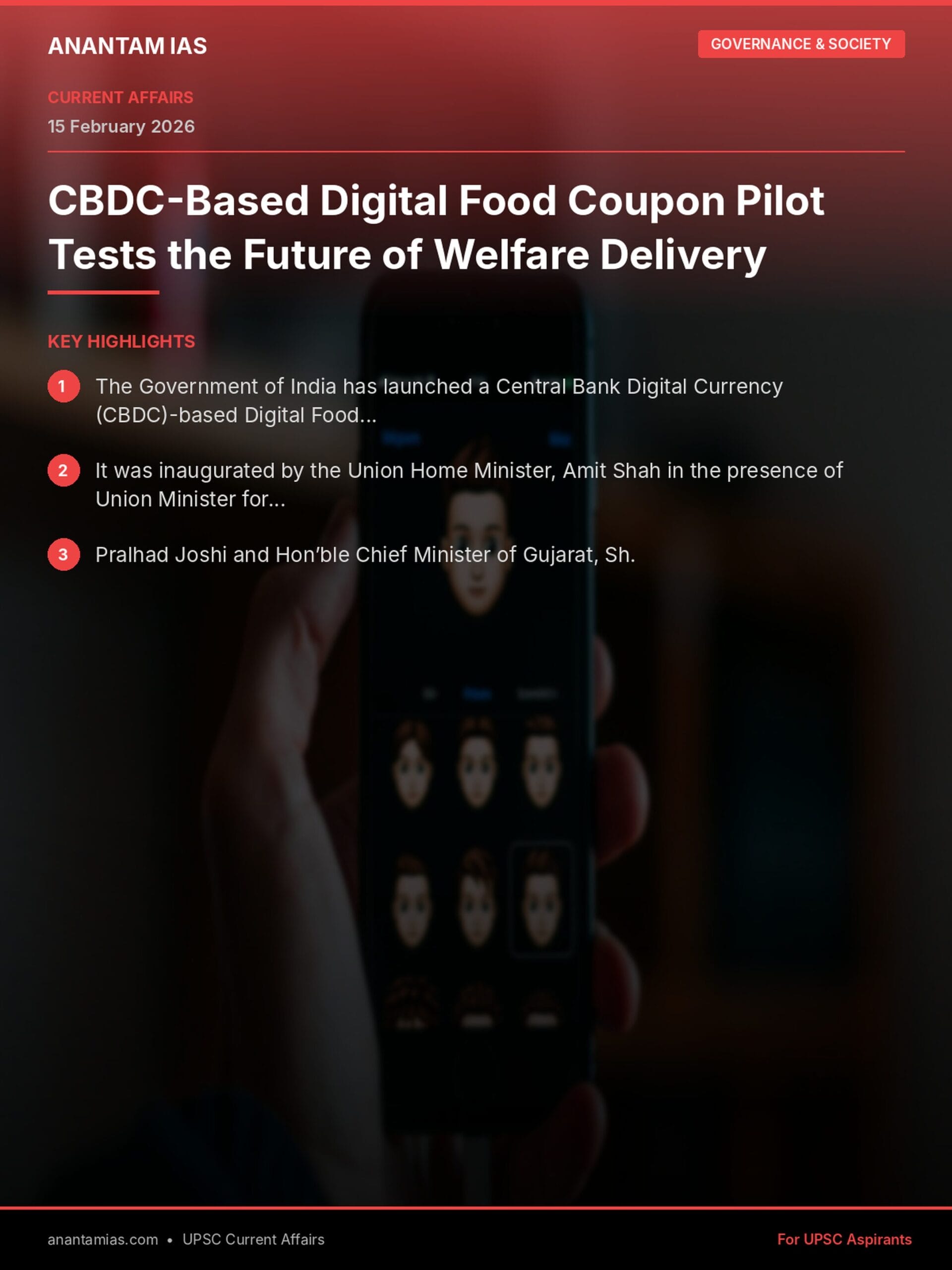
  • The Government of India has launched a Central Bank Digital Currency (CBDC)-based
  • It was inaugurated by the Union Home Minister, Amit Shah in the presence of Union
  • Pralhad Joshi and Hon’ble Chief Minister of Gujarat, Sh.

What Happened?

The Government of India has launched a Central Bank Digital Currency (CBDC)-based Digital Food Currency pilot in Gujarat. It was inaugurated by the Union Home Minister, Amit Shah in the presence of Union Minister for Consumer Affairs, Food and Public Distribution, Sh.

Pralhad Joshi and Hon’ble Chief Minister of Gujarat, Sh. Bhupendra Patel ; Minister of State for Consumer Affairs, Food and Public Distribution, Smt.

CBDC-Based Digital Food Coupon Pilot Tests the Future of Welfare Delivery infographic

Read together, the event can be understood through three immediate takeaways: The Government of India has launched a Central Bank Digital Currency (CBDC)-based Digital Food Currency pilot in Gujarat., It was inaugurated by the Union Home Minister, Amit Shah in the presence of Union Minister for Consumer Affairs, Food and Public Distribution, Sh., and Pralhad Joshi and Hon’ble Chief Minister of Gujarat, Sh.. These are the factual anchors, but the real UPSC value lies in connecting those facts with the broader story behind them.

Why it Matters

For UPSC, the significance of this topic lies in the fact that it sits at the intersection of current developments and structural change. Whether one looks at it from the lens of governance, economy, diplomacy, social policy, or strategic planning, the topic shows how day-to-day announcements often reveal larger shifts in India's state capacity and developmental priorities.

In answer writing, this makes the topic especially useful. It can serve as a factual illustration in Prelims preparation and as a layered example in Mains where the examiner expects candidates to connect institutions, outcomes, and wider policy direction.

What You Must Learn

0/5 completed

Bottom Line

CBDC-Based Digital Food Coupon Pilot Tests the Future of Welfare Delivery is important because it allows aspirants to move from a narrow event-based reading of current affairs to a broader understanding of how history, institutions, economy, politics, and governance intersect in contemporary India.

Exam Strategy

Use the topic to highlight the importance of institutions, procedural reform, and administrative accountability.

Related Current Affairs

Exam Oriented Questions

Why is this topic in the news?

It is in the news because an official development related to **CBDC-Based Digital Food Coupon Pilot Tests the Future of Welfare Delivery** was recorded on 15 February 2026.

Which official institution or source is associated with this topic?

The topic is anchored in an official source associated with **Press Information Bureau**, and aspirants should remember the source title **Government of India launches CBDC-based Digital Food Coupon Pilot in Gujarat**.

What is the core issue involved here?

The core issue revolves around the government of india has launched a central bank digital currency (cbdc)-based digital food currency pilot in gujarat, along with its wider institutional and policy implications.

How is this topic relevant for UPSC Prelims?

It is relevant for Prelims because it covers institutions, administrative mechanisms, schemes, regulations, and delivery platforms.

How is this topic relevant for UPSC Mains?

It is relevant for Mains because it can be used in GS II on governance, reforms, public administration, and institutional capacity.

What wider context should aspirants connect with this topic?

Aspirants should connect this event with the wider context of historically, many of india's reform efforts have succeeded or failed depending on the quality of institutional design and administrative follow-through.

Does this topic have an economic, political, or social angle?

Yes. Economically and socially, governance reforms matter because they determine how effectively public resources translate into outcomes on the ground. Politically, such developments illustrate the constant negotiation between central direction, state-level implementation, and citizen expectations.

How can this topic be used in answer writing?

It can be used as a recent example to strengthen analytical arguments, especially where the question asks how policy intent translates into institutional or developmental outcomes.

What factual points should be revised first?

Revise the event date, the official source, and these quick points: The Government of India has launched a Central Bank Digital Currency (CBDC)-based Digital Food Currency pilot in Gujarat., It was inaugurated by the Union Home Minister, Amit Shah in the presence of Union Minister for Consumer Affairs, Food and Public Distribution, Sh., Pralhad Joshi and Hon’ble Chief Minister of Gujarat, Sh..

What is the one-line exam takeaway?

CBDC-Based Digital Food Coupon Pilot Tests the Future of Welfare Delivery is important because it combines current relevance with a larger story about institutions, development, and public policy.

Consumer Rights Outreach to Gram Panchayats Brings Protection Closer to the Citizen

Open article →Download PDF

Why in News?

On 15 February 2026, Consumer Rights Outreach to Gram Panchayats Brings Protection Closer to the Citizen emerged as an important current-affairs theme through an official communication linked to Press Information Bureau. For UPSC aspirants, the topic is valuable not only because it marks a specific event, but because it opens a wider window into how policy, institutions, and development processes are evolving in India.

The official anchor for the topic is Consumer Rights Outreach Deepens as New Capacity-Building Series for Gram Panchayats is Launched. That matters because serious preparation requires moving beyond headlines and asking three connected questions: what happened, why now, and what deeper historical, economic, political, or governance trend this event reflects.

UPSC Relevance

  • Prelims: institutions, administrative mechanisms, schemes, regulations, and delivery platforms
  • Mains: GS II on governance, reforms, public administration, and institutional capacity
Easy to Remember
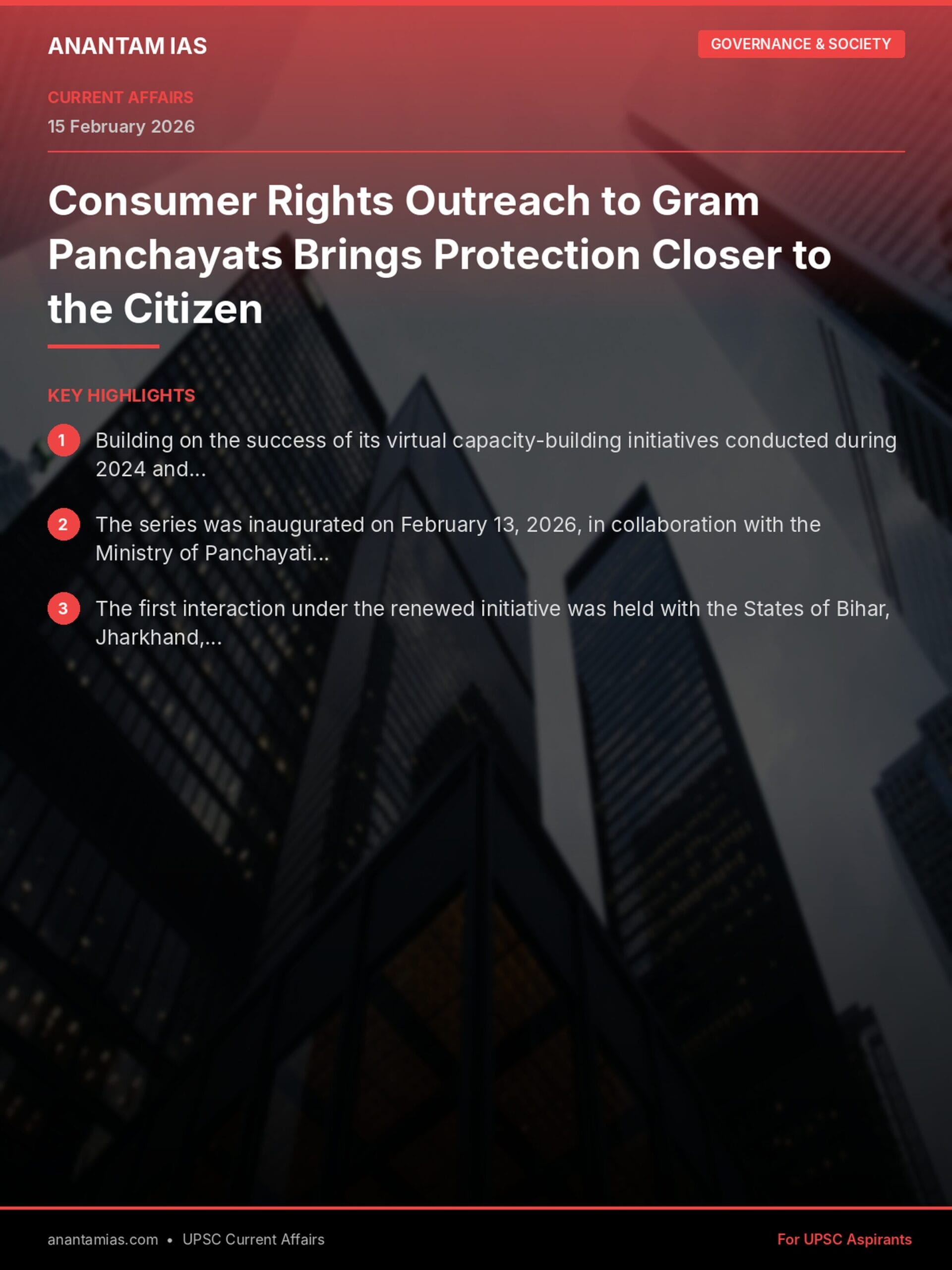
  • Building on the success of its virtual capacity-building initiatives conducted during
  • The series was inaugurated on February 13, 2026, in collaboration with the Ministry of
  • The first interaction under the renewed initiative was held with the States of Bihar,

What Happened?

Building on the success of its virtual capacity-building initiatives conducted during 2024 and 2025, the Department of Consumer Affairs (DoCA) has launched the second series of its nationwide virtual capacity-building programme for Gram Panchayats across States and Union Territories. The series was inaugurated on February 13, 2026, in collaboration with the Ministry of Panchayati Raj, with the objective of deepening consumer awareness and strengthening protection mechanisms at the grassroots level.

The first interaction under the renewed initiative was held with the States of Bihar, Jharkhand, and Odisha. The session witnessed participation through 1,011 online links, reaching thousands of stakeholders at the Panchayat level.

Consumer Rights Outreach to Gram Panchayats Brings Protection Closer to the Citizen infographic

Read together, the event can be understood through three immediate takeaways: Building on the success of its virtual capacity-building initiatives conducted during 2024 and 2025, the Department of Consumer Affairs (DoCA) has launched the second series of its nationwide virtual capacity-building programme for Gram Panchayats across States and Union Territories., The series was inaugurated on February 13, 2026, in collaboration with the Ministry of Panchayati Raj, with the objective of deepening consumer awareness and strengthening protection mechanisms at the grassroots level., and The first interaction under the renewed initiative was held with the States of Bihar, Jharkhand, and Odisha.. These are the factual anchors, but the real UPSC value lies in connecting those facts with the broader story behind them.

Why it Matters

For UPSC, the significance of this topic lies in the fact that it sits at the intersection of current developments and structural change. Whether one looks at it from the lens of governance, economy, diplomacy, social policy, or strategic planning, the topic shows how day-to-day announcements often reveal larger shifts in India's state capacity and developmental priorities.

In answer writing, this makes the topic especially useful. It can serve as a factual illustration in Prelims preparation and as a layered example in Mains where the examiner expects candidates to connect institutions, outcomes, and wider policy direction.

What You Must Learn

0/5 completed

Bottom Line

Consumer Rights Outreach to Gram Panchayats Brings Protection Closer to the Citizen is important because it allows aspirants to move from a narrow event-based reading of current affairs to a broader understanding of how history, institutions, economy, politics, and governance intersect in contemporary India.

Exam Strategy

Use the topic to highlight the importance of institutions, procedural reform, and administrative accountability.

Related Current Affairs

Exam Oriented Questions

Why is this topic in the news?

It is in the news because an official development related to **Consumer Rights Outreach to Gram Panchayats Brings Protection Closer to the Citizen** was recorded on 15 February 2026.

Which official institution or source is associated with this topic?

The topic is anchored in an official source associated with **Press Information Bureau**, and aspirants should remember the source title **Consumer Rights Outreach Deepens as New Capacity-Building Series for Gram Panchayats is Launched**.

What is the core issue involved here?

The core issue revolves around building on the success of its virtual capacity-building initiatives conducted during 2024 and 2025, the department of consumer affairs (doca) has launched the second series of its nationwide virtual capacity-building programme for gram panchayats across states and union territories, along with its wider institutional and policy implications.

How is this topic relevant for UPSC Prelims?

It is relevant for Prelims because it covers institutions, administrative mechanisms, schemes, regulations, and delivery platforms.

How is this topic relevant for UPSC Mains?

It is relevant for Mains because it can be used in GS II on governance, reforms, public administration, and institutional capacity.

What wider context should aspirants connect with this topic?

Aspirants should connect this event with the wider context of historically, many of india's reform efforts have succeeded or failed depending on the quality of institutional design and administrative follow-through.

Does this topic have an economic, political, or social angle?

Yes. Economically and socially, governance reforms matter because they determine how effectively public resources translate into outcomes on the ground. Politically, such developments illustrate the constant negotiation between central direction, state-level implementation, and citizen expectations.

How can this topic be used in answer writing?

It can be used as a recent example to strengthen analytical arguments, especially where the question asks how policy intent translates into institutional or developmental outcomes.

What factual points should be revised first?

Revise the event date, the official source, and these quick points: Building on the success of its virtual capacity-building initiatives conducted during 2024 and 2025, the Department of Consumer Affairs (DoCA) has launched the second series of its nationwide virtual capacity-building programme for Gram Panchayats across States and Union Territories., The series was inaugurated on February 13, 2026, in collaboration with the Ministry of Panchayati Raj, with the objective of deepening consumer awareness and strengthening protection mechanisms at the grassroots level., The first interaction under the renewed initiative was held with the States of Bihar, Jharkhand, and Odisha..

What is the one-line exam takeaway?

Consumer Rights Outreach to Gram Panchayats Brings Protection Closer to the Citizen is important because it combines current relevance with a larger story about institutions, development, and public policy.