
Introduction
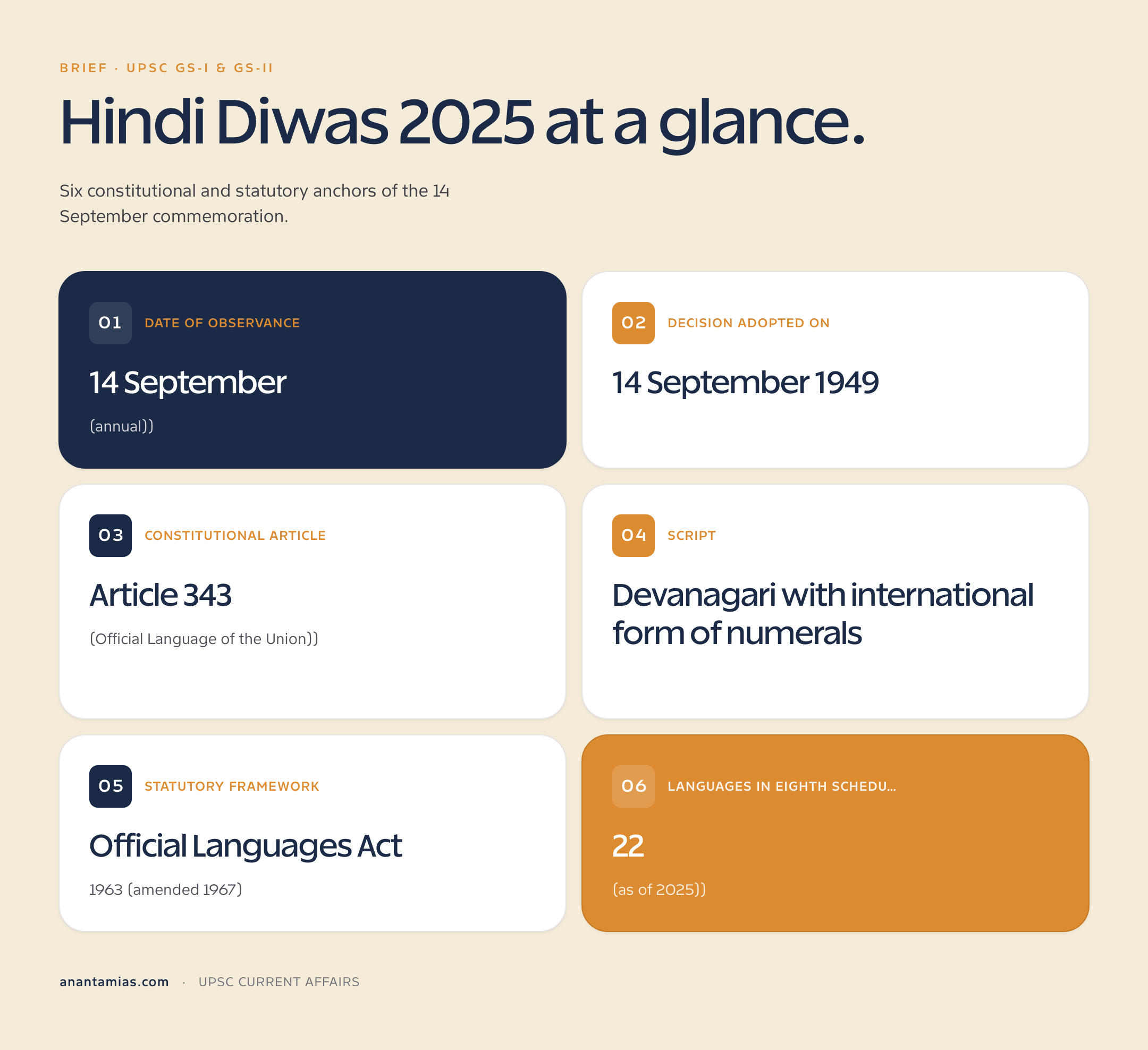
Hindi Diwas, observed annually on 14 September, commemorates the day in 1949 when the Constituent Assembly of India adopted Hindi in Devanagari script as the Official Language of the Union under Article 343 of the Constitution. The 2025 edition, marking the 76th anniversary of that decision, was observed across all Union ministries, Central Public Sector Enterprises, and Hindi-speaking states under the supervision of the Department of Official Language (Rajbhasha Vibhag), Ministry of Home Affairs. Functions emphasised the constitutional status of Hindi, the Official Languages Act, 1963, and the broader pluralistic framework laid out in the Eighth Schedule, which currently recognises 22 scheduled languages.
For UPSC aspirants, Hindi Diwas is more than ceremonial: it is a high-yield static topic that intersects GS Paper I (Indian Society and culture) and GS Paper II (Polity and Governance). The constitutional architecture around official language, the Munshi-Ayyangar Formula, the three-language formula, the persistent demand to add languages such as Tulu and Bhojpuri to the Eighth Schedule, and the language sensitivities highlighted by Tamil Nadu and the NEP 2020 mother-tongue medium policy together form a recurring examination theme. This article consolidates the constitutional, historical, statutory, and contemporary dimensions of the language question in India, anchored to the September 14, 2025 commemoration. For related coverage, see our notes on the Eighth Schedule and Article 343.
Quick Facts at a Glance
| Parameter | Detail | Source/Provision |
|---|---|---|
| Date of Observance | 14 September (annual) | Cabinet Resolution, 1953 |
| Decision Adopted On | 14 September 1949 | Constituent Assembly debate |
| Constitutional Article | Article 343 (Official Language of the Union) | Part XVII, Constitution |
| Script | Devanagari with international form of numerals | Article 343(1) |
| Statutory Framework | Official Languages Act, 1963 (amended 1967) | Parliament of India |
| Languages in Eighth Schedule | 22 (as of 2025) | 92nd Amendment (2003) |
| Nodal Department | Department of Official Language (Rajbhasha Vibhag) | Ministry of Home Affairs |
| Annual Observance | Hindi Pakhwada (1–15 September) | Government of India |
Background and Historical Context
The question of a national language was among the most divisive issues debated in the Constituent Assembly. Members were split between proponents of Hindi (largely from the Hindi-speaking belt) and representatives from southern, eastern, and north-eastern provinces who feared linguistic hegemony. Stalwarts such as Purushottam Das Tandon, Seth Govind Das, and Balkrishna Sharma championed Hindi, while T.T. Krishnamachari, N. Gopalaswami Ayyangar, and Frank Anthony warned against imposition. The deadlock was eventually resolved through the celebrated Munshi-Ayyangar Formula, named after K.M. Munshi and N. Gopalaswami Ayyangar, which became the textual basis of Part XVII of the Constitution. The compromise designated Hindi in Devanagari script as the official language but retained English as an associate official language for an initial period of fifteen years from the commencement of the Constitution (1950–1965), with Parliament empowered to extend its use thereafter.
The 14 September 1949 vote, taken after nearly three years of intermittent debate, was therefore a carefully balanced settlement rather than a triumphal declaration. The Cabinet, on the recommendation of the first Republic Day’s preparatory committee and following sustained advocacy by Hindi litterateurs such as Beohar Rajendra Simha, formally declared 14 September as Hindi Diwas in 1953. The day is now part of a longer Hindi Pakhwada (Hindi Fortnight, 1–15 September) during which Union ministries, Central Public Sector Enterprises, and public sector banks conduct essay competitions, technical-translation workshops, and award ceremonies for departmental Hindi work. The contemporary calendar also recognises World Hindi Day on 10 January, marking the 1975 Nagpur World Hindi Conference. Together, these observances structure how the Indian state performs its constitutional commitment to linguistic pluralism while privileging Hindi’s official-language role under Article 343.
Key Features / Highlights
Constitutional Architecture: Articles 343–351
Part XVII of the Constitution (Articles 343–351) governs official language. Article 343 declares Hindi in Devanagari script as the Union’s official language, with English continuing for fifteen years. Article 344 provides for an Official Language Commission and a Joint Parliamentary Committee, while Article 345 empowers states to adopt one or more state languages. Article 346 covers communication between states and the Union, and Article 347 allows the President to recognise a language spoken by a substantial population as official for any state purpose. Articles 348 and 349 deal with language used in courts and legislative texts. Article 350-A mandates primary-stage instruction in mother tongue for linguistic minorities, while Article 351 directs the Union to promote Hindi’s spread and enrich it from Sanskrit and other Indian languages.
Official Languages Act, 1963 and the 1967 Amendment
As the fifteen-year window approached its 1965 expiry, the Official Languages Act, 1963 was enacted to permit continued use of English alongside Hindi for official Union purposes. After the violent 1965 anti-Hindi agitation in Tamil Nadu, in which students and political workers led by the DMK resisted what they saw as Hindi imposition, the Act was amended in 1967 to guarantee the indefinite continuation of English as an associate official language until a resolution to discontinue it is passed by the legislatures of all non-Hindi states and by both Houses of Parliament. This statutory safeguard, often called the “virtual veto” of non-Hindi states, remains central to India’s bilingual federal arrangement. The Act also notifies the Official Languages Rules, 1976, which classify states into Region A, B, and C based on Hindi-correspondence quotas. See PRS India for the consolidated text.
Eighth Schedule and Scheduled Languages
The Eighth Schedule, originally listing 14 languages in 1950, has been expanded four times to include 22 languages as of 2025. Sindhi was added by the 21st Amendment (1967); Konkani, Manipuri, and Nepali by the 71st Amendment (1992); and Bodo, Dogri, Maithili, and Santhali by the 92nd Amendment (2003). Inclusion in the Eighth Schedule entitles a language to be considered for the Sahitya Akademi awards, allows candidates to use it in the UPSC Civil Services Examination, and obliges the Union to develop it. There is no fixed objective test for inclusion: the criteria laid down by the Sitakant Mahapatra Committee (2003) remain non-binding guidelines. As a result, demands to add 38+ languages, including Tulu, Bhojpuri, Rajasthani, and Garhwali, are pending before the Ministry of Home Affairs.
Significance for UPSC
- Polity static (GS-II): Articles 343–351 and the Eighth Schedule are perennial Prelims and Mains anchors; Hindi Diwas refreshes them annually.
- Indian Society (GS-I): Language is a core marker of identity, regionalism, and pluralism — directly tested in essays and society questions.
- Federalism debates: The 1967 amendment and the “virtual veto” of non-Hindi states are case studies in cooperative federalism and minority rights.
- Education policy linkage: The three-language formula and NEP 2020‘s mother-tongue medium provision intersect language with schooling outcomes.
- Current affairs hooks: Recurring demands for inclusion of Tulu, Bhojpuri, and others, and Tamil Nadu’s resistance to Hindi imposition, generate fresh question stems each cycle.
- Essay potential: “Language and the Indian republic,” “Unity in diversity,” and “Mother tongue and education” are durable essay themes drawing on this corpus.
Detailed Analysis
India’s official-language regime is best understood as a constitutionally-mandated bilingualism overlaid on statutorily-protected multilingualism. At the Union level, Article 343 designates Hindi while the Official Languages Act, 1963 perpetuates English; at the state level, Article 345 permits adoption of regional languages, producing the actual lived diversity captured in the Eighth Schedule. The 1971 Census recorded 1,652 mother tongues; the 2011 Census grouped these into 121 languages, of which 22 are scheduled and 99 are non-scheduled. According to the 2011 figures, Hindi (including its 56 dialect-mother-tongues) is spoken by 43.6% of the population as a first language, Bengali by 8.0%, Marathi by 6.9%, and Tamil by 5.7%. These figures are consistently cited by both Hindi advocates and federalist critics, with diametrically opposite conclusions about majoritarian or pluralist policy implications.
The list below shows the 22 scheduled languages with their year of constitutional inclusion. The four post-1950 additions reflect successive waves of linguistic mobilisation: Sindhi after Partition-induced advocacy by displaced communities; the trio of Konkani, Manipuri, and Nepali following sustained agitation in Goa, Manipur, and the Darjeeling hills; and the 2003 quartet of Bodo, Dogri, Maithili, and Santhali, which was tied to the contemporaneous push for autonomous councils and recognition of tribal languages. The list is not, however, a static taxonomy. The Sitakant Mahapatra Committee (2003) on inclusion criteria recommended evaluating literary tradition, geographical spread, and political demand together, but its recommendations were never operationalised, leaving inclusion a fundamentally political decision.
| # | Language | Year Added | Constitutional Provision |
|---|---|---|---|
| 1 | Assamese | 1950 | Original Schedule |
| 2 | Bengali | 1950 | Original Schedule |
| 3 | Gujarati | 1950 | Original Schedule |
| 4 | Hindi | 1950 | Original Schedule |
| 5 | Kannada | 1950 | Original Schedule |
| 6 | Kashmiri | 1950 | Original Schedule |
| 7 | Malayalam | 1950 | Original Schedule |
| 8 | Marathi | 1950 | Original Schedule |
| 9 | Odia | 1950 | Original Schedule |
| 10 | Punjabi | 1950 | Original Schedule |
| 11 | Sanskrit | 1950 | Original Schedule |
| 12 | Tamil | 1950 | Original Schedule |
| 13 | Telugu | 1950 | Original Schedule |
| 14 | Urdu | 1950 | Original Schedule |
| 15 | Sindhi | 1967 | 21st Amendment |
| 16 | Konkani | 1992 | 71st Amendment |
| 17 | Manipuri (Meitei) | 1992 | 71st Amendment |
| 18 | Nepali | 1992 | 71st Amendment |
| 19 | Bodo | 2003 | 92nd Amendment |
| 20 | Dogri | 2003 | 92nd Amendment |
| 21 | Maithili | 2003 | 92nd Amendment |
| 22 | Santhali | 2003 | 92nd Amendment |
A parallel and often confused track is the Classical Language status conferred by the Ministry of Culture. Beginning with Tamil in 2004, the list now includes Tamil, Sanskrit, Telugu, Kannada, Malayalam, Odia, Marathi, Pali, Prakrit, Assamese, and Bengali, with the latest five added in October 2024. Classical status carries different benefits — central institutes for promotion, professorial chairs, and translation funding — but does not confer official-language status or Eighth Schedule listing. Hindi is conspicuously absent from the classical list because criteria require a recorded literary tradition of 1,500–2,000 years, which Hindi as a standardised language does not meet. This distinction is a frequently-tested Prelims trap.
The three-language formula, originally articulated in the 1968 National Policy on Education and reiterated in NEP 2020, prescribes the study of three languages — typically the regional language, Hindi, and English in non-Hindi states, and a modern Indian language (usually a southern one) in Hindi states. NEP 2020’s revised formulation, which states that “no language will be imposed on any state,” nevertheless triggered controversy in Tamil Nadu, which has historically followed a two-language formula since 1968 and views any mention of Hindi as imposition. The 2025 standoff between the Union government and Tamil Nadu over Samagra Shiksha funding has been linked by state ministers to the language clauses of NEP 2020, illustrating that the language question is far from settled. For policy text, see Ministry of Education.
Challenges and Criticisms
The most enduring critique is that Hindi Diwas, by privileging one language out of 22 scheduled and 99+ non-scheduled, performs a majoritarian symbolism at odds with India’s pluralist constitutional ethos. Tamil Nadu, governed by the DMK, has consistently boycotted central Hindi promotion drives; in 2025, Chief Minister M.K. Stalin reiterated that Tamil should be granted equal official-language status with Hindi at the Union level, a demand also articulated by political formations in West Bengal, Kerala, and Karnataka. Critics argue that the Department of Official Language’s annual targets — minimum quotas of Hindi correspondence, Hindi noting on files, and bilingual signage — operate as soft coercion in non-Hindi states and impose translation costs on smaller bureaucracies.
A second cluster of criticisms concerns equity within the Eighth Schedule itself. Languages such as Bodo and Santhali, despite scheduling in 2003, receive a fraction of the central budgetary allocation for language development that Hindi receives. Pending demands to include Tulu (spoken by ~1.85 million in coastal Karnataka and Kerala) and Bhojpuri (spoken by ~50 million across Bihar, eastern UP, and Jharkhand) have languished for two decades. The classical-language equity debate adds another layer: linguists have questioned whether the criteria are applied consistently and whether the recent additions of Marathi, Pali, Prakrit, Assamese, and Bengali in 2024 reflect scholarship or political balancing. Together, these challenges suggest that India’s language regime, like its federal architecture, remains an unfinished negotiation rather than a closed settlement.
Prelims Pointers
- Hindi Diwas is observed on 14 September; the Constituent Assembly adopted Hindi on 14 September 1949.
- Article 343 designates Hindi in Devanagari script as the Official Language of the Union, with international form of Indian numerals.
- The Munshi-Ayyangar Formula resolved the Constituent Assembly deadlock; named after K.M. Munshi and N. Gopalaswami Ayyangar.
- The Official Languages Act, 1963 enabled continued use of English; the 1967 amendment made it indefinite.
- The Eighth Schedule originally had 14 languages in 1950; it now has 22 languages as of 2025.
- Sindhi was added by the 21st Constitutional Amendment, 1967.
- Konkani, Manipuri, and Nepali were added by the 71st Amendment, 1992.
- Bodo, Dogri, Maithili, and Santhali were added by the 92nd Amendment, 2003.
- The Sitakant Mahapatra Committee (2003) recommended objective criteria for inclusion in the Eighth Schedule.
- The Department of Official Language (Rajbhasha Vibhag) functions under the Ministry of Home Affairs.
- India’s Classical Languages, as of 2024, are 11: Tamil (2004), Sanskrit, Telugu, Kannada, Malayalam, Odia, Marathi, Pali, Prakrit, Assamese, and Bengali.
- World Hindi Day is observed on 10 January, marking the 1975 Nagpur World Hindi Conference.
Mains Practice Questions
- “The Indian Constitution does not declare Hindi the national language; it merely designates it the Official Language of the Union.” Examine the constitutional architecture of language in India in light of this statement. (15 marks, 250 words)
- Discuss the role of the Munshi-Ayyangar Formula in resolving the language question in the Constituent Assembly. To what extent does its compromise still shape Centre-state relations? (10 marks, 150 words)
- Critically evaluate the demands for inclusion of Tulu, Bhojpuri, and Rajasthani in the Eighth Schedule. Should there be objective criteria for such inclusion? (15 marks, 250 words)
- “The three-language formula has been more honoured in the breach than in the observance.” Comment with reference to NEP 2020 and the Tamil Nadu experience. (10 marks, 150 words)
- India’s pluralist linguistic identity is a constitutional commitment, not a cultural accident. Discuss with reference to Articles 29, 30, 350-A, and 351. (15 marks, 250 words)
Conclusion
Hindi Diwas 2025 is best read as a constitutional commemoration rather than a celebration of any single linguistic identity. The 14 September 1949 vote, conducted in a fraught Assembly chamber, was the product of one of independent India’s earliest and most consequential compromises — the Munshi-Ayyangar Formula — and its careful balancing of Hindi promotion, English continuity, and state-level linguistic autonomy continues to define the Union’s working bilingualism. The four expansions of the Eighth Schedule, the 1963 Official Languages Act and its 1967 safeguard, and the layered framework of Articles 343 to 351 together demonstrate that language policy in India has been continuously negotiated rather than settled.
For UPSC aspirants, the topic is a high-yield static that rewards integrated preparation across Polity, Society, and Governance. The persistent demands to add Tulu, Bhojpuri, and others; the controversies around classical-language status; and the federal sensitivities around the three-language formula and NEP 2020 ensure that fresh hooks emerge each cycle. Aspirants should commit the constitutional articles, the four amendment numbers, and the 22-language list to memory, while also developing analytical positions on majoritarian symbolism versus pluralist policy. The deeper takeaway from Hindi Diwas is that India’s republic is held together not by linguistic uniformity but by a constitutional grammar that accommodates its 1,652 mother tongues within a single, federal political community. For continued reading, see our Polity notes and the UPSC syllabus mapping.
Frequently Asked Questions
Is Hindi the national language of India?
No. The Indian Constitution does not declare any language as the “national language.” Article 343 designates Hindi in Devanagari script as the Official Language of the Union. The Eighth Schedule recognises 22 scheduled languages with equal constitutional status for the purposes specified.
Why is Hindi Diwas celebrated on 14 September?
On 14 September 1949, the Constituent Assembly adopted Hindi in Devanagari script as the Official Language of the Union. The Cabinet formally declared 14 September as Hindi Diwas in 1953 to commemorate this decision.
What is the Munshi-Ayyangar Formula?
It is the compromise drafted by K.M. Munshi and N. Gopalaswami Ayyangar that resolved the Constituent Assembly deadlock on language. It designated Hindi as the Union’s official language while retaining English as an associate official language for fifteen years, forming the textual basis of Part XVII of the Constitution.
How many languages are in the Eighth Schedule of the Constitution?
As of 2025, the Eighth Schedule contains 22 scheduled languages. The original Schedule had 14 languages in 1950; Sindhi was added in 1967, three more in 1992 (Konkani, Manipuri, Nepali), and four in 2003 (Bodo, Dogri, Maithili, Santhali).
What is the difference between Eighth Schedule status and Classical Language status?
Eighth Schedule status is constitutional and confers Sahitya Akademi eligibility, UPSC examination use, and developmental obligations. Classical Language status is administrative, granted by the Ministry of Culture, and confers research grants, professorial chairs, and central institutes for the language. The two lists overlap but are not identical.
Which languages are demanding inclusion in the Eighth Schedule?
Tulu, Bhojpuri, Rajasthani, Garhwali, Kumaoni, Kodava, Mizo, and around 38 languages have pending demands before the Ministry of Home Affairs. Tulu and Bhojpuri are the most prominent claims, supported by significant speaker populations and literary traditions.
What is the three-language formula?
It is an education policy first articulated in 1968 and reiterated in NEP 2020, prescribing study of three languages — typically the regional language, Hindi, and English in non-Hindi states, and a modern Indian language (usually a southern one) in Hindi states. Tamil Nadu has historically rejected it in favour of a two-language formula.
Why does Tamil Nadu oppose Hindi imposition?
Tamil Nadu’s resistance dates to the 1937 anti-Hindi agitation and intensified during the 1965 protests when the fifteen-year transition under Article 343 was set to expire. The DMK has historically argued that any Union-level privileging of Hindi disadvantages Tamil and other Dravidian languages, leading to the 1967 amendment that guaranteed indefinite continuation of English.