UPSC CSE 2026 Essay Paper Discussion

Daily Digest · Monday

15 September 2025 Current Affairs for UPSC

4 current affairs published on Monday, 15 September 2025

15 September 2025 Current Affairs for UPSC — every Why-in-News article AnantamIAS published on Monday, 15 September 2025, broken down with Why in News?, the exact GS paper it feeds, sub-topic mapping, MCQ-ready facts and a UPSC-style practice question. 4 articles in total, covering Polity, Economy, Environment, S&T, IR, Geography, History, Society and Internal Security — the same Why-in-News + GS-paper-mapping + practice-question format the Compass uses across every daily digest on the site.

Daily current affairs for UPSC is where new material enters your prep stream. Read this 15 September 2025 digest end-to-end in 25–35 minutes, attempt the practice question at the foot of each article (it's MCQ for some, 10/15-marker for others), then bookmark the entries that fall inside your active revision window. Everything stays cross-linked: tap any subject pill to jump to that subject's hub, or use the table of contents above to skip straight to a specific story.

Use this page three ways. Read sequentially for a one-sitting scan of everything that mattered on 15 September 2025. Download the 15 September 2025 PDF below for offline study or print revision. Or use the September 2025 Current Affairs compilation to see this day in the month's full context. For the previous day's reading, see 14 September 2025 Current Affairs; the next day's is 16 September 2025 Current Affairs.

Why we publish daily current affairs separately from the monthly compilation: daily is learning, monthly is revision. Use the daily page to add fresh material to your notes the day it breaks; come back to the September 2025 compilation 60 days before Prelims when the noise has settled and only the lasting takeaway is worth re-reading.

Pink Tax

Open article →Download PDF

Context

The article explains the concept of Pink Tax—a form of gender-based price discrimination where products or services marketed towards women are priced higher than similar items for men.

UPSC Relevance:

Tax System and Key terms.

UPSC PYQ:

Q.Consider the following items: (2018) 

  1. Cereal grains hulled
  2. Chicken eggs cooked
  3. Fish processed and canned
  4. Newspapers containing advertising material

Which of the above items is/are exempted under GST (Good and Services Tax)? 

(a) 1 only 

(b) 2 and 3 only 

(c) 1, 2 and 4 only 

(d) 1, 2, 3 and 4 

Q. Consider the following: (2023)

  1. Demographic performance 
  2. Forest and ecology 
  3. Governance reforms 
  4. Stable government 
  5. Tax and fiscal efforts 

For the horizontal tax devolution, the Fifteenth Finance Commission used how many of the above as criteria other than population area and income distance? 

(a) Only two 

(b) Only three 

(c) Only four 

(d) All five 

About Pink Tax:

  • Pink tax is neither a real tax, nor is it a government imposed fee.
  • It’s just a pricing phenomenon wherein women pay more for buying a product exclusively made for them or enjoying a service tailor-made for them.
  • As there is no out right ban on pink tax, firms reap benefits by pocketing extra revenue generated out of selling the items, without contributing to government’s coffers.
History:

  • The term “Pink Tax” is be lieved to have originated in the U.S. in California in 1994. As per a study done in the U.S., personal care products targeting women were 13% costlier than men’s. Further, women’s accessories and adult clothing were 7% and 8% more expensive.

Pink Tax in India:

  • The problem of Pink Taxis yet to bother most Indian families.
  • ‘The Gender Tax: Assessing the Economic Toll on Women,’ almost 67% of Indian individuals have never heard of the Pink Tax.
  • In July 2018, the Union Government exempted sanitary napkins and tam pons from the Goods and Services Tax (GST). Prior to this rule, these hygiene items were levied 12% GST. Probably, this was the time when Indian women took notice of this gender-based disparity in pricing.

India First Bamboo Based Ethanol Plant

Open article →Download PDF

Context:

Prime Minister Narendra Modi inaugurated India’s first bamboo-based ethanol plant in Golaghat district, Assam, which is being hailed as the world’s first green bamboo bioethanol plant.

UPSC Relevance:

  • Indian Economy and issues relating to planning, mobilization, of resources, growth, development and employment.
  • Science and Technology- developments and their applications and effects in everyday life.

UPSC PYQ:

Q. According to India’s National Policy on Biofuels, which of the following can be used as raw materials for the production of biofuels? (2020)

  1. Cassava
  2. Damaged wheat grains
  3. Groundnut seeds
  4. Horse gram
  5. Rotten potatoes
  6. Sugar beet

Select the correct answer using the code given below:

(a) 1, 2, 5 and 6 only
(b) 1, 3, 4 and 6 only
(c) 2, 3, 4 and 5 only
(d) 1, 2, 3, 4, 5 and 6

Q. Given below are the names of four energy crops. Which one of them can be cultivated for ethanol? (2010)

(a) Jatropha
(b) Maize
(c) Pongamia
(d) Sunflower

For more Details: https://anantamias.com/current-affairs/e-20-fuel/

Project Details:

  • Location: Numaligarh Refinery, Golaghat (Assam).
  • Capacity: 250,000 crore bioethanol plant.
  • Description: A “zero-waste” facility that produces ethanol from green bamboo.

This is India’s first bamboo-based ethanol plant and the world’s first green bamboo bioethanol project, making it a landmark in renewable energy.

Significance:

  • Energy Security: Aims to reduce India’s dependence on fossil fuels and imported crude oil.
  • Sustainability: Bamboo is a renewable resource, and the plant ensures a zero-waste model.
  • Economic Boost: Provides direct livelihood opportunities to local bamboo farmers and communities in Assam.
  • Strategic Location: Northeast India has abundant bamboo resources, making it a natural choice for such a project.

Malaria

Open article →Download PDF

Context

The U.S. Centres for Disease Control and Prevention (CDC) calls mosquitoes the “world’s
deadliest animals.”
They have good reason. Small, annoying but dangerous: this disease carrying insect helps kill more than a million people in the world every year. Now, as the world becomes warmer, their domain could be expanding. Previously, mosquitoes were only a concern in the warmer, tropical areas of the world. But now, malaria cases in the U.S. are on the rise, as are the number of warm and humid days when the insects can thrive.

UPSC Relevance:

Examination has tested our knowledge with respect to critical and emrging disease frequetly in Prelims as can be seen by the following questions:

UPSC PYQ:

Prelims 2013

Q: Which of the following diseases can be transmitted from one person to another through tattooing?

  1. Chikungunya
  2. Hepatitis B
  3. NW-AIDS

Select the correct answer using the codes given below.

A 1 only

B 2 and 3 only

C 1 and 3 only

D 1, 2 and 3

Prelims 2010:

Q. Widespread resistance of malarial parasite to drugs like chloroquine has prompted attempts to develop a malarial vaccine to combat malaria. Why is it difficult to develop an effective malaria vaccine?

(a) Malaria is caused by several species of Plasmodium 

(b) Man does not develop immunity to malaria during natural infection 

(c) Vaccines can be developed only against bacteria 

(d) Man is only an intermediate host and not the definitive host 

About Malaria:

Key facts according to WHO:

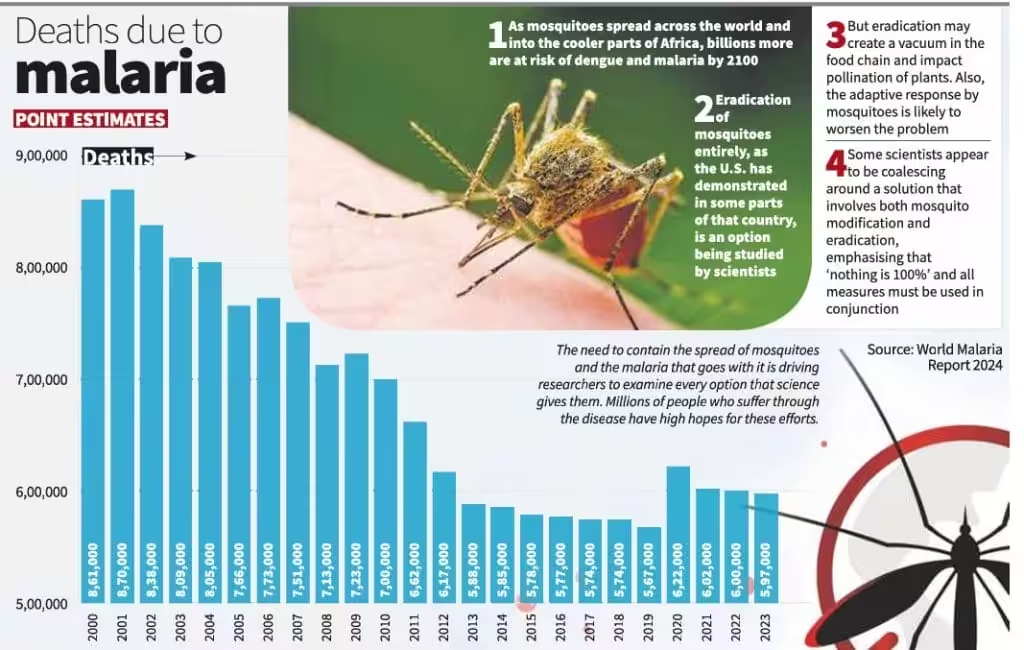
  • Globally in 2023, there were an estimated 263 million malaria cases and 597 000 malaria deaths in 83 countries.
  • The WHO African Region carries a disproportionately high share of the global malaria burden.
  • In 2023, the WHO African Region was home to 94% of malaria cases (246 million) and 95% (569 000) of malaria deaths.
  • Children under 5 accounted for about 76% of all malaria deaths in the Region.

Malaria:

  • Malaria is a life-threatening disease spread to humans by some types of mosquitoes. It is mostly found in tropical countries. It is preventable and curable.
  • The infection is caused by a parasite and does not spread from person to person.
  • Symptoms: fever, chills and headache. Severe symptoms include fatigue, confusion, seizures, and difficulty breathing.
  • Malaria mostly spreads to people through the bites of some infected female Anopheles mosquitoes. 

There are 5 Plasmodium parasite species that cause malaria in humans and 2 of these species – P. falciparum and P. vivax – pose the greatest threat. P. falciparum is the deadliest malaria parasite and the most prevalent on the African continent.

Prevention:

  • Vector control is a vital component of malaria control and elimination strategies as it is highly effective in preventing infection and reducing disease transmission.
  • Since October 2021, WHO has recommended broad use of the RTS,S/AS01 malaria vaccine among children living in regions with moderate to high P. falciparum malaria transmission.
  • In October 2023, WHO recommended a second safe and effective malaria vaccine, R21/Matrix-M. Vaccines are now being rolled out in routine childhood immunization programmes across Africa. 

FDI goes to tax haven

Open article →Download PDF

Context:

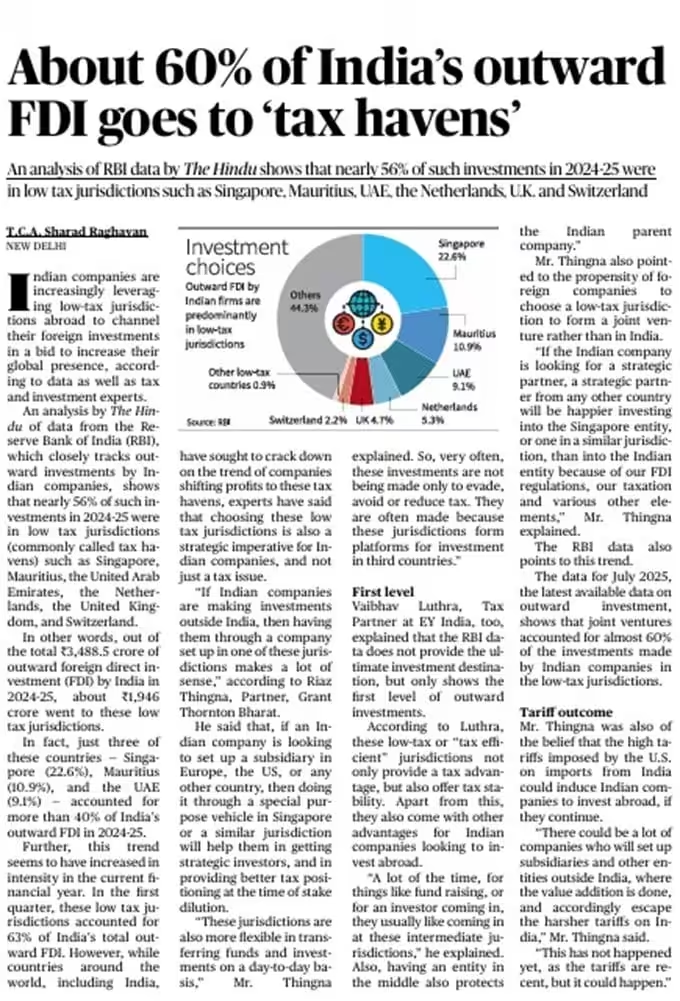
Indian companies are increasingly routing their outward FDI (Foreign Direct Investment) through low-tax jurisdictions (tax havens) such as Singapore, Mauritius, UAE, the Netherlands, the UK, and Switzerland. An RBI dataset for 2024–25 reveals that nearly 60% of India’s outward FDI went to these tax havens.

UPSC Relevance:

CSE in prelims as well as in mains examination has focused on FDI. A case in point is a following PYQ

Mains PYQ 2014

Q1: Foreign direct investment in the defence sector is now set to be liberalized. What influence this is expected to have on Indian defence and economy in the short and long run?

Mains PYQ 2013

Q2: Though India allowed foreign direct investment (FDI) in what is called multi brand retail through joint venture route in September 2012, the FDI ,even after a year, has not picket up. Discuss the reasons.(2013)

UPSC Prelims PYQ:

Consider the following:(2021)
Foreign currency convertible bonds
Foreign institutional investment with certain conditions
Global depository receipts
Non-resident external deposits
Which of the above can be included in Foreign Direct Investments?
A 1, 2 and 3 only
B 3 only
C 2 and 4 only
D 1 and 4 only

For Basics: https://anantamias.com/current-affairs/foreign-direct-investment/

Analysis of article:

  • RBI’s July 2025 data showed that nearly 60% of India’s outward FDI continues to be routed through tax havens.
  • The Total outward FDI (2024–25): ₹3,48,885 crore out of this, nearly ₹1,946 crore went to tax havens.
  • Singapore (22.6%), Mauritius (10.9%), and UAE (9.1%)—attracted more than 40% of India’s outward FDI because they are tax haven country and India sign DTAA with these Nations.

Tax Haven Countries mean:

  • Lower tax rates and flexible financial regimes.
  • Favourable regulatory systems, easier cross-border transactions.
  • Setting up in tax havens allows companies to route investments further into third countries.
  • Attracts foreign partners who prefer dealing with entities incorporated in such jurisdictions.

Issues:

  • Money outflow form India to save taxes. Here company take advantage of loop holes lies in (DTAA).
  • Loss of Government Revenue.
  • Difficult to track origin of funds.

Double Tax Avoidance Agreement:

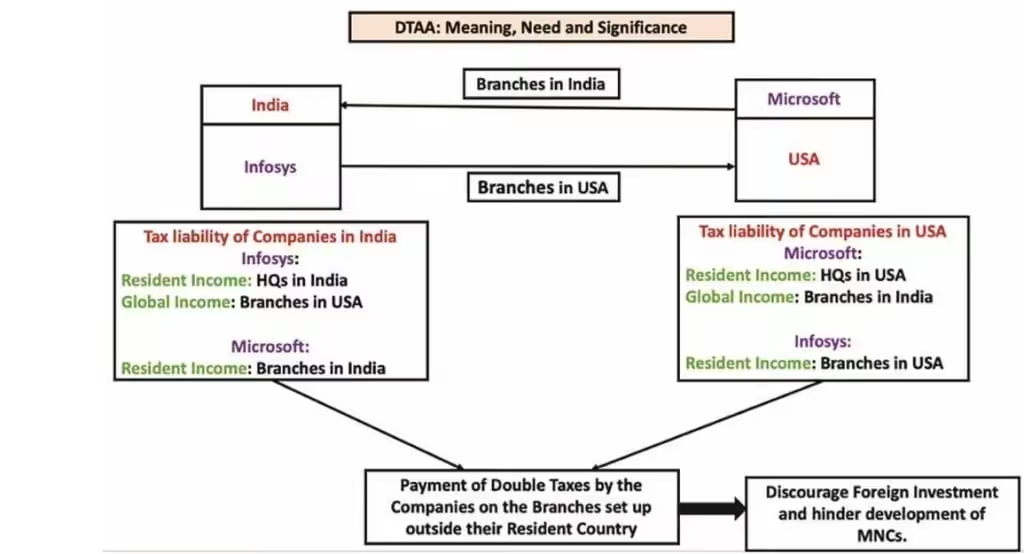
A Double Tax Avoidance Agreement (DTAA), also known as a tax treaty, is an agreement signed between two countries to prevent individuals or businesses from being subject to double taxation on their income.

Misuse of DTAA:

India has signed DTAA with the tax havens such as Mauritius, Singapore, Cayman Islands etc. These DTAAs have been misused by the MNCs in order to reduce their tax liability in India. For example, If a company (Shell Company) is registered in tax haven and carries out the operations through its subsidiary based in India. Under the provisions of DTAA, the company would be liable to pay tax only in the tax haven country, even for the profits which it makes in India. This causes significant revenue loss for India.

Round tripping: It is the practice where, capital belonging to India goes out to tax haven country where it is used to set up Shell Company. The money is then, reinvested back in India in the form of FDI.