
Opens in a new tab
Join Anantam IAS Channel on Telegram

Daily Digest · Saturday

2 August 2025 Current Affairs for UPSC

2 current affairs published on Saturday, 2 August 2025

2 August 2025 Current Affairs for UPSC — every Why-in-News article AnantamIAS published on Saturday, 2 August 2025, broken down with Why in News?, the exact GS paper it feeds, sub-topic mapping, MCQ-ready facts and a UPSC-style practice question. 2 articles in total, covering Polity, Economy, Environment, S&T, IR, Geography, History, Society and Internal Security — the same Why-in-News + GS-paper-mapping + practice-question format the Compass uses across every daily digest on the site.

Daily current affairs for UPSC is where new material enters your prep stream. Read this 2 August 2025 digest end-to-end in 25–35 minutes, attempt the practice question at the foot of each article (it's MCQ for some, 10/15-marker for others), then bookmark the entries that fall inside your active revision window. Everything stays cross-linked: tap any subject pill to jump to that subject's hub, or use the table of contents above to skip straight to a specific story.

Use this page three ways. Read sequentially for a one-sitting scan of everything that mattered on 2 August 2025. Download the 2 August 2025 PDF below for offline study or print revision. Or use the August 2025 Current Affairs compilation to see this day in the month's full context. For the previous day's reading, see 1 August 2025 Current Affairs; the next day's is 3 August 2025 Current Affairs.

Why we publish daily current affairs separately from the monthly compilation: daily is learning, monthly is revision. Use the daily page to add fresh material to your notes the day it breaks; come back to the August 2025 compilation 60 days before Prelims when the noise has settled and only the lasting takeaway is worth re-reading.

HOPE – Human Outer Planet Exploration

Open article →Download PDF

image 8

Why in news:

HOPE Station in Ladakh begins research to simulate life on Moon, Mars.

image 8 1

UPSC CSE Relevance:

UPSC CSE in prelims examination has focused on awareness in the fields of IT, space mission, computers, robotics, nano-technology.

UPSC Prelims PYQ 2020:

Q: “The experiment will employ a trio of spacecraft flying in formation in the shape of an equilateral triangle that has sides one million kilometres long, with lasers shining between the craft.” The experiment in question refers to
A) Voyager-2
B) New Horizons
C) LISA Pathfinder
D) Evolved LISA

UPSC Mains PYQ 2022:

Q: Launched on 25th December, 2021, James Webb Space Telescope has been much in the news since then. What are its unique features which make it superior to its predecessor Space Telescopes? What are the key goals of this mission? What potential benefits it hold for the human race?

Project launched by:

  • Protoplanet, a Bengaluru-based company involved in space science popularisation.
  • ISRO funded a portion of the station’s development as well as advised on the criteria for selecting candidates.

Why Ladakh?

  • Ladakh’s unique characteristics, including its high altitude, arid climate, and terrain, closely resemble the conditions found on Mars and the Moon.
  • This makes it an ideal location for testing various aspects of space exploration, including habitat design, resource management, and astronaut training.

Objective:

  • To prepare for possible manned space missions to the Moon and potentially Mars.
    • PM Narendra Modi has stated that he expects India will have its own Bharatiya Antariksh Station by 2035 and a manned Moon mission by 2040. 
    • The United States’ National Aeronautical and Space Administration (NASA) has indicated the possibility of a manned mission to Mars “in the 2030s”
  • It will be instrumental in developing robust protocols and technologies for sustained human presence beyond Earth.

Location – Tso Kar, Ladakh:

image 8

Research:

  • Selected ‘crew’, beginning August 1, will take turns inhabiting the station as part of a 10-day ‘isolation mission.’
  • The crew will undergo extensive physiological, epigenetics and psychological studies to assess human adaptability and resilience in conditions simulating deep space environments.

Other similar stations:

  • Mars Desert Station (United States)
  • Flashline Mars Arctic Research Station in Canada
  • BIOS-3 in Russia

Note:

  • HOPE is different from the analogous space mission launched by ISRO in Leh in November 2024.
  • India’s first analog space mission kicked off in Leh last year with the  collaborative effort by Human Spaceflight Centre, ISRO, AAKA Space Studio, University of Ladakh, IIT Bombay, and supported by Ladakh Autonomous Hill Development Council. 
  • This analogous mission will simulate life in an interplanetary habitat to tackle the challenges of a base station beyond Earth.

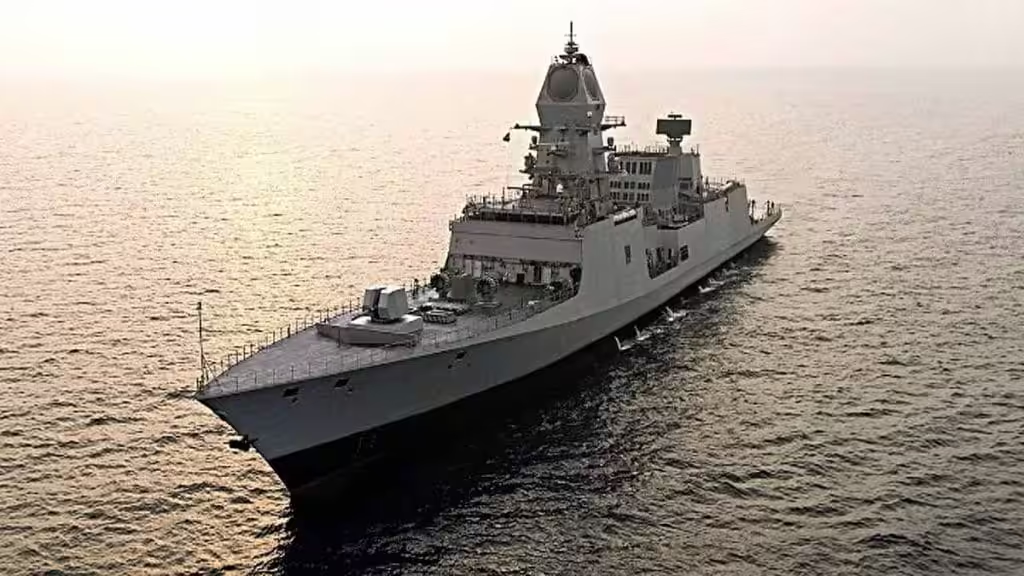
Himgiri Missile Frigate

Open article →Download PDF

image 9

Why in news:

The Indian Navy received the advanced guided-missile frigate Himgiri built by Garden Reach Shipbuilders and Engineers (GRSE) in Kolkata.

image 9 1

UPSC CSE Relevance:

UPSC CSE in prelims examination has focused on awareness in the fields of IT, space mission, computers, robotics, nano-technology.

Himgiri (Yard 3022):

  • 3rd ship of Nilgiri Class (Project 17A)
  •  a reincarnation of the erstwhile INS Himgiri, a Leander-class frigate, that was decommissioned on 06 May 2005.
  • The state-of-the-art frigate reflects a quantum leap in naval design, stealth, firepower, automation and survivability.
  • Indigenously developed – an admirable symbol of Aatmanirbharta in warship building.
  • Driven by the philosophy of ‘Integrated Construction’, the ship is modular and ergonomic.
  • The ship is 149 meters long and has a displacement of 6,670 tonnes, making it one of the largest and most sophisticated frigates built by Garden Reach Shipbuilders & Engineers (GRSE).
  • The weapon suite comprises:
    • BrahMos supersonic cruise missiles for anti-ship and land-attack roles.
    • Barak 8 medium range surface-to-air missiles for aerial defense.
    • 76 mm Gun
    • a combination of 30 mm and 12.7 mm rapid-fire Close-in Weapon Systems.
  • Fitted with advanced Active Electronically Scanned Array (AESA) radar and Integrated Platform Management System (IPMS).
  • Accommodation for 225 personnel and provides full aviation facilities for the operation of helicopters.

Project 17A:

  • This project is a follow-on to the earlier Project 17 (Shivalik-class) frigates, with significant improvements in stealth, firepower, and technology. The project is a key component of India’s “Aatmanirbhar Bharat” (Self-reliant India) initiative, with a high degree of indigenous content.
  • Project 17A frigates are versatile multi-mission platforms, designed to address current and future challenges in the maritime domain.
  • Designed by the Warship Design Bureau (WDB) and overseen by the Warship Overseeing Team (Kolkata), P17A frigates reflect a generational leap in indigenous ship design, stealth, survivability, and combat capability.
  • P17A ships are fitted with an advanced weapon and sensor suite compared to the P17 (Shivalik) class.
  • These ships are configured with Combined Diesel or Gas (CODOG) propulsion plants, comprising a diesel engine and gas turbine, that drives a Controllable Pitch Propeller (CPP) on each shaft, and a state-of-the-art Integrated Platform Management System (IPMS).
  • Indigenous content of 75%
  • The project involves the construction of seven frigates, with four being built by MDL and three by GRSE. The ships are named after mountain ranges in India, reviving the names of the retired Leander-class frigates.
  • The first three frigates to be delivered are:
    • INS Nilgiri: The lead ship of the class, built by MDL. It was commissioned into the Indian Navy.
    • INS Udaygiri: The second ship, also built by MDL, was delivered to the Indian Navy in July 2025.
    • INS Himgiri: The third ship of the class and the first to be built by GRSE, was delivered to the Indian Navy in July 2025.
  • The remaining four ships under the project are:
    • INS Taragiri: Being built by MDL.
    • INS Dunagiri: Being built by GRSE.
    • INS Vindhyagiri: Being built by GRSE.
    • INS Mahendragiri: The seventh and final ship of the class, being built by MDL.

Project 17- Shivalik class:

  • INS Shivalik (F47): The lead ship of the class, commissioned in 2010.
  • INS Satpura (F48): Commissioned in 2011.
  • INS Sahyadri (F49): Commissioned in 2012.

Differences between a frigate and a destroyer warship:

FeatureFrigateDestroyer
RolePrimarily focused on escorting other vessels and performing anti-submarine warfare (ASW). They also handle patrol duties and provide air defense for a limited area.Designed to escort larger vessels and engage in direct combat with enemy ships. They are often part of a carrier battle group and are more offensively oriented.
Size & DisplacementGenerally smaller and lighter. A modern frigate typically displaces between 1,500 and 6,000 tons.Larger and heavier than frigates, with displacements ranging from around 3,500 to over 10,000 tons.
SpeedOften designed for speed and maneuverability to fulfill their escort and patrol duties.While still fast, their larger size can sometimes make them slightly less agile than frigates.
ArmamentEquipped with a variety of weapons, including surface-to-air missiles (SAMs), anti-submarine warfare (ASW) torpedoes, and guns.Generally more heavily armed than frigates, with a greater number of vertical launch system (VLS) cells for missiles, making them capable of broader air and missile defense.