Why in news:
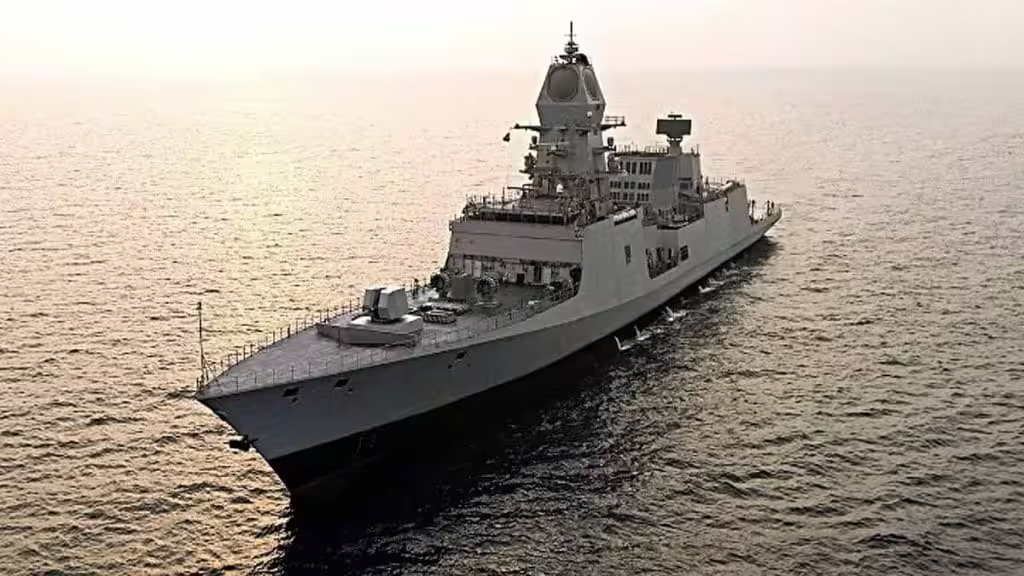
The Indian Navy received the advanced guided-missile frigate Himgiri built by Garden Reach Shipbuilders and Engineers (GRSE) in Kolkata.
UPSC CSE Relevance:
UPSC CSE in prelims examination has focused on awareness in the fields of IT, space mission, computers, robotics, nano-technology.
Himgiri (Yard 3022):
- 3rd ship of Nilgiri Class (Project 17A)
- a reincarnation of the erstwhile INS Himgiri, a Leander-class frigate, that was decommissioned on 06 May 2005.
- The state-of-the-art frigate reflects a quantum leap in naval design, stealth, firepower, automation and survivability.
- Indigenously developed – an admirable symbol of Aatmanirbharta in warship building.
- Driven by the philosophy of ‘Integrated Construction’, the ship is modular and ergonomic.
- The ship is 149 meters long and has a displacement of 6,670 tonnes, making it one of the largest and most sophisticated frigates built by Garden Reach Shipbuilders & Engineers (GRSE).
- The weapon suite comprises:
- BrahMos supersonic cruise missiles for anti-ship and land-attack roles.
- Barak 8 medium range surface-to-air missiles for aerial defense.
- 76 mm Gun
- a combination of 30 mm and 12.7 mm rapid-fire Close-in Weapon Systems.
- Fitted with advanced Active Electronically Scanned Array (AESA) radar and Integrated Platform Management System (IPMS).
- Accommodation for 225 personnel and provides full aviation facilities for the operation of helicopters.
Project 17A:
- This project is a follow-on to the earlier Project 17 (Shivalik-class) frigates, with significant improvements in stealth, firepower, and technology. The project is a key component of India’s “Aatmanirbhar Bharat” (Self-reliant India) initiative, with a high degree of indigenous content.
- Project 17A frigates are versatile multi-mission platforms, designed to address current and future challenges in the maritime domain.
- Designed by the Warship Design Bureau (WDB) and overseen by the Warship Overseeing Team (Kolkata), P17A frigates reflect a generational leap in indigenous ship design, stealth, survivability, and combat capability.
- P17A ships are fitted with an advanced weapon and sensor suite compared to the P17 (Shivalik) class.
- These ships are configured with Combined Diesel or Gas (CODOG) propulsion plants, comprising a diesel engine and gas turbine, that drives a Controllable Pitch Propeller (CPP) on each shaft, and a state-of-the-art Integrated Platform Management System (IPMS).
- Indigenous content of 75%
- The project involves the construction of seven frigates, with four being built by MDL and three by GRSE. The ships are named after mountain ranges in India, reviving the names of the retired Leander-class frigates.
- The first three frigates to be delivered are:
- INS Nilgiri: The lead ship of the class, built by MDL. It was commissioned into the Indian Navy.
- INS Udaygiri: The second ship, also built by MDL, was delivered to the Indian Navy in July 2025.
- INS Himgiri: The third ship of the class and the first to be built by GRSE, was delivered to the Indian Navy in July 2025.
- The remaining four ships under the project are:
- INS Taragiri: Being built by MDL.
- INS Dunagiri: Being built by GRSE.
- INS Vindhyagiri: Being built by GRSE.
- INS Mahendragiri: The seventh and final ship of the class, being built by MDL.
Project 17- Shivalik class:
- INS Shivalik (F47): The lead ship of the class, commissioned in 2010.
- INS Satpura (F48): Commissioned in 2011.
- INS Sahyadri (F49): Commissioned in 2012.
Differences between a frigate and a destroyer warship:
| Feature | Frigate | Destroyer |
| Role | Primarily focused on escorting other vessels and performing anti-submarine warfare (ASW). They also handle patrol duties and provide air defense for a limited area. | Designed to escort larger vessels and engage in direct combat with enemy ships. They are often part of a carrier battle group and are more offensively oriented. |
| Size & Displacement | Generally smaller and lighter. A modern frigate typically displaces between 1,500 and 6,000 tons. | Larger and heavier than frigates, with displacements ranging from around 3,500 to over 10,000 tons. |
| Speed | Often designed for speed and maneuverability to fulfill their escort and patrol duties. | While still fast, their larger size can sometimes make them slightly less agile than frigates. |
| Armament | Equipped with a variety of weapons, including surface-to-air missiles (SAMs), anti-submarine warfare (ASW) torpedoes, and guns. | Generally more heavily armed than frigates, with a greater number of vertical launch system (VLS) cells for missiles, making them capable of broader air and missile defense. |
Tell Google you want more of this.
Add Anantam IAS as a preferred sourceOne tap, and this site shows up more often in your own Top Stories, AI Overviews and AI Mode. Remove it any time.