3 current affairs published on Friday, 1 August 2025
1 August 2025 Current Affairs for UPSC — every
Why-in-News article AnantamIAS published on Friday, 1 August 2025, broken down with
Why in News?, the exact GS paper it feeds, sub-topic mapping, MCQ-ready facts and a
UPSC-style practice question. 3 articles in total, covering Polity, Economy, Environment, S&T, IR, Geography, History, Society and Internal
Security — the same Why-in-News + GS-paper-mapping + practice-question format the Compass uses across
every daily digest on the site.
Daily current affairs for UPSC is where new material enters your prep stream. Read this
1 August 2025 digest end-to-end in 25–35 minutes, attempt the practice question
at the foot of each article (it's MCQ for some, 10/15-marker for others), then bookmark the entries
that fall inside your active revision window. Everything stays cross-linked: tap any subject pill to jump
to that subject's hub, or use the table of contents above to skip straight to a specific story.
Use this page three ways. Read sequentially for a one-sitting scan of everything that
mattered on 1 August 2025. Download the
1 August 2025 PDF below for offline study or print revision. Or use
the August 2025 Current Affairs compilation
to see this day in the month's full context. For the previous day's reading, see
31 July 2025 Current Affairs;
the next day's is 2 August 2025 Current Affairs.
Why we publish daily current affairs separately from the monthly compilation: daily is learning,
monthly is revision. Use the daily page to add fresh material to your notes the day it breaks;
come back to the August 2025 compilation 60 days before Prelims when the
noise has settled and only the lasting takeaway is worth re-reading.
One of the strongest earthquakes ever recorded struck Russia’s sparsely populated far east on July 30, causing tsunamis up to four metres (12 feet) across the Pacific and sparking evacuations from Hawaii to Japan. The magnitude 8.8 quake struck in the morning off Petropavlovsk on Russia’s remote Kamchatka peninsula and was one of the 10 biggest recorded, according to the United States Geological Survey (USGS).
UPSC CSE Relevance:
UPSC CSE in prelims and mains examination has focused on Important Geophysical phenomena such as earthquakes, Tsunami, Volcanic activity, cyclone etc. A case in point is a following PYQ.
UPSC mains PYQ 2020:
Discuss the geophysical characteristics of Circum- Pacific Zone.
What is an earthquake?
As per NCERT, an earthquake is defined as a sudden shaking or trembling of the earth. It can be caused either naturally or anthropogenically. Based on these causal factors, there are following types of earthquakes:
Types of Earthquakes:
Natural Earthquakes –
These are caused by natural processes occurring inside the Earth
Tectonic Earthquakes:
Cause: Sudden movement of tectonic plates along faults or plate boundaries. Majorly caused due to subduction of tectonic plates.
This process results in deformities and creates a huge stress at the plate boundaries. It is this stress that is released in the form of earthquakes.
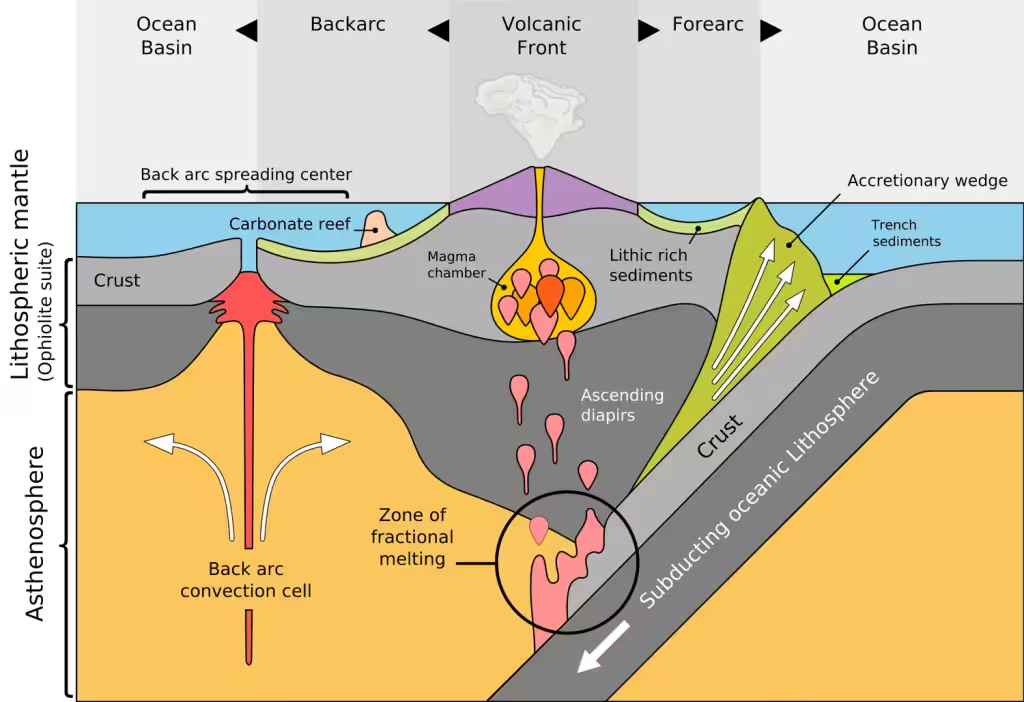
Subduction is a geological process in which one tectonic plate-put simply, a large section of the Earth’s crust-presses against another. Usually, the heavier or denser plate, that is, the one with more mass per unit of area, tends to go below the lighter plate.
Location: Occur mostly in subduction zones, transform faults, and mid-ocean ridges.
Example:
Recent quake in Kamchatka.
San Andreas Fault (USA) – Strike-slip tectonic fault
2004 Indian Ocean Earthquake – Caused by subduction of the Indian Plate
Earthquake in Anatolian region in Turkey in 2023.
Volcanic Earthquakes:
Cause: Result from volcanic activity like magma movement or eruption.
Location: Usually near active volcanoes.
Example:
Japan and Indonesia – Volcanic belts
Earthquakes around Mount St. Helens (USA)
Collapse Earthquakes:
Cause: Collapse of underground caves, caverns, or mines (typically in karst areas).
Location: Local and minor in intensity.
Example:
Sinkholes in limestone regions
Minor quakes due to mine collapses in coal regions.
Man-Made (Artificial) Earthquakes:
Mining-Induced Earthquakes
Cause: Explosions or deep excavation in mining areas.
Example: Rock bursts in deep coal mines (South Africa, Poland).
Reservoir-Induced Earthquakes
Cause: Filling of large dams creates pressure on bedrock, reactivating faults.
Example: Koyna Dam (India) – Well-known example of human-induced seismicity.
Nuclear Explosions
Cause: Underground nuclear tests displace rocks and generate seismic waves.
Example: Nuclear test sites like Nevada (USA) or Pokhran (India).
Other Human Activities
Cause: Deep well injection, fracking (hydraulic fracturing), geothermal projects.
Example:
Induced tremors near geothermal plants in Iceland and California.
Earthquakes in Oklahoma (USA) linked with fracking
Distribution of EQ – 3 Major Zones:
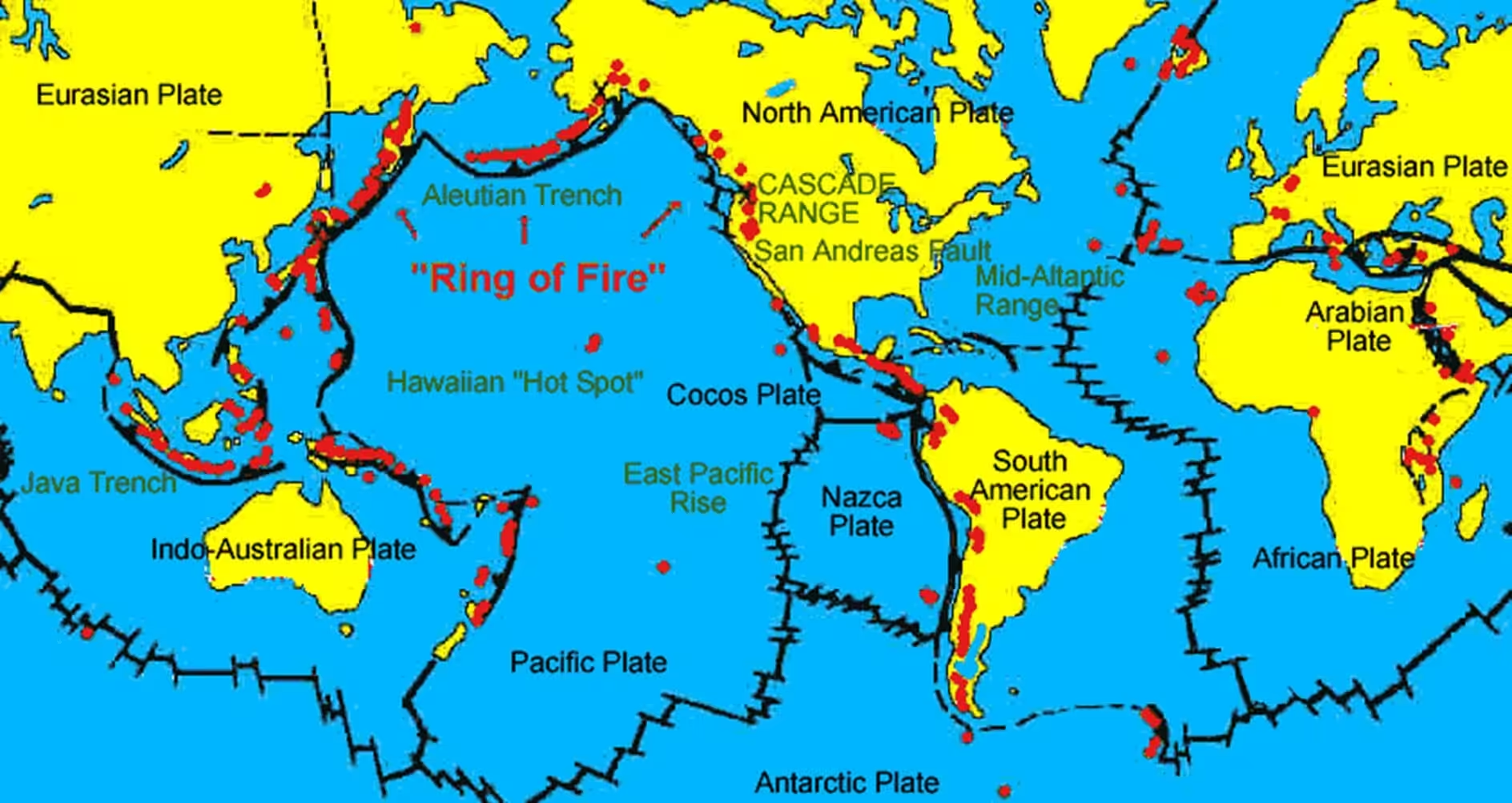
65 – 70 % EQ in Circum-Pacific Zone (with 80% of big EQs):
Reason:
Active volcanoes
Subduction zones
High energy accumulation for longer durations
young fold mountains – unstable topography
20- 25 % in Mid-Continental Belt or [Alpide-Himalayan Belt]:
Reason:
Example-Turkey (Anatolian plate)
weak zone of fold mountains like Himalayas
fault induced EQ due to faults zones like that of Anatolia
High risk of damage due to high population density
Mid Atlantic Ridge Area:
shallow focii EQs due to Diverging boundaries
under the ocean, far from populated areas.
Rift zones with neo-tectonic activity(new tectonic faults and fractures) are also prone to EQs.
Ex. African Rift valley
What is the Ring of Fire?
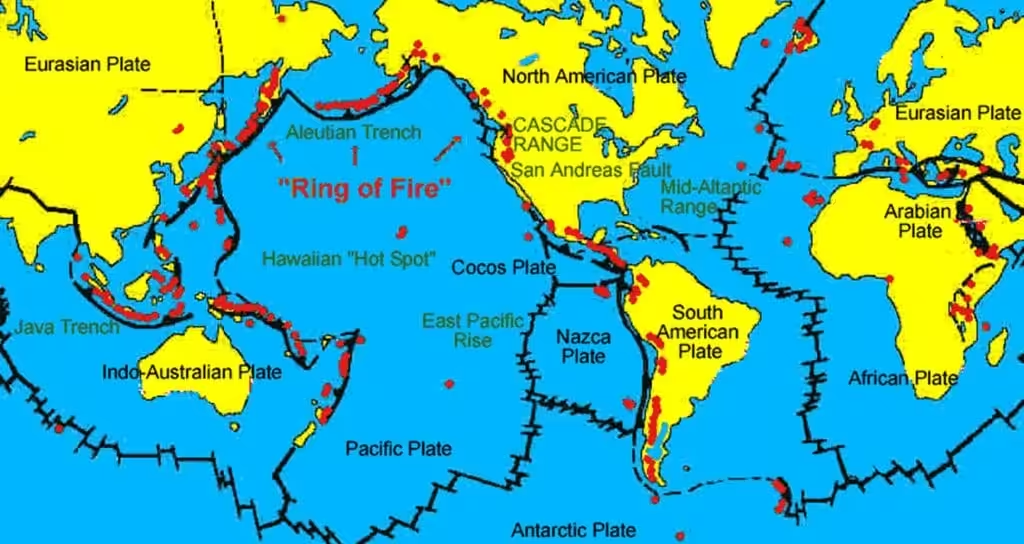
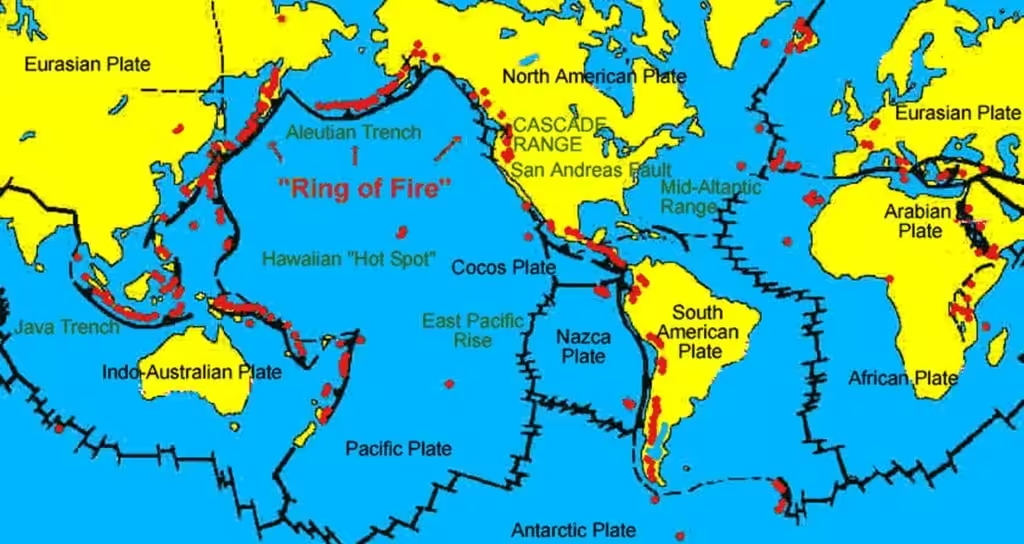
The Ring of Fire is a horseshoe-shaped belt around the edges of the Pacific Ocean. It is known for having the most active volcanoes and earthquakes in the world.
Major Subduction Zones:
It is located along convergent boundaries, where oceanic plates subduct under continental plates causing EQs and volcanic eruptions.
Nazca Plate subducting under South American Plate (e.g., Chile)
Pacific Plate subducting under Philippine and Eurasian Plates
Juan de Fuca Plate under North America (Cascadia Subduction Zone)
The recently Kamchatka EQ Zone lies near Ring of Fire.
How is EQ measured?
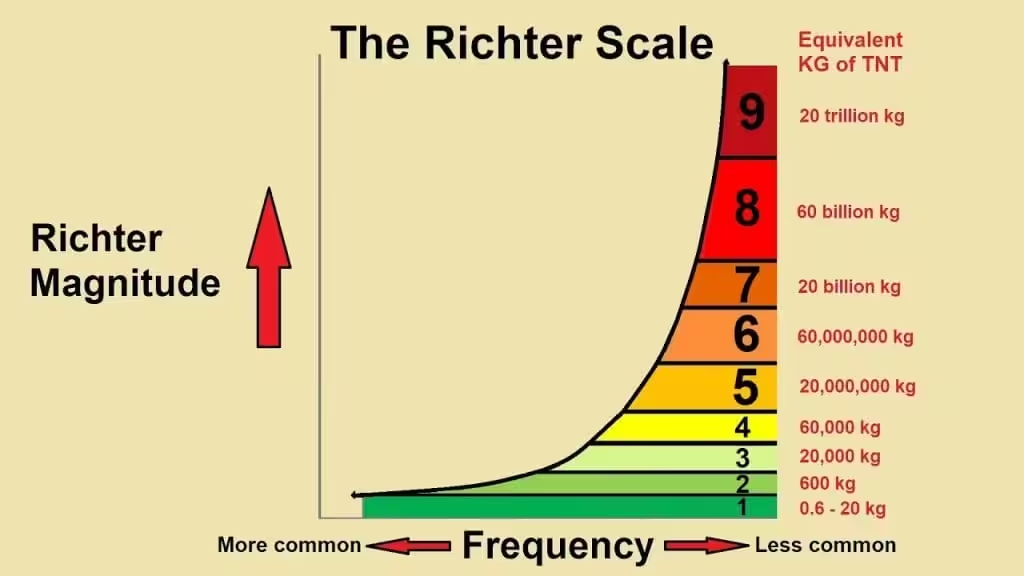
Richter Scale (Magnitude Scale) – measures the energy released at the source of an earthquake developed by Charles F. Richter in 1935.
Scale Range: From 0 to 10+ (logarithmic scale).
Each whole number increase represents: 10 times more ground shaking and 32 times more energy release.
Example: A 6.0 magnitude earthquake releases 32 times more energy than a 5.0.
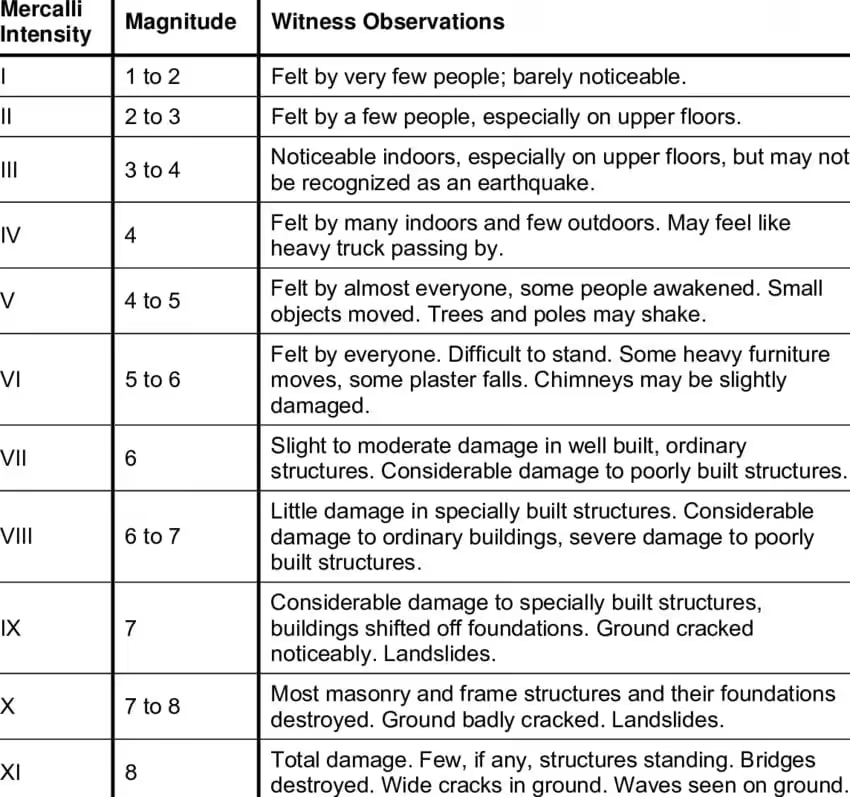
Modified Mercalli Intensity (MMI) Scale:
measures the impact and damage caused by an earthquake (human perception, building suffering, etc.).
Scale Range: From I (not felt) to XII (total destruction).
Subjective: Varies based on people’s experiences and structures in a specific area.
Impact of EQs:
Damage to property and life.
Development of new faults Ex- Allah Bund Fault after Delhi-Bhuj EQ
Landslides, avalanches, ground lurching
Tsunamis. Ex-Tsunami 2004-India, S-E Asia, Japan Tsunami, 2011
Soil Liquefaction – a phenomenon where saturated or loosely packed soil loses its strength and stiffness, behaving like a liquid, due to strong stress like earthquake shaking.
Ex- Northern Part of Bihar in riverine area after EQ in Nepal, 2015
Dam levee failures causing flooding.
NDMA Guidelines for Earthquake Management:
Risk Assessment and Hazard Mapping
Identify seismic zones and prepare microzonation maps.
Update building by-laws based on seismic risk.
Create earthquake vulnerability atlases for states/districts.
2. Building Safety and Infrastructure
Enforce seismic-safe construction provisions in buildings and infrastructure.
Promote use of IS Codes (Indian Standards) related to earthquake-resistant construction.
Retrofit critical lifeline buildings (schools, hospitals, water supply, etc.).
Ensure proper evaluation and retrofitting of public and private buildings, especially in Zones III–V.
3. Training, Awareness, and Capacity Building
Train engineers, architects, and masons in earthquake-resistant design and construction.
Conduct public awareness campaigns in schools, offices, residential areas.
Establish disaster response teams and conduct regular earthquake mock drills.
4. Early Warning and Communication Systems
Develop and improve earthquake early warning systems (EEWS).
Strengthen seismic networks in high-risk areas.
Set up robust communication channels between agencies, emergency services, and communities.
5. Emergency Response Planning
Prepare site-specific Earthquake Disaster Management Plans at District, State, and National levels.
Ensure availability of search and rescue teams, medical teams, temporary shelters, and essential supplies.
Coordinate with NDRF (National Disaster Response Force) and civil defense units.
Media professionals’ representatives, along with the National Campaign for the People’s Right to Information (NCPRI), said on Wednesday (July 30, 2025) that the Digital Personal Data Protection Act, 2023 and its draft rules were “extremely problematic” and would erode both the right to information and did not protect journalists from identifying people whose wrongdoing they uncover.
UPSC CSE Relevance:
UPSC CSE in mains examination has focused on Important aspects of governance, transparency and accountability, e-governance- applications, models, successes, limitations, and potential in GSII.
UPSC mains PYQ 2023:
E-governance, as a critical tool of governance, has ushered in effectiveness, transparency and accountability in governments. What inadequacies hamper the enhancement of these features?
The Rationale for RTI:
“Information is the currency of democracy.” – Thomas Jefferson
The basic idea and philosophy of the Right to Information (RTI) in a democracy is rooted in the belief that government belongs to the people, and therefore, citizens have a right to know how it functions and makes decisions on their behalf. The Right to Information is based on the principle of transparency, accountability, and citizen empowerment in governance.
Tracing the evolution:
Early Judicial Recognition and the Constitutional Basis:
Article 19(1)(a) of the Indian Constitution: The genesis of the RTI Act can be traced to the fundamental right to freedom of speech and expression. The Supreme Court of India, through a series of landmark judgments, interpreted this right to include the “right to know” or “right to information.”
The Case of State of U.P. v. Raj Narain (1975): This was a pivotal moment. The Supreme Court ruled that the public had the right to know about the affairs of the government, and this right was an essential part of a democratic republic. The court stated that in a democracy, the people are the masters, and they have the right to know how their government is functioning.
The Case of S.P. Gupta v. Union of India (1981): The Supreme Court further reinforced this principle, stating that the principle of “open government” stems from the implicit right to know within Article 19(1)(a). The court emphasized that the disclosure of government information should be the norm, with secrecy as the exception.
Grassroots Movements and Civil Society Activism:
The Mazdoor Kisan Shakti Sangathan (MKSS) Movement (1990s): The real momentum for a formal law came from the grassroots. The MKSS, a people’s organization in Rajasthan, started a campaign for transparency in local government records. They organized “Jan Sunwai” (public hearings) to expose corruption in public works, demanding to see official records. This movement was instrumental in demonstrating the power of information as a tool for empowerment and accountability.
National Campaign for People’s Right to Information: The success of the MKSS movement inspired a wider national campaign that eventually drafted a model RTI law for the government.
State-level Enactments:
Recognizing the growing demand, several Indian states took the lead in enacting their own Right to Information laws. Tamil Nadu was the first state to pass an RTI law in 1997. Other states like Goa, Rajasthan, Delhi, and Maharashtra followed suit, creating a patchwork of varying regulations.
The Freedom of Information Act, 2002:
The central government, in response to the pressure from civil society and a growing consensus, enacted the Freedom of Information Act, 2002.
This act, while a step in the right direction, was widely criticized for its weaknesses. It had limited scope, weak enforcement mechanisms, and a lack of a clear appellate authority outside the government. It also failed to acknowledge the “right” to information explicitly, instead using the term “freedom,” which implied a discretionary grant rather than a legal right. The act also did not have a strong penal provision for non-compliance. It was a precursor, but not the final solution.
The Right to Information Act, 2005:
Building on the experience of the 2002 Act and the demands of civil society, a new and more robust bill was drafted. The Right to Information Act, 2005 was passed by the Indian Parliament on June 15, 2005, and came into full force on October 12, 2005.
Major Provisions of the RTI Act, 2005:
Right to Information (Section 3): Every citizen of India has the right to access information from public authorities, subject to some reasonable restrictions (national security, privacy, etc.).
Public Authorities (Section 2(h)):
They are obligated to maintain and disclose records in a manner that facilitates easy access.
Includes all levels of government, funded NGOs, and institutions substantially financed by public money.
Information (Section 2(f)): Refers to any material in any form, including records, documents, memos, emails, opinions, reports, samples, models, etc.
Proactive Disclosure (Section 4):
Organizational structure,
Functions and duties,
Decision-making processes,
Norms and rules,
Budgets and expenditure,
Directory of officers, etc.
Helps reduce the need for formal RTI applications.
Public Information Officer (PIO) (Section 5 & 6):
Every public authority must designate a Public Information Officer (PIO) to process RTI requests.
Citizens can file a written or digital application to the PIO, without giving reasons.
If a person is unable to write, the PIO is required to provide assistance in putting the request in writing.
Time Limits (Section 7):
30 days: Normal time to reply by the PIO.
48 hours: If the matter concerns life or liberty of a person.
35 days: When application is submitted to Assistant PIO.
40 days: If third-party information is involved.
Exemptions from Disclosure (Section 8 and 9): Certain information is exempted from disclosure, such as:
National security and sovereignty.
Trade secrets or intellectual property.
Information forbidden by court or affecting investigations.
Cabinet papers (until decisions are made).
Personal information without public interest.
information received in confidence from a foreign government.
If it breaches the privilege of Parliament or a State Legislature.
Third-Party Information (Section 11): If the requested information involves a third party, the PIO must seek their opinion before disclosure.
Appeals and Complaints (Sections 18–20) – 2 tier:
Complaint: May be filed directly to the Information Commission for non-compliance, delays, denial, etc.
First Appeal: File within 30 days to the senior officer in the same office.
Second Appeal: File to State or Central Information Commission.
Penalties (Section 20):
PIO can be fined ₹250 per day for delay (up to ₹25,000).
Disciplinary action can be taken for:
Refusing to accept application,
Providing false or misleading information,
Delaying information without reasonable causes.
No Need to State Reason: Applicants do not have to give any reason or personal details except for contact information necessary to deliver the response.
Fees
Below Poverty Line (BPL) applicants are exempt from payment
₹10 for application (some states may vary).
Additional charges may apply for photocopying or accessing large records.
Information Commissions
Headed by a Chief Information Commissioner and Information Commissioners (appointed by the President or Governor).
Central Information Commission (CIC) and State Information Commissions (SICs) are established under the Act.
Aspect
Central Information Commission (CIC)
State Information Commission (SIC)
Composition
Chief Information Commissioner and up to 10 Information Commissioners
State Chief Information Commissioner and up to 10 State Information Commissioners
Appointment Authority
Appointed by the President based on recommendations of a committee including the Prime Minister, Leader of Opposition (Lok Sabha), and a Union Cabinet Minister nominated by PM
Appointed by the Governor on recommendation of a committee including Chief Minister, Leader of Opposition in State Assembly, and a State Cabinet Minister nominated by CM
Qualifications
Eminent persons in public life with experience in law, science & tech, social service, management, journalism, mass media, or governance; no MPs/MLAs, no office of profit, no political affiliations or business interests
Same as CIC; persons of eminence in public life with similar expertise; same restrictions
Tenure (Post-2019 Amendment)
Term fixed by Central Government notification. Term of CIC shall not be less than that of Information Commissioners
Same as CIC
Salary and Service Conditions (Post-2019 Amendment)
Salaries, allowances, and terms of service as prescribed by Central Government but can’t be varied to disadvantage.
Same as CIC
Removal Authority
President on specified grounds (insolvency, conviction, misbehavior/incapacity after Supreme Court inquiry, paid employment outside duties, infirmity, financial interest affecting duties)
Governor on specified grounds similar to CIC
Powers
Functions under RTI Act; can inquire into complaints; powers of civil court including summoning witnesses, documents, inspection of records
Similar to CIC; inquiry powers; can recommend compliance; report to State Government
Terms of Service
Cannot engage in other professional/business activity or political affiliation during tenure; office conditions protected
Same as CIC for independence and service protection
Recent Controversial Amendments:
1. Changes to the Status of Information Commissions (RTI Amendment Act, 2019)
This is the most critical and debated amendment to the original act.
Term of Office: The original Act set a fixed term of five years for the Chief Information Commissioner (CIC) and Information Commissioners (ICs) at both the central and state levels (or until they reached 65 years of age, whichever was earlier). The 2019 amendment removed this fixed 5 year term. The Central Government now has the power to prescribe the term of office for the CIC and ICs.
Salary and Service Conditions: Previously, the salary and service conditions of the CIC and ICs were equated with those of the Chief Election Commissioner and Election Commissioners, respectively. This was to ensure their independence and autonomy. The 2019 amendment gave the Central Government the power to unilaterally determine the salaries, allowances, and other terms and conditions of service for both central and state-level information commissioners.
Impact: These changes have been widely criticized for potentially undermining the independence of the Information Commissions. Critics argue that by giving the government control over the tenure and salary of the commissioners, it makes them more susceptible to government influence and less effective as independent oversight bodies.
2. Changes to Personal Information Exemption (Digital Personal Data Protection Act, 2023)
The DPDP Act, 2023, brought a significant change to Section 8(1)(j) of the RTI Act.
Original Provision: The original Section 8(1)(j) exempted “personal information the disclosure of which has no relationship to any public activity or interest, or which would cause an unwarranted invasion of the privacy of the individual.” Crucially, it had a “public interest override” which allowed for the disclosure of personal information if the public interest in such disclosure outweighed the harm to the individual’s privacy.
Amended Provision: The DPDP Act, 2023, amended Section 8(1)(j) to a blanket exemption for “personal information.” This change removed the “public interest override,” making it easier for public authorities to deny requests for personal information.
Impact: This amendment has been a major point of concern for transparency advocates. They argue that it severely restricts access to information that is crucial for public scrutiny, such as details of public officials’ assets, educational qualifications, and disciplinary actions. By removing the public interest test, it provides a legal loophole for authorities to withhold information that was previously accessible for the sake of public accountability.
Government’s Stand – Need of Amendment:
Protecting the right to privacy: The government’s primary argument is that the amendment is necessary to align the RTI Act with the Supreme Court’s landmark 2017 ruling in the Justice K.S. Puttaswamy case, which declared the right to privacy as a fundamental right. The government maintains that the DPDP Act protects individuals’ personal data from being disclosed and prevents the “misuse” of the RTI Act for personal vendettas or harassment.
Justification for correcting an anomaly: The government argued that the original RTI Act had an “anomaly” by giving Information Commissions, which are statutory bodies, the same status as constitutional bodies like the Election Commission.
Maintaining autonomy: The government has maintained that the amendments do not tamper with the autonomy or independence of the Information Commissions. It asserts that the government is merely correcting legislative shortcomings and is not seeking to control the commissions.
Addressing an inconsistency: The government also highlighted an inconsistency where the Central Information Commissioner had the status of a Supreme Court judge, but their judgments could be challenged in the High Courts. The amendment, according to the government, was meant to “correct” this.
RTI over 20 years:
Positive Impact: A Tool for Transparency and Empowerment
The RTI Act’s greatest achievement lies in fundamentally altering the relationship between the state and the citizen. It moved India from a culture of official secrecy to one of openness, where information is a right, not a privilege.
Exposing Corruption and Malfeasance: The RTI Act has been a powerful tool for investigative journalism and citizen activism. Numerous high-profile scams and instances of administrative wrongdoing have been brought to light through RTI applications.
RTI was instrumental in uncovering the 2G Spectrum Scam, revealing irregularities in the allocation of telecom licenses, and the Commonwealth Games Scam, which exposed financial mismanagement and inflated costs.
In a more local context, the RTI Act has been used by a village resident to get a death certificate that was being delayed, and by villagers in Gujarat to ensure they received their full quota of kerosene from ration shops.
Empowering the Common Citizen: The Act has empowered ordinary people to hold local officials accountable. From demanding to know the status of a delayed pension application to questioning the quality of public works, citizens have used RTI to ensure their entitlements are delivered.
Facilitating Social Audits: The RTI Act has enabled citizens and civil society organizations to conduct social audits of government schemes. By accessing information about expenditures, beneficiaries, and project implementation, they have been able to verify the ground reality and demand corrective action.
This has been particularly effective in schemes like the Mahatma Gandhi National Rural Employment Guarantee Act (MGNREGA).
Judicial and Electoral Transparency: The Act has also helped to bring greater transparency to other pillars of democracy. RTI applications have been used to seek information about judges’ assets and the functioning of courts.
The Association for Democratic Reforms (ADR) has extensively used RTI to analyze the financial and criminal records of electoral candidates, enabling voters to make more informed choices.
Waning Efficacy of RTI:
Weakening of Information Commissions: The RTI (Amendment) Act, 2019, has been a major point of criticism. By giving the central government the power to unilaterally set the tenure, salaries, and service conditions of Information Commissioners, the amendments are seen as undermining the independence of these crucial appellate bodies. This has led to concerns that commissioners will be less likely to pass judgments that are unfavorable to the government.
Rising Backlogs and Delays: Information Commissions at both the central and state levels are severely understaffed and face a massive backlog of appeals. Vacancies in key positions and the sheer volume of cases mean that appeals can remain unresolved for years, effectively defeating the time-bound nature of the RTI Act. This delay is a form of information denial in itself. Reports by civil society organizations like the Satark Nagrik Sangathan consistently highlight the growing backlog of appeals and complaints. A report from October 2024 revealed that over 4 lakh appeals and complaints were pending across the 29 Information Commissions in India as of June 30, 2024.
Many Information Commissions, both at the central and state levels, operate with fewer members than sanctioned. In an October 2024 report, it was found that several commissions, including those in Jharkhand, Telangana, Goa, and Tripura, were defunct for varying periods, and many others were without a Chief Information Commissioner.
Bureaucratic Resistance : Despite the law, bureaucratic resistance remains a significant obstacle. Public Information Officers (PIOs) often deny requests, cite flimsy exemptions, or provide incomplete information.
In a 2021 study, it was found that 40% of RTI requests were denied without a valid reason
Threats and Violence Against RTI Activists: The Commonwealth Human Rights Initiative (CHRI) has been tracking attacks on RTI activists since the Act’s inception.
In a tragic example, RTI activist Mirtyunjay Singh in Bihar was killed after he exposed corruption in local-level projects. These incidents create a climate of fear, discouraging ordinary citizens from using the Act to expose wrongdoing, particularly at the local level.
The Whistleblower Protection Act, 2014, which was meant to provide a legal framework to protect such individuals, has been stalled and remains largely unimplemented.
The Privacy vs. Transparency Debate: The Digital Personal Data Protection (DPDP) Act, 2023, has introduced a new and significant legal challenge. By providing a blanket exemption for “personal information” and removing the “public interest override” from Section 8(1)(j) of the RTI Act, the government has given public authorities a powerful tool to deny information. Critics argue that this effectively legalizes secrecy and makes it harder to scrutinize the assets and actions of public officials.
Misuse and Frivolous Requests: While a small fraction, the issue of “misuse” of the RTI Act for personal feuds, frivolous queries, or for commercial gain has been raised by the government. This has been used as a justification for tightening the law, though critics argue that the issue of misuse is often exaggerated to create a pretext for limiting transparency.
How can the RTI Act be made more effective?
1. Strengthening the Information Commissions
Restore Autonomy: Ensuring their independence from political pressure via fixed tenure and terms of service and salary.
Fill Vacancies Promptly: The government must fill the vacancies in the Central and State Information Commissions in a time-bound manner. As of late 2024, reports from groups like the Satark Nagrik Sangathan have shown that some commissions were non-functional or operating with a fraction of their sanctioned strength, leading to massive backlogs. A clear, transparent, and non-partisan appointment process should be established.
Empower Commissions with Enforcement Powers: Currently, Information Commissions can impose penalties on non-compliant Public Information Officers (PIOs), but they lack the power to take action against public authorities that ignore their directives. Commissions should be given more teeth to enforce their orders, such as the power to initiate disciplinary action or impose a higher penalty for repeated non-compliance.
2. Promoting Proactive Disclosure (Section 4):
Mandate Comprehensive and Timely Disclosure: Public authorities must be held accountable for failing to adhere to Section 4 of the Act. They should be required to proactively upload key documents like budgets, project details, tender information, and beneficiary lists on their websites in a user-friendly and machine-readable format.
Example: The Gujarat High Court has set a good precedent by making all its judgments and orders available online, reducing the need for people to file RTIs for them. This kind of suo-motu disclosure should be replicated across all government departments.
Use Technology for Dissemination: Public authorities should leverage digital platforms to disseminate information.
Example: The RTI Online Portal (rtionline.gov.in) is a great initiative by the central government. States should be mandated to adopt a similar user-friendly, single-window online system for filing applications and appeals, making the process accessible to people regardless of their location.
3. Training and Incentivizing Public Information Officers (PIOs)
Mandatory Training: PIOs and other government officials should undergo regular, mandatory training on the provisions of the RTI Act. This would not only enhance their understanding of the law but also foster a culture of transparency.
Performance Evaluation: The performance of PIOs should be linked to their annual performance appraisals. Providing timely and accurate information should be an incentive, while non-compliance should carry consequences. This would encourage them to take their duties under the Act seriously.
4. Protecting RTI Activists and Whistleblowers
Effective Whistleblower Protection: The Whistleblower Protection Act, 2014, must be fully implemented and made more robust. This would provide legal protection to individuals who expose wrongdoing, reducing the climate of fear that currently surrounds RTI activism.
Fast-Track Courts for RTI-related Violence: A special legal mechanism, such as fast-track courts, should be established to expeditiously investigate and prosecute cases of violence, harassment, or intimidation against RTI users. This would send a strong message that such attacks will not be tolerated.
5. Expanding the Act’s Scope and Accessibility
Bring Political Parties under RTI: The Central Information Commission (CIC) has held that political parties that receive public funding are “public authorities” under the Act. However, this decision has not been implemented. Bringing political parties under the ambit of the RTI Act would be a major step towards ensuring greater political transparency and accountability.
Bridge the Digital Divide: While online portals are effective, they exclude a large portion of the rural population.
Example: The “Jaankari” helpline in Bihar is an excellent model where citizens can file RTI applications over the phone. This type of citizen-friendly, low-tech solution should be replicated in other states to ensure that the Act is truly accessible to the marginalized and less-educated sections of society.
The RTI Act can regain its momentum and fulfill its original promise of transforming India into a more open, transparent, and accountable democracy via these strategies.
Q. Under the Right to Information Act, 2005, which of the following statements is/are correct?
The Act provides for suo motu disclosure of information by public authorities.
Information related to cabinet papers including records of deliberations is completely exempt from disclosure.
The Central Information Commission can impose penalties on Public Information Officers (PIOs) for refusal to receive an application.
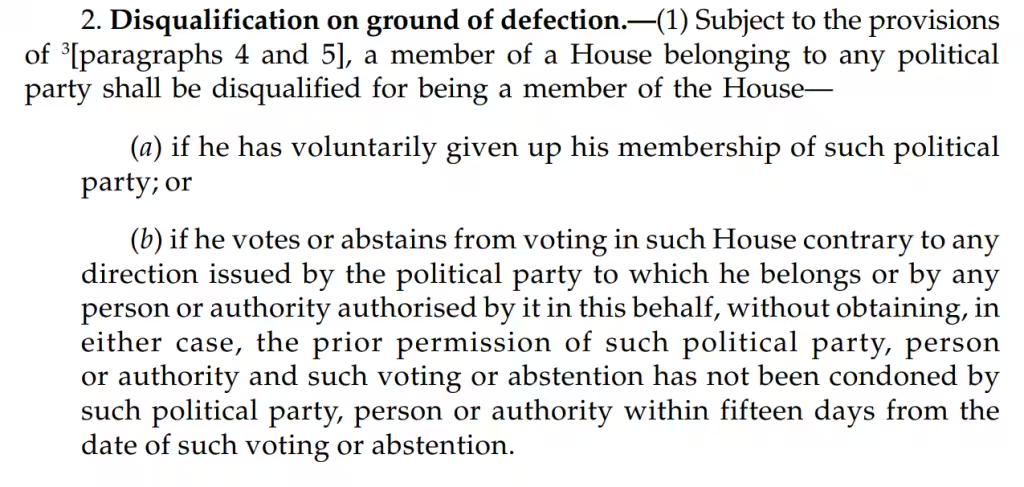
The Supreme Court of India has strongly criticized the Telangana Legislative Assembly Speaker for delaying decisions on anti-defection petitions filed against 10 BRS (Bharat Rashtra Samithi) MLAs who defected to the Congress in 2024. The Court has now given a 3-month deadline to decide on the matter and warned that such delays compromise democratic values and the dignity of the Speaker’s office.
UPSC CSE Relevance:
UPSC CSE in prelims and mains examination has focused on Parliament and State legislatures—structure, functioning, conduct of business, powers & privileges and issues arising out of these. As you can see previous year question related to anti defection law.
UPSC Mains PYQ 2013:
Q: The role of individual MPs (Members of Parliament) has diminished over the years and as a result healthy constructive debates on policy issues are not usually witnessed. How far can this be attributed to the anti-defection law, which was legislated but with a different intention?
UPSC Prelims PYQ 2022:
Q: With reference to anti-defection law in India, consider the following statements: 1.The law specifies that a nominated legislator cannot join any political party within six months of being appointed to the House. 1.The law does, not provide any time-frame within which the presiding officer has to decide a defection case. Which of the statements given above is/are correct? A) 1 only B) 2 only C) Both 1 and 2 D) Neither 1 nor 2
Need of Anti-defection law:
Helps maintain governmental stability by discouraging frequent changes in party affiliation.
Ensures elected representatives uphold loyalty to both their political party and the electorate that voted for them.
Reinforces internal discipline within political parties.
Allows for the legitimate merger of political parties without triggering disqualification under the anti-defection provisions.
Aims to curb political corruption by deterring opportunistic defections.
Empowers the legislature to take disciplinary action against members who defect from one party to another.
About Anti-defection law:
For both Parliament and state assemblies.
Aaya Ram Gaya Ram was a phrase that became popular in Indian politics after a Haryana MLA Gaya Lal changed his party thrice within the same day in 1967. The anti-defection law sought to prevent such political defections which may be due to reward of office or other similar considerations.
Then,
The 10th schedule was inserted in the Constitution in 1985 by 52nd constitution amendment act(At the time of Rajiv Gandhi).
Legislators may be disqualified on grounds of defection by the Presiding Officer (Speaker of Lok Sabha and Chairman of Rajya Sabha) of a legislature based on a petition by any other member of the House.
A legislator is deemed to have defected if he either voluntarily gives up the membership of his party or disobeys the directives of the party leadership on a vote.
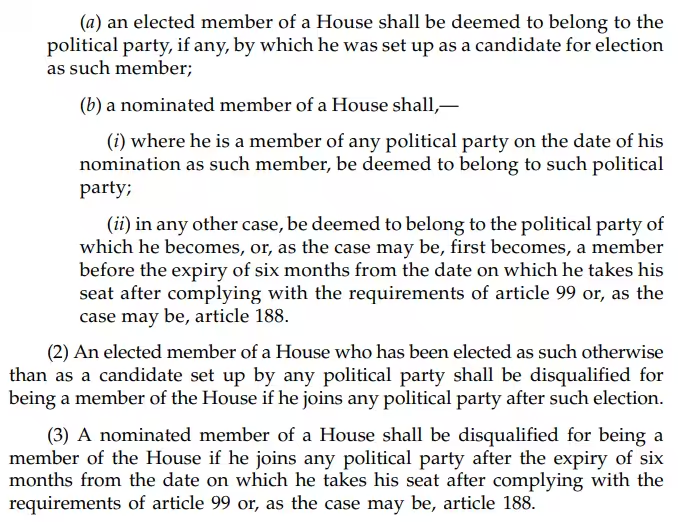
Independent Member: If he joins any political party after such election, he is disqualified from the House.
Nominated Member: If he joins any political party after the expiration of six months from the date on which he takes his seat in the House.
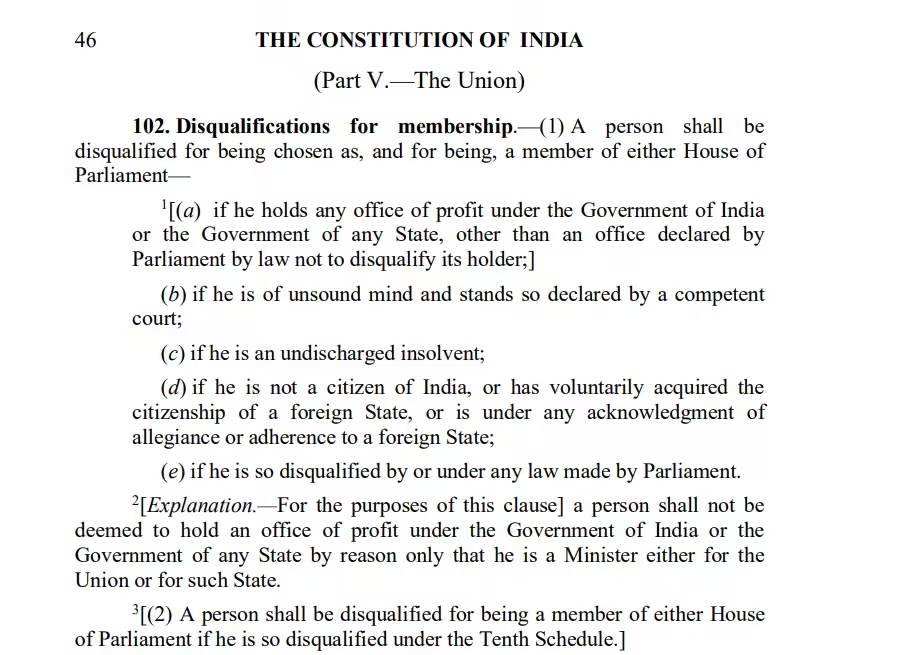
Amrit Pal Singh Case: Article 101(4) provides that if for a period of sixty days, a member of either House of Parliament is, without permission of the House, absent from all meetings of the House, the House may declare his seat vacant. However, in computing the said period of sixty days, no account shall be taken of any period during which the House is prorogued or is adjourned for more than four consecutive days.
Exceptions:
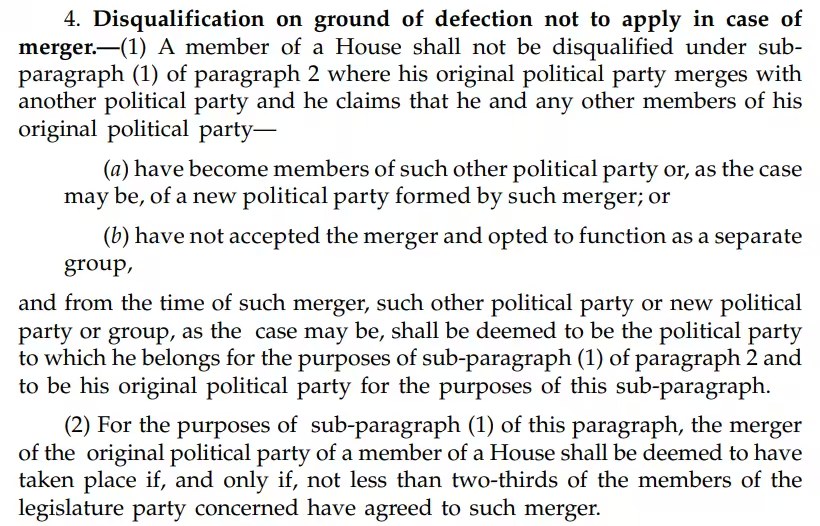
91st Constitution Amendment Act: Allows a party to merge with or into another party provided that at least two-thirds of its legislators are in favour of the merger.
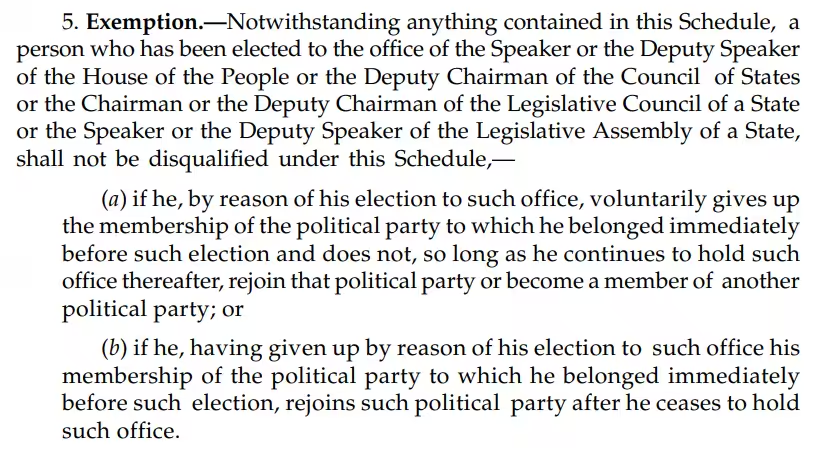
If an elected member becomes the Presiding Officer of the House and voluntarily relinquishes their party membership during their tenure, or re-associates with the party after demitting that office.
The law does not specify a time-period for the Presiding Officer to decide on a disqualification plea.
Issues:
Speaker’s Discretion and Delay in Adjudication: The law provides no definite timeline for delivering rulings. As a result, cases sometimes drag on for months or even years, and in some instances, are resolved only after the legislative term has ended.
Weakening of Parliamentary Debate and Dissent: A critical consequence of the law is the reduction in meaningful debate within the legislature. By penalizing dissent under the same framework as defection, the law discourages alternative viewpoints and mutes internal criticism within parties.
Selective Tolerance for Defections: The law effectively permits mass defections—where two-thirds of members defect en masse—but penalizes individual or small-group dissent.
Abolition of ‘Split’ and Confusion in Recognizing Group Movements: This change has created confusion and allowed collective defections under the guise of a merger, even if no such merger occurs at the organizational level.
Erosion of Democratic Norms and Legislative Independence: making MPs and MLAs more accountable to party leadership than to the electorate. The result is a diminished role for individual judgment in legislative processes.
It introduces terms such as “original party,” “legislature party,” and “deemed merger,” yet does not offer precise definitions. The term “original party” lacks clarity—whether it refers to a national entity or a regional outfit is not specified, despite the Election Commission of India recognizing both as separate categories.
SC Important Judgements Related to Anti-defection law:
Kihoto Hollohan case(1992):
The Supreme Court has held that while adjudicating matters under the anti-defection law, the Speaker or Chairman functions as a tribunal, and their decisions are open to judicial review. However, such review can only be undertaken after the Speaker or Chairman has delivered a decision, not during the proceedings.
Speakers and Chairpersons occupy a crucial role within the framework of Parliamentary democracy, serving as custodians of the rights and privileges of the legislature.
The provisions of the Tenth Schedule are corrective in nature, designed to uphold the integrity of India’s Parliamentary system by discouraging opportunistic and unethical defections.
Cases:
Case 1: In the Madhya Pradesh Legislative Assembly, wherein, 16 MLAs absconded, and their resignations were not accepted at first instance by the Speaker of the House. Later on, under the direction of the Supreme Court, the floor test was conducted at midnight and Shri Kamal Nath Government was defeated on the floor of the House. Immediately, thereafter, the Speaker accepted the resignation of these MLA, which he was not willing to accept. These elected members were disqualified and joined the opposition political party and assured tickets to contest the forthcoming by-election.
Case 2: In a controversial move, the Speaker of the Karnataka Legislative Assembly disqualified 17 MLAs for the remainder of the assembly’s term, aiming to prevent them from contesting by-elections and re-entering the House. However, in the case of Srimanth Balasaheb Patil vs. Speaker, Karnataka Legislative Assembly, the Supreme Court ruled this action unconstitutional. The Court held that while the Speaker has the authority to disqualify members, extending the disqualification to cover the entire term — thereby barring them from contesting by-elections — exceeds constitutional limits. Consequently, the Court declared the disqualified MLAs eligible to contest the by-elections.
Defection in Other Jurisdictions:
USA:
A more liberal model pertaining to party discipline is followed in the United States. A member of the House can vote on any matter of policy as per their choice and no matter what, such person shall not be disqualified for exercising their vote in a specific manner.
Recommendations:
Hashim Abdul Haleem Committee recommended clearly defining “voluntary renunciation”.
Dinesh Goswami Committee (1990): ADL should be decided by the President/Governor or by the Election Commission.
Law Commission recommended removal of exemption for merger.
National Commission to Review the Working of the Constitution: Defectors should be barred from holding public office