
Introduction: A Cabinet Push for Pulse Self-Sufficiency
On 2 October 2025, coinciding with Gandhi Jayanti, the Union Cabinet approved the National Pulses Mission (NPM) 2025–31, a six-year umbrella scheme aimed at making India self-reliant — aatmanirbhar — in the production of pulses. The decision operationalises the pulses self-sufficiency vision laid out by NITI Aayog in its 10 August 2025 working paper and folds the existing pulses component of the National Food Security Mission (NFSM) into a more focused, mission-mode architecture. For a country that consumes roughly a quarter of the world’s pulses but still imports several million tonnes annually, the scheme is being projected as the agricultural anchor of the broader Atmanirbhar Bharat programme. (Source: PIB Cabinet release; Department of Agriculture & Farmers Welfare.)
The NPM is structured around three pillars: production augmentation through climate-resilient seed varieties, an assured procurement and price stabilisation regime anchored on Minimum Support Price (MSP), and demand-side reforms including a strengthened pulses buffer stock. For UPSC aspirants, the scheme straddles GS Paper III topics on agriculture, food security, and public distribution, while raising governance and federal questions relevant to polity.
Quick Facts
| Parameter | Detail |
|---|---|
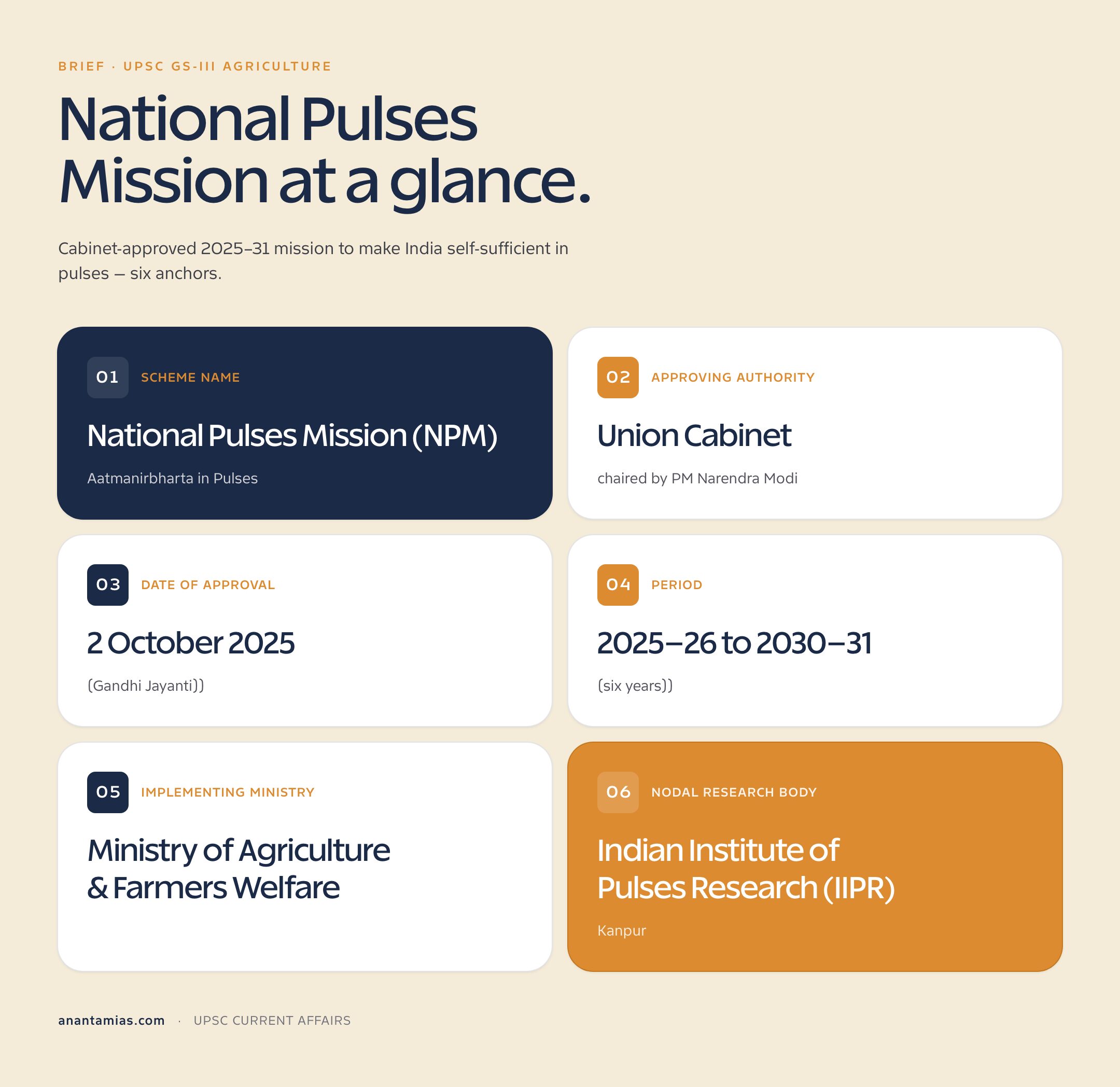
| Scheme Name | National Pulses Mission (NPM) — Aatmanirbharta in Pulses |
| Approving Authority | Union Cabinet, chaired by PM Narendra Modi |
| Date of Approval | 2 October 2025 (Gandhi Jayanti) |
| Period | 2025–26 to 2030–31 (six years) |
| Implementing Ministry | Ministry of Agriculture & Farmers Welfare |
| Nodal Research Body | Indian Institute of Pulses Research (IIPR), Kanpur |
| Anchor Crops | Tur (arhar), urad, moong, gram (chana), masur, kulthi |
| Procurement Backstop | NAFED, NCCF at MSP under PM-AASHA |
| UPSC Relevance | GS-III: Agriculture, Food Security, MSP, Buffer Stock |
Background: Why Pulses, Why Now
India is simultaneously the world’s largest producer, consumer, and importer of pulses. Domestic output rose from about 17 million tonnes (MT) in 2014–15 to a record 27.4 MT in 2023–24, but consumption — driven by the protein needs of a 1.4-billion population — has consistently outpaced supply. As per Directorate of Economics & Statistics data, India still imported around 4.7 MT of pulses in 2023–24, primarily tur from Mozambique and Myanmar and yellow peas from Canada and Russia, draining roughly USD 3.7 billion in foreign exchange.
The NITI Aayog working paper of 10 August 2025 set a target of 35 MT pulses output by 2030, with a 70 per cent share of acreage under improved varieties. The Cabinet’s NPM is the operational follow-on to that vision. It also responds to a structural challenge: pulses cultivation is concentrated on rainfed, marginal lands in Madhya Pradesh, Rajasthan, Maharashtra, Karnataka and Uttar Pradesh, where yields are low (around 850 kg/ha against a global average above 1,000 kg/ha) and weather risk is high. Without targeted intervention, even the existing National Food Security Mission–Pulses component was unlikely to close the demand gap.
Key Features of the National Pulses Mission
1. Production Augmentation and Seed Replacement
The first pillar focuses on raising productivity through accelerated adoption of climate-resilient, short-duration varieties developed by IIPR Kanpur and the ICAR network. The mission targets a Seed Replacement Rate (SRR) of at least 50 per cent for tur, urad and moong by 2028–29, supported by a network of seed hubs, Krishi Vigyan Kendras (KVKs) and state agricultural universities. Drone-based extension, integrated pest management for pod borer, and rhizobium biofertiliser distribution form supplementary components. (Source: ICAR.)
2. Assured Procurement at MSP
The most politically significant element is the open-ended procurement guarantee for tur, urad and masur at Minimum Support Price for the next five years through NAFED and NCCF, originally announced in January 2024 and now formally absorbed into NPM. This is meant to neutralise the historical disincentive to pulses sowing — namely that prices crash below MSP in surplus years. The procurement network will be linked to Farmer Producer Organisations (FPOs) registered under the 10,000-FPO scheme to ensure smallholder access.
3. Pulses Buffer Stock and Market Stabilisation
The third pillar revamps the Pulses Buffer Stock, raising its dynamic ceiling and giving the Department of Consumer Affairs operational control for retail interventions through Bharat Dal outlets. The buffer is intended to dampen cyclical price spikes such as the tur dal flare-up of 2023–24. A digital pulses dashboard integrated with e-NAM mandi data will provide real-time price and arrival monitoring.
Significance for UPSC and Policy
- Food and nutritional security: Pulses are the cheapest source of vegetable protein and a staple in PDS-linked nutrition programmes such as PM Poshan.
- Forex saving: Closing the import gap could save USD 3–4 billion annually, easing the current account.
- Soil health: Pulses fix atmospheric nitrogen, reducing urea dependence — a direct contribution to the One Nation One Fertiliser rationalisation push.
- Rainfed agriculture push: Targets the Deccan plateau and central Indian dryland belt, which has lagged in the post-Green-Revolution transition.
- Federalism: Reinforces cooperative federalism through state-level pulses cells and convergence with state agriculture departments.
- Climate adaptation: Short-duration, drought-tolerant varieties align with National Adaptation Fund for Climate Change priorities.
Detailed Analysis: Targets vs Current Output
The mission’s success will be measured against a clear quantitative benchmark. The table below maps current production against the 2030–31 target on a crop-wise and state-wise basis, drawing on Department of Agriculture & Farmers Welfare advance estimates and the NITI Aayog working paper.
| Crop / State | Production 2023–24 (MT) | NPM Target 2030–31 (MT) | Lead Producing States |
|---|---|---|---|
| Tur (Arhar) | 3.4 | 5.6 | Maharashtra, Karnataka, MP |
| Gram (Chana) | 11.5 | 14.2 | MP, Maharashtra, Rajasthan |
| Urad | 2.3 | 3.8 | MP, UP, Andhra Pradesh |
| Moong | 3.7 | 5.5 | Rajasthan, MP, Maharashtra |
| Masur (Lentil) | 1.6 | 2.4 | UP, MP, Bihar |
| Other pulses | 4.9 | 3.5 | Various |
| Total | 27.4 | 35.0 | — |
The state-wise concentration matters: Madhya Pradesh alone accounts for nearly a quarter of national pulses output, and three states — MP, Maharashtra and Rajasthan — together produce more than half. The NPM therefore concentrates 60 per cent of its area-expansion outlay in 220 identified districts across these states, with convergence layered on top of Pradhan Mantri Krishi Sinchayee Yojana for protective irrigation and the Soil Health Card scheme.
Challenges and Concerns
- Yield gap: Indian pulses yields remain 30–40 per cent below the global average; varietal turnover has been historically slow.
- Procurement fatigue: Open-ended MSP procurement has fiscal and storage implications; NAFED has previously reported losses on tur stockpiles.
- Climate volatility: Pulses are highly sensitive to terminal heat and erratic rainfall; the 2023 tur shortfall was largely a monsoon failure.
- Pest and disease pressure: Pod borer in tur and yellow mosaic virus in moong continue to cause 10–20 per cent yield losses annually.
- Import dependence transition: Sudden tariff reversals on yellow peas could distort domestic chana prices, as seen in 2023–24.
- Federal coordination: States control land use and mandi regulation; without state buy-in, central targets risk under-implementation.
- Data and monitoring: Real-time arrival and price data on pulses remain patchy in non-APMC states.
Prelims Pointers
- NPM 2025–31 was approved on 2 October 2025 (Gandhi Jayanti).
- Implementing ministry: Ministry of Agriculture & Farmers Welfare.
- Nodal pulses research institute: IIPR Kanpur, an ICAR institute.
- Anchor crops: tur, urad, moong, gram, masur, kulthi.
- Procurement agencies: NAFED and NCCF, under the umbrella of PM-AASHA.
- India’s pulses output 2023–24: 27.4 MT; target 2030–31: 35 MT.
- Largest pulses-producing state: Madhya Pradesh.
- Pulses fix atmospheric nitrogen via Rhizobium symbiosis — important for soil-health questions.
- Bharat Dal is a retail brand operated by NCCF/NAFED for subsidised pulses sale.
- NITI Aayog working paper preceding NPM was released on 10 August 2025.
Mains Practice Questions
- “The National Pulses Mission 2025–31 is less a new scheme and more a consolidation of existing pulses interventions.” Critically examine. (15 marks, 250 words) — GS-III
- Discuss the role of Minimum Support Price and assured procurement in incentivising pulses cultivation in India. What are the fiscal and market-distortion concerns? (10 marks, 150 words) — GS-III
- How can pulses cultivation contribute to India’s climate adaptation, soil health and nutritional security goals simultaneously? Illustrate. (15 marks, 250 words) — GS-III
- Examine the federal challenges in implementing centrally sponsored agricultural missions, with reference to the National Pulses Mission. (10 marks, 150 words) — GS-II/III
Conclusion
The National Pulses Mission 2025–31 is the most consequential pulses-policy decision since the launch of the NFSM-Pulses component in 2007. By bundling production, procurement and buffer stock under a single mission and tying it explicitly to the Atmanirbhar Bharat programme, the government has signalled that pulse self-sufficiency is no longer a residual ambition but a measurable, time-bound target. The hard work, however, lies ahead — in seed replacement, mandi reform, climate-resilient extension, and a federal compact that translates Delhi’s targets into MP, Maharashtra and Rajasthan farm gates. For UPSC aspirants, NPM is a textbook case of how schematic continuity (NFSM-Pulses), institutional convergence (NAFED, NCCF, IIPR, KVKs, FPOs), and political signalling (Gandhi Jayanti) come together in Indian agricultural policy. Watch this scheme closely; it will headline GS-III paragraphs for the next five years.
Frequently Asked Questions
Q1. What is the National Pulses Mission 2025–31?
It is a six-year umbrella mission approved by the Union Cabinet on 2 October 2025 to make India self-sufficient in pulses production through coordinated interventions on seeds, MSP procurement and buffer stock.
Q2. Which crops are covered under the mission?
The anchor crops are tur (arhar), urad, moong, gram (chana), masur (lentil) and kulthi (horse gram), with priority given to the first three because they account for the bulk of import dependence.
Q3. How does NPM differ from the earlier NFSM-Pulses component?
NFSM-Pulses was a sub-component of the broader food security mission. NPM elevates pulses to a standalone mission, adds an open-ended MSP procurement guarantee and a revamped buffer stock, and ties outputs to a 35-MT 2030 target.
Q4. Who are the implementing agencies?
The Ministry of Agriculture & Farmers Welfare is the nodal ministry, with IIPR Kanpur as the research anchor, and NAFED and NCCF as procurement agencies. State governments, KVKs and FPOs are key delivery partners.
Q5. What is the production target under NPM?
The mission targets 35 million tonnes of pulses output by 2030–31, up from 27.4 MT in 2023–24, with a Seed Replacement Rate of at least 50 per cent for tur, urad and moong.
Q6. How does NPM link to Atmanirbhar Bharat?
By aiming to eliminate the structural pulses import gap of around 4–5 MT and saving USD 3–4 billion in forex annually, NPM directly contributes to the Atmanirbhar Bharat goal of reducing strategic dependence on agricultural imports.
Q7. Which states will benefit most?
Madhya Pradesh, Maharashtra, Rajasthan, Karnataka, Uttar Pradesh and Andhra Pradesh — together accounting for about 80 per cent of national pulses output — will receive the bulk of area-expansion and seed-hub investment.
Q8. Why is NPM relevant for UPSC?
It is a high-yield current-affairs topic spanning GS-III (agriculture, food security, MSP, buffer stock), GS-II (federalism, cooperative federalism) and Prelims (institutions like IIPR, NAFED, NCCF, schemes like PM-AASHA and Bharat Dal).