
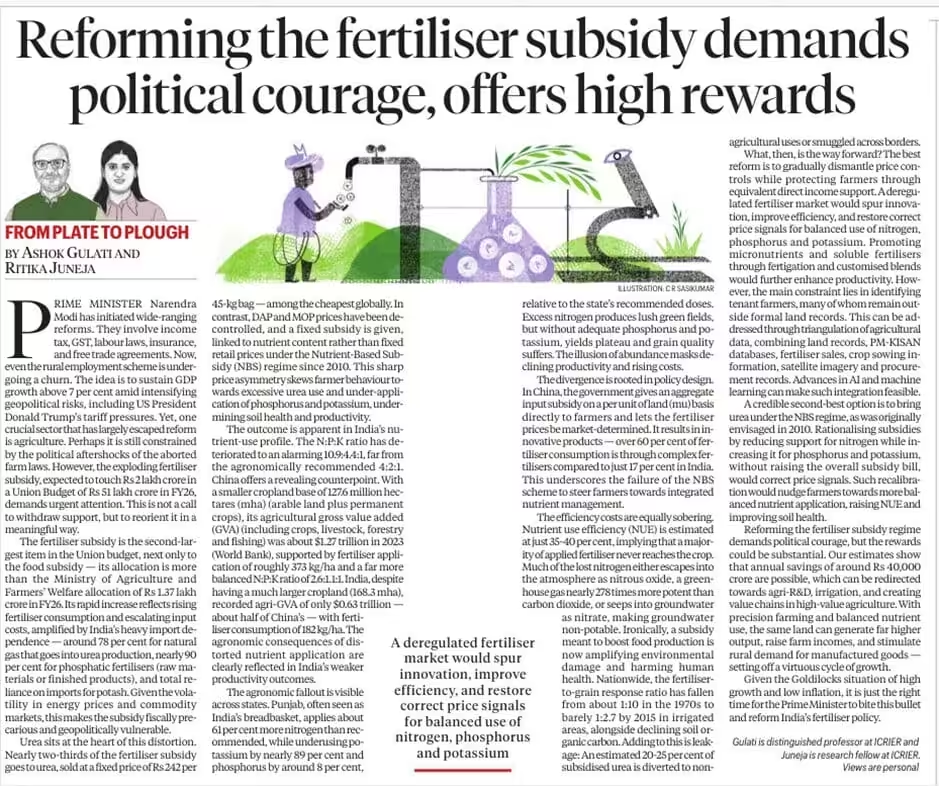
Why in News:
Government of India has not taken any major reform on Agricultural sector
UPSC Relevance:
GS-III (Agriculture, Economy, Environment), GS Paper II (Government Policies & Interventions)
PYQ:
With reference to chemical fertilizers in India, consider the following statements:
1.At present, the retail price of chemical fertilizers is market-driven and not administered by the Government.
2.Ammonia, which is an input of urea, is produced from natural gas.
3.Sulphur, which is a raw material for phosphoric acid fertilizer, is a by-product of oil refineries.
Which of the statements given above is/are correct?
a) 1 only
b) 2 and 3 only
c) 2 only
d) 1, 2 and 3
Context & Background:
- The Government of India has undertaken major structural reforms in taxation (GST), labour laws, insurance, trade agreements, and welfare delivery.
- Agriculture, however, remains largely unreformed due to:
- Political sensitivity
- Fallout from the repealed farm laws
- Meanwhile, the fertiliser subsidy has ballooned:
- ₹2 lakh crore (FY26) out of a total Union Budget of ₹51 lakh crore
- Second largest subsidy after food
- This makes fertiliser subsidy:
- A fiscal concern
- An agronomic problem
- An environmental threat
There is a need for restructuring it intelligently.
Structure of the Fertiliser Subsidy (What is wrong?)
(a) Import Dependence & Fiscal Vulnerability:
India is heavily import-dependent:
- 78% natural gas (for urea)
- ~90% phosphatic fertilisers (DAP) (Diammonium Phosphate)
- 100% potash (MOP) (Muriate of Potash)
-> This exposes India to:
- Energy price shocks
- Geopolitical risks
- Volatile global commodity markets
(b) Urea-Centric Distortion:
| Fertiliser | Policy Status |
| Urea | Price controlled (₹242 per 45 kg bag) |
| DAP & MOP | Decontrolled, under NBS |
- Two-thirds of subsidy goes to urea
- Urea price in India is among the cheapest globally
- Leads to overuse of nitrogen and underuse of Phosphorus (P) and Potassium (K)
Agronomic Impact:
(a) Nutrient Imbalance
- Ideal N:P:K ratio → 4:2:1
- India’s current ratio → 10.9:4.4:1
-> Excess nitrogen:
- Weakens soil structure
- Reduces crop response
- Lowers grain quality over time
(b) State-Level Evidence (Punjab)
- Nitrogen: +61% over recommended
- Potassium: −89%
- Phosphorus: −8%
-> Result:
- Lush green fields
- Plateauing yields
- A yield plateau is when the amount of crop produced per area stops increasing, or even decreases, after a period of significant growth (like after the Green Revolution). It signals that farmers are reaching the maximum potential output for a crop in a specific region
- Rising input costs
- Illusion of productivity
Productivity & Global Comparison (Data-based argument):
India vs China:
| Indicator | India | China |
| Cropland | 168.3 mha | 127.6 mha |
| Fertiliser use | 182 kg/ha | 373 kg/ha |
| N:P:K ratio | 10.9:4.4:1 | 2.6:1.1:1 |
| Agri-GVA (2023) | $0.63 trillion | $1.27 trillion |
-> Despite more land, India produces half the agri output of China.
Key Insight:
China subsidises farmers directly per unit land, not fertilisers.
Environmental & Efficiency Costs:
(a) Low Nutrient Use Efficiency (NUE)
- Only 35–40% fertiliser reaches crops
- Rest is lost as:
- Nitrous oxide (N₂O) → 278× more potent than CO₂
- Nitrate leaching → groundwater contamination
(b) Declining Fertiliser Response
- 1970s: 1 kg fertiliser → 10 kg grain
- 2015: 1 kg fertiliser → 2.7 kg grain
-> Indicates:
- Soil degradation
- Declining organic carbon
- Unsustainable intensification
(c) Leakage & Diversion
- 20–25% of urea:
- Diverted to industry
- Smuggled across borders
What is Nutrient-Based Subsidy (NBS) and why it is failed in India:
What was NBS supposed to do? (Intent)
- Nutrient-Based Subsidy (NBS), 2010 was introduced to:
- Move away from product-based subsidy (subsidy on fertiliser bags)
- Shift to nutrient-based subsidy (N, P, K, S per kg)
- Allow market pricing of fertilisers
- Encourage balanced fertiliser use
- Promote innovation (customised & complex fertilisers)
In theory, this was a scientific and market-friendly reform.
What actually happened? (Design flaw)
Key mistake: Partial reform
| Fertiliser | Policy Treatment |
| Urea (Nitrogen) | ❌ Excluded from NBS, price controlled |
| DAP, MOP (P & K) | ✅ Included under NBS, price decontrolled |
- This created a dual pricing system.
Why was urea kept outside NBS?
Political Economy Reasons:
- Urea is used by small and marginal farmers
- Cheap urea = visible welfare
- Fear of:
- Farmer protests
- Food inflation
- Electoral backlash
Hence, political compulsions overrode agronomic logic.
Price Asymmetry: The Core Problem
Because of this policy:
- Urea price → Artificially cheap (₹242 per bag)
- DAP & MOP prices → Market-linked and volatile
Farmer’s Rational Response:
“Why buy expensive DAP or MOP when urea is cheap?”
-> Farmers overuse nitrogen
-> Farmers underuse phosphorus & potassium
This is called price-induced nutrient imbalance.
How this distorted farmer behaviour?
Ideal (Recommended):
- N:P:K = 4:2:1
Actual (India):
- N:P:K = 10.9:4.4:1
-> Excess nitrogen causes:
- Poor root development
- Lodging of crops
- Lower grain quality
- Declining long-term yields
Failure to promote complex fertilisers?
What are complex fertilisers?
- Fertilisers containing multiple nutrients in one granule
- Example: NPK blends customised for soil & crop
Outcome in India:
- Only 17% fertiliser use is via complex fertilisers
Why?
- Farmers prefer cheap urea + minimal DAP
- No price incentive for balanced nutrients
China’s contrasting success (Why comparison matters)
China’s policy approach:
- No price control on fertilisers
- Direct subsidy to farmers per unit land
- Fertiliser prices reflect real costs
Result:
- Farmers demand balanced & customised fertilisers
- 60%+ fertiliser use via complex blends
- Better nutrient efficiency
- Higher productivity
Key lesson:
Subsidise the farmer, not the fertiliser.
Reform Options?
Option 1: Best Reform (First Best Solution)
🔹 Dismantle price controls
🔹 Direct income support to farmers
🔹 Market-determined fertiliser prices
Benefits:
- Correct price signals
- Balanced nutrient use
- Innovation (customised & micronutrient blends)
- Higher productivity & Nutrient Use Efficiency (NUE)
Challenge:
- Identifying tenant farmers
Solution:
- Data triangulation using:
- Land records, PM-KISAN
- Fertiliser sales, Crop sowing data
- Satellite imagery, Procurement records
- AI & ML tools
Option 2:
🔹 Bring urea under NBS
🔹 Reduce nitrogen subsidy
🔹 Increase P & K subsidy
🔹 No increase in overall subsidy bill
Impact:
- Nudges balanced fertiliser use
- Improves soil health
- Raises productivity gradually
Economic Payoff (Why reform is worth it)
- Estimated annual savings: ₹40,000 crore
- Funds can be redirected to:
- Agri-R&D
- Irrigation
- High-value agriculture
- Value chains & food processing
-> Leads to:
- Higher farm incomes
- Increased rural demand
- Manufacturing growth
- Virtuous growth cycle
Political Economy Angle:
- Fertiliser reform requires political courage
- But current conditions are favourable:
- High GDP growth
- Low inflation
- Digital infrastructure (DBT, AI)
- This a “Goldilocks moment”:
- Neither too hot nor too cold for reform
Reforming fertiliser subsidy is not about withdrawing state support, but realigning incentives with agronomic science, environmental sustainability, and fiscal prudence. A shift from product-based subsidies to farmer-centric income support can enhance productivity, protect natural resources, and strengthen India’s long-term food security. The costs of inaction are rising, while the rewards of reform are transformative.