UPSC CSE 2026 Essay Paper Discussion

Daily Digest · Monday

22 December 2025 Current Affairs for UPSC

2 current affairs published on Monday, 22 December 2025

22 December 2025 Current Affairs for UPSC — every Why-in-News article AnantamIAS published on Monday, 22 December 2025, broken down with Why in News?, the exact GS paper it feeds, sub-topic mapping, MCQ-ready facts and a UPSC-style practice question. 2 articles in total, covering Polity, Economy, Environment, S&T, IR, Geography, History, Society and Internal Security — the same Why-in-News + GS-paper-mapping + practice-question format the Compass uses across every daily digest on the site.

Daily current affairs for UPSC is where new material enters your prep stream. Read this 22 December 2025 digest end-to-end in 25–35 minutes, attempt the practice question at the foot of each article (it's MCQ for some, 10/15-marker for others), then bookmark the entries that fall inside your active revision window. Everything stays cross-linked: tap any subject pill to jump to that subject's hub, or use the table of contents above to skip straight to a specific story.

Use this page three ways. Read sequentially for a one-sitting scan of everything that mattered on 22 December 2025. Download the 22 December 2025 PDF below for offline study or print revision. Or use the December 2025 Current Affairs compilation to see this day in the month's full context. For the previous day's reading, see 21 December 2025 Current Affairs; the next day's is 23 December 2025 Current Affairs.

Why we publish daily current affairs separately from the monthly compilation: daily is learning, monthly is revision. Use the daily page to add fresh material to your notes the day it breaks; come back to the December 2025 compilation 60 days before Prelims when the noise has settled and only the lasting takeaway is worth re-reading.

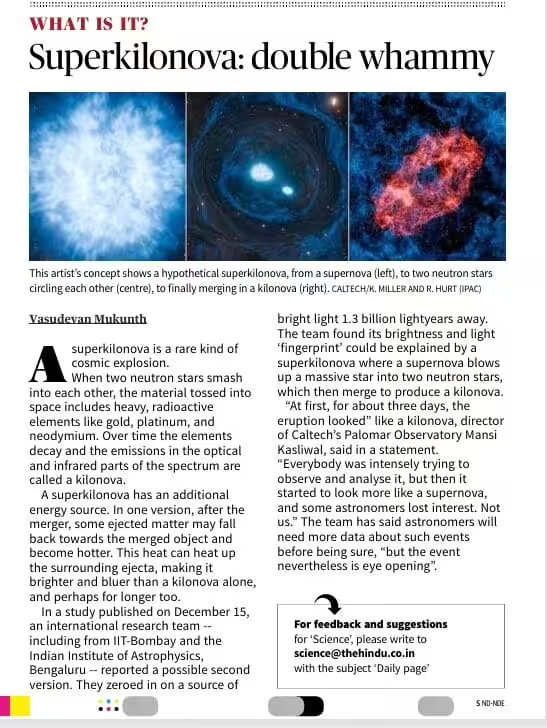
Superkilonova

Open article →Download PDF

Context:

Astronomers have reported observational evidence of a rare cosmic explosion called a superkilonova, based on analysis of an unusually bright and long-lasting astronomical event detected about 1.3 billion light-years away.

UPSC Relevance:

Science and Tech.

UPSC PYQ:

Q. Consider the following pairs : (2023)

Objects in spaceDescription
1.CepheidsGiant clouds of dust and gas in space
2.NebulaeStars which brighten and dim periodically
3.PulsarsNeutron stars that are formed when massive stars run out of fuel and collapse

How many of the above pairs are correctly matched?

(a) Only one
(b) Only two 
(c) All three 
(d) None

About Kilonova?

  • A kilonova occurs when two neutron stars merge.
  • This merger ejects material rich in heavy radioactive elements like:
    • Gold
    • Platinum
    • Neodymium
  • These elements undergo radioactive decay, producing:
  • Bright emission in optical and infrared wavelengths.
  • Kilonovae are key sources of heavy elements in the universe (r-process nucleosynthesis).

What is a Superkilonova?

A superkilonova is a rarer, more energetic version of a kilonova.

Why “Double Whammy”?

  • Because it involves two energy sources:
    • Produces a kilonova.
  • Supernova explosion
    • A massive star explodes.
    • Leaves behind two neutron stars.
  • Neutron star merger
    • The neutron stars spiral inward and merge.

About Neutron Star:
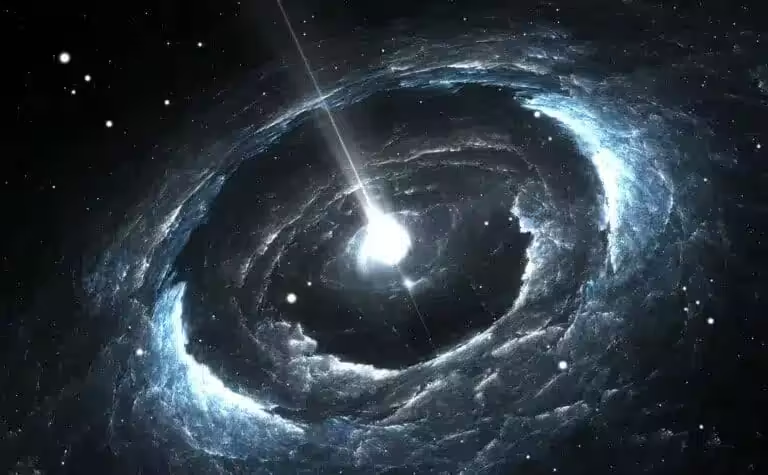
  • Extremely dense and compact celestial objects formed from the collapse of a massive star’s core after it runs out of fuel.
    • During this collapse, protons and electrons are crushed together, forming neutrons.
    • If the collapsing core’s mass is between 1 and 3 solar masses, the newly-created neutrons can halt further collapse, resulting in a neutron star.
    • Cores with masses exceeding this range continue to collapse into stellar-mass black holes .

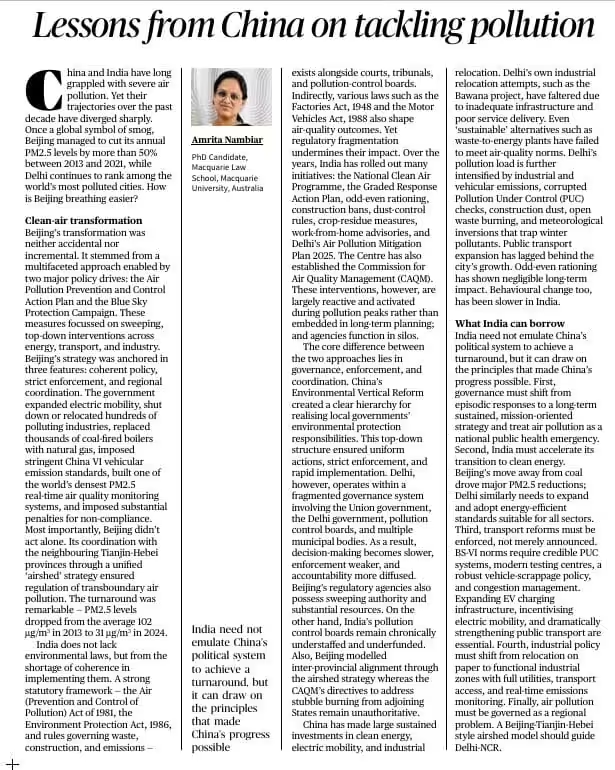
Lesson from China on tackling pollution

Open article →Download PDF

Context:

How China—especially Beijing—has sharply reduced air pollution over the past decade, drawing policy lessons for India, particularly Delhi-NCR, which continues to face severe air-quality crises.

Key Evidence Highlighted (China vs India)

China (Beijing)

  • Achieved a ~50% reduction in annual PM2.5 levels between 2013 and 2021.
  • Implemented:
    • Clean Air Action Plan
    • Blue Sky Protection Campaign
  • Used:
    • Strict industrial emission norms
    • Closure/relocation of polluting industries
    • Massive push for electric mobility
    • Real-time air-quality monitoring
    • Heavy penalties and strong enforcement
  • Followed a regional approach: Beijing–Tianjin–Hebei “airshed” coordination to control transboundary pollution.

India (Delhi-NCR)

  • Has laws like:
    • Air (Prevention and Control of Pollution) Act, 1981
    • Environment (Protection) Act, 1986
  • But faces:
    • Fragmented governance (Centre–State–Local overlap)
    • Weak enforcement and regulatory capacity
    • Over-reliance on short-term emergency measures (odd-even, construction bans)
  • Bodies like CAQM exist but lack:
    • Strong enforcement powers
    • Adequate funding and accountability

What India Can Learn (Policy Lessons)

Shift from episodic response to mission-mode strategy

  • Treat air pollution as a public health emergency, not a seasonal problem.

Strengthen institutional capacity

  • Empower CAQM with:
    • Enforcement authority
    • Financial autonomy
    • Accountability mechanisms

Regional (airshed-based) governance

  • Adopt a Beijing–Tianjin–Hebei–style model for Delhi-NCR and neighbouring states.

Transport-sector reforms

  • Stronger vehicle emission standards (beyond BS-VI)
  • Expansion of public transport and EVs
  • Congestion pricing and better traffic management

Data-driven regulation

  • Public access to air-quality and emissions data
  • Real-time emissions monitoring
  • Source-apportionment-based policymaking

Must Visit: